 How to resolve AdBlock issue?
News
- Details
- Written by: LAKE COUNTY NEWS REPORTS

LAKEPORT, Calif. — The Lakeport Main Street Business Association will host the second annual Pumpkin & Dia de los Muertos Festival in downtown Lakeport on Saturday, Oct. 2.
The event will be held from 11 a.m. to 8 p.m. on Main Street between First and Fourth streets.
The association held the inaugural festival in October 2019 and is excited to be able to “finally” have the second annual event next month.
The festival celebrates October and everything that fall has to offer, including pumpkins and Dia de los Muertos, the Day of the Dead.
This year's festival will include a car show offering people’s choice awards for the best festival-themed decoration.
The master of ceremonies will be Lakeport’s favorite local Fabian “Looch” Moreno from La Mexicana Taqueria with all-day awesome music spinning provided by DJ 800$MONEY.
During the festival, everyone will have a chance to guess the weight of the “Great Pumpkin.”
Make sure the kids don’t miss out on the Haunted House put on by Haunted Lake County. There will be other fun stuff for the children including crafts, face painting and lawn games.
There is still time to enter the scarecrow contest and you can go to the association’s Facebook page and website for more info.
The Clearlake Club will be hosting a corn hole tournament for the adults and, besides a few other libations, O’Meara Bros. is brewing up some special beer for the festival.
There will be fun and entertainment for the whole family to enjoy to celebrate October and the fall season. Of course, a must have at a Dia de los Muertos celebration is an altar to celebrate and honor those who have passed and you will be able to add the name of your loved one to the altar during the event.
The association urges community members to visit the downtown businesses during the festival that will be offering festival specials. Watch the association’s social media pages to find out what they will offer. There will also be crafts, goods and food vendors for you to visit during the day as well.
Other highlights will include native Pomo dancers, singer Irma Lopez, the Si Señor Mexican dance group from Lower Lake, the Lake County Clickers, line dancing and some singalong and dance-along fun during the day. A schedule of events will be posted on the association’s social media pages before and at the event.
From 5 to 8 p.m., there will be a street dance featuring the music of “Beats Werkin.”
Visit the Lakeport Main Street Association online at www.lakeportmainstreet.com.
Although an outside event, visitors are encouraged to wear masks.
- Details
- Written by: LAKE COUNTY NEWS REPORTS
The wildfire season in the Lake County area has been very active during the past several years.
When wildfires occur near electrical power lines, PG&E turns off power to impacted power lines as part of its public safety power shut-off, or PSPS, events.
Electricity power has historically been turned off to a significant area of Lake County during wildfire incidents and can remain off for several days or even weeks at a time.
To maintain emergency services to the Lower Clear Lake area, Woodland Community College, Lake County Campus — part of the Yuba Community College District — has partnered with PG&E to install a temporary microgrid power station at the front of the campus during fall 2021.
A permanent microgrid power station is planned to be installed on the east side of the campus during winter 2021.
The YCCD Governing Board approved resolutions at its April 8 and May 13 regular meetings conveying easements of land to PG&E in support of the microgrid power station project.
A third resolution, declaring intent to convey a second easement of land to PG&E, was approved at the Sept. 9 regular board meeting.
“The partnership between PG&E and YCCD is an excellent example of the public/private collaborations that are needed to better serve our community,” said interim Chancellor Dr. James Houpis. “The microgrid power station, in the Clear Lake area, will allow critical public functions to continue during general power outages.”
The temporary and permanent microgrid power stations will provide power to a one-to-two-mile radius ensuring that during PSPS events power will be maintained at the local hospital, fire station, grocery store and local shopping areas, the transportation corridor, residential areas, the Konocti School District Middle School and the Woodland Community College Lake County Campus.
“The Yuba Community College District Board of Trustees is thrilled to support these forward-thinking measures that will aid in protecting and safeguarding our communities,” Board President Susan Alves said.
The Lake County Campus has historically been utilized by firefighters and emergency responders during natural emergency events such as wildfires.
Yuba Community College District officials said the district is committed to supporting the needs of the Lake County community through its partnership with PG&E.
- Details
- Written by: Elizabeth Fernandez
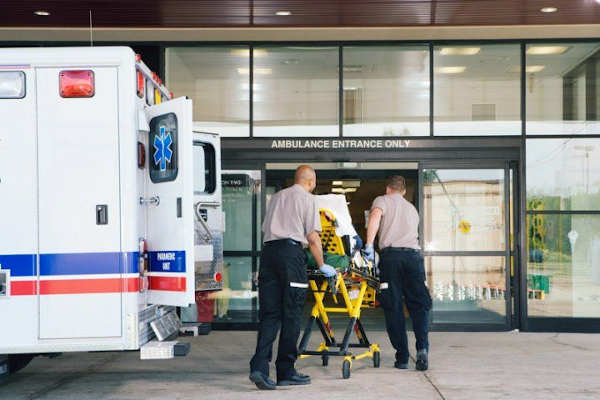
An increasing percentage of emergency visits and hospitalizations in the United States before the pandemic involved patients with alcohol and other substance use disorders, according to a study by UC San Francisco researchers. The authors say hospitals need to develop better ways to identify and treat those patients.
The study, led by Leslie Suen, MD, MAS, of the UCSF Department of Medicine, found that from 2014 to 2018, emergency department, or ED, visits made by adults with alcohol and substance use disorders increased by 30 percent. Hospitalizations among patients with those disorders increased by 57 percent.
The authors found that during the study period, one out of 11 ED visits and one out of nine hospitalizations each year involved an individual with an alcohol or another substance use disorder.
“These statistics are comparable to common conditions like heart failure, but hospitals and EDs are rarely as equipped to treat addiction as they are to treat cardiovascular diseases,” said Suen, a fellow in the National Clinician Scholars Program at the UCSF Philip R. Lee Institute of Health Policy Studies.
“These data suggest that there is an urgent need for hospitals to develop systems of hospital-based interventions to provide addiction treatment for those accessing emergency and inpatient care. Models providing hospital-based addiction services already exist, including UCSF’s Addiction Care Team at San Francisco General Hospital.”
The study was published on Sept. 13 in the Journal of General Internal Medicine.
The researchers found that patients with alcohol and other substance use disorders who came into the emergency department were more likely to have Medicaid health insurance, have depression, be experiencing homelessness, have received mental health treatment and present with injury and trauma.
“Illness and death from complications of alcohol and other substance use are increasing nationally,” noted Suen. “Hospitals are one place where we can begin to reverse that trend, but we must be prepared to identify and treat these patients while they are in the hospital and continue following and treating them after they are discharged, as well.”
For the study, the researchers analyzed data from the National Hospital Ambulatory Medical Care Survey, an annual survey administered by the National Center for Health Statistics. Alcohol use disorder and other substance use disorders were identified based on patients’ medical charts.
“Our estimate of alcohol and substance use disorders among ED visits is higher than in some other recent studies,” said Suen. “This is possibly because our study is the first to use comprehensive medical chart reviews, which are more likely to reflect true prevalence of these disorders, rather than relying solely on billing diagnosis codes.”
UCSF co-authors are Leslie Suen, MD, MAS; Anil N. Makam, MD, MAS; Hannah R. Snyder, MD; Daniel Repplinger, MD; Margot B. Kushel, MD; Marlene Martin, MD; and Oanh Kieu Nguyen, MD, MAS. The study was supported by the National Heart, Lung and Blood Institute. The authors declare no conflicts of interest.
Elizabeth Fernandez writes for the University of California, San Francisco.
- Details
- Written by: Christine Pulliam
This animation portrays the complementary nature of imaging and spectroscopy to understand galaxies. It begins with a portion of the Hubble GOODS-South field, a region of the sky containing hundreds of visible galaxies. Then rainbow-colored lines called spectra are added next to selected galaxies; in reality, every star and galaxy has its light spread out. The underlying image later fades away to highlight the galaxies’ spectra, which contain a wealth of information including distances (redshifts). The image and spectra were obtained by Hubble and illustrate what will be done with Roman, but over a vastly larger number of galaxies. Credits: NASA, ESA, and J. DePasquale (STScI)
When NASA’s Nancy Grace Roman Space Telescope launches in the mid-2020s, it will revolutionize astronomy by providing a panoramic field of view at least 100 times greater than Hubble's at similar image sharpness, or resolution.
The Roman Space Telescope will survey the sky up to thousands of times faster than can be done with Hubble.
This combination of wide field, high resolution, and an efficient survey approach promises new understandings in many areas, particularly in how galaxies form and evolve over cosmic time.
How did the largest structures in the universe assemble? How did our Milky Way galaxy come to be in its current form? These are among the questions that Roman will help answer.
Galaxies are conglomerations of stars, gas, dust, and dark matter. The largest can span hundreds of thousands of light-years. Many gather together in clusters containing hundreds of galaxies, while others are relatively isolated.
How galaxies change over time depends on many factors: for example, their history of star formation, how rapidly they formed stars over time, and how each generation of stars influenced the next through supernova explosions and stellar winds. To tease out these details, astronomers need to study large numbers of galaxies.
“Roman will give us the ability to see faint objects and view galaxies over long intervals of cosmic time. That will allow us to study how galaxies assembled and transformed,” said Swara Ravindranath, an astronomer at the Space Telescope Science Institute (STScI) in Baltimore, Maryland.
While wide-field imaging will be important for galaxy studies, just as important are Roman’s spectroscopic capabilities.
A spectrograph takes light from an object and spreads it into a rainbow of colors known as a spectrum. From this range of colors, astronomers can glean many details otherwise unavailable, like an object’s distance or composition.
Roman’s ability to provide a spectrum of every object within the field of view, combined with Roman imaging, will enable astronomers to learn more about the universe than from either imaging or spectroscopy alone.
Revealing when and where stars were born
Galaxies don’t form stars at a constant rate. They speed up and slow down — forming more or fewer stars — under the influence of a variety of factors, from collisions and mergers to supernova shock waves and galaxy-scale winds powered by supermassive black holes.
By studying a galaxy’s spectrum in detail, astronomers can explore the history of star formation. “Using Roman we can estimate how fast galaxies are making stars and find the most prolific galaxies that are producing stars at an enormous rate. More importantly, we can find out not only what’s happening in a galaxy at the moment we observe it, but what its history has been,” stated Lee Armus, an astronomer at IPAC/Caltech in Pasadena, California.
Some precocious galaxies birthed stars very rapidly for a short time, only to cease forming stars surprisingly early in the universe’s history, undergoing a rapid transition from lively to “dead.”
“We know galaxies shut off star formation, but we don’t know why. With Roman’s wide field of view, we stand a better chance of catching these galaxies in the act,” said Kate Whitaker, an astronomer at the University of Massachusetts in Amherst.
Growing the cosmic web
Even as galaxies themselves have grown over time, they also have gathered together in groups to form intricate structures billions of light-years across. Galaxies tend to collect into bubbles, sheets, and filaments, creating a vast cosmic web.
By combining high-resolution imaging, which yields a galaxy’s position on the sky, with spectroscopy, which provides a distance, astronomers can map this web in three dimensions and learn about the universe’s large-scale structure.
The expansion of the universe stretches light from distant galaxies to longer, redder wavelengths — a phenomenon called redshift. The more distant a galaxy is, the greater its redshift.
Roman’s infrared detectors are ideal for capturing light from those galaxies. More distant galaxies are also fainter and harder to spot.
Combining this with the fact that some galaxy types are rare, you have to search a larger area of the sky with a more sensitive observatory to find the objects that often have the most interesting stories to tell.
“Right now, with telescopes like Hubble we can sample tens of high-redshift galaxies. With Roman, we’ll be able to sample thousands,” explained Russell Ryan, an astronomer at STScI.
Seeking the unknown
While astronomers can anticipate many of the discoveries of the Roman Space Telescope, perhaps most exciting is the possibility of finding things that no one could have predicted. Typical high-resolution observations from space-based observatories, like Hubble, target specific objects for detailed investigation. Roman’s survey approach will cast a wide net, thereby opening up a new “discovery space.”
“Roman will excel in unknown unknowns. It will certainly find rare, exotic things that we don’t expect,” said Ryan.
“Roman’s combined imaging and spectroscopy surveys will gather the ‘gold nuggets’ that we never would have mined otherwise,” added Ravindranath.
The Nancy Grace Roman Space Telescope is managed at NASA’s Goddard Space Flight Center in Greenbelt, Maryland, with participation by NASA's Jet Propulsion Laboratory and Caltech/IPAC in Southern California, the Space Telescope Science Institute in Baltimore, and a science team comprising scientists from various research institutions. The primary industrial partners are Ball Aerospace and Technologies Corporation in Boulder, Colorado; L3Harris Technologies in Melbourne, Florida; and Teledyne Scientific & Imaging in Thousand Oaks, California.
Christine Pulliam works for the Space Telescope Science Institute in Baltimore, Maryland.