 How to resolve AdBlock issue?
News
- Details
- Written by: Elizabeth Larson
The board will meet beginning at 9 a.m. Tuesday, Oct. 26, in the board chambers on the first floor of the Lake County Courthouse, 255 N. Forbes St., Lakeport.
The meeting can be watched live on Channel 8, online at https://countyoflake.legistar.com/Calendar.aspx and on the county’s Facebook page. Accompanying board documents, the agenda and archived board meeting videos also are available at that link.
To participate in real-time, join the Zoom meeting by clicking this link.
The meeting ID is 963 1160 6935, pass code 252799. The meeting also can be accessed via one tap mobile at +16699006833,,96311606935#,,,,*252799#.
All interested members of the public that do not have internet access or a Mediacom cable subscription are encouraged to call 669-900-6833, and enter the Zoom meeting ID and pass code information above.
To submit a written comment on any agenda item visit https://countyoflake.legistar.com/Calendar.aspx and click on the eComment feature linked to the meeting date. If a comment is submitted after the meeting begins, it may not be read during the meeting but will become a part of the record.
At 9:06 a.m., the board will present a proclamation designating the month of October 2021 as Domestic Violence Awareness Month.
At 9:30 a.m., the board will consider the exchange agreement for the Lakeport Armory at 1431 Hoyt Ave. and a county-owned property at 15837 18th Ave., Clearlake.
“This land exchange would provide an opportunity to build at least 50% of the housing units as deed restricted affordable units located within the City of Clearlake and would allow the relocation of the Sheriff’s Office to the Lakeport Armory to help address their space needs,” County Administrative Officer Carol Huchingson wrote in a memo to the board.
At 10:45 a.m., the board will hold a public hearing to consider an appeal of the Lake County Planning Commission’s approval of a major use permit and adoption of an initial study for a commercial cannabis project on 46 acres at 10717 and 10680 Schuette Road in Upper Lake, owned by Blue Lakes Organics.
The appeal was submitted on behalf of Ray Hoffman, owner of Le Trianon Resort. Part of the basis for the appeal is that Hoffman alleges that the land use compatibility with the resort was not studied. Concerns about drainage and runoff to nearby properties and into Blue Lake, odor and the site plan are among other issues raised in the appeal.
In other business on Tuesday, with Agriculture Commissioner Steve Hajik planning to retire effective Feb. 11, 2022, in an untimed item the board will consider giving staff direction regarding the recruitment process for Hajik’s successor.
The full agenda follows.
CONSENT AGENDA
5.1: Approve Amendment No. 2 to Agreement for recruitment services for Lake County Public Health officer.
5.2: Adopt resolution reappointing Anita L. Grant as county counsel for the county of Lake.
5.3: Adopt resolution authorizing the agreement in the amount of $757,550.00 between the county of Lake and the California Mental Health Services Authority for the period of agreement execution through Dec. 31, 2024, and authorize the board chair to sign the agreement.
5.4: Adopt proclamation designating the month of October 2021 as Domestic Violence Awareness Month.
5.5: Approve continuation of resolution authorizing teleconferenced meetings during a state of emergency continue to exist.
5.6: Approve the Lake County District Attorney's Office — Victim Witness Division's Policy for direct financial victim assistance.
5.7: Adopt resolution approving county of Lake Health Services Department to submit a renewal application and certification statement for the Maternal, Child and Adolescent Health Grant with the State of California, Department of Public Health for Fiscal Year 2021 through 2022, in the amount of $270,601.06 and authorizing the board chair to sign said certification and interim Health Services director to sign application.
5.8: Approve amendment five to the agreement between the county of Lake and the Kelseyville Motel for COVID-19 emergency isolation housing and authorize the board chair to sign.
5.9: Adopt resolution approving the certification statement for the State Department of Health Care Services, CMS Branch’s California Children’s Services Administration Plan Renewal Grant for FY 2021-2022 and authorize the board chair to sign said certification statement.
5.10: (a) Waive the formal bidding process, pursuant to Lake County Code Section 38.2, as it is not in the public interest due to the unique nature of goods or services; and (b) approve the first amendment to the agreement between the county of Lake and Management Connections for temporary staffing support services completed during fiscal year 2021-22 for a sum not to exceed $60,000 and authorize the board chair to sign the amendment.
5.11: Authorize the IT director to issue a purchase order to Dell Technologies for Microsoft Windows server licenses in the amount of $29,930.
5.12: (a) Waive the formal bidding process, pursuant to Lake County Code Section 38.2, as it is not in the public interest due to the unique nature of the goods or services, and (b) approve the master agreement between the county of Lake and NCE for consulting services related to pavement preservation and rehabilitation of county roads, and (c) approve supplemental services agreement number one and authorize the chair to sign the agreements.
5.13: Adopt resolutions rescinding prior rejections and accepting certain roadways for public use for the purpose of providing increased water flow and necessary fire hydrants for fire protection to the communities of Forest Oaks and Bonanza Springs Subdivision No. 1.
5.14: a) Approve the FY 2021 Emergency Management Performance Grant application in the amount of $137,931 and b) approve the FY 2021 Emergency Management Performance Grant – American Rescue Plan Act (ARPA) in the amount of $60,483 and c) authorize Sheriff Brian Martin to sign the grant subaward face sheet, the authorized agent document and the subrecipient grants management assessment form; d) authorize County Administrative Officer Carol J. Huchingson to act as the authorized agent on behalf of the county to sign the standard assurances and initial each page, the lobbying certification and the FFATA financial disclosure document and e) authorize the chairperson of the board of supervisors to sign the certification of the governing body resolution.
TIMED ITEMS
6.2, 9:06 a.m.: Presentation of proclamation designating the month of October 2021 as Domestic Violence Awareness Month.
6.3, 9:15 a.m.: Presentation of an annual report on the activities of Lake County Resource Conservation District.
6.4, 9:30 a.m.: Consideration of the Clearlake-Lakeport Armory Exchange Agreement to exchange the properties located at 1431 Hoyt Ave., Lakeport, CA (APN 003-046-750-000) and 15837 18th Ave., Clearlake, CA (APN 010-043-010) .
6.5, 10:45 a.m.: Public hearing, discussion and consideration of appeal (AB 21-03) of the Planning Commission approval of major use permit (UP 20-45) and adoption of initial study (IS 20-56) for a commercial cannabis cultivation license on a property located at 10717 and 10680 Schuette Rd., Upper Lake; APN's 003-002-11 (cultivation site) and 003-001-21 (clustering property).
UNTIMED ITEMS
7.2: Direction to staff regarding recruitment for new agriculture commissioner upon the retirement of Steve Hajik effective Feb. 11, 2022.
7.3: Consideration of (a) waiving the formal bidding process, pursuant to Lake County Code Section 38.2, as it is not in the public interest due to the unique nature of goods or services; and (b) approval of the agreement between the county of Lake and North American Mental Health Services for telehealth psychiatry services for fiscal year 2021-22 for a contract maximum of $975,000.00 and authorize the board chair to sign the agreement.
ASSESSMENT APPEALS
8.1: Approve withdrawal on the following Assessment Appeal Applications: No. 24-2019 Charles Bellig Trs., 01-2020 Rodney Miller, and 25-2020 Lakeshore Drive II.
8.2: Continue the following Assessment Appeal Applications: No. 21-2020 Renfro Family and 23-2020 Brad Revelli.
8.3: Approve stipulation on the following Assessment Appeal Applications: a) No. 24-2020 Charles E. Bellig; and b) No. 26-2020 Deborah Ann Bakhtiari.
8.4: Deny the following assessment appeal applications on timeliness, as no request for hearing received: 02-2020 Beatrice Bell and 11-2020 through 20-202 H&S Energy.
CLOSED SESSION
9.1: Conference with legal counsel: Existing litigation pursuant to Gov. Code section 54956.9(d)(1): Center for Biological Diversity et al. v. County of Lake, et al.
9.2: Public employee evaluation: Director of Public Works, Water Resources and Community Development (until 06/13/21) Scott De Leon.
9.3: Public employee evaluation: County Administrative Officer Carol Huchingson.
9.4: Public Employee Evaluation: Interim Health Services Director Carol Huchingson.
9.5: Conference with negotiators regarding property tax exchange for the annexation of the South Main Area (136.78 acres south of the current Lakeport City limits); price and terms of payment: (a) County negotiators: Supervisor Scott, Supervisor Simon and C. Huchingson and (b) city of Lakeport.
Email Elizabeth Larson at
- Details
- Written by: STEPHEN WHEELER
All but two of 36 reporting areas, spanning 35 states and the District of Columbia, had increased revenues for public school systems, according to preliminary fiscal year, or FY, 2020 finance data on elementary and secondary schools.
All but five states reported an increase in total expenditure in FY 2020.
Because of the pandemic, the two areas that had 1-year declines (student transportation and food services) had slower growth in 10-year spending than other categories.
Increased spending in instruction and teacher salaries offset notable decreases in spending on student transportation and food services in a school fiscal year that included a global pandemic.
In 2020, as a result of COVID-19, school closures affected at least 55.1 million students in 124,000 U.S. public and private schools.
The survey also offers a window into 10-year trends, which shows steady increases in revenue and expenditures across public school systems.
Because of the pandemic, the two areas that had 1-year declines (student transportation and food services) had slower growth in 10-year spending than other categories.
Some revenue and spending categories decrease
Preliminary Annual Survey of School System Finances provides users with an early look at FY 2020 school system finance data compared to the prior year. State education agencies submit a majority of the data, which they collect from school systems in their respective states.
The U.S. Census Bureau is releasing data tables and the accompanying visualization early in an effort to provide the public with timely information about how these data may have been impacted by the COVID-19 pandemic.
Reporting areas’ total revenue increased to $584.9 billion in FY 2020, up 2.2% from $572.5 billion in FY 2019, according to survey data.
Total expenditure by these reporting areas grew to $586.4 billion in FY 2020, an increase of 2.5% from $571.8 billion in FY 2019.
The survey also provides spending breakdowns across categories: instruction, administration, instructional staff support, pupil support and other support services for students and staff.
Current spending consists of expenses for day-to-day activities of school systems, including teachers’ salaries and benefits and most other school system daily expenses.
It is the largest category of total expenditures, accounting for 87.3% of total expenditures in FY 2020 with $512.0 billion reported by school systems — up 1.5% from $504.2 billion in FY 2019.
Despite the increase in overall current spending, two significant categories of current spending decreased from FY 2019: student transportation and food services.
Total student transportation expenditure for reporting areas decreased 5.7% to $20.1 billion in FY 2020 from $21.3 billion in FY 2019.
Only five out of 36 reporting areas — Delaware, the District of Columbia, Minnesota, Washington, Wyoming — reported increases in student transportation.
Food services expenditures decreased overall for reporting areas, from $23.7 billion in FY 2019 to $15.9 billion in FY 2020, a 32.9% decrease.
Only eight out of 35 reporting states — Alaska, Kentucky, Michigan, Nebraska, North Carolina, Oklahoma, South Dakota, Wyoming — reported an increase in food services expenditure in FY 2020.
Federal revenue for public school systems also decreased slightly from the prior year. Overall revenue from federal sources was $40.8 billion in FY 2020, a 1.0% decrease from $41.2 billion in FY 2019.
How COVID-19 affected school finances over whole decade
The graphic below shows trends in public elementary and secondary school finance statistics over the last 10 years for the areas that reported on the preliminary FY 2020 Annual Survey of School System Finances.
While most categories of revenue and expenditure have increased steadily over the past decade, there is one notable exception — a decline in federal funding for schools. Some categories, such as transportation and food services, continued to grow over the previous 10 years but were disrupted, at least temporarily, due to the COVID-19 pandemic.
Revenue from both state and local sources have increased each of the past 10 years, while revenue from federal sources has decreased overall from FY 2011, a year during which additional funding was provided by the federal government through the American Recovery and Reinvestment Act of 2009.
Despite additional assistance for public elementary and secondary school systems from the Coronavirus Aid, Relief, and Economic Security Act, or CARES Act, total federal revenue was only $40.8 billion in FY 2020, a decrease of 1.5% from $41.2 billion in FY 2019.
However, the full implications of the CARES Act on federal revenue for public school systems is not expected to be felt until the next full fiscal year.
Final data release expected in May 2022
These data are preliminary and are subject to change by the final release of FY 2020 Annual Survey of School System Finances data tables and files.
The full release of public elementary and secondary school system finance data from the FY 2020 Annual Survey of School System Finances is expected in May 2022 and will include finance data for all 50 states and the District of Columbia.
Due to the early release of the data, only a subset of geographic areas is included in the data tables and visualization.
State education agencies that submit the majority of the data for the survey had a soft due date of August 13, 2021 to submit data files, but also have the option of submitting later in the calendar year in order to verify the quality of their school systems’ financial data.
Stephen Wheeler is a supervisory survey statistician in the Census Bureau’s Economic Reimbursable Surveys Division.
- Details
- Written by: ESTHER OERTEL
LAKE COUNTY, Calif. — The Scotts Valley area of Lake County was once awash in hops, so much so that a rise in the earth on 11th Street at Scotts Valley Road was known colloquially as “Brewery Hill.”
Though the days of commercial hops cultivation in Lake County have fallen by the wayside, a Lake County farmer is doing his part to bring back the aromatic glory of that era.
Alex Vollelunga of Valley Long Farms in Lakeport has been growing hops on his property for the last four years. Vollelunga inherited the farm with its organic walnut orchard from his grandfather and has since expanded its offerings to encompass an extensive list of crops, including six varieties of hops.
Hops is integral to brewing beer and is one of the four main ingredients used to produce the quaff. The other three are malt, yeast and, of course, water.
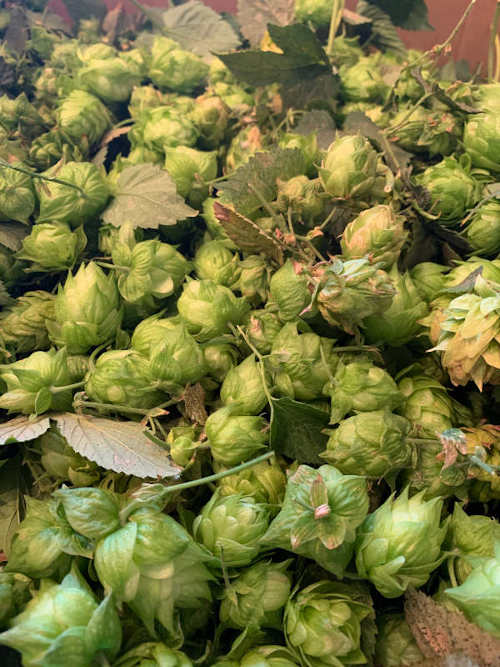
It is the cone-shaped flowers of the hop plant that are used in the brewing process. Hidden inside each cone are tiny yellow pods, sticky glands called lupulin, which produce the resin that provides the characteristic bitterness that lends its aroma and flavor to beer.
This bitterness helps balance the sweetness of the malt. In addition, brewers can selectively use hops to produce a wide range of flavors within their created brews.
Much like wine grapes, each variety of hops has unique characteristics and can contribute wide-ranging flavor profiles such as citrus, pine, mango, resin, melon, and even the herbaceous notes of freshly cut grass.
Vegetal ingredients other than hops can also produce bitterness and flavor, and beer brewed using these rather than hops is known as “gruit.” A wide variety of plants can be used in gruit, including orange rind, spruce tips, juniper, yarrow, and bog myrtle.
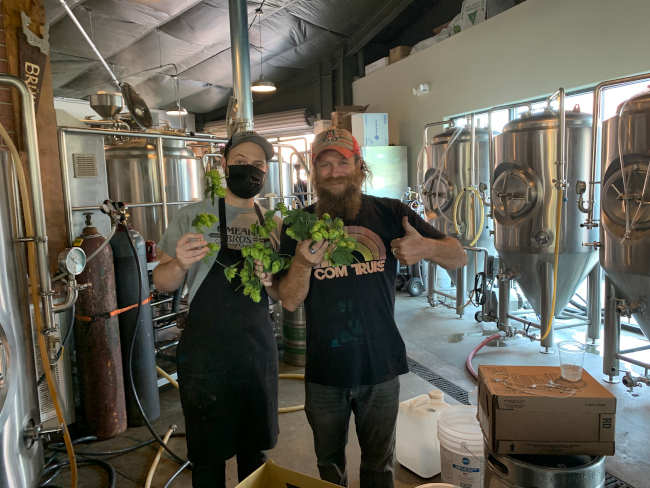
This year Vollelunga’s hop bines (as the long hop stems are called) produced beyond his home brewing needs, so he offered some to Lakeport’s O’Meara Brothers Brewing Co. for use in their beer production.
According to brew master Tim O’Meara, the three varieties from Vollelunga — Cascade, Chinook, and Willamette — were “fantastic, very fresh and aromatic.”
“The beer came out great, with aromas of grapefruit and pineapple, as well as some herbaceous grassy notes. We are very grateful,” said O’Meara.
The beer created by O’Meara using these local hops was dubbed Hydrilla Killa and is a double India pale ale, or DIPA.
When brewed in the fall using fresh hops, beer is considered “wet hopped.” At other times of year when fresh hops aren’t available, brewers use the “dry hopped” method with processed hop pellets.
According to O’Meara, the fresh, whole cone hops were steeped in a large sack during the pre-fermentation wort boil to make a sort of hops tea. The wort boil is done to ensure that any harmful bacteria are eliminated from the brew.
In addition to imparting flavor, hops have inherent preservative qualities, extending the life of beer. The acids within hop resin are naturally antimicrobial, helping to ward off spoiling bacteria during fermentation, as well as keeping it fresher longer once brewed.
Beer brewers in times past understood this. By the late 1700s, British brewers were adding extra hops when beer was being exported to faraway places, averting spoilage on long ocean voyages or overland expeditions.
Another plus is that hops help to retain beer’s head of foam, a key component of its aroma and flavor.
The hop plant, Humulus lupulus, is a hardy climbing perennial in the Cannabinaceae family, which also includes hemp and marijuana. Despite its near relative, smoking or otherwise imbibing hops will not produce a high.
As mentioned above, the long arms of the hop plant are known as bines, rather than vines. Botanically speaking, vines climb using tendrils or suckers, while bines grow in a helix around a support.
Vollelunga has cleverly interplanted hops among his walnut trees so the bines can use the trunks as supportive trellises. His hops are harvested in August and September when the cones have started turning from green to crisp brown, prior to the walnut harvest in October and November.
Vollelunga plans to expand the number of hops bines every year, with the goal of being able to supply Lake County breweries with fresh hops during the “wet hop” brewing season. They currently have more than 20 bines and will plant more next spring.
In addition to crop cultivation, Vollelunga makes oils for culinary and grooming purposes from his farmed walnuts under the name The Bearded Nut. To reach him about hops or any of the Valley Long Farms products, he may be contacted at
There is more to hops than beer.
Hops are utilized in herbal medicine in a similar way to valerian, as a treatment for restlessness, insomnia or anxiety. A pillow filled with hops was a common folk remedy for sleeplessness, and studies with animals have shown hops to have sedative qualities.
And while not a kitchen staple, hops may be incorporated into foods to add a touch of bitterness, such as in a marinade or pesto, or as a sprinkled seasoning.
Depending on the variety, hops will add a floral, earthy, peppery, or citrus flavor to dishes. Without a light hand, however, the bitterness can be overpowering.
The flowers, or cones, of the plant are most widely used in cuisine, but several other parts of the plant are edible, including the young shoots, which can be treated like asparagus.
Salt flavored with hops can be made with either processed pellets or fresh hops cones. Pellets may be ground and combined with salt using a ratio of one teaspoon ground hops to one tablespoon of salt, or a few fresh hops cones may be covered with salt in a closed container to impart a hoppy flavor.
Hops is used in some products because of its inherent aromatherapeutic properties, like lip balm and soap, or in herbal teas.
Today’s recipe for beer bread is reprinted from my March 2020 column on local craft beer breweries and includes several variations. To expand on the theme, try using an exceptionally hops-forward beer in the bread.
I’ll leave you with a “hoppy” (and perhaps happy) poem from Thomas Tusser’s 1557 work, “Five Hundred Points of Good Husbandry.”
"The hop for his profit I thus do exalt,
It strengtheneth drink and it flavoureth malt;
And being well-brewed long kept it will last,
And drawing abide, if ye draw not too fast."
Beer Bread with Rosemary and Olives
3 cups unbleached white flour
3 tablespoons sugar
1 tablespoon baking powder
1 teaspoon salt
2 teaspoons fresh rosemary, minced
½ cup roughly chopped pitted kalamata olives
12 ounces (1 ½ cups) good quality beer
4 tablespoons extra virgin olive oil, divided
Preheat oven to 350 degrees and grease a 13 x 9 x 2 baking dish with one tablespoon of the olive oil.
Stir together the flour, sugar, salt and baking powder in a medium bowl. Stir in the rosemary, then the chopped olives until both are well distributed.
Pour in the beer and stir until just incorporated into the mix. The dough will be sticky and somewhat heavy.
Spoon the dough into the baking pan and spread evenly. Drizzle the remaining olive oil over the top.
Bake for 20 to 25 minutes or until the top is golden brown. Transfer bread to a trivet or cooling rack.
Cut into rectangles and serve warm.
Variations:
Eliminate olives and add ½ cup shredded sharp cheddar cheese.
Diced apple (from one medium peeled apple) can be added along with the cheese.
Go crazy with the olives and add several different types, up to 1 ½ cup total.
Substitute honey for the sugar.
Substitute half the white flour for whole wheat.
Use melted butter instead of olive oil.
Increase or decrease the sugar or honey. (Anywhere from one to four tablespoons will work.)
Increase or decrease rosemary to taste.
Add an equal amount of fresh thyme along with the rosemary.
Add a couple tablespoons chopped scallions or chives to any of the variations or on their own.
Add ¼ cup chopped sun-dried tomatoes to the olives and rosemary.
Esther Oertel is a writer and passionate home cook from a family of chefs. She grew up in a restaurant, where she began creating recipes from a young age. She’s taught culinary classes in a variety of venues in Lake County and previously wrote “The Veggie Girl” column for Lake County News. Most recently she’s taught culinary classes at Sur La Table in Santa Rosa. She lives in Middletown, California.
- Details
- Written by: Elizabeth Larson
Lower Lake High’s homecoming festivities typically stretch across two days, including a Friday night football game and a Saturday night dance, said Konocti Unified Superintendent Dr. Becky Salato.
However, Salato said both football teams had to go into modified quarantine due to close contacts with a few staffers and one or two students who had tested positive for COVID-19.
She said the contact tracing process required by the California Department of Public Health included about 85 students and 20 staff members.
“The contact tracing is huge,” said Salato, noting principals have to do it daily.
“We always err on the side of doing more than not to make sure we’re keeping everyone safe,” she said.
Ultimately, about 60 students on the football teams ended up being placed in modified quarantine, Salato said. “It was a big group.”
While on modified quarantine, students can attend school but can’t take part in extracurricular activities, Salato said.
The California Department of Public Health’s latest health guidance for K-12 schools in the 2021-22 school year, updated on Oct. 20, explains that modified quarantine is used for unvaccinated students who are close contacts with COVID-19-positive cases; close contact is defined as more than 15 minutes over a 24-hour period within zero to 6 feet.
Students in modified quarantine may continue to attend school in-person if they have no symptoms; continue to appropriately mask, as required; undergo at least twice weekly testing during quarantine; and continue to quarantine for all extracurricular activities at school, including sports, and activities within the community setting, based on the state requirements.
While the homecoming rally took place on Friday, Salato said the homecoming games scheduled for Friday night, matching the Lower Lake Trojans junior varsity and varsity football teams against the Willits High School Wolverines’ teams, had to be canceled.
With so many students missing out on that event, Salato said the school administration wanted to make some adjustments to ensure everyone had a chance to participate in a homecoming event.
So they moved the homecoming dance, which had been scheduled for Saturday night, to the night of Saturday, Nov. 6, the night after the final football game of the season against Kelseyville High School.
Friday, Nov. 5, also is senior night, and Salato said moving the homecoming dance to the following night fit nicely.
Salato said the intent is to keep the students involved. “We know these extra things are important when they've missed so much in other years,” she said.
While COVID-19 is a key concern for educators, it’s not shut down schools so far this academic year, Salato said.
“Fortunately, we have not had any incidents that are considered outbreaks, where we’ve had to shut down completely,” she said.
There have been a few classes, including a special education classroom with 10 kids, that she said had to be placed on distance learning after a contact with a COVID-19-positive individual, a measure taken out of caution.
Salato said Lake County Public Health has been great, and works with the district’s team daily to address COVID-19 requirements such as contact tracing.
“It’s a difficult time for everybody,” she said.
Email Elizabeth Larson at