 How to resolve AdBlock issue?
News
- Details
- Written by: Mikayla Mace Kelley
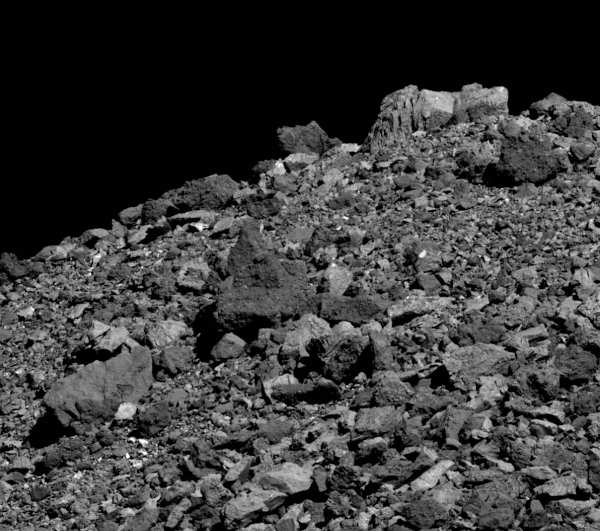
Scientists thought Bennu's surface was like a sandy beach, abundant in fine sand and pebbles, which would have been perfect for collecting samples.
Past telescope observations from Earth had suggested the presence of large swaths of fine-grained material smaller than a few centimeters called fine regolith.
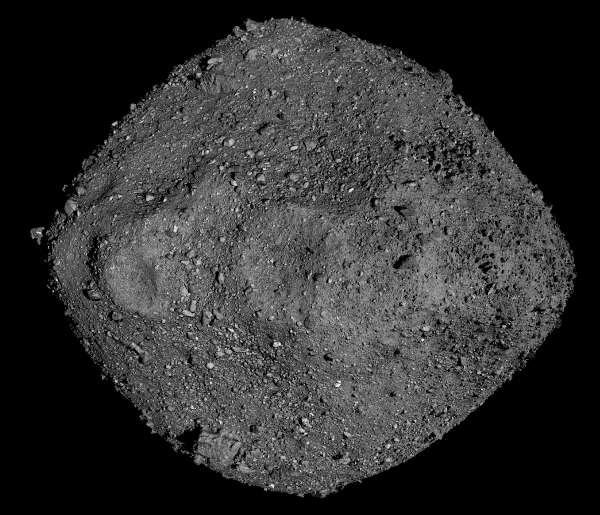
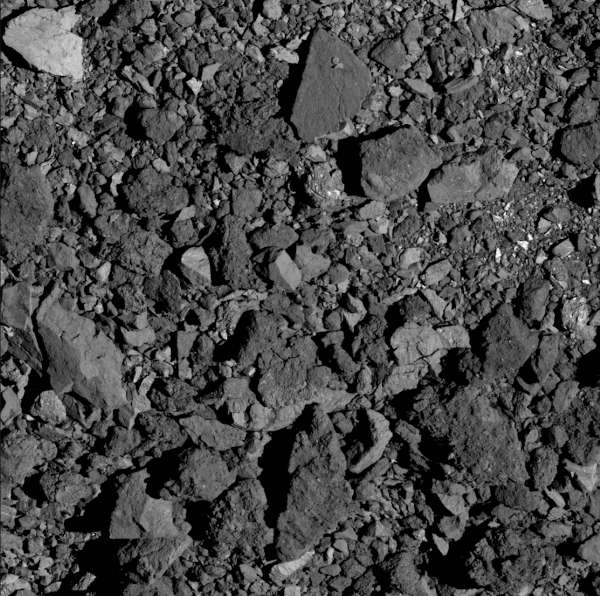
But when NASA's OSIRIS-REx mission arrived at Bennu in late 2018, the mission saw a surface covered in boulders.
The mysterious lack of fine regolith became even more surprising when mission scientists observed evidence of processes potentially capable of grinding boulders into fine regolith.
New research, published in Nature and led by Saverio Cambioni, of the University of Arizona, used machine learning and surface temperature data to solve the mystery.
Cambioni conducted the research at the university's Lunar and Planetary Laboratory. He and his colleagues ultimately found that Bennu's highly porous rocks are responsible for the surface's surprising lack of fine regolith.
"The 'REx' in OSIRIS-REx stands for Regolith Explorer, so mapping and characterizing the surface of the asteroid was a main goal," said study co-author and OSIRIS-REx Principal Investigator Dante Lauretta, a Regents Professor of Planetary Sciences at the University of Arizona. "The spacecraft collected very high-resolution data for Bennu's entire surface, which was down to 3 millimeters per pixel at some locations. Beyond scientific interest, the lack of fine regolith became a challenge for the mission itself, because the spacecraft was designed to collect such material."
A rocky start and solid answers
"When the first images of Bennu came in, we noted some areas where the resolution was not high enough to see whether there were small rocks or fine regolith. We started using our machine learning approach to distinguish fine regolith from rocks using thermal emission (infrared) data," Cambioni said.
The thermal emission from fine regolith is different from that of larger rocks, because the size of its particles controls the former, while the latter is controlled by rock porosity.
The team first built a library of thermal emissions associated with fine regolith mixed in different proportions with rocks of various porosity.
Next, they used machine-learning techniques to teach a computer how to "connect the dots" between the examples, Cambioni said. They analyzed 122 areas on the surface of Bennu, that were observed both during the day and the night.
"Only machine learning could efficiently explore a dataset this large," Cambioni said.
Cambioni and his collaborators found something surprising when the data analysis was completed: the fine regolith was not randomly distributed on Bennu.
Instead, it was up to several tens of percent in those very few areas where rocks are non-porous, and systematically lower where rocks have higher porosity, which is most of the surface.
The team concluded that very little fine regolith is produced from Bennu's highly porous rocks because these are compressed rather than fragmented by meteoroid impacts. Like a sponge, the voids within rocks cushion the blow from incoming meteoroids. These findings are also in agreement with laboratory experiments from other research groups.
"Basically, a big part of the energy of the impact goes into crushing the pores restricting the fragmentation of the rocks and the production of new fine regolith," said study co-author Chrysa Avdellidou, a postdoctoral researcher at the French National Centre for Scientific Research (CNRS) – Lagrange Laboratory of the Côte d'Azur Observatory and University in France. Additionally, Cambioni and colleagues showed that cracking caused by the heating and cooling of Bennu's rocks as the asteroid rotates through day and night proceeds more slowly in porous rocks than in denser rocks, further frustrating the production of fine regolith.
"When OSIRIS-REx delivers its sample of Bennu (to Earth) in September 2023, scientists will be able to study the samples in detail," said Jason Dworkin, OSIRIS-REx project scientist at NASA's Goddard Space Flight Center in Greenbelt, Maryland. "This includes testing the physical properties of the rocks to verify this study."
Other missions have evidence to support the team's findings. The Japan Aerospace and Exploration Agency (JAXA) Hayabusa2 mission to Ryugu, a carbonaceous asteroid like Bennu, found that Ryugu also lacks fine regolith and has high-porosity rocks.
Conversely, JAXA's Hayabusa mission in 2005 revealed abundant fine regolith on the surface of asteroid Itokawa, an S-type asteroid with rocks of a different composition than Bennu and Ryugu.
A previous study also from Cambioni and colleagues provided evidence that its rocks are less porous than Bennu's and Ryugu's using observations from Earth.
"For decades, astronomers disputed that small, near-Earth asteroids could have bare-rock surfaces," said study co-author Marco Delbo, research director with CNRS, also at the Lagrange Laboratory. "The most indisputable evidence that these small asteroids could have substantial fine regolith emerged when spacecraft visited S-type asteroids Eros and Itokawa in the 2000s and found fine regolith on their surfaces."
The team predicts that large swaths of fine regolith should be uncommon on carbonaceous asteroids, the most common of all asteroid types observed, and which the team expects to have high-porosity rocks like Bennu. By contrast, they predict terrains rich in fine regolith to be common on S-type asteroids, the second-most populous type of asteroids observed in the solar system, which they expect to have denser, less porous rocks than carbonaceous asteroids.
"This is an important piece in the puzzle of what drives the diversity of asteroids' surfaces," Cambioni said. "Asteroids are thought to be relics of the early solar system, so understanding the evolution they have undergone in time is crucial to comprehend how the solar system formed and evolved. Now that we know this fundamental difference between carbonaceous and S-type asteroids, future teams can better prepare sample collection missions depending on the nature of the target asteroid."
Cambioni is continuing his research on planetary diversity as a distinguished postdoctoral fellow in the Department of Earth, Atmospheric and Planetary Sciences at the Massachusetts Institute of Technology.
The University of Arizona leads the OSIRIS-REx science team and the mission's science observation planning and data processing. NASA's Goddard Space Flight Center in Greenbelt, Maryland, provides overall mission management, systems engineering, and the safety and mission assurance for OSIRIS-REx. Lockheed Martin Space in Littleton, Colorado, built the spacecraft and provides flight operations. Goddard and KinetX Aerospace are responsible for navigating the OSIRIS-REx spacecraft. OSIRIS-REx is the third mission in NASA's New Frontiers Program, managed by NASA's Marshall Space Flight Center in Huntsville, Alabama, for the agency's Science Mission Directorate at NASA Headquarters in Washington, D.C.
Mikayla Mace Kelley is with the University of Arizona.
- Details
- Written by: LAKE COUNTY NEWS REPORTS
Clearlake Police Chief Andrew White reported that his agency is trying to determine what led to the death of 44-year-old Steven Chrisman of Clearlake, who died after being assaulted.
At 9:30 p.m. Saturday, Oct. 16, the Clearlake Police Department received a call from a citizen reporting an unresponsive male lying on the ground in the rear parking lot of the Burns Valley Shopping Center, located in the 14900 block of Olympic Drive.
Police said officers and paramedics were dispatched to the scene, where officers located a male adult in the rear parking lot of the shopping center.
Paramedics with Lake County Fire Protection District attempted life saving measures but the victim, identified as Chrisman, was pronounced deceased on scene.
Police concluded Chrisman was the victim of an assault by an unknown subject. Detectives with the Clearlake Police Department responded to the scene for processing of evidence.
At this time, the department said the motive is unclear and the investigation is ongoing.
The circumstances which led to Chrisman’s death are being withheld by police at this time to preserve the case integrity.
Anyone with information related to this case is encouraged to call Det. Leonardo Flores at 707-994-8251, Extension 315.
- Details
- Written by: Elizabeth Larson
LAKE COUNTY, Calif. — Just two months after the Cache fire tore through a portion of the city of Clearlake, a state cleanup effort is about to start.
The fire, which began on Aug. 18, burned 83 acres and destroyed 138 structures, including 57 homes, many of them in the Cache Creek and Creekside mobile home parks.
In September, Gov. Gavin Newsom proclaimed a state of emergency for Lake County in response to the fire, which made the city and impacted residents eligible for state assistance with fire recovery, including debris removal.
During an update on the fire at its Thursday night meeting, which begins at the 1:16:37 mark in the video above, Clearlake City Council members heard from staff that the Governor’s Office of Emergency Services, or Cal OES, is set to begin its part of the recovery work this week.
Finance Director Kelcey Young said city staff has been working with the community to get right of entry forms from property owners completed so Cal OES can begin the hazardous debris and tree removal.
As of Thursday night, 51 of the forms had been completed, with four pending signatures that are expected early next week, and the city unable to contact the owners of five other properties, Young said.
Enough of the forms have been completed and submitted that the cleanup process can move forward, she said.
Young said Cal OES is planning to be in Clearlake on Friday to start with asbestos abatement before moving directly into debris removal. She said they’re grateful to Cal OES for its support.
“We’re very excited to finally be at this point,” she said.
Due to the weather — several inches of rain are forecast to fall in Lake County through early next week — there may be additional delay in the cleanup, Young said. However, she said Cal OES is aware of the urgency to start the debris removal because of the weather conditions.
“We’re very pleased with where we are,” City Manager Alan Flora said about the process.
He said almost every employee in the city has touched this process at some point, and the work of Young and other staff has resulted in the city of Clearlake being one of the first — if not the first — community impacted by wildfire that will begin debris removal under this contract, “which is exceptional.”
Flora said Public Works has been monitoring protective measures installed for stormwater and, according to the Public Works director, everything looks good. Cal OES has been impressive in coordinating with the city, Flora added.
He said he’d gotten a call earlier that day from Cal OES to check on whether the city had any concerns about measures put in place to protect the watershed.
Flora said a third of an inch of rain is one thing, 3 to 6 inches “is something quite different,” so they’re hoping what’s in place will hold up and the debris removal will start next week.
In response to questions from Councilwoman Joyce Overton about the water systems for the impacted mobile home parks, Flora said Sen. Mike McGuire has been pushing the state water board to move Konocti County Water District’s plans and the needed fundings for improvements in that area through the state approval process.
Before the fire Konocti County Water District already had a plan for providing water for Cache Creek Mobile Home Park. Creekside Mobile Home Park has had its water provided by the county’s Lower Lake water district.
Flora said the long-term expectation is that Konocti County Water District will provide water for both parks.
While some people had been living in Creekside Mobile Home Park after the fire, due to issues with water supply Flora said the city had to red-tag the park and provide housing. Cache Creek has a temporary water connection through Konocti County Water.
Council holds bond hearing, approves water park demolition contract
In other business, the council held a Fiscal Responsibility Act hearing to adopt a resolution approving the issuance of tax-exempt bonds not-to-exceed $8 million by the California Statewide Communities Development Authority, or CSCDA.
The bonds in question are not for the city, but for HPD Clearlake II LP to finance the acquisition and rehabilitation of the 72-unit multifamily Clearlake Apartments, located at 7145 Old Highway 53. Previous financing was done in 2005.
James Hamill of CSCDA, who attended via Zoom, said the hearing was a federal and local requirement, with Clearlake a longtime member of the authority.
He said the bonds are to refinance the Clearlake Apartments, where the plan includes spending $60,000 per unit for rehabilitation and extending affordability covenants for up to 55 years.
There is no liability to the city, and the hearing was merely a perfunctory requirement of tax code, said Hamill, noting they don’t issue bonds in the city without letting officials know about it.
Councilman Russ Cremer moved to approve the resolution, which the council approved 5-0.
On Thursday the council also approved a $239,800 contract with Resource Environmental for the demolition of the remaining structures at the former Outrageous Waters water park.
In August, the council approved the purchase of the 11-acre property at 6885 and 7110 Old Highway 53 for $1 million from Burbank Housing and Development Corp. of Sonoma County.
That property had previously been part of the former Pearce Field airport, now owned by the city, and the city’s plans are to include it in a larger commercial development plan for the land.
Public Works Director Dale Goodman said the demolition is a small project but an important one to the city.
“As part of the cleanup, it is necessary to remove all of the infrastructure that was placed there for the water park,” Goodman said.
The city received two bids, with Resource Environmental’s being the lowest. The only other bid, from Chernoh Excavating, was for $496,464.
After some consideration of the bid — which was higher than the city’s rough estimate of $150,000 — and council concerns that the company could do the work for the price and that rebidding may not bring a lower price, the contract was unanimously approved.
The council on Thursday also met one of the city shelter’s adoptable dogs; awarded a $100,000 contract to All In One Auto Repair and Towing contract for the city’s Abandoned Vehicle Abatement Program towing, storing, dismantling and disposal services; appointed Cremer to attend upcoming Board of Supervisors redistricting meetings; and reached consensus for a plan for a storage facility for disaster supplies at the senior center to come back for a formal vote in November.
Email Elizabeth Larson at
- Details
- Written by: NATIONAL OCEANIC AND ATMOSPHERIC ADMINISTRATION
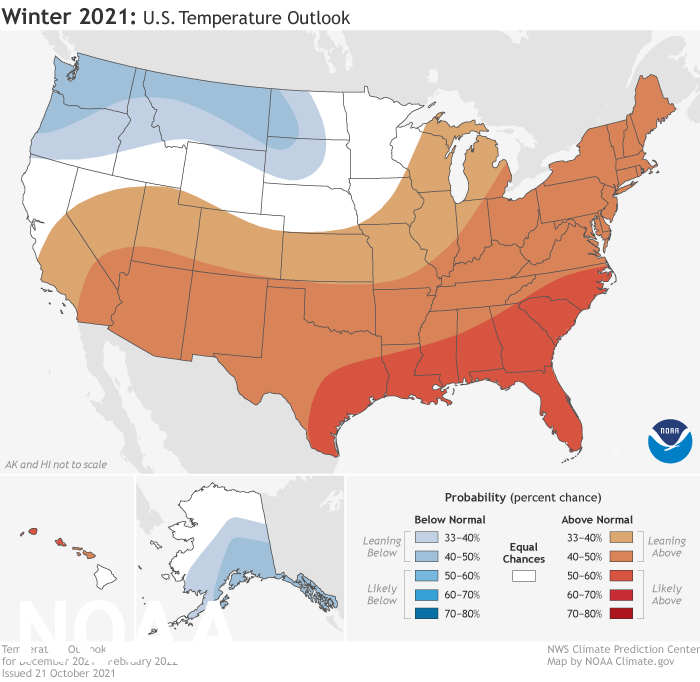
Above-average temperatures are favored across the South and most of the eastern U.S. as La Nina climate conditions have emerged for the second winter in a row according to NOAA’s Climate Prediction Center — a division of the National Weather Service.
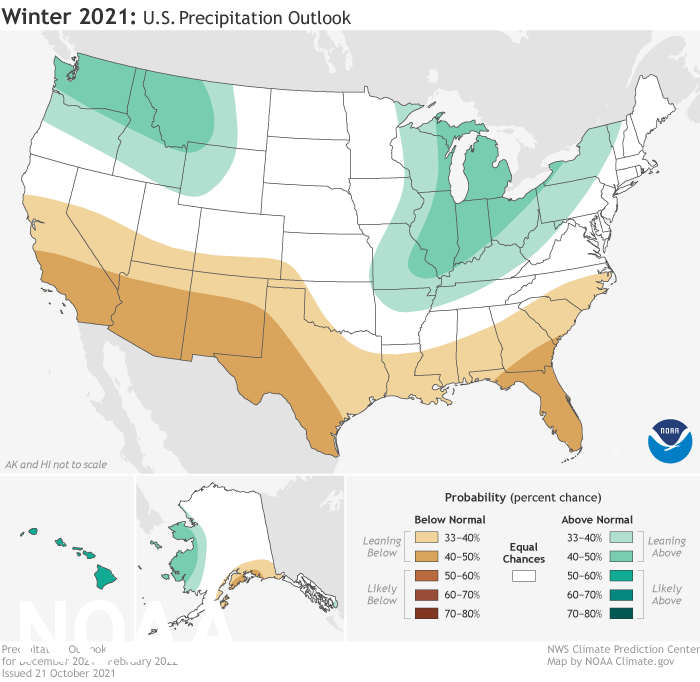
In NOAA’s 2021 Winter Outlook — which extends from December 2021 through February 2022 — wetter-than-average conditions are anticipated across portions of the Northern U.S., primarily in the Pacific Northwest, northern Rockies, Great Lakes, Ohio Valley and western Alaska.
“Using the most up-to-date observing technologies and computer models, our dedicated forecasters at the Climate Prediction Center produce timely and accurate seasonal outlooks to help communities prepare for the months ahead,” said Michael Farrar, Ph.D., director of the National Centers for Environmental Prediction.
NOAA experts also continue to monitor the widespread, ongoing drought that has persisted across much of the western half of the U.S. since late last year, keeping a close eye on the Southwest region.
“Consistent with typical La Nina conditions during winter months, we anticipate below-normal temperatures along portions of the northern tier of the U.S. while much of the South experiences above-normal temperatures,” said Jon Gottschalck, chief, Operational Prediction Branch, NOAA’s Climate Prediction Center. “The Southwest will certainly remain a region of concern as we anticipate below-normal precipitation where drought conditions continue in most areas.”
Temperature
Warmer-than-average conditions are most likely across the Southern tier of the U.S. and much of the Eastern U.S. with the greatest likelihood of above-average temperatures in the Southeast.
Below-average temperatures are favored for southeast Alaska and the Pacific Northwest eastward to the northern Plains.
The Upper Mississippi Valley and small areas of the Great Lakes have equal chances for below-, near- or above-average temperatures.
Precipitation
The Pacific Northwest, northern Rockies, Great Lakes and parts of the Ohio Valley and western Alaska have the greatest chances for wetter-than-average conditions.
Drier-than-average conditions are favored in south-central Alaska, southern California, the Southwest, and the Southeast.
The forecast for the remainder of the U.S. shows equal chances for below-, near- or above-average precipitation during winter months.
Drought
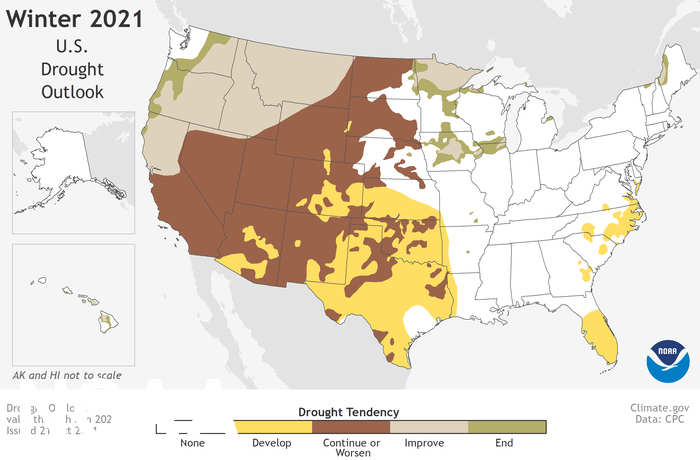
Widespread severe to exceptional drought continues to dominate the western half of the continental U.S., Northern Plains, and the Missouri River Basin.
Drought conditions are forecast to persist and develop in the Southwest and Southern Plains.
The Pacific Northwest, northern California, the upper Midwest, and Hawaii are most likely to experience drought improvement.
About NOAA's seasonal outlooks
NOAA’s seasonal outlooks provide the likelihood that temperatures and total precipitation amounts will be above-, near- or below-average, and how drought conditions are anticipated to change in the months ahead.
The outlook does not project seasonal snowfall accumulations as snow forecasts are generally not predictable more than a week in advance.
NOAA’s Climate Prediction Center updates the three-month outlook each month. The next update will be available Nov. 19.
Seasonal outlooks help communities prepare for what is likely to come in the months ahead and minimize weather's impacts on lives and livelihoods. Empowering people with actionable forecasts and winter weather tips is key to NOAA’s effort to build a more Weather-Ready Nation.