 How to resolve AdBlock issue?
News
- Details
- Written by: Elizabeth Larson
In a Wednesday morning briefing, Dr. Mark Ghaly, secretary of California Health & Human Services Agency, and Dr. Erica Pan, state epidemiologist with the California Department of Public Health, discussed vaccine booster eligibility and the state’s plan to vaccinate children ages 5 to 11 once the federal and state review process is complete.
Later in the day, Gov. Gavin Newsom received a Moderna vaccine booster at an Asian Health Services’ clinic in Oakland’s Chinatown, encouraging eligible Californians to get their booster and keep immunity strong, especially as the winter months approach.
As of Wednesday, nearly two million Californians had received their booster dose, representing 14.3% of the nationwide total recipients as reported by the CDC.
Ghaly said that, to date, 52 million COVID-19 doses have been administered across California, where 87% of the eligible population have received at least one dose.
He said the case numbers across the state have stabilized, but they are still seeing a significant impact on the unvaccinated, who are 6.6 times more likely to be infected, 12 times more likely to be hospitalized and 18 times more likely to have the worst outcome in death.
As of Wednesday, Ghaly said California had a seven-day case rate of 1.9% and testing positivity of 2.2%, numbers which have stopped declining and are plateauing. In some parts of the state, where there are higher numbers of unvaccinated residents, Ghaly said they are concerned they may be starting to witness an uptick in cases.
At that time, there were about 4,000 people hospitalized, with about 1,000 in intensive care units, Ghaly said.
Ghaly said health officials are concerned about COVID-19 as well as other respiratory illnesses like flu circulating in the fall and winter months, and they need to double down on vaccination efforts.
Last year at this time, Ghaly the state started seeing an increase in cases, and California’s seven day positivity rate peaked at 17.1% at the end of the year. In January, around 21,000 people were hospitalized, and more than 18,500 people in California died that month, accounting for 25% of the pandemic’s death toll in the state.
“Vaccines continue to save lives,” said Ghaly, noting they will help the state get back to normal.
With the Food and Drug Administration extending emergency authorization to all three vaccine manufacturers for booster shots, Ghaly urged Californians to get boosters as well as the flu vaccine, which can be co-administered.
He said those who received the Pfizer and Moderna vaccine and are eligible should get a booster six months after they received their series.
Those who are eligible are age 65 years and older, those 18 and older who live in long-term care facilities, have underlying health issues or who are at increased risk of social inequities — such as living in a community hard hit by COVID-19 — or who have significant risk for exposure due to work.
Everyone older than 18 who received the Johnson & Johnson vaccinate should get a booster two months after the vaccine, he said.
Ghaly — who along with Pan has received a booster — said mixing and matching boosters have now been approved for COVID-19, and it’s a strategy common with other vaccines. “We now have more options than ever before for maintaining this protection.”
He said the nation’s top immunization experts and state experts have analyzed the data and determined that these boosters are safe and effective.
There are reports of mild side effects such as headache, fever and soreness but no serious illness due the boosters, Ghaly said.
State ready to roll out vaccinations for children
Dr. Pan, who is herself a parent, said the state’s youngest children have remained vulnerable to COVID-19 as older Californians have received vaccines. “Now the time is coming to protect them,” she said of children.
As of Oct. 21, over six million children in the United States have been infected by COVID-19, with more than one million child cases added over the last six weeks. Pan said the proportion of pediatric cases have increased as older people have been vaccinated.
She said there are nearly 700,000 cases in young people 17 and younger, with the median age of 11. There have been more than 35 pediatric deaths in California alone, more than what is seen in a very bad flu season.
In an FDA advisory committee meeting on Tuesday, Pan said the Centers for Disease Control and Prevention reported that the number of COVID-19 deaths among 5- to 11-year-old children was equivalent to the top 10 leading causes of death in that age group recently.
She said there isn’t an acceptable number of childhood deaths when protection is available.
Pan said children can experience “long COVID” as well as multisystem inflammatory syndrome, or MIS-C, which is a rare inflammatory condition associated with COVID-19 that can damage multiple organ systems, can require hospitalization and is sometimes life-threatening.
As of Oct. 25, the California Department of Public Health reported that there have been 677 cases of MIS-C in the state among children with a median age of 8 years old.
Pan said the FDA has made an emergency authorization recommendation for Pfizer for children ages 5 to 11.
About 4,000 children ages 5 to 11 have been enrolled in the clinical trials, which have shown a strong immune response for children and more than 90% efficacy. She said it’s given in two doses and is about a third the size of adult doses. She said research has found there might be mild side effects, with serious side effects being rare.
COVID-19 vaccines were authorized for children ages 16 and older in December and 12 and up in May, Pan said.
Pan said it’s expected that vaccines for children will be available as soon as the end of next week after the review process is completed and if recommended by both the CDC and the Western States Scientific Review Workgroup.
“We are ready to administer in California,” Pan said.
She said the United States government has procured enough vaccine supply to vaccinate all 5 to 11 years old in the state, which total about 3.5 million children, or 9% of the population.
There will be 1.2 million doses in the first week when the vaccine is fully approved for children, and Pan said it will be administered in accordance with the state’s COVID-19 action plan.
She said 4,000 sites are ready to administer the vaccine to children, with more than 8,000 providers enrolled to provide the services. More than 860,000 doses have already been ordered.
The state will leverage existing infrastructure for this latest vaccination effort, working closely with health departments, schools, community partners and clinics to administer it through mobile clinics and vaccine pop ups across the state, Pan said.
Once the vaccine is fully approved for 5- to 11-year-olds, Pan urged parents to call their pediatricians or local clinics to schedule their children for the vaccine.
In Lake County, vaccination clinics for students and community members at large have been hosted at some schools.
As for whether schools would again be involved in the vaccination effort for younger children, Jill Ruzicka, director of communications and government affairs for the Lake County Office of Education, told Lake County News, “For right now, we're waiting for the approval of the vaccine for the younger children, so we know the exact details. Once we know the details, we will work with all of our state, local and school district partners and come up with a plan that works best for our community.”
Vaccinations for children and adults also can be scheduled via the state’s My Turn website.
Email Elizabeth Larson at
- Details
- Written by: Elizabeth Larson
The National Weather Service’s Eureka office said precipitation totals since Oct. 1 show that Lake County is at or above 300% of normal.
The Lake County Department of Water Resources also is reporting that Clear Lake’s level has shown improvement.
The department said that the United States Geological Survey gauge on Clear Lake — which recently was moved due to the low water conditions — showed the lake level to be -2.25 feet Rumsey, the special measure for Clear Lake, on Friday. As of Thursday, it had improved to -1.47 feet Rumsey thanks to the rain.
Now, more rain is in the forecast.
The National Weather Service said above-normal temperatures and precipitation are expected across northwest California through the first week of November.
The regional forecast calls for showers and the possibility of thunderstorms on Friday and Saturday, to be followed by a series of frontal systems expected to impact the area Monday and again on Wednesday.
The specific Lake County forecast calls for chances of showers from Sunday night through Wednesday.
Temperatures over the next week will hover in the high 40s at night, ranging from the mid-50s to high 60s during the daytime hours.
Email Elizabeth Larson at
- Details
- Written by: Jaymes Pyne, Stanford University; Elizabeth Vaade, University of Wisconsin-Madison, and Eric Grodsky, University of Wisconsin-Madison
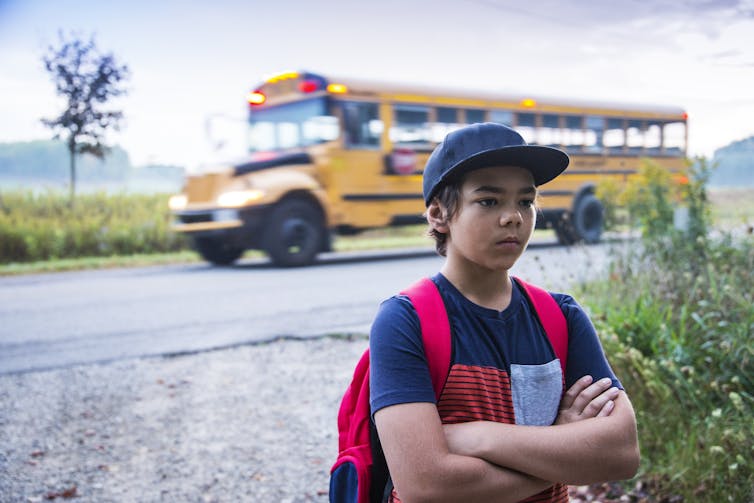
Nationally, one in six children miss 15 or more days of school in a year and are considered chronically absent. Education officials have lamented that all this missed instruction has for years constituted an attendance crisis in U.S. elementary, middle and high schools.
The fear among policymakers is that these chronically absent students suffer academically because of all the classroom instruction they miss out on. In 2015, the U.S. secretary of education and other federal officials responded to this perceived crisis, urging communities to “support every student, every day to attend and be successful in school[.]” Their open letter stated that missing 10% of school days in a year for any reason – excused or unexcused – “is a primary cause of low academic achievement.”
Worrying about whether children attend school makes sense. After all, if students don’t show up, teachers can’t teach them.
But what if America’s attendance crisis is about much more than students missing class? What if, instead, it is a reflection of family and community crises these students face – such as being evicted from the family apartment, fearing for their safety in their neighborhood or suffering an illness? These circumstances can both limit children’s academic achievement and keep them from getting to school.
Excused vs. unexcused absences
As social scientists who study inequality in schools, and an education researcher and school district leader, we investigated how excused and unexcused absences relate to children’s academic achievement.
Excused absences are those for which a parent or guardian contacts the school, or responds to the school’s request for information, explaining why the child is not or won’t be in class. If that doesn’t happen, the child is marked “unexcused.”
Our study tracks how both types of absences are linked to elementary school reading and math test scores in Madison, Wisconsin, which is home to a diverse urban public school district.
We show that absences excused by a parent or guardian do little to harm children’s learning over the school year. In fact, children with no unexcused absences – but 15 to 18 excused absences – have test scores on par with their peers who have no absences.
Meanwhile, the average child with even just one unexcused absence does much worse academically than peers with none. For example, the average student in our study with no unexcused absences is at the 58th percentile of math test scores. The average student with one unexcused absence is at the 38th percentile of math test, and the average student with 18 unexcused absences is at the 17th percentile.
Signals of family crisis
Does this mean schools shouldn’t worry about a student’s education as long as a parent calls in each time the child misses class?
Not exactly.
But our findings don’t make sense if absence from school affects achievement mainly because kids miss class time.
That is most apparent when considering the relationship between 18 unexcused absences and test score achievement. Accounting for differences among students unrelated to the current year of instruction – including their health conditions, prior academic achievement and family education and income – explains 88% of that relationship. That means children with so many unexcused absences would almost certainly have similarly low test scores even if their parents called in or if they had attended school more regularly.
Instead, we believe unexcused absence is a strong signal of the many challenges children and families face outside of school. Those challenges include economic and medical hardships and insecurity with food, transportation, family and housing. Unexcused absences can be a powerful signal of how those out-of-school challenges affect children’s academic progress.
[Get the best of The Conversation, every weekend. Sign up for our weekly newsletter.]
Policy changes
To be clear, our evidence suggests unexcused absences are problematic, but for a different reason than people often think. Absence from school, and especially unexcused absence, matters mainly as a signal of many crises children and their families may be facing. It matters less as a cause of lower student achievement due to missed instruction.
How researchers and the public choose to think of school absences matters for educational policy. National, state and school district attendance policies typically hold schools and families accountable for all of the days children miss, regardless of whether they were excused or unexcused absences.
These policies assume that missing school for any reason harms children academically because they are missing classroom instruction. They also assume that schools will be able to effectively intervene to increase academic achievement by reducing student absences. We find neither to be the case.
As a result, these attendance policies end up disproportionately punishing families dealing with out-of-school crises in their lives and pressuring schools who serve them to get students to school more often.
We instead suggest using unexcused absence from school as a signal to channel resources to the children and families who need them most.
Jaymes Pyne, Quantitative Research Associate, Stanford University; Elizabeth Vaade, Education Researcher, University of Wisconsin-Madison, and Eric Grodsky, Professor, University of Wisconsin-Madison
This article is republished from The Conversation under a Creative Commons license. Read the original article.
- Details
- Written by: Elizabeth Larson
Authorities said the body of 75-year-old Shirley Schield, 75, was found at 11:20 a.m. Wednesday in a brushy area approximately one quarter mile from her residence in the Northport Trailer Park, located at 5020 Lakeshore Blvd.
The sheriff’s office said foul play is not suspected and an autopsy is scheduled for later this week to determine her cause of death.
Schield, also known as Carol Mann, had last been seen leaving her home at around 3 a.m. Monday, the sheriff’s office said.
The sheriff’s office said she was carrying a dog leash and headed on foot toward the Lakeport area on Lakeshore Boulevard.
Schield’s family had told authorities that she may have suffered from dementia.
On Tuesday, the Lake County Sheriff's Office Search and Rescue and Kelseyville High School K-Corp continued the search for her in the north Lakeport area.
On Wednesday, the Marin County Sheriff's Office Search and Rescue and the California Rescue Dog Association joined the search.
Also on Wednesday, the sheriff’s office had asked residents to check their properties for Schield and also to check footage on their surveillance cameras.
Early Wednesday afternoon, the sheriff’s office confirmed the search had ended with the discovery of her body.
The sheriff’s office offered condolences to Schield’s family.
The agency also thanked the Marin County Sheriff’s Office Search and Rescue team and the California Rescue Dog Association for their help with the search.
Email Elizabeth Larson at