 How to resolve AdBlock issue?
News
- Details
- Written by: Aram Goudsouzian, University of Memphis
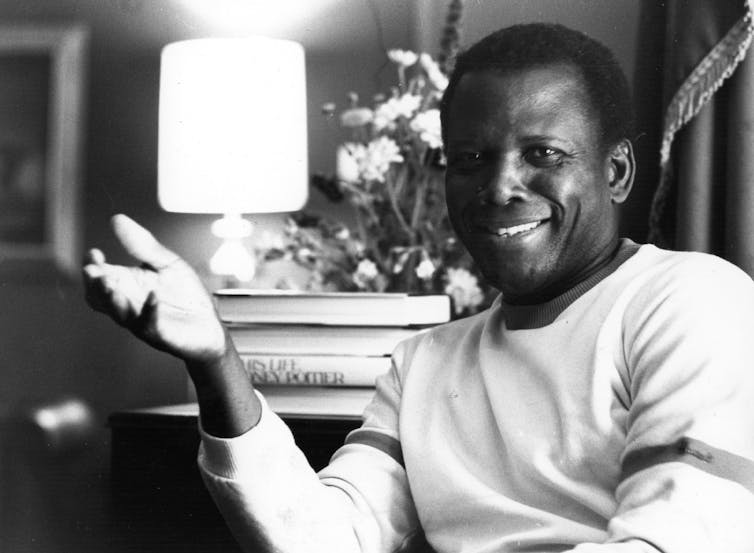
In the summer of 1967, Martin Luther King Jr. introduced the keynote speaker for the 10th-anniversary convention banquet of the Southern Christian Leadership Conference. Their guest, he said, was his “soul brother.”
“He has carved for himself an imperishable niche in the annals of our nation’s history,” King told the audience of 2,000 delegates. “I consider him a friend. I consider him a great friend of humanity.”
That man was Sidney Poitier.
Poitier, who died at 94 on Jan. 7, 2021, broke the mold of what a Black actor could be in Hollywood. Before the 1950s, Black movie characters generally reflected racist stereotypes such as lazy servants and beefy mammies. Then came Poitier, the only Black man to consistently win leading roles in major films from the late 1950s through the late 1960s. Like King, Poitier projected ideals of respectability and integrity. He attracted not only the loyalty of African Americans, but also the goodwill of white liberals.
In my biography of him, titled “Sidney Poitier: Man, Actor, Icon,” I sought to capture his whole life, including his incredible rags-to-riches arc, his sizzling vitality on screen, his personal triumphs and foibles and his quest to live up to the values set forth by his Bahamian parents. But the most fascinating aspect of Poitier’s career, to me, was his political and racial symbolism. In many ways, his screen life intertwined with that of the civil rights movement – and King himself.
An age of protests
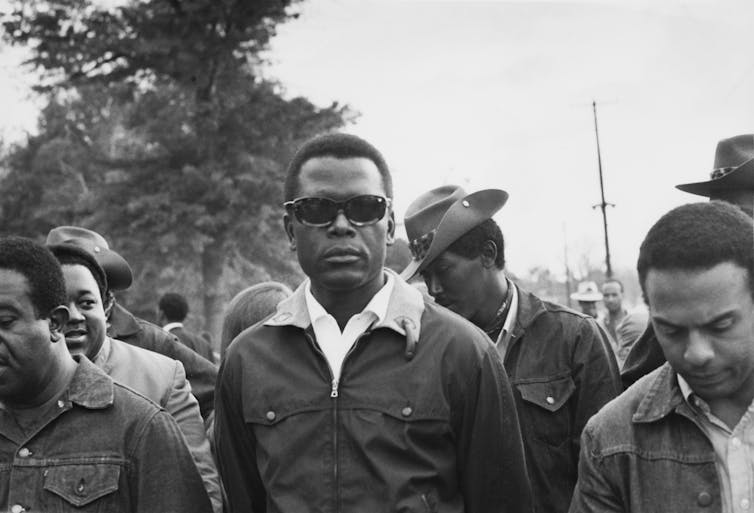
In three separate columns in 1957, 1961 and 1962, a New York Daily News columnist named Dorothy Masters marveled that Poitier had the warmth and charisma of a minister. Poitier lent his name and resources to King’s causes, and he participated in demonstrations such as the 1957 Prayer Pilgrimage and the 1963 March on Washington. In this era of sit-ins, Freedom Rides and mass marches, activists engaged in nonviolent sacrifice not only to highlight racist oppression, but also to win broader sympathy for the cause of civil rights.
In that same vein, Poitier deliberately chose to portray characters who radiated goodness. They had decent values and helped white characters, and they often sacrificed themselves. He earned his first star billing in 1958, in “The Defiant Ones,” in which he played an escaped prisoner handcuffed to a racist played by Tony Curtis. At the end, with the chain unbound, Poitier jumps off a train to stick with his new white friend. Writer James Baldwin reported seeing the film on Broadway, where white audiences clapped with reassurance, their racial guilt alleviated. When he saw it again in Harlem, members of the predominantly Black audience yelled “Get back on the train, you fool!”
King won the Nobel Peace Prize in 1964. In that same year, Poitier won the Oscar for Best Actor for “Lilies of the Field,” in which he played Homer Smith, a traveling handyman who builds a chapel for German nuns out of the goodness of his heart. The sweet, low-budget movie was a surprise hit. In its own way, like the horrifying footage of water hoses and police dogs attacking civil rights activists, it fostered swelling support for racial integration.
A better man
By the time of the actor’s Southern Christian Leadership Conference speech, both King and Poitier seemed to have a slipping grip on the American public. Bloody and destructive riots plagued the nation’s cities, reflecting the enduring discontent of many poor African Americans. The swelling calls for “Black Power” challenged the ideals of nonviolence and racial brotherhood – ideals associated with both King and Poitier.
When Poitier stepped to the lectern that evening, he lamented the “greed, selfishness, indifference to the suffering of others, corruption of our value system, and a moral deterioration that has already scarred our souls irrevocably.” “On my bad days,” he said, “I am guilty of suspecting that there is a national death wish.”
By the late 1960s, both King and Poitier had reached a crossroads. Federal legislation was dismantling Jim Crow in the South, but African Americans still suffered from limited opportunity. King prescribed a “revolution of values,” denounced the Vietnam War, and launched a Poor People’s Campaign. Poitier, in his 1967 speech for the SCLC, said that King, by adhering to his convictions for social justice and human dignity, “has made a better man of me.”
Exceptional characters
Poitier tried to adhere to his own convictions. As long as he was the only Black leading man, he insisted on playing the same kind of hero. But in the era of Black Power, had Poitier’s saintly hero become another stereotype? His rage was repressed, his sexuality stifled. A Black critic, writing in The New York Times, asked “Why Does White America Love Sidney Poitier So?”

That critic had a point: As Poitier himself knew, his films created too-perfect characters. Although the films allowed white audiences to appreciate a Black man, they also implied that racial equality depends on such exceptional characters, stripped of any racial baggage. From late 1967 into early 1968, three of Poitier’s movies owned the top spot at the box office, and a poll ranked him the most bankable star in Hollywood.
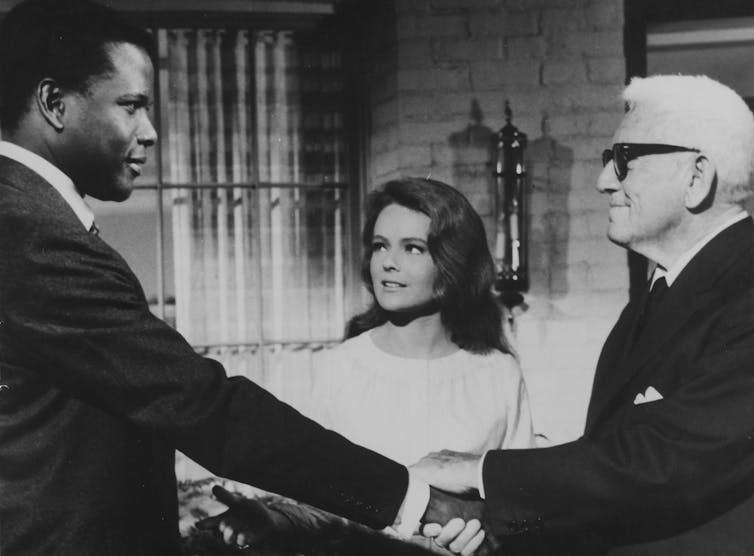
Each film provided a hero who soothed the liberal center. His mannered schoolteacher in “To Sir, With Love” tames a class of teenage ruffians in London’s East End. His razor-sharp detective in “In the Heat of the Night” helps a crotchety white Southern sheriff solve a murder. His world-renowned doctor in “Guess Who’s Coming to Dinner” marries a white woman, but only after winning the blessing of her parents.
“I try to make movies about the dignity, nobility, the magnificence of human life,” he insisted. Audiences flocked to his films, in part, because he transcended racial division and social despair – even as more African Americans, baby boomers and film critics tired of the old-fashioned do-gooder spirit of these movies.
Intertwined lives
And then, the lives of Martin Luther King Jr. and Sidney Poitier intersected one final time. After King’s assassination on April 4, 1968, Poitier was a stand-in for the ideal that King embodied. When he presented at the Academy Awards, Poitier won a massive ovation. “In the Heat of the Night” and “Guess Who’s Coming to Dinner” captured most of the major awards. Hollywood again dealt with the nation’s racial upheaval through Poitier movies.
But after King’s violent murder, the Poitier icon no longer captured the national mood. In the 1970s, a generation of “Blaxploitation” films featured violent, sexually charged heroes. They were a reaction against the image of a Black leading man associated with Poitier. Although his career evolved, Poitier was no longer a superstar, and he no longer bore the burden of representing the Black freedom movement. Yet for a generation, he had served as popular culture’s preeminent expression of the ideals of Martin Luther King.
[Get the best of The Conversation, every weekend. Sign up for our weekly newsletter.]
Aram Goudsouzian, Bizot Family Professor of History, University of Memphis
This article is republished from The Conversation under a Creative Commons license. Read the original article.
- Details
- Written by: Elizabeth Larson
Dogs available for adoption this week include mixes of Akita, black mouth cur, border collie, Chihuahua, German shepherd, Labrador retriever, pit bull and Rhodesian ridgeback.
Dogs that are adopted from Lake County Animal Care and Control are either neutered or spayed, microchipped and, if old enough, given a rabies shot and county license before being released to their new owner. License fees do not apply to residents of the cities of Lakeport or Clearlake.
The following dogs at the Lake County Animal Care and Control shelter have been cleared for adoption (additional dogs on the animal control website not listed are still “on hold”).
Call Lake County Animal Care and Control at 707-263-0278 or visit the shelter online for information on visiting or adopting.

Black mouth cur-Labrador retriever mix
This 5-year-old female black mouth cur-Labrador retriever mix has a golden coat with white markings.
She is in kennel No. 2, ID No. LCAC-A-2449.

Male German shepherd
This 1-year-old male German shepherd has a black and tan coat.
He is in kennel No. 12, ID No. LCAC-A-1892.

‘Cinnamon’
“Cinnamon” is a 5-year-old female chocolate Labrador retriever-pit bull mix with a short chocolate-colored coat.
She is in kennel No. 13, ID No. LCAC-A-1769.

‘Bruce’
“Bruce” is a 2-year-old male pit bull terrier with a short brown coat.
He is in kennel No. 14, ID No. LCAC-A-2351.

Male pit bull terrier
This male pit bull terrier has a short tan coat with white markings.
He is in kennel No. 17, ID No. LCAC-A-2444.

‘Nioki’
“Nioki” is a 1-year-old female shepherd with a black coat.
She is in kennel No. 21, ID No. LCAC-A-2442.

Female border collie mix
This 2-year-old female border collie mix has a black and white coat.
She is in kennel No. 23, ID No. LCAC-A-2207.

Female Chihuahua
This 2-year-old female Chihuahua has a short black coat.
She is in kennel No. 24, ID No. LCAC-A-2446.

‘Brownie’
“Brownie” is a young male Chihuahua mix with a red and white coat.
He is in kennel No. 25a, ID No. LCAC-A-2414.

‘Nugget’
“Nugget” is a male Chihuahua mix puppy with a short tan coat.
He is in kennel No. 25b, ID No. LCAC-A-2413.

Male German shepherd
This 2-year-old male German shepherd has a black and tan coat.
He is in kennel No. 26, ID No. LCAC-A-1903.

Male German shepherd
This 2-year-old male German shepherd has a black and tan coat.
He is in kennel No. 29, ID No. LCAC-A-2400.

‘Duke’
“Duke is a 1-year-old male Rhodesian ridgeback with a short brown coat.
He is in kennel No. 30, ID No. LCAC-A-2219.

Female Akita-shepherd mix
This 1-year-old female Akita-shepherd mix has a black and tan coat.
She is in kennel No. 33, ID No. LCAC-A-2438.
Email Elizabeth Larson at
- Details
- Written by: NATIONAL AERONAUTICS AND SPACE ADMINISTRATION

NASA’s James Webb Space Telescope team fully deployed its 21-foot, gold-coated primary mirror, successfully completing the final stage of all major spacecraft deployments to prepare for science operations.
A joint effort with the European Space Agency and Canadian Space Agency, the Webb mission will explore every phase of cosmic history — from within our solar system to the most distant observable galaxies in the early universe.
“Today, NASA achieved another engineering milestone decades in the making. While the journey is not complete, I join the Webb team in breathing a little easier and imagining the future breakthroughs bound to inspire the world,” said NASA Administrator Bill Nelson. “The James Webb Space Telescope is an unprecedented mission that is on the precipice of seeing the light from the first galaxies and discovering the mysteries of our universe. Each feat already achieved and future accomplishment is a testament to the thousands of innovators who poured their life’s passion into this mission.”
The two wings of Webb’s primary mirror had been folded to fit inside the nose cone of an Arianespace Ariane 5 rocket prior to launch. After more than a week of other critical spacecraft deployments, the Webb team began remotely unfolding the hexagonal segments of the primary mirror, the largest ever launched into space. This was a multi-day process, with the first side deployed Jan. 7 and the second Jan. 8.
Mission Operations Center ground control at the Space Telescope Science Institute in Baltimore began deploying the second side panel of the mirror at 8:53 a.m. EST. Once it extended and latched into position at 1:17 p.m. EST, the team declared all major deployments successfully completed.
The world’s largest and most complex space science telescope will now begin moving its 18 primary mirror segments to align the telescope optics.
The ground team will command 126 actuators on the backsides of the segments to flex each mirror — an alignment that will take months to complete. Then the team will calibrate the science instruments prior to delivering Webb’s first images this summer.
“I am so proud of the team — spanning continents and decades — that delivered this first-of-its kind achievement,” said Thomas Zurbuchen, associate administrator for the Science Mission Directorate in NASA Headquarters in Washington. “Webb’s successful deployment exemplifies the best of what NASA has to offer: the willingness to attempt bold and challenging things in the name of discoveries still unknown.”
Soon, Webb will also undergo a third mid-course correction burn — one of three planned to place the telescope precisely in orbit around the second Lagrange point, commonly known as L2, nearly one million miles from Earth.
This is Webb’s final orbital position, where its sunshield will protect it from light from the Sun, Earth, and Moon that could interfere with observations of infrared light. Webb is designed to peer back over 13.5 billion years to capture infrared light from celestial objects, with much higher resolution than ever before, and to study our own solar system as well as distant worlds.
“The successful completion of all of the Webb Space Telescope’s deployments is historic,” said Gregory L. Robinson, Webb program director at NASA Headquarters. “This is the first time a NASA-led mission has ever attempted to complete a complex sequence to unfold an observatory in space — a remarkable feat for our team, NASA, and the world.”
NASA’s Science Mission Directorate oversees the mission. NASA’s Goddard Space Flight Center in Greenbelt, Maryland, manages the project for the agency and oversees the Space Telescope Science Institute, Northrop Grumman, and other mission partners.
In addition to Goddard, several NASA centers contributed to the project, including Johnson Space Center in Houston, the Jet Propulsion Laboratory in Pasadena, Marshall Space Flight Center in Huntsville, Alabama, Ames Research Center in Silicon Valley, and others.
For more information about the Webb mission, visit https://www.nasa.gov/webb.
- Details
- Written by: Elizabeth Larson
Registrar Maria Valadez reported that the local offices up for election on June 7 are the county superintendent of schools, District 2 county supervisor, District 3 county supervisor, assessor-recorder, county clerk-auditor, district attorney, sheriff-coroner and treasurer-tax collector.
So far, several incumbents and some new candidates have filed candidate intention statements, Valadez said Friday.
The incumbents who have filed include Superintendent of Schools Brock Falkenberg, County Clerk-Auditor Cathy Saderlund, Sheriff-Coroner Brian Martin and District Attorney Susan Krones.
Anthony Farrington, who plans to challenge Krones for the district attorney’s job, also has filed a statement, Valadez said.
Patrick Sullivan has filed the statement to run for treasurer-tax collector, Valadez said. Incumbent Barbara Ringen has previously stated she did not plan to seek reelection.
For the assessor-recorder, incumbent Richard Ford hasn’t filed the statement yet but he told Lake County News he intends to do so.
Valadez said Hannah Lee has filed a statement to also run against Ford for the assessor-recorder job.
Candidates for the District 2 and 3 supervisorial seats can’t begin to pull any paperwork until after Jan. 11, Valadez said.
However, Lake County News confirmed with the incumbents, District 2 Supervisor Bruno Sabatier and District 3 Supervisor EJ Crandall, that they would both be running for reelection. They are completing their first terms.
Those early filings, however, are just an initial step, and Valadez emphasized there are other parts of the process to complete before they officially become candidates and have their names on the ballot.
The registrar’s office said candidates for those elective offices may submit “in-lieu-of-filing fee petitions” containing signatures of registered voters in the jurisdiction in which he or she seeks nomination, to offset all or part of the cost of their filing fee.
The in-lieu-of-filing petitions are available for voter-nominated offices and countywide offices between Jan. 3 and Feb. 9 and for county Board of Supervisor candidates starting Jan. 11 and continuing until Feb. 9, the elections office said.
The registrar’s office said the in-lieu-of-filing fee petitions are available to countywide candidates during regular office hours of 8 a.m. to 5 p.m. Monday through Friday. The office is closed on cunty holidays and weekends.
The deadline to file the in-lieu-of-filing fee petitions with the Lake County Registrar of Voters’ Office is the close of business on Wednesday, Feb. 9.
There are still more steps beyond those petitions, including the requirement that all candidates must file a declaration of candidacy form and nomination papers within the nomination period of Feb. 14 through March 11 in order for their name to be printed on the June 7 primary election ballot.
In addition to local offices to be filled, Valadez said the June 7 primary election will include several state offices: governor, lieutenant governor, secretary of state, controller, treasurer, attorney general, insurance commissioner, District 2 Board of Equalization member and the nonpartisan superintendent of public instruction.
Federal offices on the ballot in June will include United States representative, District 4; United States senator; State Senate, District 2; and State Assembly member, District 4.
Voters wanting more information about filing for any of these elective offices may contact the Registrar of Voters Office in person at the Lake County Courthouse, 255 N Forbes St, Room 209, Lakeport or by phone at 707-263-2372.
Email Elizabeth Larson at