 How to resolve AdBlock issue?
News
- Details
- Written by: Jessica Heiges, University of California, Berkeley and Kate O'Neill, University of California, Berkeley
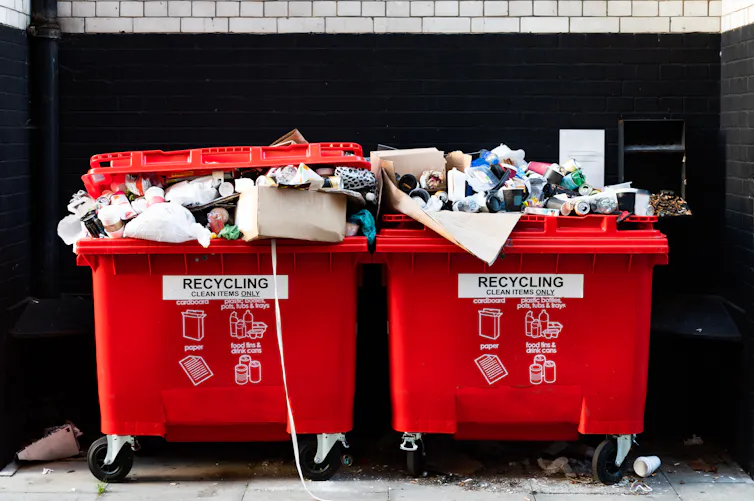
Wishcycling is putting something in the recycling bin and hoping it will be recycled, even if there is little evidence to confirm this assumption.
Hope is central to wishcycling. People may not be sure the system works, but they choose to believe that if they recycle an object, it will become a new product rather than being buried in a landfill, burned or dumped.
The U.S. recycling industry was launched in the 1970s in response to public concern over litter and waste. The growth of recycling and collection programs changed consumers’ view of waste: It didn’t seem entirely bad if it could lead to the creation of new products via recycling.
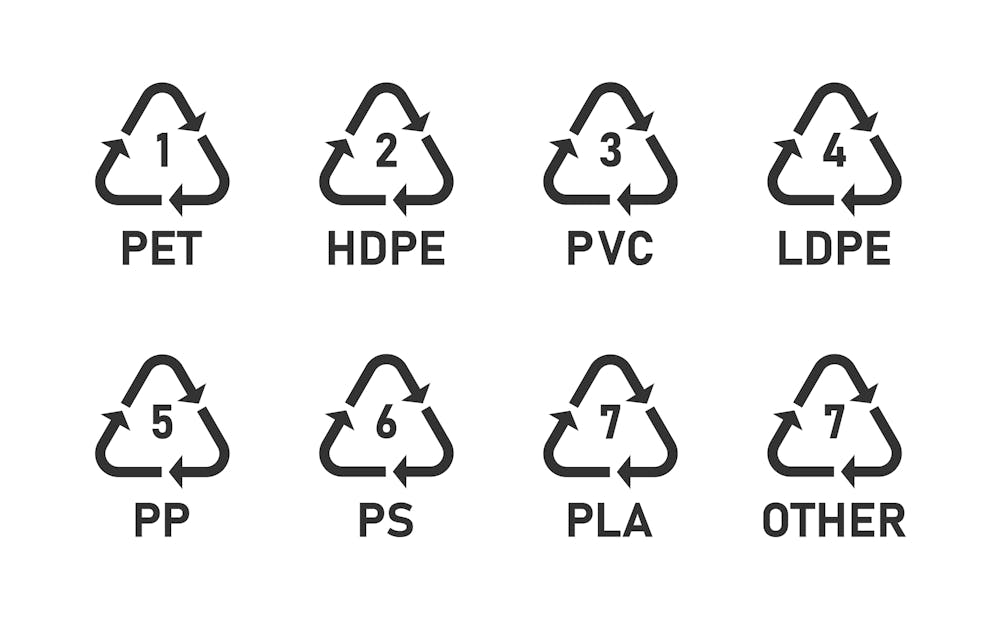
Pro-recycling messaging from governments, corporations and environmentalists promoted and reinforced recycling behavior. This was especially true for plastics that had resin identification codes inside a triangle of “chasing arrows,” indicating that the item was recyclable – even though that was usually far from the truth. In fact, only resins #1 (polyethylene terephthalate, or PET) and #2 (high-density polyethylene, or HDPE) are relatively easy to recycle and have viable markets. The others are hard to recycle, so some jurisdictions don’t even collect them.
Wishcycling entered public consciousness in 2018 when China launched Operation National Sword, a sweeping set of restrictions on imports of most waste materials from abroad. Over the preceding 20 years, China had purchased millions of tons of scrap metal, paper and plastic from wealthy nations for recycling, giving those countries an easy and cheap option for managing waste materials.
The China scrap restrictions created enormous waste backups in the U.S., where governments had under-invested in recycling systems. Consumers saw that recycling was not as reliable or environmentally friendly as previously believed.
An unlikely coalition of actors in the recycling sector coined the term “wishcycling” in an effort to educate the public about effective recycling. As they emphasize, wishcycling can be harmful.
Contaminating the waste stream with material that is not actually recyclable makes the sorting process more costly because it requires extra labor. Wishcycling also damages sorting systems and equipment and depresses an already fragile trading market.

Huge waste management companies and small cities and towns have launched educational campaigns on this issue. Their mantra is “When in doubt, throw it out.” In other words, only place material that truly can be recycled in your bin. This message is hard for many environmentalists to hear, but it cuts costs for recyclers and local governments.
[Over 140,000 readers rely on The Conversation’s newsletters to understand the world. Sign up today.]
We also believe it’s important to understand that the global waste crisis wasn’t created by consumers who failed to wash mayonnaise jars or separate out plastic bags. The biggest drivers are global. They include capitalistic reliance on consumption, strong international waste trade incentives, a lack of standardized recycling policies and the devaluation of used resources. To make further progress, governments and businesses will have to think more about designing products with disposal and reuse in mind, reducing consumption of single-use products and making massive investments in recycling infrastructure.
Jessica Heiges, PhD Candidate in Environmental Science, Policy, and Management, University of California, Berkeley and Kate O'Neill, Professor of Global Environmental Politics, University of California, Berkeley
This article is republished from The Conversation under a Creative Commons license. Read the original article.
- Details
- Written by: Elizabeth Larson
The council and board held a joint 70-minute-long meeting at City Hall on Tuesday night, at the end of which they voted unanimously — first the council, then the supervisors — to approve the agreement.
Both sides called the agreement a “win-win,” for the two governments, the business owners and residents of the 135-acre South Lakeport Annexation Project area, consisting of 50 parcels, that runs along South Main Street and onto a portion of Soda Bay Road.
The tone of the meeting was both collegial and complimentary, a far cry from the tenor of interactions between the county and city on the topic since Lakeport first began to discuss pursuing the annexation a decade ago.
“It’s a very good moment for us,” Board Chair EJ Crandell noted at the meeting’s beginning.
During the course of the discussion on Tuesday, both Supervisor Tina Scott and Councilwoman Mireya Turner noted that annexation had previously been a bad word, with Turner adding that it had been a problem in an otherwise functional relationship between the two governments.
The city has maintained that the proposed annexation area, while outside of the city limits, has been in its sphere of influence since at least the 1980s.
For the county, the loss of the most lucrative commercial area in its jurisdiction — and the associated tax revenue — was a major concern, and it led to serious contention between the two governments.
At one point in 2016, the county asked the Lake Local Area Formation Commission, or LAFCo, the agency which is responsible for reviewing and approving spheres of influence and annexations, to remove the proposed annexation area from the city’s sphere of influence.
As recently as February 2019, the two sides had indicated that their deep disagreements continued. Then, in December 2020, LAFCo asked the city and council to participate in a good faith process to resolve the ongoing dispute over the proposed annexation.
A hang-up was a series of previous tax sharing agreements the two governments had reached in previous decades that were meant to address the county’s potential revenue losses.
The city would later, at LAFCo’s request, agree to pay for another fiscal analysis conducted by a third party, which contributed to the new negotiations.
Those previous disagreements have now been resolved with the new agreement. However, officials caution there are many steps still ahead for annexation to be approved, with property owners and registered voters in the area able to challenge the action.
An outline of the agreement
The negotiating team whose work resulted in the proposed agreement included, on the city side, Mayor Stacey Mattina and Councilman Kenny Parlet, City Manager Kevin Ingram, Assistant City Manager/Finance Director Nick Walker and City Attorney David Ruderman, and from the county, supervisors Tina Scott and Moke Simon, County Administrative Officer Carol Huchingson and two of her deputies, Susan Parker and Steve Carter, Tax Administrator Patrick Sullivan and County Counsel Anita Grant.
“It’s a complicated agreement,” and it took a while to work out the various aspects of it, Ingram told Lake County News.
It will provide for basic services in the area, like hydrants, a public water system and a commitment to finishing the South Main Street-Soda Bay Road Corridor Project, and includes incentives for the city and county to work together, Ingram said.
The tax sharing agreement runs from July 1, 2022, to June 30, 2040, and applies to both sales and property tax.
From July 2022 to June 2029, the county will receive 80% of Bradley-Burns sales tax from the area and the city will receive 20%.
Bradley-Burns sales tax is the 1.25% statewide rate; of that, 1% is allocated to cities or counties. Ingram said that for every dollar of sales tax, that percentage equates to 2.5 cents for local jurisdictions. “The rest of it all goes to Sacramento.”
While the lion’s share of the Bradley-Burns sales tax would go to the county in that initial seven-year period, Ingram said the city would receive 100% of its Measure I and Z sales taxes, which is a key part of the agreement and is what he said made the negotiations possible.
From July 2029 to June 2039, the county will receive 50% plus 50% of the cumulative growth of the Bradley-Burns sales tax since the final year of the first period.
After the agreement’s end, the city would continue to pay that share of Bradley-Burns sales tax to the county indefinitely, at the same amount received for the final year of the second phase.
Ingram said the county will receive 65.3% and the city 34.7% during the agreement, which is the same split for any property in city jurisdiction.
“The real winner there on the property tax side is the fire district,” said Ingram, noting the district will receive more money for the new land added to the city.
He said a fiscal analysis showed revenue neutrality, and the amounts established in the agreement give the city and county enough to cover their services.
That includes taking over policing in the area, with Ingram pointing out that the Lakeport Police Department already responds to assist the sheriff’s department on mutual aid. “It’s not that large of an impact.
The agreement establishes that the city will offer water services to the area, but that it will be optional, not required.
There also is the matter of wastewater services expansion, an area which still has to undergo a separate negotiation.
Ingram said the city and county have an existing agreement for wastewater in place that runs through the end of 2026. The county currently maintains the infrastructure, with the city maintaining the pump station at 16th Street. The city takes the flows during the low months and the agreement calls for the county to take some of the flow into its system.
“We want to start looking at it sooner rather than later,” Ingram said of that agreement.
Common ground
During Tuesday’s meeting, Ingram acknowledged, “For many years this issue has been both challenging and controversial.”
Now, however, for the first time, Ingram said the city and county have found some common ground.
In discussing aspects of the agreement, Ingram touched on the South Main Street-Soda Bay Road Corridor Project.
“There have been significant delays to this project. It has been going on for quite some time,” he said.
While it’s been moving forward at a slow pace, he said they are nearing a point where they want to get water into the area. However, they don’t want to burden businesses by digging up the road twice.
Once the right of way acquisition is completed, undergrounding of utilities can start. Ingram expected that to happen around the end of 2023 or early 2024.
Mattina said it was exciting to see the level of cooperation between the city and county, and she noted what they could accomplish in Lake County if they’re working together.
Supervisor Bruno Sabatier gave kudos to the city for forcing the conversation with the LAFCo application. “The past was haunting the conversation in the first place.”
While officials are enthusiastic, there is the community response to consider.
Ingram said he and Parker walked the annexation area on Friday to share information and answer questions with residents and business owners.
He said the response was “mixed,” with some remaining adamantly opposed and others excited about the possibility of a reliable water supply to be provided by the city.
One property owner who came to the meeting to express support was Scott Lotter, who owns Lakeport Cinema 5 and Lakeport Auto Movies. He is the largest property owner in the annexation area, making up 20% of the land area.
“We’re delighted,” he said, explaining that when he built the theater 25 years ago, he signed an agreement to support the annexation. “We still support the annexation.”
Lotter said he’s looking forward to improved water service. He now spends a lot of money to get the water service he needs.
During the meeting, Ingram read a letter from Lakeport Fire Chief Jeffrey Thomas, who emphasized that having a reliable water supply is critical for the department and those who rely on them to “quickly and efficiently put out fires.”
“Considering normal modern day house fires, we have about five minutes before the combustible fire gases can completely involve the interior of a structure,” he said.
Thomas said the area’s water supply has a direct influence on insurance premiums and cost of doing business.
“I do feel a sense of collaboration with the county that was absent just a short time ago,” said Councilman Michael Green, adding there are compelling reasons for the city and county to move forward.
He said cities need to grow and he wanted the community to have every confidence that this is a very public, transparent and complicated process.
On the city side, Turner moved to approve the agreement, with the council voting 5-0. That was followed by Scott moving approval by the board, also accepted with a unanimous vote.
The annexation application itself is separate and must go through a process that still has several steps ahead, including consideration by LAFCo and then responding to any potential challenges.
It’s expected that the annexation application could be reviewed by LAFCo by March or April.
Ingram said there will be more opportunities for public outreach, including plans for a community meeting in the annexation area in the near future.
More information is available on the process at www.lakeportannexation.org.
Email Elizabeth Larson at
South Lakeport Annexation Tax Exchange Agreement_Final Version 1-6-21 (Revised 1-11-21 CLEAN) v2 by LakeCoNews on Scribd
- Details
- Written by: Lake County Fair Foundation
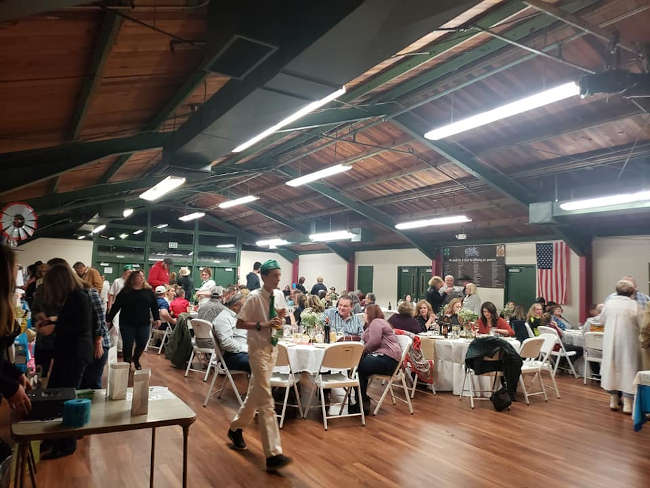
LAKEPORT, Calif. — The Lake County Fair Foundation is hosting a February fundraiser to support the goal of improving the county’s fairgrounds and hosting educational events.
The third annual Wrangler Round-Up Dinner and Dance will take place from 6 to 10 p.m. Saturday, Feb. 5, at Fritch Hall at the Lake County Fairgrounds, 401 Martin St. in Lakeport.
The evening will include a barbecue meal and a no-host bar, plus live music provided by a local band, the Time Travelers.
There also will be a live auction, raffle, and a dessert auction.
The cost is $50 per person or $90 per couple. Table sponsorships also are available.
Proceeds support the nonprofit foundation’s efforts at the fairgrounds, which include raising funds to purchase equipment, renovate facilities, and provide outreach to the community regarding agriculture and natural resources.
To purchase tickets or for additional information, visit https://www.lakecountyfairfoundation.com.
You can also contact Jeff Warrenburg at 925-381-0359 or
- Details
- Written by: Lake County Wine Alliance
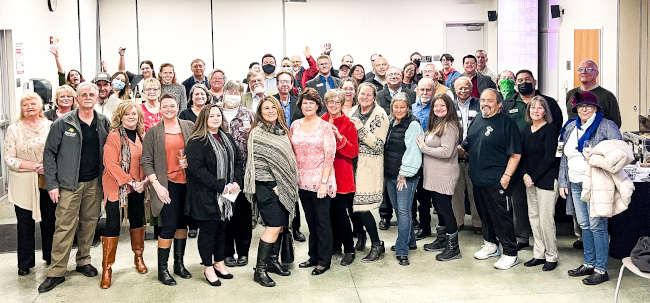
LAKE COUNTY, Calif. — The Lake County Wine Alliance recently held their check presentation ceremony for the beneficiaries of the 2021 Lake County Wine Auction, where over $250,000 was given to local organizations whose mission is to support those in need within the community.
Through the hard work of volunteers, board of directors, donors, sponsors, and auction attendees, the Lake County Wine Alliance was able to donate substantial amounts to several organizations.
This latest group of beneficiaries includes LC Rural Arts Initiative, Lake County Symphony Association, Adventist Shower/Trailer Project, Yuba Community College District, all LC FFA and Arts Programs, Lake County Senior Centers, Lake County Youth Services, Lake County Sheriff’s Activities League, Lake County Channel Cats, Totes for Teens, Hospice Services of LC, People Services, Lake Family Resource Center, Mother-Wise and Operation Tango Mike.
This year’s sponsors donated enough to cover the cost of the event, so all funds raised were able to go directly to these organizations.
Sponsors are Adventist Health, Sysco, California Exterminators, Six Sigma Ranch and Winery, Beckstoffer, Travel Center, Richard Knoll Consulting, Pabst Blue Ribbon Construction, Reynolds Systems, Sutter Health, Bella Vista Farming, Tribal Health, Cork Supply, Tricobraun WinePak, Calpine and West Coast Fire and Water.