 How to resolve AdBlock issue?
News
- Details
- Written by: Anthony Siracusa, University of Colorado Boulder
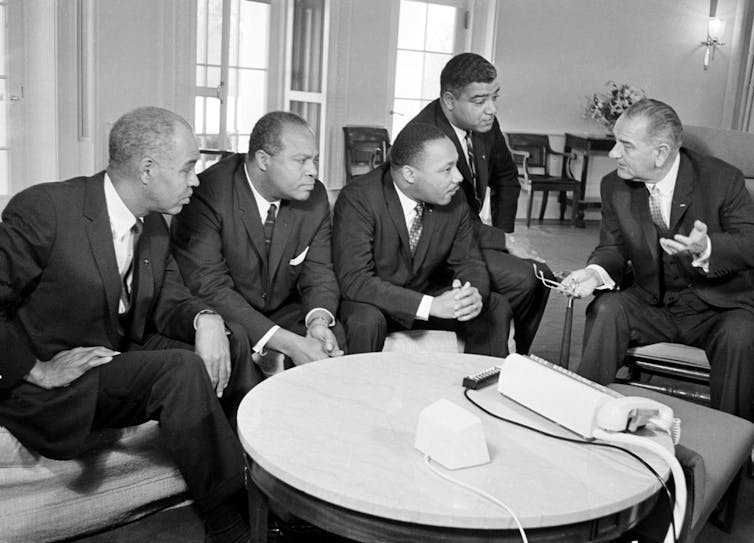
On July 2, 1964, Martin Luther King Jr. stood behind President Lyndon Baines Johnson as the Texan signed into law the Civil Rights Act of 1964. Although not the first civil rights bill passed by Congress, it was the most comprehensive.
King called the law’s passage “a great moment … something like the signing of the Emancipation Proclamation by Abraham Lincoln.” Johnson recognized King’s contributions to the law by gifting him a pen used to sign the historic legislation.
A year later, as Johnson signed the Voting Rights Act of 1965 into law, King again joined the president for the occasion.
But by the start of 1967, the two most famous men in America were no longer on speaking terms. In fact, they would not meet again before King fell to an assassin’s bullet on April 4, 1968.
King was foremost a minister who pastored to a local church throughout his career, even while he was doing national civil rights work. And he became concerned that his political ally Johnson was making a grave moral mistake in Vietnam. Johnson quickly escalated American troop presence in Vietnam from 75,000 to 125,000 in 1965. And by 1968, more than a half a million troops were stationed in the Southeast Asian nation.
As I write in my 2021 book “Nonviolence Before King,” the Baptist preacher had been on a “pilgrimage to nonviolence” for years. And by 1967, he was a radical apostle of Christian nonviolence.
King called on the United States to “be born again” and undergo a “radical revolution of values.” King believed that Jim Crow segregation and the war in Vietnam were rooted in the same unjust ethic of race-based domination, and he called on the nation to change its ways.
Speaking against the Vietnam War
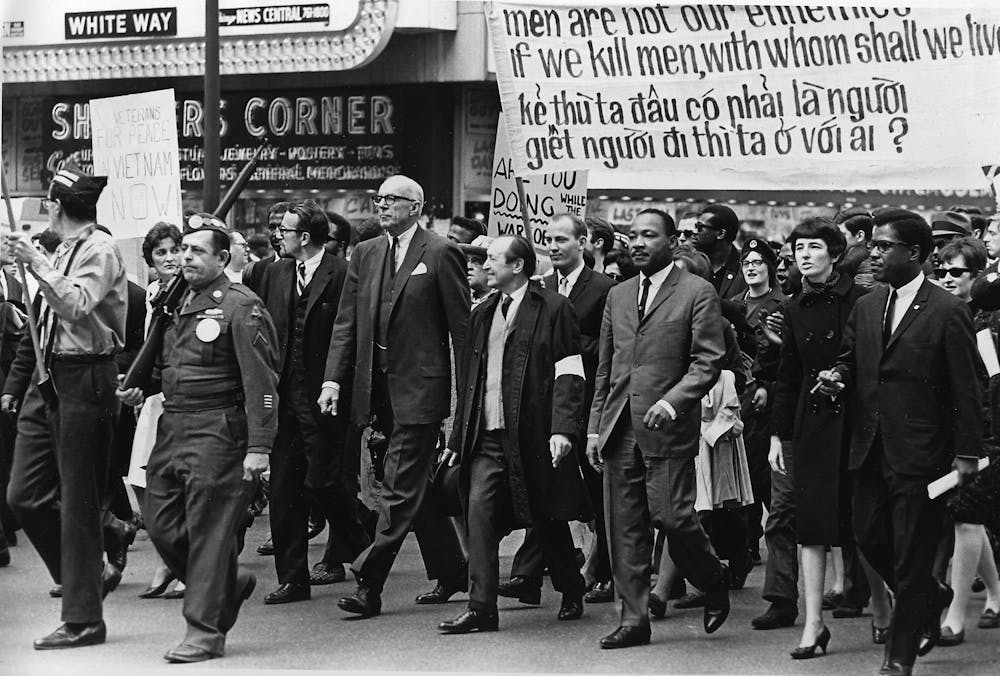
King preached nonviolent direct action for years, and his team organized massive protest movements in the cities of Albany, Georgia, and Selma and Birmingham in Alabama. But by 1967, King’s religious vision for nonviolence went beyond nonviolent street protest to include abolishing what he called the “triple evils” crippling American society. King defined the triple evils as racism, poverty and militarism, and he believed these forces were contrary to God’s will for all people.
He came to believe, as he said in 1967, that racism, economic exploitation and war were crippling America’s ability to create a “beloved community” defined by love and nonviolence. And on April 4, 1967, he publicly rebuked the president’s war policy in Vietnam at Riverside Presbyterian Church in New York City in a speech titled “Beyond Vietnam.”
“I speak as a child of God and brother to the suffering poor of Vietnam,” he told those gathered in the majestic cathedral. “I speak for the poor of America who are paying the double price of smashed hopes at home, and death and corruption in Vietnam.”
King was initially optimistic that Johnson’s Great Society program, which aimed to make historic investments in job growth, job training and economic development, would tackle domestic poverty. But by 1967 the Great Society appeared to be a casualty of the mounting costs of the war in Vietnam. “I was increasingly compelled to see the war as an enemy of the poor and to attack it as such,” King said in his speech.
King saw the grinding poverty facing Black people at home as inseparable from the war overseas. As he noted, “If our nation can spend 35 billion dollars a year to fight an unjust, evil war in Vietnam, and 20 billion dollars to put a man on the moon, it can spend billions of dollars to put God’s children on their own two feet right here on earth.”
King could no longer ignore that military force ran contrary to the nonviolence he espoused. As urban revolts in Watts and Newark in the late 1960s rocked the nation, he pleaded with people to remain nonviolent.
“But they ask – and rightly so – what about Vietnam?” King said in the same 1967 speech. “They ask if our own nation wasn’t using massive doses of violence to solve its problems, to bring about the changes it wanted. Their questions hit home, and I knew that I could never again raise my voice against the violence of the oppressed in the ghettos without having first spoken clearly to the greatest purveyor of violence in the world today – my own government.”
King’s vision
By 1967, King’s vision of justice was one of flourishing for all people, not only civil rights for African Americans. King was criticized for expanding his vision beyond civil rights for Black Americans. Some worried that aligning with the peace movement would weaken the civil rights movement. The National Association for the Advancement of Colored People even issued a statement clearly opposing what it saw as a merging of the civil rights and peace movements.
But in his 1967 “Beyond Vietnam” speech, King called “for a worldwide fellowship that lifts neighborly concern beyond one’s tribe, race, class, and nation … an all-embracing and unconditional love for all mankind.” Such unconditional love is “the key that unlocks the door which leads to ultimate reality,” and he noted that this unifying principle was present in Hinduism, Islam, Christianity, Judaism and Buddhism.
King was always first a religious leader. He never sought nor gained elected office, because he wanted to maintain a moral voice and be free to challenge policies he believed to be unjust.
But the cost for King’s speaking out was high: By the time of his assassination, King’s national approval rating was at an all-time low.
He was not a morally perfect man. Declassified files show how the FBI Director J. Edgar Hoover tried to target King over his extramarital affairs. Hoover used a wiretap to tape King having sex with other women and sent those to his wife, Coretta Scott King, with a letter indicating King should kill himself because of his moral transgressions.
Honoring King
For those seeking to honor King’s legacy today, his religious nonviolence is demanding. It asks that people go beyond acts of service and charity – as important as those are – to both speak and act against violence and racism as well as to organize to end those pernicious forces.
[3 media outlets, 1 religion newsletter. Get stories from The Conversation, AP and RNS.]
It is a radical concept of love that demands we embrace those we know and those we don’t, to acknowledge, as King said, “that all life is interrelated, that somehow we’re caught in an inescapable network of mutuality tied in a single garment of destiny.”
On Martin Luther King Jr. Day, the challenge may be to decipher the meaning of this idea in action for our own lives. The future of what King called the beloved community depends on it – a world at peace because justice is present.
Editor’s Note: This article has been updated with the correct location of Albany.
Anthony Siracusa, Senior Director of Inclusive Culture and Initiatives, University of Colorado Boulder
This article is republished from The Conversation under a Creative Commons license. Read the original article.
- Details
- Written by: Elizabeth Larson
The board will meet at 7 p.m. Tuesday, Jan. 18, in the Tom Aiken Student Center at Kelseyville High School, 5480 Main St.
Those participating in the meeting are asked to wear facial coverings based on state guidelines.
The resolution is listed as an action item on the board’s agenda.
It uses similar language to resolutions accepted last month by the Lakeport Unified, Lucerne Elementary and Konocti Unified school district boards, as Lake County News has reported.
However, the Kelseyville document has introduced some changes, in particular, noting that the district “will continue to partner with public health agencies to provide education material and offer vaccination opportunities for school-age children and employees; however, the governing board respectfully asks that the California Legislature not mandate the COVID-19 vaccine for students and staff of TK-12 grade Local Education Agencies.”
The resolution also resolves that the district governing board will petition the state that the COVID-19 vaccine not be a condition of enrollment for students or employment for staff.
Middletown Unified first considered its own version of the resolution last month but postponed a vote. It is due to consider that resolution again on Tuesday night, after having to delay its meeting for nearly a week due to a board member being in COVID quarantine.
Email Elizabeth Larson at
- Details
- Written by: Elizabeth Larson
The council will meet at 6 p.m. Tuesday, Jan. 18, in the council chambers at Lakeport City Hall, 225 Park St.
The agenda can be found here.
The council chambers will be open to the public for the meeting. In accordance with updated guidelines from the state of California and revised Cal OSHA Emergency Temporary Standards, persons who are not fully vaccinated for COVID-19 are required to wear a face covering at this meeting.
If you cannot attend in person, and would like to speak on an agenda item, you can access the Zoom meeting remotely at this link or join by phone by calling toll-free 669-900-9128 or 346-248-7799.
The webinar ID is 973 6820 1787, access code is 477973; the audio pin will be shown after joining the webinar. Those phoning in without using the web link will be in “listen mode” only and will not be able to participate or comment.
Comments can be submitted by email to
On Tuesday, the council will present a proclamation designating January 2022 as Human Trafficking Awareness Month in the City of Lakeport and will get an update on the All Children Thrive Youth Governance Council.
Under council business, Police Chief Brad Rasmussen will seek the council’s approval of the purchase of a 2022 Dodge Charger patrol vehicle at a cost of up to $65,000.
Rasmussen also will ask the council to authorize him to implement an automated license plate recognition program and approve funds for up to a year of operation, estimated at $22,000.
Public Works Superintendent Ron Ladd will ask for the council to authorize professional services agreements with Dokken Engineering for the Forbes Creek Headwall Repair Project and the Hartley Street Culvert Repair Project.
City Manager Kevin Ingram will give the council traffic safety reports and Utilities Superintendent Paul Harris will present a resolution to submit an application to the Small Community Drought
Relief Program for the modification of the city’s intake structure.
On the consent agenda — items usually accepted as a slate on one vote — are ordinances; minutes of the council’s regular meeting on Jan. 4 and special joint meeting with the Board of Supervisors on Jan. 11; approval of amendment No. 2 to the agreement for the lease of acreage devoted to spray irrigation disposal of wastewater; introduction of an ordinance adding chapter 12.30 and amending chapters 9.08 and 10.08 of the Lakeport Municipal Code related to skating and skateboarding in any skate park, parklands, and the downtown district and setting a public hearing for the consideration of the ordinance for Feb. 15; receive and file the midyear Community Development Activity Report.
Email Elizabeth Larson at
- Details
- Written by: Elizabeth Larson
Dogs available for adoption this week include mixes of Akita, border collie, Chihuahua, German shepherd, Labrador retriever, pit bull and Rhodesian ridgeback.
Dogs that are adopted from Lake County Animal Care and Control are either neutered or spayed, microchipped and, if old enough, given a rabies shot and county license before being released to their new owner. License fees do not apply to residents of the cities of Lakeport or Clearlake.
The following dogs at the Lake County Animal Care and Control shelter have been cleared for adoption (additional dogs on the animal control website not listed are still “on hold”).
Call Lake County Animal Care and Control at 707-263-0278 or visit the shelter online for information on visiting or adopting.
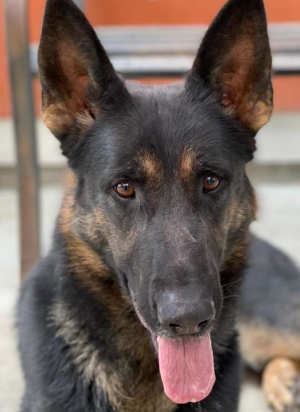
Male German shepherd
This 1-year-old male German shepherd has a black and tan coat.
He is in kennel No. 12, ID No. LCAC-A-1892.
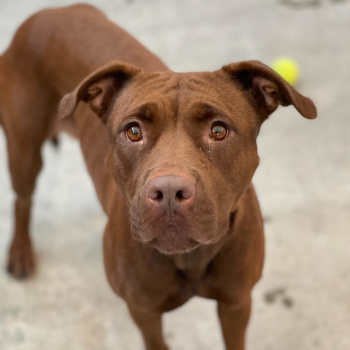
‘Cinnamon’
“Cinnamon” is a 5-year-old female chocolate Labrador retriever-pit bull mix with a short chocolate-colored coat.
She is in kennel No. 13, ID No. LCAC-A-1769.
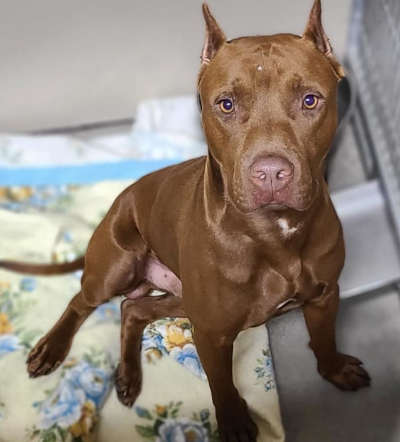
‘Bruce’
“Bruce” is a 2-year-old male pit bull terrier with a short brown coat.
He is in kennel No. 14, ID No. LCAC-A-2351.
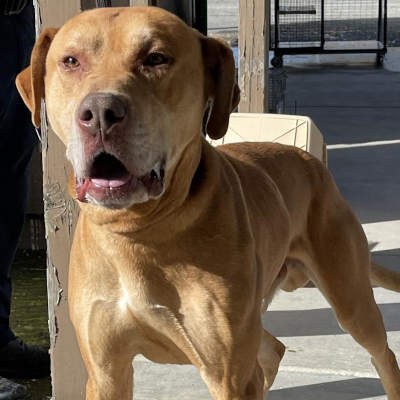
Male pit bull
This 6-year-old male pit bull mix has a short tan coat.
He is in kennel No. 17, ID No. LCAC-A-2445.
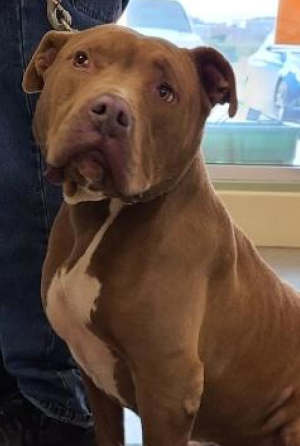
‘Chapo’
“Chapo” is a 7-year-old male pit bull with a tan coat.
He is in kennel No. 19, ID No. LCAC-A-2458.

‘Nioki’
“Nioki” is a 1-year-old female shepherd with a black coat.
She is in kennel No. 21, ID No. LCAC-A-2442.
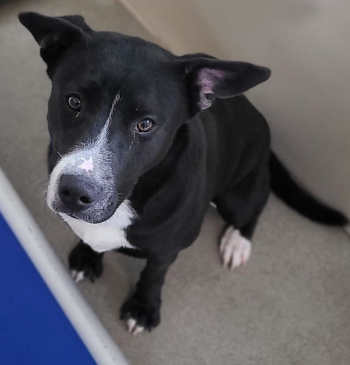
Female border collie mix
This 2-year-old female border collie mix has a black and white coat.
She is in kennel No. 23, ID No. LCAC-A-2207.

‘Nugget’
“Nugget” is a male Chihuahua mix puppy with a short tan coat.
He is in kennel No. 25b, ID No. LCAC-A-2413.

Male German shepherd
This 2-year-old male German shepherd has a black and tan coat.
He is in kennel No. 26, ID No. LCAC-A-1903.
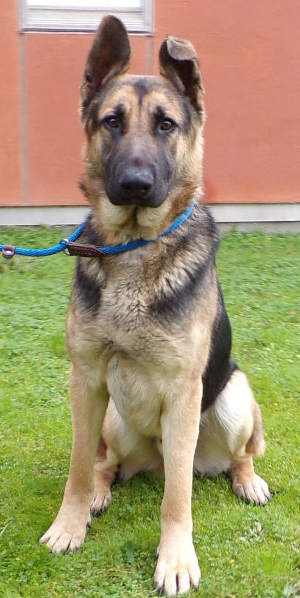
Male German shepherd
This 2-year-old male German shepherd has a black and tan coat.
He is in kennel No. 29, ID No. LCAC-A-2400.
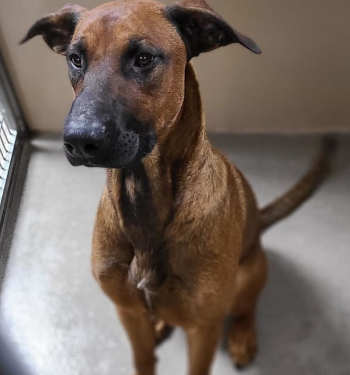
‘Duke’
“Duke is a 1-year-old male Rhodesian ridgeback with a short brown coat.
He is in kennel No. 30, ID No. LCAC-A-2219.
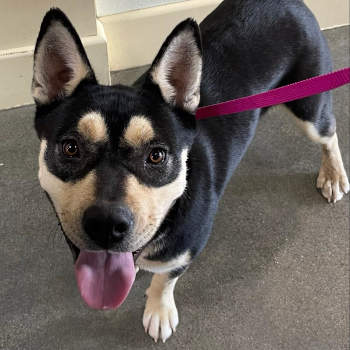
Female Akita-shepherd mix
This 1-year-old female Akita-shepherd mix has a black and tan coat.
She is in kennel No. 33, ID No. LCAC-A-2438.
Email Elizabeth Larson at