 How to resolve AdBlock issue?
News
- Details
- Written by: YERÍS MAYOL-GARCÍA
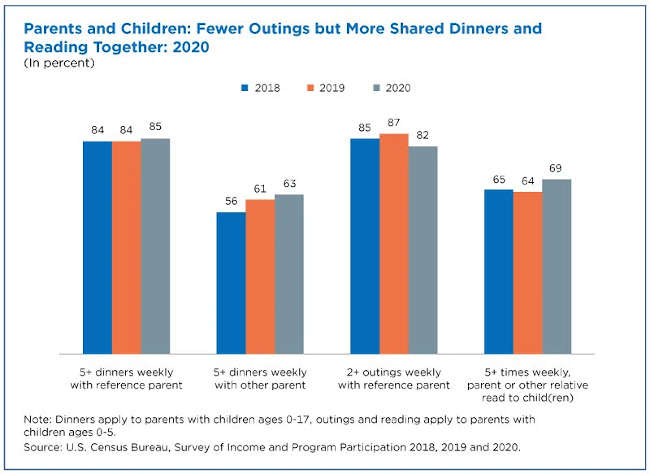
The COVID-19 pandemic upended many family dynamics but one positive consequence of this upheaval: Parents shared more dinners and read to their children more often, according to the U.S. Census Bureau’s 2020 Survey of Income and Program Participation, or SIPP.
Many families spent extra time together in spring and summer 2020, when lockdowns were in place in many parts of the United States.
Most interviews for the 2020 SIPP were conducted during March-June 2020. The data show that parental interactions with children changed from prior years: While parents shared more dinners and read to children more often in 2020, they also took them on fewer outings.
There were, however, big differences depending on parents’ socioeconomic characteristics. Frequent outings with young children dropped for most parents, but more so for parents with fewer economic resources. And parents who were married and more educated read more often to young children.
SIPP and parental involvement
The SIPP collects information on child well-being, including details on parental involvement with children.
Specifically, it asks a reference parent (usually the mother) to identify the number of times in a typical week they had dinner with their children ages 0-17 and how many times another parent (usually the spouse or cohabiting partner of the reference parent) did.
The survey also asks how many outings the reference parent or other parent took their young children ages 0-5 on and whether they or another family member read to them. All of these behaviors have been associated with improved child well-being and family dynamics. All estimates shown are at the reference-parent level at the time of interview.
In recent decades, parents have been highly engaged with children. Since 1998, at least 80% of children ate dinner with their parent often (five or more times per week). Since 2014, about 80% of children were often taken on outings by their parents (two or more times per week) and at least 48% of young children were read to by parents often (five or more times per week).
Impact of COVID-19 on parental involvement
Most likely as a result of COVID-19 lockdowns in early 2020, the proportion of parents taking their young children on outings two or more times a week dropped from 87% in 2019 to 82% in 2020. The frequency of children’s weekly outings with their other parent were not statistically different across those same years (about 67%).
In contrast, parents shared more weekly meals with children ages 0-17.
There was only a one percentage point increase in shared dinners from 2018 (84%) and 2020 (85%). But the change was statistically significant and coupled with the dip in outings, resulted in shared meals becoming the most common type of parental involvement in 2020.
The proportion of shared meals between children and their other parent, as reported by the reference parent, also rose, from 56% in 2018 to 63% in 2020.
Plus, parents or relatives read to children more often in 2020 than in prior years.
In 2020, 69% of parents reported reading to young children five or more times per week compared with 65% in 2018, and 64% in 2019.
Parent-child outings dropped in almost all socioeconomic categories
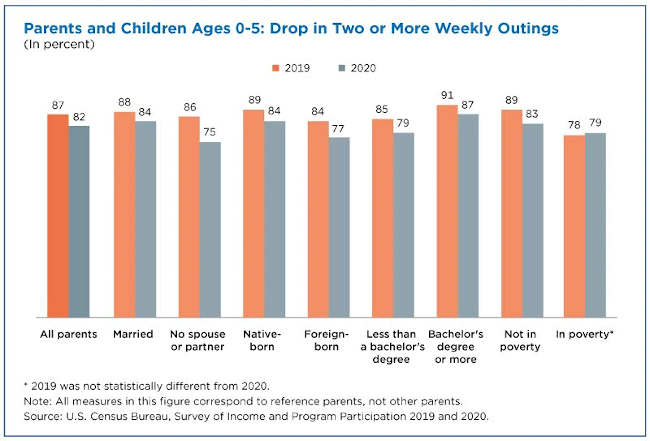
Across all but one (poverty) of the characteristics considered, the proportion of parents taking kids on frequent outings dropped four percentage points from 2019 to 2020.
Frequent parent-child outings decreased in 2020 compared with 2019 for many reasons, including shutdowns and travel bans.
Many places that families typically visit like restaurants and malls closed and travel, both domestic and foreign, was discouraged or banned during the pandemic.
Families have struggled during COVID-19. Many have had to juggle work and child care responsibilities while also facing food insufficiency and financial hardships such as job or wage loss.
For example, unemployment, stimulus and Child Tax Credit payments have been used to pay for the basics like food, rent, and paying off debt, leaving little discretionary income for outings.
Solo parents — those with no spouse or cohabiting partner present — experienced an 11 percentage point drop in frequent outings with young children: 75% reported going on two or more outings a week in 2020 compared with 86% in 2019.
Solo parents, by definition the sole parental figure living with young children, were especially hard hit during the pandemic with limited time, financial resources and support networks.
Although younger solo parents are typically more involved than older solo parents with young children, young adults experienced some of the highest levels of job loss due to the COVID-19 downturn which may have impacted their involvement with their children.
Even parents with more resources did not take their children on outings as frequently. That includes parents with more education and married parents who may alternate child care responsibilities. Frequent outings among those socio-economic groups dropped about four percentage points in 2020 compared with 2019.
Results for parents in poverty were not statistically different during the period examined (2019 and 2020), which may be due to no real changes or to nonresponse issues (described further below).
Frequent reading to children increased among advantaged parents
The share of married parents who read to young children five or more times a week increased from 68% in 2019 to 73% in 2020.
Groups who read to their young children more frequently:
• Native-born parents (66% in 2019 compared to 71% in 2020).
• Parents who were above the poverty level (66% in 2019 compared to 70% in 2020).
• Highly educated parents with a bachelor’s degree or more read to their kids frequently at a higher rate than all parents in 2020: 81% compared to 69%.
These characteristics are associated with certain advantages, like higher income, residential and family stability and white-collar jobs with flexible work schedules. That may have allowed these parents to leverage their resources to be more involved with children during the COVID-19 pandemic.
Comparisons of reading together between 2019 and 2020 were not statistically different for parents with fewer resources: poor, solo, and foreign-born parents, which may be due to no real change or to nonresponse issues described below.
However, there is plenty of evidence showing that parents with fewer resources suffered high levels of job losses.
In 2020, parents who were solo (58%), foreign-born (62%), poor (56%), or did not have a bachelor’s degree (60%) read to young children less often than all parents (69%). Still, more than half of parents with fewer resources managed to read to young children five or more times a week in 2020.
Parent characteristics impacted by nonresponse bias
The 2020 SIPP had high nonresponse rates, meaning that many people who were asked to participate in the survey did not. Additionally, there was nonresponse bias, that is, the characteristics of those who responded were different than those who did not respond.
Consequently, reference parents who reported on their involvement with children in SIPP were more likely to be older, foreign-born, married, more educated, and above the poverty level than in the two prior years.
The proportions of parents who were foreign-born or married were not statistically different between 2019 and 2020, but the 2019 SIPP also experienced higher nonresponse rates due to the 2018-2019 lapse in federal funding that stopped operations and other factors.
The results discussed in this story may have been impacted by nonresponse.
The Survey of Income and Program Participation is a nationally representative longitudinal survey administered by the U.S. Census Bureau that provides comprehensive information on the dynamics of income, employment, household composition and government program participation.
The estimates presented here are subject to sampling and nonsampling error.
Yeris Mayol-Garcia is a survey statistician in the Census Bureau’s Social, Economic, and Housing Statistics Division.
- Details
- Written by: LAKE COUNTY NEWS REPORTS
CDPH said its universal masking for indoor settings, which began on Dec. 15, will now be extended from its original sunset of Jan. 15 to Feb. 15.
The state is requiring masks for all individuals in all indoor public settings, regardless of vaccination status.
Surgical masks or higher-level respirators — such as N95s, KN95s and KF94s — with good fit are recommended.
The agency, citing studies that support the effectiveness of masking, said the measure is meant to protect against serious disease, hospitalizations and death, and an effort to keep schools open.
“This measure brings an added layer of mitigation as the Omicron variant, a Variant of Concern as labeled by the World Health Organization, continues to increase in prevalence across California, the United States, and the world and spreads much more easily than the original SARS-CoV-2 virus and the Delta variant,” the updated guidance explains.
Those who remain exempt from wearing masks at all times include children under age 2; individuals with a medical condition, mental health condition, or disability that prevents wearing a mask; persons who are hearing impaired, or communicating with a person who is hearing impaired, where the ability to see the mouth is essential for communication; and those for whom wearing a mask would create a risk to them related to their work.
CDPH reported that over the last two weeks, the statewide seven-day average case rate has increased by more than sixfold and hospitalizations have doubled.
“While the percentage of Californians fully vaccinated and boosted continues to increase, we continue to have areas of the state where vaccine coverage is low, putting individuals and communities at greater risk for COVID-19,” the updated guidance said.
“Given the current hospital census, which is over capacity, the surge in cases and hospitalizations has materially impacted California's health care delivery system within many regions of the state. Staffing levels are also increasingly impacted by COVID-19 transmission in many critical sectors,” the guidance also noted.
- Details
- Written by: Elizabeth Larson
LAKE COUNTY, Calif. — The Lakeport City Council on Tuesday night directed City Manager Kevin Ingram to begin negotiating a 30-year lease with Westside Community Park, which proposes to develop a new horse park on a city-owned property.
The unanimous vote to support the new horse park property lease came toward the end of the council’s first meeting of the year, which ran nearly three hours.
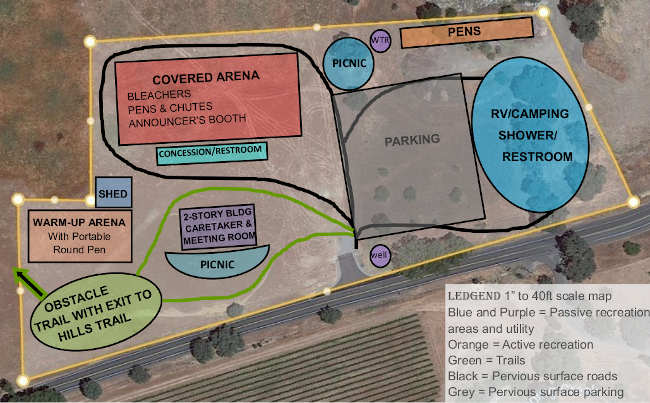
The Westside Community Park Committee is proposing to use a 7.5-acre site on City of Lakeport Municipal Sewer District property, located on Highway 175 at Mathews Road, for the new horse park.
The lease is contingent on the park’s committee receiving a $3 million state Proposition 68 grant. Ingram said the grant requires such a lease agreement for approval. The city also will offer the state a letter of support for the project.
Ingram said he was excited to present the proposal, explaining that the project’s partners have worked very hard over the past year to put together the extensive grant to develop the community equestrian facility.
He said Westside Community Park’s original phase three called for an equestrian facility to be developed there. However, after years of design and other practical challenges, it was decided that the City of Lakeport Municipal Sewer District, or CLMSD, site was more preferable, which Ingram said allows the main park’s third phase to be available for other uses.
The park committee and city have been working through the logistics over the last few years, including receiving a Caltrans-approved encroachment off Highway 175 near Mathews Road, which Ingram said was no easy feat.
Ingram said the park committee and equestrian committee have been holding meetings and working on the grant submission. He said it’s a very similar grant program to the one that awarded the city nearly $6 million for its new Lakeside Park development.
The lease designates the city as the property owner and the park committee as the operator, Ingram said.
He said the site also needs to be reviewed for its size. While it’s stated as seven and a half acres, it may be closer to nine acres.
The project, as proposed, includes a 150-foot by 328-foot covered arena with bleachers and an announcer’s booth, a 30-foot by 45-foot warmup arena with a portable round pen, an obstacle course, a meeting room, tractor shed, caretaker unit, picnic areas and parking, and room for overnight camping.
The committee also is seeking an easement to provide access to hill areas for horse trail development, Ingram said.
The CLMSD property is primarily used for wastewater treatment and a large part of it has sprinklers installed to distribute the wastewater. Ingram said that while it’s owned by the city, a portion of the land is within the county’s unincorporated area.
The land is zoned as open space under the county’s zoning ordinance, and most of the uses proposed for the horse park are uses by right. However, Ingram said the committee may need to get land use entitlements from the county for other uses.
Ingram said Utilities Superintendent Paul Harris has reviewed the proposal carefully to make sure the city can expand its operations for the sewer facility if necessary. The horse park site isn’t the best for the placement of sprinklers.
For the horse park, however, it’s a very good location. “I think this is a great fit,” Ingram said.
“We’re very hopeful that they're able to secure this grant,” Ingram added.
Even if they don’t, Ingram said the park committee has taken some huge steps forward on the project.
Westside Community Park Committee Chair Dennis Rollins and committee member Carol Maxwell were on hand in the chambers Tuesday night to answer questions.
Rollins, who has offered key leadership for the Westside Community Park’s development, credited Maxwell for doing the lion’s share of the grant work.
He said one of the questions in the grant application is whether the committee is able to carry out the project.
“We’ve been fairly successful” in what we’ve tried to do,” Rollins said. “I think we can pull this off if we get the grant.”
Mayor Stacey Mattina called the project “very exciting.”
Maxwell said people who have nothing to do with horses can also enjoy the horse park. “I think it will be a real addition.”
She said she couldn’t believe the beautiful views from the ridge on the property when scouting trails, adding it’s a tremendous thing to make it open to the public to enjoy.
“It is a really beautiful property,” said Councilman Michael Froio, noting he admires it every time he drives through that area. “Keeping that open for the public is quite a public treasure. I applaud your hard work.”
Councilman Kenny Parlet said it’s important to support both dog and horse people, noting they are an integral part of society and strong proponents of outdoor recreation.
“This is a wonderful project,” he said, noting the perfect location. “This would be a real feather in our cap in Lakeport if we could pull this off.”
Parlet added, “We are poised to do something really, really big here,” and praised Rollins for his efforts. “With Dennis behind the wheel, I don’t think we can fail.”
Councilman Michael Green asked if land use entitlements would be necessary if the site becomes an overnight venue with accommodations.
Rollins said the county said that without major events, the committee could probably just have a minor use permit.
That prompted Green to ask if they anticipated occasional special or larger events, which would be logical. Rollins said they would apply for a major use permit at the time of seeking county permits.
Councilwoman Mireya Turner voted to direct Ingram to negotiate the lease, contingent on approval of the grant, with Parlet seconded and the council approved 5-0.
“Good luck you guys, keep us posted,” said Mattina.
Rollins said the grant application is due Jan. 20 and a state official has told him they are not likely to be notified until sometime between July and the fall.
The council also held a public hearing to introduce city code updates to be in compliance with new state laws regarding recycling and water efficient landscaping; held a discussion on outdoor dining in the right of way that has been allowed to help restaurants during the pandemic; approved the purchase of three generators for city water treatment facilities the amount of $186,994.54; approved Mattina’s appointments of council members as liaisons to various boards, committees and commissions; adopted a resolution appointing council members to represent and vote on behalf of the City at the League of California Cities, Redwood Empire Division Business meetings and represent the city and vote at Division Legislative Committee meetings; received an update on the city’s communications strategic plan; and approved a resolution to assign a new 12th seat to the Lakeport Economic Advisory Committee, with that seat to be assigned to Sutter Lakeside Hospital.
Email Elizabeth Larson at
- Details
- Written by: Elizabeth Larson

LAKE COUNTY, Calif. — The Board of Supervisors held its first meeting of the new year on Tuesday, electing the chair and vice chair for 2022.
All board members were present in the chambers for Tuesday’s meeting, sitting together, masked, on the dais.
After taking public comment, the board turned to the election of its leadership.
Outgoing Chair Bruno Sabatier thanked the board for the opportunity to be the chair for 2021. “It was definitely an honor.”
He passed the gavel to Supervisor Moke Simon and then nominated EJ Crandell for chair and Tina Scott for vice chair.
Sabatier said he had been humbled by the opportunity to serve as chair and was humbled to pass on the opportunity.
The board voted unanimously to support Sabatier’s motion.
The supervisors took a brief break for the new leadership to switch seats before continuing business.
Crandell represents District 3, which covers the Northshore. Scott’s District 4 covers the Lakeport area.
Board members then went on to elect Crandell and Scottt as chair and vice chair, respectively, of the Lake County Board of Equalization and the Lake County In-Home Supportive Services Public Authority Board of Directors.
The supervisors’ other business on Tuesday included deciding committee assignments and advisory board appointments, and receiving a presentation by Graham Knaus, California State Association of Counties executive director.
Following the meeting, the County Administrative Office released a statement from Crandell on his appointment.
“It is a great honor to have the opportunity to serve as chair of the Lake County Board of Supervisors. I look forward to continuing to build consensus surrounding complex issues, and will seek to listen effectively, and ensure key stakeholders have a voice in matters before our Board. Goals and priorities for our county government, as a whole, are driven by Vision 2028. As chair, I will work to ensure progress is made in those defined areas of priority,” he said.
“The lens that focuses all of our work as a board is seeking to promote the well-being of every Lake County resident. I look forward to being a part of Community Visioning Forums promoting tolerance, respect, equity and inclusion this year, for example, and seeing us make real progress in celebrating our county’s diverse communities, including the rich history of our seven tribal nations,” said Crandell, who is himself a member of the Robinson Rancheria Band of Pomo Indians.
“I will also continue to listen to and promote the needs of District 3 residents, specifically; it is a privilege to give voice to the concerns and needs of my neighbors,” he continued.
Crandell concluded, “This is an exciting time to be in Lake County. We are building, and making investments that will resonate for generations. Together, we can continue the upward trend, and I look forward to leading further efforts to strengthen Lake County, now and for the future.”
Email Elizabeth Larson at