 How to resolve AdBlock issue?
News
- Details
- Written by: GOVERNOR’S OFFICE

On the final day of Women’s History Month, acting Gov. Eleni Kounalakis on Thursday signed legislation that extends eviction protections for Californians participating in rental assistance programs, making her the first woman in California’s history to sign a piece of legislation into law.
"California’s nation-leading rent relief program has provided much needed relief for more than 220,000 households across the state. Today’s action will provide additional time to thousands more who are in the process of acquiring emergency relief,” said Kounalakis. “I am deeply humbled to take this action and to be part of history today as the first woman in state history to sign legislation into law. I remain more determined than ever to ensure that while I may be the first to do so, I will certainly not be the last.”
AB 2179 by Assemblymember Tim Grayson (D-Concord) and Assemblymember Buffy Wicks (D-Oakland) extends eviction protections through June 30, 2022, to help ensure housing stability for eligible tenants who apply for assistance from state or local rental assistance programs by March 31, 2022.
“California is leading the nation's economic recovery from the pandemic, and we’re committed to ensuring all of our communities can access the supports they need to get back on their feet,” said Gov. Gavin Newsom on Thursday. “Today’s action preserves important protections so that struggling families can keep a roof over their heads as the state works to provide critical assistance to thousands of households across California.”
Kounalakis was joined Thursday by Senate President pro Tempore Toni G. Atkins, Assembly Speaker Anthony Rendon, Assemblymembers Grayson and Wicks, Sen. Josh Becker and Assemblymember Blanca Rubio.
California’s $5.5 billion COVID-19 Rent Relief program is the largest statewide renter assistance program in the country and covers 100% of past-due rent payments for qualified low-income Californians.
The state program has to date assisted more than 220,000 low-income households, with thousands of additional households assisted by local rent relief programs.
Under the state program, tenants can access rental funds directly if their landlord chooses not to participate, and landlords can receive compensation even if their otherwise income-qualified tenants have already vacated a unit.
Additional program information is available at the Housing Is Key website.
Kounalakis on Thursday also signed SB 504 by Sen. Josh Becker (D-Menlo Park), which will allow military and overseas voters and voters with disabilities to complete a same day voter registration and cast a ballot.
Additionally, it provides the secretary of state more accurate voter rolls and streamlines the process for the state’s universal vote by mail system by removing a number of unnecessary provisions.
For full text of the bills, visit http://leginfo.legislature.ca.gov.
- Details
- Written by: Elizabeth Larson
The City of Clearlake Animal Association also is seeking fosters for the animals waiting to be adopted.
Call the Clearlake Animal Control shelter at 707-273-9440, or email
Visit Clearlake Animal Control on Facebook or on the city’s website.
The following dogs are available for adoption.

‘Pooh Bear’
“Pooh Bear” is a 1-year-old male American pit bull mix with a copper and white coat.
He has been neutered.
He is dog No. 49603144.

‘Scrappy’
“Scrappy” is an 11-month-old male American pit bull mix with a short cream-colored coat.
He has been neutered.
He is dog No. 49603144.

‘Andy’
“Andy” is a male American pit bull mix with a short gray and white coat.
He is dog No. 48995415.

‘Bear’
“Bear” is a male Labrador retriever-American pit bull mix with a short charcoal and fawn coat.
He has been neutered.
He is dog No. 48443153.

‘Chai’
“Chai” is a female Alaskan husky mix with a gray and white coat.
She has been spayed.
She is dog No. 49279552.

‘Ebenezer’
“Ebenezer” is a male American pit bull terrier mix with a short tan and white coat.
He is dog No. 49191651.

‘Fritz’
“Fritz” is a male Australian shepherd mix with a black and white coat.
He is dog No. 49278179.

‘Snowball’
“Snowball” is a male American Staffordshire mix terrier with a white coat.
He has been neutered.
He is dog No. 49159168.

‘Terry’
“Terry” is a male shepherd mix with a short brindle coat.
He is dog No. 48443693.
Email Elizabeth Larson at
- Details
- Written by: Scott L. Montgomery, University of Washington

The Biden administration on March 31, 2022, said it plans to release an unprecedented 180 million barrels of oil from the U.S. Strategic Petroleum Reserve to combat the recent spike in gas and diesel prices. About a million barrels of oil will be released every day for up to six months.
If all the oil is released, it would represent almost one-third of the current volume of the Strategic Petroleum Reserve. It follows a release of 30 million barrels in early March, a large withdrawal until the latest one.
But what is the Strategic Petroleum Reserve, why was it created, and when has it been used? And does it still serve a purpose, given that the U.S. exports more oil and other petroleum products than it imports?
As an energy researcher, I believe considering the reserve’s history can help answer these questions.
Origins of the reserve
Congress created the Strategic Petroleum Reserve as part of the Energy Policy and Conservation Act of 1975 in response to a global oil crisis.
Arab oil-exporting states led by Saudi Arabia had cut supply to the world market because of Western support for Israel in the 1973 Yom Kippur War. Oil prices quadrupled, resulting in major economic damage to the U.S. and other countries. This also shook the average American, who had grown used to cheap oil.
The oil crisis caused the U.S., Japan and 15 other advanced countries to form the International Energy Agency in 1974 to recommend policies that would forestall such events in the future. One of the agency’s key ideas was to create emergency petroleum reserves that could be drawn on in case of a severe supply disruption.
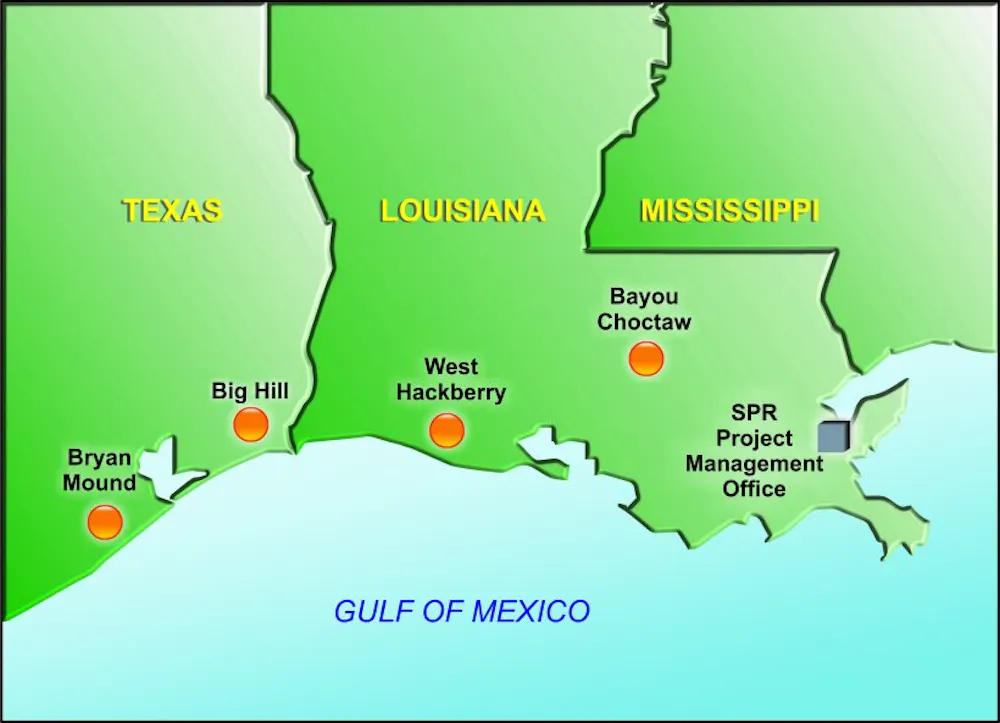
The Energy Policy and Conservation Act originally stipulated the reserve should hold up to 1 billion barrels of crude and refined petroleum products. Though it has never reached that size, the U.S. reserve is the largest in the world, with a maximum volume of 714 million barrels. The cap was previously set at 727 million barrels.
As of March 25, 2022, the reserve contained about 568 million barrels.
Oil in the reserve is stored underground in a series of large underground salt domes in four locations along the Gulf Coast of Texas and Louisiana, and is linked to major supply pipelines in the region.
Salt domes, formed when a mass of salt is forced upward, are a good choice for storage since salt is impermeable and has low solubility in crude oil. Most of the storage sites were acquired by the federal government in 1977 and became fully operational in the 1980s.
History of drawdowns
In the 1975 act, Congress specified that the reserve was intended to prevent “severe supply interruptions” – that is, actual oil shortages.
Over time, as the oil market has changed, Congress expanded the list of reasons for which the Strategic Petroleum Reserve could be tapped, such as domestic supply interruptions due to extreme weather.
Prior to March 2022, about 280 million barrels of crude oil had been released since the reserve’s creation, including a 50 million release that began in November 2021.
There have only been three emergency releases in the reserve’s history. The first was in 1991 after Iraq invaded Kuwait the year before, which resulted in a sharp drop in oil supply to the world market. The U.S. released 34 million barrels.
The second release, of 30 million barrels, came in 2005 after Hurricanes Rita and Katrina knocked out Gulf of Mexico production, which then comprised about 25% of U.S. domestic supply.
The third was a coordinated release by the International Energy Agency in 2011 as a result of supply disruptions from several oil-producing countries, including Libya, then facing civil unrest during the Arab Spring. In all, the agency coordinated a release of 60 million barrels of crude, half of which came from the U.S.
In addition, there have been 11 planned sales of oil from the reserve, mainly to generate federal revenue. One of these – the 1996-1997 sale to reduce the federal budget deficit – seemed to serve political ends rather than supply-related ones.
A better way to avoid pain at the pump
President Joe Biden’s November decision to tap the reserve was also seen as political by Republicans because there was no emergency shortage of supply at that time.
Similarly, the latest historic release of 180 million barrels could also be seen as serving a political purpose – in an election year, no less. But I believe it also seems perfectly legitimate in terms of fulfilling the Strategic Petroleum Reserve’s original purpose: reducing the negative impacts of a major oil price shock.
Though the U.S. is today a net petroleum exporter, it continues to import as much as 8.2 million barrels of crude oil every day.
[Over 150,000 readers rely on The Conversation’s newsletters to understand the world. Sign up today.]
But in my view, the best way to avoid the pain of oil price shocks is to lower oil demand by reducing global carbon emissions – rather than mainly relying on releases from the reserve.
This is an updated version of an article originally published on Nov. 24, 2021.
Scott L. Montgomery, Lecturer, Jackson School of International Studies, University of Washington
This article is republished from The Conversation under a Creative Commons license. Read the original article.
- Details
- Written by: Elizabeth Larson
During a special Wednesday morning meeting, the Lake Local Agency Formation Commission, or LAFCo, voted unanimously to set a protest hearing on the proposed annexation, which covers about 137 acres and 50 parcels south of the city limits.
LAFCo Chief Executive Officer John Benoit told Lake County News after the meeting that he expects the protest hearing will take place in about a month, with no firm date yet set.
Lakeport has been working for decades to prepare for the annexation, which includes the most lucrative commercial corridor in the unincorporated county that has long been within its sphere of influence.
City and fire officials have argued that annexing the area will allow for the efficient delivery of services, including water, which Lakeport Fire Chief Jeff Thomas emphasized on March 16 is critical because of the significant hazardous material issues along that corridor.
Earlier this year, the city and county of Lake reached a tax sharing agreement that cleared the way for the proposal to move forward.
The annexation appeared on track to be approved at LAFCo’s regular March 16 meeting. However, a written protest submitted by business owner Justin Ratcliffe led to questions about whether a protest proceeding could be avoided by simply eliminating Ratcliffe’s property from the annexation area. That led to the scheduling of Wednesday's special meeting.
LAFCo received one additional written protest since the March 16 meeting, Benoit said Wednesday.
Counsel Scott Browne took the last two weeks to analyze the options for moving forward if the city chose to remove Ratcliffe’s property at 53 Soda Bay Road and proceed with approving the annexation.
For his part, Benoit said the public hearing notices had been sent out according to procedure and they had only received one protest, referring to Ratcliffe’s.
His recommendation was the same as it was at the meeting two weeks ago — to approve the annexations subject to certain terms and conditions.
Browne explained that the law governing annexations, the Cortese Knox Hertzberg Act of 2000, isn’t clear about the question before LAFCo, regarding excluding territory before a final resolution is approved. He said it’s very clear applications can be amended to add or exclude territory.
It was his conclusion that by removing Ratcliffe’s property from the annexation area, it would waive the objection to the annexation since he got what he wanted by not being included.
However, Browne added, “There’s no clear law on this.”
In the absence of clear law, Browne suggested the commissioners could approve going back and starting a new notice and hearing process to see if there are any new protests.
“That would be the bulletproof way of doing it, but I don’t think it’s necessary,” he said.
Lakeport area Supervisor Tina Scott asked the commission to reopen the public hearing to give people a chance to comment.
Commission Chair and District 2 Supervisor Bruno Sabatier also questioned the process and whether LAFCo could simply waive protests by just removing specific properties. He believed the right thing to do was to go forward with the protest hearing process, citing sections of state law.
Browne said Sabatier’s questions were good ones, noting that sections of the law Sabatier referred to were specifically about changing an adopted resolution, not changing it ahead of acceptance.
“So those provisions do not apply to this particular situation,” Browne said. “Nevertheless, the issue is unclear.”
County Counsel Anita Grant said that when items are unclear, she usually urges moving forward with abundant caution.
“I will say that there is also a very clear procedural track for these to take,” she said, pointing to the importance state statute gives to property owners’ ability to protest.
She said she’d never seen a response like the one proposed in this case, which she said seemed to be inconsistent with protest hearings.
“I think the timing of this may give one pause,” she said.
Lakeport City Manager Kevin Ingram said the city was OK with removing Ratcliffe’s property as proposed and moving ahead. However, if the protest process occurred, they wanted the property to stay in.
Ratcliffe told the commission he wanted to keep his protest active, and said he did not feel there was sufficient notice. He said 90% of property owners were unaware that the meeting was their last chance to formally protest.
Benoit said there is a provision in LAFCo code that a process can’t be set aside if people haven’t read the meeting notices. He questioned why Ratcliffe was at the meeting if he didn’t receive a notice.
Commissioner and Lakeport Mayor Stacey Mattina thanked Browne for taking the extra time to clarify the matter. “This has been a really complicated process.”
She said the city’s application meets LAFCo’s policies and offers efficient delivery of public services and the need for fire protection, and eliminates public health and safety threats.
Mattina suggested it was the most important decision the commission has had in 10 years. She then moved to offer the resolution to approve the annexation, amending the original resolution to remove Ratcliffe’s property. Commissioner Ed Robey seconded the motion.
Property owners argue against annexation
Benoit said the public hearing was closed so Sabatier instead opened public comment, after which Mattina called the motion.
The commission then heard from six community members and property owners — including Ratcliffe — who said they opposed the annexation.
“I feel like this was a railroad that actually goes back quite a few years,” said P.J. Racine, whose late father, Paul Racine, had opposed the annexation and conducted a survey that found that 79% of property owners didn’t support it.
Paul Racine died two years ago, and P.J. Racine said he felt the city was railroading it through now that there was no one to head the opposition.
Both Sabatier and Robey responded that the matter had been discussed for years.
Property owner Kathleen Miller also spoke against the annexation. She was at the meeting on March 16 and had handed in a written protest after the public hearing had closed, and so it was not counted. She said she also hadn’t gotten a notice about the meeting and had only heard about it through word of mouth.
Ingram said the city has done outreach through letters, a special community meeting, a newspaper notice and social media postings. He said the process has been ongoing for a long time.
Mattina said the protest vote process is convoluted and not an opportunity for everyone in the public to vote. “I don’t think everyone realizes that.”
“It’s definitely a unique process,” said Sabatier.
With the number of additional objections offered on Wednesday, Browne suggested the circumstances had changed and LAFCo was no longer in a position to waive protest proceedings.
Commissioner and Clearlake Mayor Dirk Slooten agreed with Browne, saying it was obvious that some community members either didn’t receive the notice or didn’t understand it. “We have to be on solid legal ground to move on with these procedures.”
Slooten said he wasn’t against the annexation, but wanted to make sure the commission was on legally solid ground to move forward.
After Mattina asked for a 10-minute break, the commission returned to settle on its course of action.
Benoit said they could do the protest proceeding or a new notice and start over. Since he believed adequate noticing had been done, he suggested pursuing the protest hearing.
Mattina withdrew her original motion and offered the resolution to approve the annexation subject to the terms and conditions of the protest hearing process, with Robey seconding.
Commissioner and county Supervisor Moke Simon said for community members to be looking for the protest proceeding notices. “Be aware, it is coming.”
The commission voted unanimously to approve the resolution.
Benoit said a brief summary of the process will be mailed out, an eight-page notice will be put in the newspaper and people will have an opportunity to provide a written protest or to appear in person at the proceeding when it’s scheduled in the next month.
LAFCo will then evaluate the value of the protest and decide whether or not it would go to an election, Benoit said.
Email Elizabeth Larson at