How to resolve AdBlock issue?
News
- Details
- Written by: Elizabeth Larson
Dogs available for adoption this week include mixes of Australian cattle dog, Australian Kelpie, border collie, boxer, German shepherd, husky, shepherd and pit bull.
Dogs that are adopted from Lake County Animal Care and Control are either neutered or spayed, microchipped and, if old enough, given a rabies shot and county license before being released to their new owner. License fees do not apply to residents of the cities of Lakeport or Clearlake.
The following dogs at the Lake County Animal Care and Control shelter have been cleared for adoption.
Call Lake County Animal Care and Control at 707-263-0278 or visit the shelter online for information on visiting or adopting.

Male cattle dog
This 3-year-old male cattle dog has a short black coat with white markings.
He is in kennel No. 6, ID No. LCAC-A-3228.

Male pit bull terrier
This 1-year-old male pit bull terrier has a short white and tan coat.
He is in kennel No. 7, ID No. LCAC-A-2821.

Female pit bull puppy
This female pit bull puppy has a short black coat with white markings.
She is in kennel No. 9a, ID No. LCAC-A-3232.

Female pit bull puppy
This female pit bull puppy has a short tan coat with white markings.
She is in kennel No. 9b, ID No. LCAC-A-3233.

‘Cleo’
“Cleo” is a 1-year-old female boxer mix with a short black and white coat.
She is in kennel No. 12, ID No. LCAC-A-3110.

Australian cattle dog
This 3-year-old male Australian cattle dog has a black coat with tan markings.
He is in kennel No. 16, ID No. LCAC-A-3131.

Male border collie
This young male border collie has a short black and white coat.
He is in kennel No. 17, ID No. LCAC-A-3207.

‘Max’
“Max” is a 4-year-old male Australian Kelpie mix with a black and tan coat with white markings.
She is in kennel No. 18, ID No. LCAC-A-2852.

Female German shepherd
This 2-year-old female German shepherd has a black coat.
She is in kennel No. 19, ID No. LCAC-A-2844.

Female shepherd mix
This 1-year-old female shepherd mix has a short tricolor coat.
She is in kennel No. 20, ID No. LCAC-A-2843.

‘Kimber’
“Kimber” is a 1-year-old female pit bull terrier with a short red and white coat.
She is in kennel No. 22, ID No. LCAC-A-2957.

‘Barney’
“Barney” is a 3-year-old male retriever with a brown and black coat with white markings.
He is in kennel No. 23, ID No. LCAC-A-2856.

Male pit bull mix
This 3-year-old pit bull mix has a short tan and white coat.
He is in kennel No. 24, ID No. LCAC-A-2948.

‘Blue’
“Blue” is a 4-year-old female husky with a gray and white coat, and blue eyes.
She is in kennel No. 25, ID No. LCAC-A-2816.

Male Doberman pinscher mix pup
This male Doberman pinscher mix puppy has a short tan coat.
He is in kennel No. 31, ID No. LCAC-A-3210.

‘King’
“King” is a 1-year-old American bulldog with a short brown and white coat.
He is in kennel No. 32, ID No. 3109.

Female pit bull terrier
This 2-year-old female pit bull terrier has a short black and white coat.
She is in kennel No. 33, ID No. LCAC-A-3085.

Male Australian cattle dog
This 3-year-old male Australian cattle dog has a short black, tan and white coat.
He is in kennel No. 34, ID No. LCAC-A-3130.
Email Elizabeth Larson at
- Details
- Written by: NATIONAL AERONAUTICS AND SPACE ADMINISTRATION
NASA’s Hubble Space Telescope has established an extraordinary new bench mark: detecting the light of a star that existed within the first billion years after the universe’s birth in the big bang — the farthest individual star ever seen to date.
The find is a huge leap further back in time from the previous single-star record holder; detected by Hubble in 2018. That star existed when the universe was about 4 billion years old, or 30 percent of its current age, at a time that astronomers refer to as “redshift 1.5.”
Scientists use the word “redshift” because as the universe expands, light from distant objects is stretched or “shifted” to longer, redder wavelengths as it travels toward us.
The newly detected star is so far away that its light has taken 12.9 billion years to reach Earth, appearing to us as it did when the universe was only 7 percent of its current age, at redshift 6.2. The smallest objects previously seen at such a great distance are clusters of stars, embedded inside early galaxies.
“We almost didn’t believe it at first, it was so much farther than the previous most-distant, highest redshift star,” said astronomer Brian Welch of the Johns Hopkins University in Baltimore, lead author of the paper describing the discovery, which is published in the March 30 journal Nature. The discovery was made from data collected during Hubble’s RELICS (Reionization Lensing Cluster Survey) program, led by co-author Dan Coe at the Space Telescope Science Institute, or STScI, also in Baltimore.
“Normally at these distances, entire galaxies look like small smudges, with the light from millions of stars blending together,” said Welch. “The galaxy hosting this star has been magnified and distorted by gravitational lensing into a long crescent that we named the Sunrise Arc.”
After studying the galaxy in detail, Welch determined that one feature is an extremely magnified star that he called Earendel, which means “morning star” in Old English. The discovery holds promise for opening up an uncharted era of very early star formation.
“Earendel existed so long ago that it may not have had all the same raw materials as the stars around us today,” Welch explained. “Studying Earendel will be a window into an era of the universe that we are unfamiliar with, but that led to everything we do know. It’s like we’ve been reading a really interesting book, but we started with the second chapter, and now we will have a chance to see how it all got started,” Welch said.
When stars align
The research team estimates that Earendel is at least 50 times the mass of our Sun and millions of times as bright, rivaling the most massive stars known.
But even such a brilliant, very high-mass star would be impossible to see at such a great distance without the aid of natural magnification by a huge galaxy cluster, WHL0137-08, sitting between us and Earendel.
The mass of the galaxy cluster warps the fabric of space, creating a powerful natural magnifying glass that distorts and greatly amplifies the light from distant objects behind it.
Thanks to the rare alignment with the magnifying galaxy cluster, the star Earendel appears directly on, or extremely close to, a ripple in the fabric of space.
This ripple, which is defined in optics as a “caustic,” provides maximum magnification and brightening. The effect is analogous to the rippled surface of a swimming pool creating patterns of bright light on the bottom of the pool on a sunny day. The ripples on the surface act as lenses and focus sunlight to maximum brightness on the pool floor.
This caustic causes the star Earendel to pop out from the general glow of its home galaxy. Its brightness is magnified a thousandfold or more. At this point, astronomers are not able to determine if Earendel is a binary star, though most massive stars have at least one smaller companion star.
Confirmation with Webb
Astronomers expect that Earendel will remain highly magnified for years to come. It will be observed by NASA’s James Webb Space Telescope. Webb’s high sensitivity to infrared light is needed to learn more about Earendel, because its light is stretched (redshifted) to longer infrared wavelengths due to the universe’s expansion.
“With Webb we expect to confirm Earendel is indeed a star, as well as measure its brightness and temperature,” Coe said. These details will narrow down its type and stage in the stellar life cycle. "We also expect to find the Sunrise Arc galaxy is lacking in heavy elements that form in subsequent generations of stars. This would suggest Earendel is a rare, massive metal-poor star,” Coe said.
Earendel’s composition will be of great interest for astronomers, because it formed before the universe was filled with the heavy elements produced by successive generations of massive stars.
If follow-up studies find that Earendel is only made up of primordial hydrogen and helium, it would be the first evidence for the legendary Population III stars, which are hypothesized to be the very first stars born after the big bang. While the probability is small, Welch admits it is enticing all the same.
“With Webb, we may see stars even farther than Earendel, which would be incredibly exciting,” Welch said. “We’ll go as far back as we can. I would love to see Webb break Earendel’s distance record.”
The Hubble Space Telescope is a project of international cooperation between NASA and the European Space Agency. NASA’s Goddard Space Flight Center in Greenbelt, Maryland, manages the telescope. The Space Telescope Science Institute, or STScI, in Baltimore, Maryland, conducts Hubble science operations. STScI is operated for NASA by the Association of Universities for Research in Astronomy in Washington, D.C.
- Details
- Written by: Lake County Office of Education

MIDDLETOWN, Calif. — What does it mean to have the "Best Day Ever"?
Over 100 participants came together to find out at the Lake County Quality Care Counts, or LCQC, conference on March 19 at Twin Pine Casino in Middletown.
The Lake County Office of Education’s LCQC is a program that improves the quality of early learning for children ages zero through five by providing professional development, supplies and coaching to early childhood providers
"LCQC hosts this conference every year to provide inspiration, new ideas and high-quality professional development that early educators can use in their classrooms," said LCQC Director Angela Cuellar-Marroquin.
The conference succeeded in bringing together early childhood educators from across Northern California to participate and leave with new knowledge and passion for continuing their work.
“Optimizing the early years of children’s lives is the best investment we can make in our community to ensure their future success,” Lake County Superintendent of Schools Brock Falkenberg said.
The first presenter, Sharron Krull, gave a keynote about incorporating art with science. Krull is an early childhood consultant through her company, Play Power. She is a veteran preschool teacher with over 45 years’ experience that encompasses nearly all areas of early childhood education.
Steve Spangler finished the day with an inspiring and interactive keynote. Spangler is an Emmy award-winning television host, science communicator, and celebrity educator.
During his high-energy presentation, he covered that the "Best Day Ever" is more than just a feeling or an emotion. It is a powerful principle that helps people connect, engage and share experiences with each other.
Participants gave the conference high marks.
“Best training I’ve been to. Truly. After the last two years … feeling a smidge burnt out and bogged down,” said Jacqui Joyce of Miss Jacqui’s Childcare. “This training completely reminded me why I do what I do. Got me excited for Monday, and who gets excited for Mondays!?"
"I am beyond grateful for today’s conference. The inspiration I left with today, is going right back into my classroom on Monday,” said Jacklyn Edwards, a teacher at Pomo Elementary in the Konocti Unified School District.
"I had so much fun I almost cried when it was over. Shooting toilet paper out of a leaf blower was just way too much fun. The excitement of the whole day was truly the "Best Day Ever,” said Jody Mederos of the North Coast Opportunities Head Start program.
Learn more about LCQC by visiting the Lake County Office of Education website at www.lakecoe.org/LCQC.
- Details
- Written by: California Department of Water Resources
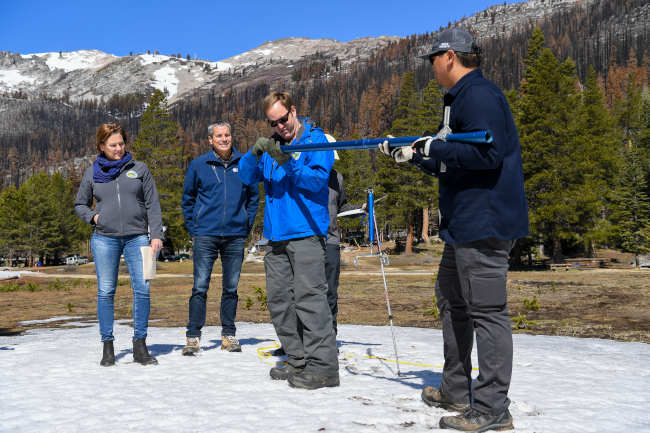
NORTHERN CALIFORNIA — California’s snowpack is continuing to dwindle after months of dry weather.
The Department of Water Resources on Friday conducted the fourth snow survey of the season at Phillips Station.
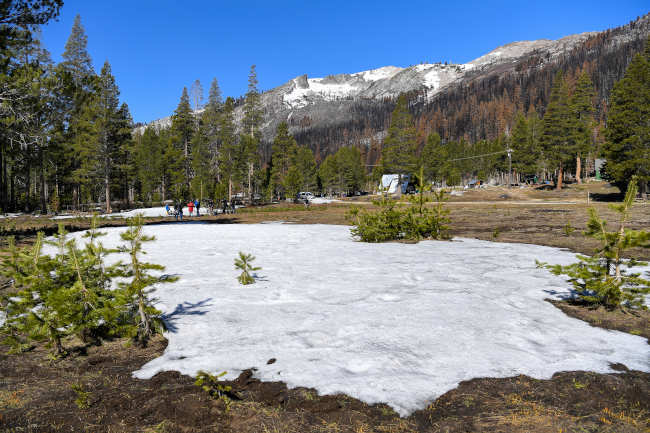
Following three straight months of record dry conditions, the manual survey recorded just 2.5 inches of snow depth and a snow water equivalent of one inch, which is four percent of average for this location for April 1.
Statewide, the snowpack is just 38% of average for this date.
The snowpack at Phillips Station has plummeted since the beginning of the year, officials said.
On Dec. 30, the snowpack stood at 202% of normal for that date. In a normal season, the snowpack depth would be about five feet deep at this time of year.
The snow water equivalent measured at the snow survey shows the amount of water contained in the snowpack and is a key component of DWR’s water supply forecast, including anticipated runoff into the state’s reservoirs.
April 1 is typically when the snowpack is at its highest, however the statewide snowpack likely peaked in early-March this year and the Northern Sierra snowpack peaked in mid-January.
“The conditions we are seeing today speak to how severe our drought remains. DWR has been planning for the reality of a third dry year since the start of the water year on October 1,” said DWR Director Karla Nemeth. “While DWR has made significant investments in forecasting technology and other tools to ensure we make the most out of the snowmelt we do receive, water conservation will remain our best tool in the face of this ongoing drought and the statewide impacts of a warming climate. All Californians must focus on conserving water now.”
Dry conditions are impacting every region of the state, as the Northern, Central, and Southern Sierra snowpacks are all standing just above 28% to 43% of average for this date.
“With the exceptionally dry conditions during the past three months, our latest statewide snowmelt forecasts are only 44% of average,” said Sean de Guzman, manager of DWR’s Snow Surveys and Water Supply Forecasting Unit. “While today usually marks the typical peak of the state’s snowpack, this year’s snowpack likely peaked in mid-January in the Northern Sierra. Most of the snow accumulation this year came from just two storms in December that were followed by the driest January and February on record in the Sierra, and unfortunately March only brought a few weak systems.”
“Today’s snow survey reinforces what we’ve all observed – California just experienced the driest three months on record, and drought is worsening throughout the West,” California Secretary for Natural Resources Wade Crowfoot said. “Climate-driven water extremes are part of our reality now, and we must all adapt and do our part to save water every day.”
While the state continues to take necessary actions to help extend the state’s existing water supply, all Californians are also encouraged to do their part now to conserve as much water as possible to make it last.
Gov. Newsom has called on all Californians to voluntarily reduce their water use by 15% with simple measures to protect water reserves.
Earlier this week, the governor called on local water suppliers to move to level two of their water shortage contingency plans, which require locally-appropriate actions that will conserve water across all sectors, and directed the State Water Resources Control Board to consider a ban on the watering of decorative grass at businesses and institutions.
Individuals looking for information about reducing water consumption at home can visit SaveOurWater.com for water-wise tips.