 How to resolve AdBlock issue?
News
- Details
- Written by: Elizabeth Larson
Dr. Erik McLaughlin resigned on June 21 following a closed session evaluation with the supervisors, as Lake County News has reported.
McLaughlin’s tenure, which began March 1, was the shortest of any permanently appointed Public Health officer in Lake County in 20 years.
At the start of the board’s Tuesday morning meeting, County Administrative Officer Susan Parker brought to the board a request for an extra item allowing them to consider the interim Public Health officer appointment of Dr. Gary Pace, who held the position until he stepped down in the spring of 2021, and ratification of a physician consultation services contract with Pace.
Parker said that after the board accepted McLaughlin’s resignation last week, Health Services Director Jonathan Portney informed her that there was “an urgent and immediate need for a public health officer or alternate to provide services and to comply with state regulations.”
At the time when the agenda was posted late last week, Parker said she was still evaluating all of their options for filling the Public Health officer position.
To ensure continuity of services, Parker said she temporarily authorized Pace’s appointment and contract and asked for the board to ratify that action on Tuesday.
The board voted unanimously to add the item to the agenda and then took it up immediately.
“After last Tuesday, I began researching our options to retain a public health officer in the interim” while starting a new search to replace McLaughlin, Parker said.
That’s when she heard of the urgent need to fill the Public Health officer position as soon as possible.
Not explained by Parker or staff during the meeting is that state law requires counties to have health officers to enforce local health orders and ordinances, as well as state regulations and statutes relating to public health.
Her written report explained that after McLaughlin’s resignation, “I learned that a replacement would be delayed in order to fully develop the scope and complete the administrative review and State approval.”
She said she was still evaluating the county’s options to ensure continuity of services. “As such, I was unable to confirm the full range of related medical services including the backup PHO [Public Health officer] services until after the posting of this agenda. Therefore, I authorized this very temporary appointment and have now brought the contract to your Board to ratify.”
Parker said Tuesday that she drafted the contract with Pace with the assistance of County Counsel Anita Grant.
The agreement runs from June 22 to July 31, unless renewed in writing before the termination date. It also can be extended annually with mutual written agreement.
Under the agreement’s terms, Pace will be paid a flat rate of $500 per week for on-call coverage, not to exceed $2,000 per month; will receive a rate of $150 per hour for remote working, or on-site or in-county work on Fridays, one day per week or four days per week within the month, not to exceed $4,000 per month; and a total combined compensation not to exceed $6,000.
Supervisor Bruno Sabatier pointed out that the agreement said notices, reports and communications are to be given to Public Health Services, but he said the Public Health officer answers to the Board of Supervisors so he wanted to have a board signature added.
Grant said if the board approved the agreement that a line would be added for the board chair to sign it and indicating formally that the ratification occurred.
She said the board could adjust the agreement as it sees fit, and if the supervisors wanted the communications to come to the County Administrative Office directly, they could change the agreement to reflect that.
Supervisors Moke Simon and Tina Scott both said they agreed with taking that action.
Sabatier moved to appoint Pace as interim Public Health officer and ratify the physician consultation services contract with the amendments. Simon seconded and the board approved it 5-0.
Also on Tuesday, as part of its consent agenda — a slate of noncontroversial items usually accepted with one vote — the supervisors waived the formal bidding process and approved a contract with Mosaic Public Partners for the recruitment of a permanent Public Health officer.
The contract is not to exceed $29,000 and runs through June 30, 2023, unless terminated sooner.
Parker’s memo with the contract explained, “It has been challenging to recruit for a full-time Public Health Officer (PHO) for the County of Lake. This challenge is not unique to Lake County; other counties are experiencing the same challenges due to the repercussions of the COVID-19 health pandemic and the shortage of available health professionals.”
She said based on the responses to the Public Health officer recruitment last year, Human Resources contacted those firms that had submitted proposals and additional ones, for a total of six, and only one qualified firm, Mosaic Public Partners, responded.
“Most firms do not have the capacity to respond as they are currently unavailable to provide the services we need,” Parker wrote.
Email Elizabeth Larson at
- Details
- Written by: LAKE COUNTY NEWS REPORTS
AB 1314, by Assemblymember James C. Ramos (D-Highland), would create a state Endangered Missing Advisory, or EMA, system when Native Americans are at risk.
On Tuesday, the State Senate Public Safety voted 5-0 to pass the bill following a hearing.
Currently, law enforcement agencies use the EMA to investigate suspicious disappearances of at-risk missing children or other threatened persons.
The California Highway Patrol’s website states, “EMAs provide immediate information to the public to aid in the swift recovery of at-risk persons.”
In April, Washington state approved similar legislation, and Colorado is considering implementing an alert program.
In California, a case used as an example of why the new system is needed comes from Mendocino County.
On Feb. 8, 2018, Khadijah Rose Britton, age 23, joined hundreds of Native American women who are missing.
Witnesses saw her leave a party at gunpoint in Covelo. but it took days for law enforcement to treat the disappearance as suspicious.
More than four years later the young woman’s family continues searching for her and believe more could have been done at an earlier point in Britton’s disappearance.
“My bill, AB 1314, would help us get the word out sooner when an individual is missing or endangered by asking the public for tips and leads as quickly as possible when quick action is critical. Creating an alert or advisory system was a top recommendation from tribal leaders at a May 4 hearing to highlight this issue,” said Ramos, the first and only California Native American serving in the state Legislature.
Ramos also noted that California, the state with the greatest population of Native Americans in the nation, is also among the states with the highest rates of reported cases of Missing and Murdered Indigenous People.
Various studies found there are more than 5,700 cases of Missing and Murdered Indigenous Women — known as MMIW — but only 116 of the women in the cases were placed on the United States Department of Justice missing persons list.
In 2020, the Sovereign Bodies Institute found only 165 Missing and Murdered Indigenous Women, Girls, and Two-Spirit, or MMIWG2, were reported across California. The report was funded and co-authored by the Yurok Tribe.
“The Legislature and administration are listening to those in the trenches fighting these crimes. These violent acts affect not only victims, but also families — and in too many instances, the lives of children who are left without a parent. We have much more work to do, but this is one step that can help now,” Ramos said.
Assembly Speaker Anthony Rendon stated, “Assemblymember James Ramos has repeatedly worked to remind us that California’s indigenous peoples are still here, and their needs must be recognized. Establishing the Feather Alert to help stem the high rate of disappearances and violence against native Californians is another important way to do that.”
“In a recent statewide study conducted by Sovereign Bodies Institute in 2021, the research found that 45 percent of respondents felt uncomfortable or unsafe calling 911,”said Annabella Hernandez, San Manuel Band of Mission Indians Tribal Youth. “This bill will serve as the healing process to reunite the relationships between law enforcement and the Native American community.”
AB 1314 is sponsored by the Shingle Springs Band of Miwok Indians and the Tachi Santa Rosa Racheria. Also supporting the bill are the California Consortium for Urban Indian Health, California Tribal Business Alliance, the San Manuel Band of Mission Indians, and the Santa Ynez Band of Chumash Indians.
Assemblymembers Cristina Garcia (D-Bell Gardens) and Devon Mathis (R-Visalia) are joint authors and co-authors are Assemblymembers Joaquin Arambula (D-Fresno), Lisa Calderon (D-Whittier), Wendy Carrillo (D-Los Angeles), Sabrina Cervantes (D-Corona), Eduardo Garcia (D-Coachella), Mike Gipson (D-Carson), Luz Rivas (D-San Fernando), Rudy Salas (D-Bakersfield), and Phil Ting (D-San Francisco). Senators Lena Gonzalez (D-Long Beach), Monique Limón (D-Santa Barbara) and Nancy Skinner (D-Berkeley) are also authors.
- Details
- Written by: LAKE COUNTY NEWS REPORTS
Safe and sane fireworks will be permitted in the city of Lakeport from July 1 to 4.
Fireworks purchased in the city of Lakeport can only be possessed and used within the incorporated boundaries of the city.
City officials reminded community members that while those fireworks are allowed in Lakeport, they are strictly prohibited in all other parts of Lake County, including the city of Clearlake.
Hours of discharge in Lakeport are July 1 to 3, from 9 a.m. to 10 p.m., and July 4, from 9 a.m. to 11 p.m.
On July 4, a safe fireworks area will be set up at the end of Fourth Street near the lake.
Use of fireworks on private property, such as shopping centers, is only allowed by permission of the property owner.
All discharge of safe and sane fireworks must adhere to Lakeport Municipal Code Section 5.30.180, which states, “It shall be unlawful for any person to ignite, discharge, project or otherwise fire or use any Safe and Sane Fireworks, or permit the ignition, discharge or projection thereof, upon or over or onto the property of another without his/her consent, or to ignite, discharge, project or otherwise fire or make use or any Safe and Sane Fireworks within 10 feet of any residence, dwelling or other structure used as a place of habitation by human beings.”
Text the word “Fireworks” to 88877 for public safety information.
- Details
- Written by: Prakash Nagarkatti, University of South Carolina and Mitzi Nagarkatti, University of South Carolina
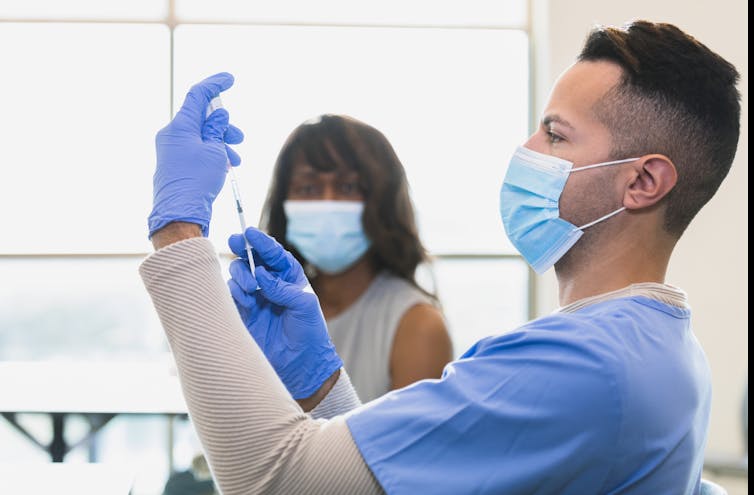
While COVID-19 vaccines continue to be highly effective at preventing hospitalization and death, it has become clear that the protection offered by the current vaccines wanes over time. This necessitates the use of booster shots that are safe and effective in enhancing the immune response against the virus and extending protection.
But when to get a first or second booster, and which shot to choose, are open questions. Many people find themselves unsure whether to wait on new, updated formulations of the COVID-19 vaccines or to mix and match combinations of the original vaccine strains.
SARS-CoV-2, the virus that causes COVID-19, uses its knob-shaped spike protein to gain entry into cells and to cause infection. Each of the existing and upcoming vaccines relies on emulating the spike protein to trigger the immune response. However, each vaccine type presents the spike protein to the immune system in different ways.
As immunologists studying inflammatory and infectious diseases, including COVID-19, we are interested in understanding how the COVID-19 vaccine designs differ in the type of immunity they trigger and the protection that results.
New bivalent vaccines
Moderna and Pfizer-BioNTech, the two companies whose mRNA vaccines have been the primary options for COVID-19 vaccination across all age groups, both have new vaccine formulations on the way. An advisory committee of the Food and Drug Administration is set to meet on June 28, 2022, to evaluate the newest versions and to decide on which are likely to be recommended for use in this fall’s booster shots.
Moderna’s new bivalent vaccine mixes mRNA that encodes for the spike proteins of the original SARS-CoV-2 virus as well as the slightly different spike protein of the more infectious omicron variant.
In early June 2022, Moderna said that in clinical trials, its bivalent vaccine outcompetes the original vaccine strain, inducing a stronger immune response and longer protection against the original SARS-CoV-2 and its variants, including omicron.
Moderna later announced that its newest formulation also performs well against the newest omicron subvariants, BA.4 and BA.5, which are quickly becoming the dominant strains in the U.S. Because of the significantly stronger immune response that the new shot induces, Moderna predicts that such protection may last a year and plans to introduce its new vaccine in August.
And most recently, on June 25, Pfizer-BioNTech also announced results for its two new COVID-19 vaccine formulations: a bivalent formulation consisting of mRNA that encodes for the spike proteins of the original SARS-CoV-2 strain and the original BA.1 omicron subvariant, and a “monovalent” version that is only directed at the spike protein of BA.1.
The company’s preliminary studies demonstrated that both the monovalent and the bivalent vaccines triggered antibodies that neutralized the newer omicron BA.4 and BA.5 subvariants, although to a lesser degree than the BA.1 subvariant. However, Pfizer’s monovalent vaccine triggered better virus-neutralizing antibodies against the omicron BA.1 subvariant than did the bivalent vaccine.
However, whether the differences in the levels of such antibodies seen with the monovalent versus bivalent vaccines translate into different levels of protection against newer omicron variants remains to be established in clinical trials.
Progress on the Novavax vaccine
Another vaccine formulation that is working its way toward authorization is Novavax, a vaccine built using the spike protein of the original SARS-CoV-2 virus. The Novavax vaccine has the advantage of being similar to traditional vaccines, such as the DTaP vaccines against diphtheria, tetanus and pertussis, or the vaccines against other viral infections such as hepatitis and shingles. The Novavax vaccine has been clinically tested in South Africa, the United Kingdom and the U.S. and found to be safe and highly effective with 90% efficacy against mild, moderate and severe forms of COVID-19.
An advisory committee to the Food and Drug Administration endorsed the Novavax vaccine in early June 2022. Now, the FDA is reviewing changes that Novavax made during its manufacturing process before making its decision to authorize the shot.
In Australia, the Novavax vaccine was recently registered provisionally as a booster for individuals aged 18 years and over. The company is performing phase 3 clinical trials to determine if its vaccine can be used safely and effectively as a booster in people who have previously taken mRNA vaccines.
When these new vaccines become available in the coming months, people will have significantly more options for mixing and matching vaccines in order to enhance the duration and quality of their immune protection against COVID-19.
Mixing and matching
Until then, clinical studies have shown that even mixing and matching the existing vaccine types is an effective strategy for boosting. For example, recent studies suggest that when adults who were fully vaccinated with any of the original three COVID-19 vaccines – Pfizer-BioNTech, Moderna or Johnson & Johnson – received a booster dose with a different vaccine brand from the one they received in their initial series, they had a similar or more robust immune response compared to boosting with the same brand of vaccine.
Vaccine mixing has been found to be safe and effective in various studies. The reason why mixing vaccines might produce a more robust immune response goes back to how each one presents the spike protein of the virus to the immune system.
When the SARS-CoV-2 virus mutates in regions of the spike protein, as has been the case with each of the variants and subvariants, and tries to evade the immune cells, antibodies that recognize different parts of the spike protein can stop it in its tracks and prevent the virus from infecting the body’s cells.
So whether you decide to get a booster shot now or wait until the fall, for many it’s heartening to know that more options are on the way.
Prakash Nagarkatti, Professor of Pathology, Microbiology and Immunology, University of South Carolina and Mitzi Nagarkatti, Professor of Pathology, Microbiology and Immunology, University of South Carolina
This article is republished from The Conversation under a Creative Commons license. Read the original article.