 How to resolve AdBlock issue?
News
- Details
- Written by: Elizabeth Larson
The fire was first reported in the 16000 block of Boyles Avenue just before 5:30 p.m. Sunday.
A large column of smoke was showing in the area, with firefighters en route reporting that it was moving quickly.
When the first units accessed the fire about 10 minutes after dispatch, it was reported to be two to three acres, with a rapid rate of spread and spotting in heavy brush.
Lake County Fire, Northshore Fire and Cal Fire were among the agencies initially responding, according to radio reports.
Cal Fire sent air resources including air attack and Copter 104 from Boggs Mountain Helitack.
Due to there being a threat to nearby structures, evacuations began taking place along the east side of Wilkinson Avenue down to Betz Drive.
Just after 6 p.m., the Clearlake Police Department issued an alert asking the public to avoid the area of Dam Road, 18th Avenue and Boyles Avenue due to a fire in the area. Radio reports had indicated numerous vehicles had been trying to drive into the area.
Fire activity continued to slow, with aircraft keeping a spot on the fire’s left flank in check while dozer lines and resources were arranged around it.
Incident command reported shortly before 6:45 p.m. that forward progress had been stopped.
Shortly after 7 p.m., the fire was reported to be 19 acres, with three to four hours of commitment time for resources on scene.
The Clearlake Police Department reported just before 7:30 p.m. that the fire was contained and evacuations were lifted.
More information will be published as it becomes available.
Email Elizabeth Larson at
- Details
- Written by: Elizabeth Larson
LAKE COUNTY, Calif. — The discovery of a suspicious device at a Lakeport church on Sunday has led to authorities issuing an evacuation order and requesting the assistance of a bomb squad.
The city of Lakeport issued an alert shortly after noon on Sunday reporting that the Lakeport Police Department had discovered the device on the grounds of St. John's Episcopal Church, located at 1190 N. Forbes St.
Lakeport Police Chief Brad Rasmussen told Lake County News that the device’s component’s hadn’t yet been confirmed, but it appeared to have a power source, accelerant and shrapnel.
Police implemented an immediate evacuation area for the surrounding area of 11th Street, Forbes Street, Main Street and Clear Lake Avenue within 1,000 feet of the church and asked community members to avoid the area until further notice.
Resulting road closures included:
• 11th Street from North Main Street to Tunis Street;
• High Street from 14th Street to 11th Street;
• Clear Lake Avenue from North Main Street to High Street;
• Forbes Street from 10th Street to 15th Street.
Drivers are asked to use the following alternative routes:
• 15th Street and North High Street to and from North Main Street;
• 10th Street and Tunis Street to and from 11th Street.
Evacuees who need a place to wait out of the heat have been invited to Lakeport City Hall at 225 Park St.
Rasmussen said about 40 residents are in the evacuation area. Most didn’t evacuate and so were ordered to shelter in place, he said.
Shortly before 2 p.m., Rasmussen said a bomb squad was en route to assist with handling the device.
At that point, he said he didn’t yet know how the device would be disposed of, and that he would have to consult with the bomb squad.
Part of the concern is whether components can be preserved and recovered as evidence for the investigation, Rasmussen said.
Just before 2:25 p.m., Lakeport Fire was requested by the bomb squad to come to the area of North Main Street at Clear Lake Avenue, with units responding a few minutes later.
The city of Lakeport reported just before 3:45 p.m. that the suspicious device found near St. John's Episcopal Church had been rendered safe. The evacuation order was lifted and roads in the area have been reopened.
Law enforcement's investigation remains ongoing.
This is a developing story. More information will be published as it becomes available.
Email Elizabeth Larson at
- Details
- Written by: Elizabeth Larson
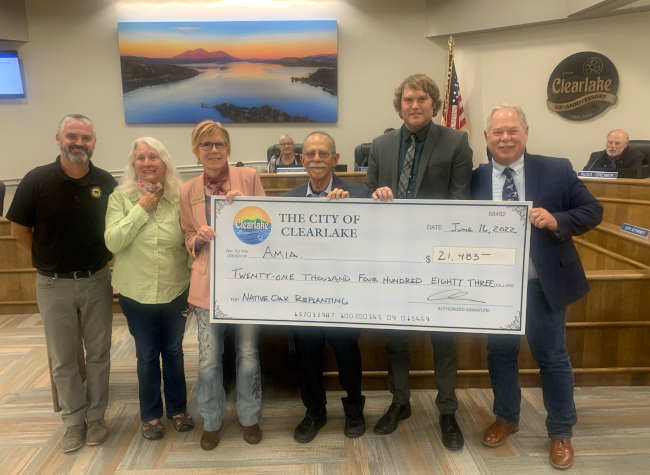
CLEARLAKE, Calif. — A partnership between the city of Clearlake, the Anderson Marsh Interpretive Association and California State Parks will lead to the planting of 100 native valley oaks at Anderson Marsh State Historic Park in the fall.
Clearlake City Manager Alan Flora introduced the project during the Clearlake City Council’s June 16 meeting.
Flora said the effort came about in response to the need to plant oak trees to replace those being taken out for affordable housing projects in the city.
As a result of the state’s desire to encourage affordable housing, it has made such projects statutorily exempt from review under the California Environmental Quality Act, Flora said.
One of those affordable housing projects is the 102-unit Konocti Gardens, which is being built by CSI Construction at 3930 Old Highway 53.
Flora said a lot of oak trees are being removed from the property. While the state has exempted the project, the city has an oak tree mitigation ordinance that requires developers who cut down native oak trees to either replant trees of the same species or choose to pay a fee to fund replanting by the city.
Because the developer didn’t want to replace the trees, Flora said the city enacted a fee in lieu of replacement.
The result was that the developer paid nearly $100,000 to the city to cover the trees’ mitigation, Flora said.
The city contacted Anderson Marsh Interpretive Association, or AMIA, about partnering with the city and State Parks to plant valley oaks at Anderson Marsh State Historic Park, which spans both Lower Lake and the city of Clearlake.
The valley oak, Quercus lobata, is native to California and is the largest of the oaks that grow in North America, reaching a height of about 100 feet, according to Calscape. Valley oaks can grow quickly but live up to 600 years.
“Trees help fight climate change by absorbing carbon dioxide and our beautiful valley oaks are part of the Lake County heritage that we leave to our descendants,” said AMIA President Roberta Lyons.
“AMIA is pleased that the city of Clearlake has undertaken to protect as many of these trees as possible and to replant trees that are cut down during the course of development projects. We are proud to partner with the city of Clearlake and State Parks in planting these valley oaks,” Lyons said.
AMIA is an all-volunteer nonprofit association that partners with State Parks to support Anderson Marsh State Historic Park in Lake County.
AMIA Board member Henry Bornstein said the group contacted State Parks, which agreed to do the initial planting, with AMIA agreeing to do the follow-up watering, weeding and maintenance necessary to help the trees survive.
The city is committing $21,000 to the planting project at Anderson Marsh.
Lyons offered her appreciation for the fact that the city cares about the beautiful oak trees that are a part of the character of the city.
She said she hopes more can be done to protect the trees, adding that she thinks the city could charge more for its mitigation fee.
Ryan Martin, the natural resources manager for the State Parks division that includes Lake County, called the agreement a “very cool partnership.”
He presented a map that showed three areas in the park where they will plant the seedlings: 60 little trees in the grassland around the historic ranch house, 30 seedlings in the North Flat area and 10 along Seigler Canyon Creek east of Highway 53.
Martin said they will prepare the planting sites, purchase supplies and equipment — including a skid mount tank and pump for watering — and hope for an early rain so all of the seedlings can be in the ground in the fall.
Once the trees are established, Martin said they plan to install two educational panels, at North Flat and near the ranch house.
Councilman Russ Cremer said he cut hay and worked on the ranch that’s now the park when he was young, and he knew people who lived in the ranch house. He said he’s glad the park property is being maintained so it will be there for future generations to enjoy.
Flora said there is more money in the oak mitigation fund and the city wants to look at investing in other projects to make up for the lost trees.
Email Elizabeth Larson at
- Details
- Written by: Howard Manly, The Conversation
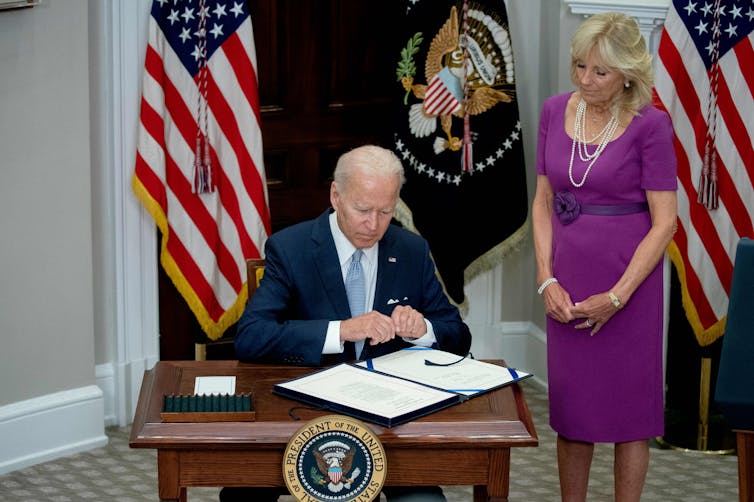
President Joe Biden signed into law on June 25, 2022, a bipartisan bill that is the first significant change in federal gun legislation in nearly three decades.
Known as the Bipartisan Safer Communities Act, the bill was written in response to the shootings in Buffalo, New York, and Uvalde, Texas, and sped through a usually slow-moving Congress.
Though the bill’s limited scope has left many disappointed, it does tighten up gun control in a number of key areas.
As the bill was making its way through Congress, The Conversation published a number of articles looking at its provisions and how effective they might be in addressing America’s gun violence crisis.
1. Support for states’ red flag laws
Among the elements of the new law is support for states to pass what are called “red flag laws.”
LaGrange College political science professor John A. Tures writes that these laws allow police to take guns from people deemed a threat to themselves or others and bar them buying firearms.
To determine if red flag laws reduce gun deaths overall, Tures examined states’ firearm death rates, in light of whether they had a red flag law or not, in each of three years – 2018, 2019 and 2020.
On average, states with red flag laws in 2019 and 2020 had significantly lower firearm death rates than states without them. In 2018, the average death rates for both groups were closer, but states with red flag laws still had a meaningfully lower rate.
“In 2020, if there were no red flag laws, I estimate that 52,530 Americans would have died in gun deaths. The number actually recorded was 45,222, indicating red flag laws saved 7,308 American lives that year,” Tures writes.
2. What is the ‘boyfriend loophole’?
One of the sticking points in negotiations over the bill that was eventually resolved was the “boyfriend loophole.”
Under current federal legislation, Michigan State University criminal justice professor April M. Zeoli explains intimate partner relationships are defined only as those in which two people are or were married, live or lived together as a couple, or have a child together.
People who were in a dating relationship are largely excluded from this definition.
As a result, Zeoli writes, “dating partners are exempt from federal laws that prohibit those convicted of domestic violence misdemeanor crimes, or those who are under domestic violence restraining orders, from buying or possessing a firearm.”
This is what is referred to as the “boyfriend loophole.”
Research suggests that when a violent male partner has access to a gun, the risk of murder to the female partner increases fivefold.
With Biden signing the bill into law, the wording extends the ban to “those who have or have had a continuing relationship of a romantic or intimate nature.”
Though the bill will close the loophole for those convicted of domestic violence misdemeanor crimes, it does not cover restraining order laws.
3. Does the law protect schools?
The new law would provide US$1 billion to help schools put in place comprehensive strategies to create safe and healthy learning environments, including $300 million to increase access to mental health services.
Part of the strategy involves risk assessment.
In the years since the Columbine shooting in 1999, researchers and federal law enforcement agencies have studied school shootings and developed risk assessments to gauge the likelihood of actual violence by a young person identified as a possible risk.
As Paul Boxer, a Rutgers University - Newark psychology professor, explains, the assessments are conducted by professionals that include police officers, teachers and mental health counselors.
Together, they determine a young person’s risk for violence.
“These teams may not be able to prevent every possible incident,” Boxer cautions. “Still, this sort of approach is critical to improving the process of identifying and stopping potential shooters overall.”
Editor’s note: This story is a roundup of articles from The Conversation’s archives.
Howard Manly, Race + Equity Editor, The Conversation
This article is republished from The Conversation under a Creative Commons license. Read the original article.