 How to resolve AdBlock issue?
News
- Details
- Written by: LAKE COUNTY NEWS REPORTS
Court Executive Office Krista LeVier said Friday that amendments and additions to the Penal Code were passed by the Legislature and signed into law by the governor.
The new legislation allows for remote appearances in many criminal proceedings. LeVier said the legislation applies to Penal Code sections 977 and 977.3.
As a result, LeVier said remote appearances will continue to be allowed on the criminal law and motion calendars when allowed under the law.
Preliminary hearings, felony sentencings, settlement conferences and trials continue to require in-person appearances, LeVier said.
She said counsel is required to appear in-person with any client who intends to appear in-person, as there is no means for private communication between the defendant and counsel prior to and during the proceedings.
Additional information can be found on the Lake County Superior Court website.
- Details
- Written by: CALTRANS
The allocations approved by the California Transportation Commission, or CTC, include $1.3 million toward roadway, guardrail, drainage and other improvements on Highway 29 near Clear Lake from Spruce Grove Road to Diener Drive in Lake County.
Senate Bill (SB) 1, the Road Repair and Accountability Act of 2017, accounts for more than $930 million of the total funding.
“The CTC’s decision to invest in our state highways while protecting city and county infrastructure will help make California’s roadways safer and more resilient one shovel, one project and one community at a time,” said Caltrans Director Tony Tavares.
In addition to the work in Lake County, projects approved this week include:
• Approximately $8.4 million toward drainage improvements along Route 299 from Blue Lake to Willow Creek in Humboldt County.
• Approximately $1.5 million toward the construction of a retaining wall along Route 36 near Bridgeville in Humboldt County.
• Approximately $4.1 million toward drainage and fish-passage improvements along U.S. 101 near Crescent City in Del Norte County.
• Approximately $1 million toward the construction and repair of buildings at the Ukiah Maintenance Station along U.S. 101 as well as the Boonville Maintenance Station along Route 128 in Mendocino County.
• Approximately $1 million toward the construction of a median barrier along U.S. 101 from Route 20 to south of North State Street near Ukiah in Mendocino County.
• Approximately $3.1 million toward drainage and fish-passage improvements along Route 1 near Philo and Boonville in Mendocino County.
• Approximately $1.1 million toward road and guardrail repairs and ADA curb ramps along Route 1 from south of Iverson Avenue to Philo Greenwood Road near Point Arena in Mendocino County.
• Approximately $1.1 million toward roadway and guardrail repairs along U.S. 101 from north of Robinson Creek Bridge to Pomo Lane Undercrossing near Ukiah in Mendocino County.
• Approximately $5.7 million toward the construction of a retaining wall along U.S. 101 near Hopland in Mendocino County.
• Approximately $588,000 toward roadway and guardrail repairs along U.S. 101 from north of the Humboldt County line to Leggett in Mendocino County.
• Approximately $1.4 million toward pavement and guardrail upgrades along Route 1 from Mill Creek Bridge to Robinson Creek Bridge near Boonville in Mendocino County.
The $1.3 billion federal local assistance allocation in fiscal year 2023 is thanks to programs that were created or expanded under the Infrastructure Investment and Jobs Act, also referred to as the Bipartisan Infrastructure Law.
Caltrans oversees funds that are available to more than 600 cities, counties, and regional agencies for the purpose of improving their transportation infrastructure and services.
Funding from new programs that were created by the law includes $45 million to build community resilience in the face of extreme weather and natural disasters and $63 million to help develop carbon reduction strategies that address the climate crisis.
SB 1 provides $5 billion in annual transportation funding annually that is split between the state and local agencies. Road projects progress through construction phases more quickly based on the availability of SB 1 funds, including projects that are partially funded by SB 1.
For more information about transportation projects funded by SB 1, visit www.RebuildingCA.ca.gov.
- Details
- Written by: Bill Steigerwald

Scientists using data from NASA’s Curiosity rover measured the total organic carbon — a key component in the molecules of life — in Martian rocks for the first time.
“Total organic carbon is one of several measurements [or indices] that help us understand how much material is available as feedstock for prebiotic chemistry and potentially biology,” said Jennifer Stern of NASA’s Goddard Space Flight Center in Greenbelt, Maryland. “We found at least 200 to 273 parts per million of organic carbon. This is comparable to or even more than the amount found in rocks in very low-life places on Earth, such as parts of the Atacama Desert in South America, and more than has been detected in Mars meteorites.”
Organic carbon is carbon bound to a hydrogen atom. It is the basis for organic molecules, which are created and used by all known forms of life.
However, organic carbon on Mars does not prove the existence of life there because it can also come from non-living sources, such as meteorites and volcanoes, or be formed in place by surface reactions.
Organic carbon has been found on Mars before, but prior measurements only produced information on particular compounds, or represented measurements capturing just a portion of the carbon in the rocks. The new measurement gives the total amount of organic carbon in these rocks.
Although the surface of Mars is inhospitable for life now, there is evidence that billions of years ago the climate was more Earth-like, with a thicker atmosphere and liquid water that flowed into rivers and seas.
Since liquid water is necessary for life as we understand it, scientists think Martian life, if it ever evolved, could have been sustained by key ingredients such as organic carbon, if present in sufficient amounts.
Curiosity is advancing the field of astrobiology by investigating Mars’ habitability, studying its climate and geology.
The rover drilled samples from 3.5-billion-year-old mudstone rocks in the Yellowknife Bay formation of Gale crater, the site of an ancient lake on Mars. Mudstone at Gale crater was formed as very fine sediment (from physical and chemical weathering of volcanic rocks) in water settled on the bottom of a lake and was buried. Organic carbon was part of this material and got incorporated into the mudstone.
Besides liquid water and organic carbon, Gale crater had other conditions conducive to life, such as chemical energy sources, low acidity, and other elements essential for biology, such as oxygen, nitrogen and sulfur.

“Basically, this location would have offered a habitable environment for life, if it ever was present,” said Stern, lead author of a paper about this research published June 27 in the Proceedings of the National Academy of Sciences.
To make the measurement, Curiosity delivered the sample to its Sample Analysis at Mars, OR SAM, instrument, where an oven heated the powdered rock to progressively higher temperatures.
This experiment used oxygen and heat to convert the organic carbon to carbon dioxide, or CO2, the amount of which is measured to get the amount of organic carbon in the rocks.
Adding oxygen and heat allows the carbon molecules to break apart and react carbon with oxygen to make CO2. Some carbon is locked up in minerals, so the oven heats the sample to very high temperatures to decompose those minerals and release the carbon to convert it to CO2.
The experiment was performed in 2014 but required years of analysis to understand the data and put the results in context of the mission’s other discoveries at Gale Crater. The resource-intensive experiment was performed only once during Curiosity’s 10 years on Mars.
This process also allowed SAM to measure the carbon isotope ratios, which help to understand the source of the carbon. Isotopes are versions of an element with slightly different weights (masses) due to the presence of one or more extra neutrons in the center (nucleus) of their atoms.
For example, Carbon-12 has six neutrons while the heavier Carbon-13 has seven neutrons. Since heavier isotopes tend to react a bit more slowly than lighter isotopes, the carbon from life is richer in Carbon-12.
“In this case, the isotopic composition can really only tell us what portion of the total carbon is organic carbon and what portion is mineral carbon,” said Stern. “While biology cannot be completely ruled out, isotopes cannot really be used to support a biological origin for this carbon, either, because the range overlaps with igneous (volcanic) carbon and meteoritic organic material, which are most likely to be the source of this organic carbon.”
The research was funded by NASA’s Mars Exploration Program. Curiosity’s Mars Science Laboratory mission is led by NASA’s Jet Propulsion Laboratory in Southern California; JPL is managed by Caltech. SAM was built and tested at NASA’s Goddard Space Flight Center in Greenbelt, Maryland. Charles Malespin is SAM's principal investigator.
Bill Steigerwald works for the NASA Goddard Space Flight Center in Greenbelt, Maryland.
- Details
- Written by: Elizabeth Larson
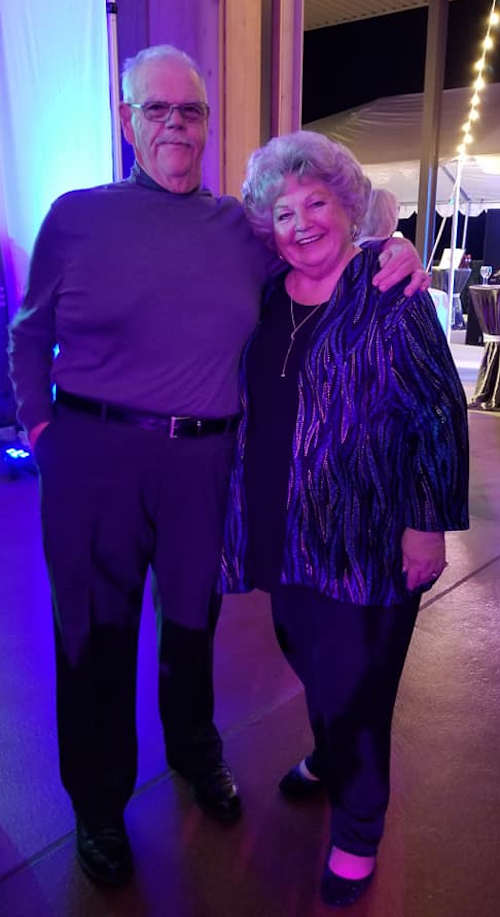
LAKE COUNTY, Calif. — Two longtime Lake County residents who have spent years in public service will be honored as the grand marshals of Saturday’s Redbud Parade.
Jim and Sue Burton of Clearlake Oaks will be the honorees during the event, which is part of Clearlake’s Independence Day celebration, which takes place beginning on Saturday morning.
The parade starts at Redbud Park at 11 a.m. before proceeding down Lakeshore Drive to Austin Park.
The theme of this year’s parade is “Rocking Lake County.”
“It is an honor,” Sue Burton told Lake County News.
Jim Burton was born and raised in Clearlake Oaks.
For 36 years he worked for the Clearlake Oaks Fire District, serving as fire chief for 26 of those years before his retirement. The district has since consolidated with several other fire districts to become Northshore Fire Protection District.
He has served as a member of the Northshore Fire District Board for 19 years, and also is a member of the Clearlake Oaks Water Board, vice president of the East Region Town Hall and president of the Clearlake Oaks Moose Lodge No. 2284.
Sue Burton has lived in Clearlake Oaks for more than 53 years. For 28 of those years, she owned her own business in the town.
She served on the Konocti Unified School District Board of Trustees for 20 years and also has been a member of the Redbud Health Care District for the past two decades.
Now, she is the first woman administrator for the Clearlake Oaks Moose Lodge.
More information about the 64th annual Redbud Parade and Festival is available here.
Email Elizabeth Larson at