 How to resolve AdBlock issue?
News
- Details
- Written by: LAKE COUNTY NEWS REPORTS
The town hall will begin at 6:30 p.m.
To join the call, RSVP to
The town hall also can be watched live on Thompson’s Facebook page.
Thompson’s special guest will be Mark Zandi, chief economist of Moody’s Analytics, who will discuss the economy and rising costs alongside other top of mind issues including the implications of recent Supreme Court decisions, gun violence prevention, the war in Ukraine and others.
If you are not able to make the town hall but have any questions email Thompson at
- Details
- Written by: Elizabeth Larson
In a unanimous vote on June 28, the board approved a resolution authorizing Public Services Director Lars Ewing to execute documents with the California Department of Transportation for the Clean California Local Grant Program.
In March, the state announced that it had awarded $1,358,545 to the county of Lake for a park improvement project.
The city of Clearlake also is receiving $1,557,158 to clean and beautify the downtown corridor with the installation of wayfinding signage and murals on exterior walls of businesses painted by local artists, as Lake County News has reported.
Unlike many grant programs, Ewing told the board that the Clean California Local Grant Program did not require a local match.
Ewing’s report to the board explained that the Clean California Initiative is a multiyear, $1.1 billion program to increase litter abatement efforts by Caltrans and local entities statewide, and to support state and local beautification projects.
He reported that in December Caltrans issued a call for projects for the grant program. Ewing submitted the grant application in February and received word it was successful in March.
The “Lake County Beautification Initiative Project” will involve work at 15 county parks, Ewing told the board on June 28.
There will be litter abatement, cleanup and beautification, public art, shade structures, trees, drinking fountains, benches, trash/recycling receptacle and litter abatement signs, Ewing reported.
He said the project also includes a countywide marketing outreach and educational campaign.
The parks to be included in the project are:
• Clearlake Oaks: Clearlake Oaks Park, Nylander Park.
• Kelseyville: Kelseyville Community Park, Lakeside Park, Saderlund Park.
• Lower Lake: Russell Rustici Park.
• Lucerne: Alpine Park, Davis Beach, Lucerne Harbor Park.
• Middletown: Middletown Square Park.
• Nice: Hammond Park, Hinman Park, Keeling Park, Triangle Park, Rodman Slough Park.
Ewing’s report explained that once the board approved the resolution, he and Caltrans officials would sign the agreement, clearing the way for Public Services to begin “reimbursable project work.”
Email Elizabeth Larson at
- Details
- Written by: Lake County Association of Realtors
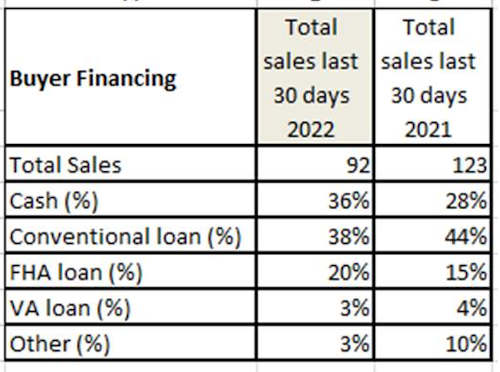
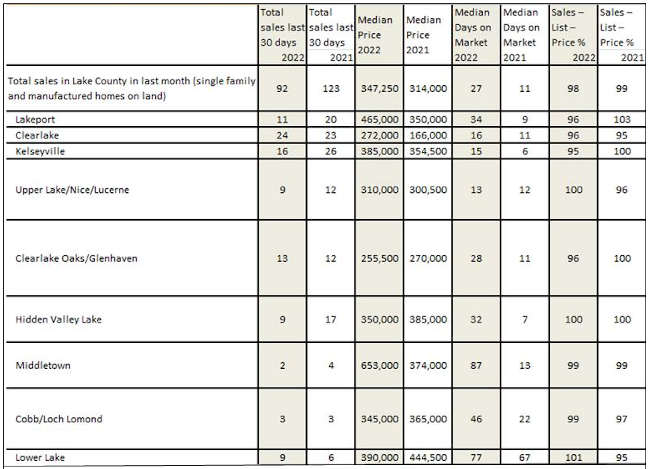
Over the last 30 days, 92 homes have sold through the multiple listing service, compared to 123 during the same time last year.
Those houses sold include traditionally built “stick-built” houses as well as manufactured homes on land.
There were 11 sales of mobile homes in parks compared to nine for the same time last year, and 32 bare land (lots and acreage) sales, compared with 45 for the same time last year.
Total percentage of homes bought for all cash was 33%, compared to 35% for the same time last year. Of those, 35% were financed by Fannie Mae or Freddie Mac and are considered “conventional loans,” compared to 54% for the same time last year.
Another 18% were financed by FHA, the same as last year this time, and 3% had other financing such as private loans or seller financed notes compared to 12% for the same time last year.
There are 403 homes on the market right now. If the rate of sales stays the same at 92 homes sold per month, there are currently 4.4 months of inventory on the market at the moment. That means that if no new homes are brought to the market for sale, in 4.4 months all of these homes would be sold and there would be none available.
Less than six months of inventory is generally considered to be a “sellers’ market” while more than six months of inventory is often called a “buyers’ market.” This is the largest inventory we have seen in the past two years.
Most homes were selling very close to the asking price, at an average of 98% of the asking price. This is in contrast to other areas, where homes sell for more than the asking price.
The median time on the market last month was 27 days, compared to 11 days for this time last year.
The median price of a single family home in Lake County over the last 30 days was $347,250 compared to $314,000 during this time period last year.
In the past 30 days, 29% of homes sold had seller concessions for an average of $7,629; a year ago 28% of homes sold had an average seller concession of $6,510.
A more detailed breakdown by the different areas is shown in the chart below.
- Details
- Written by: Edward Lempinen
While state corrections leaders and staff mounted “extraordinary” and sometimes innovative efforts to check the disease, the researchers found, their work was not enough to prevent tens of thousands of COVID infections among inmates and prison staff.
As a result, seriously ill prisoners imposed new burdens on already-stressed community hospitals, and employee illness led to severe staffing shortages.
Prison staff may have inadvertently carried the virus in and out of the prisons and into their homes and communities, the report said.
“We found that many California prison officials and staff did heroic work under incredibly difficult circumstances,” said Brie Williams, MD, MS, a professor of medicine and director of the Amend program at UCSF who helped lead the research team. “But in many cases, it still wasn’t enough.
“We believe that state policymakers and prison managers should look closely at the lessons learned in this crisis to help assure we’re better prepared in the future,” Williams said. “This includes giving attention to massively reducing the prison population in our state in the interest of public health, as overcrowding is likely the single greatest health threat in a respiratory pandemic.”
At the start of the pandemic in March 2020, the California Department of Corrections and Rehabilitation, or CDCR, held about 120,000 inmates and employed some 50,000 staff.
In all, the researchers documented more than 50,000 cases of COVID among inmates — including 240 deaths — by December 2021. Other reports have documented more than 16,000 COVID infections among prison staff, with 26 deaths.
The new report, “California State Prisons During the COVID-19 Pandemic,” was produced by researchers at UC Berkeley and UCSF who joined under the auspices of CalPROTECT.
Amend began the project before the pandemic to advise state policymakers and federal judicial officials on California’s prison health care system.
After the pandemic began, UCSF and Berkeley faculty convened experts in infectious disease, epidemiology, economics, environmental engineering, health systems and geriatrics from UCSF’s School of Medicine and from Berkeley’s School of Public Health and Goldman School of Public Policy.
“The CalPROTECT effort underscores the important role that cross-campus multidisciplinary teams of researchers can play in providing feedback to state agencies through academic-state partnerships,” said the study’s colead, Dr. Stefano Bertozzi, professor of health policy and management at Berkeley’s School of Public Health.
Covering nearly 400 pages, the report describes an array of problems that contributed to surging COVID in the state’s 34 adult prisons, analyzes causes and offers dozens of specific recommendations for improving health care policy and practice.
Policymakers at every level in the United States and around the world struggled in the early days of the pandemic, fundamentally unsure of how the virus spread and how it could be contained. In the U.S., prisons became critical nodes for the spread of the disease.
The COVID-19 pandemic has repeatedly exposed the profound public health dangers posed by carceral settings, which imprison some of society’s most medically vulnerable people.
“The COVID-19 pandemic has repeatedly exposed the profound public health dangers posed by carceral settings, which imprison some of society’s most medically vulnerable people,” the report said. “In the United States, which holds a quarter of the world’s incarcerated population, nearly half of state prisons reported that confirmed cases among incarcerated people were four or more times (and up to 15 times) higher than the rate found in the state’s general population.”
In California, the report found, the CDCR achieved some major successes. “Chief among these,” the authors wrote, “is the effective mass vaccination campaign of CDCR residents, the use of systemwide health data to guide policy, and the tireless efforts of many staff members, despite extraordinarily difficult working conditions.”
But, they found, California’s prisons were at a particular disadvantage. Old and sometimes antiquated buildings, housing thousands of inmates more than they were designed to hold, created environments where social distancing and isolation of ill inmates were nearly impossible.
Heating and air conditioning systems were often incapable of sufficient air exchange or not adequately filtering recirculated air, which meant that inmates and staff alike were more likely to be breathing virus-laden air.
In those conditions, policymakers should have prioritized the early release of prisoners, especially those who were elderly or at higher risk of infection. But those efforts were insufficient, the report said. In addition, it will be important to examine ways to improve communication with families and friends of incarcerated people during future emergencies.
Risks may have been elevated because vaccinations are not required among prison staff, and many have declined to be vaccinated.
Among the results cited in the report:
• “The COVID-19 case rate is over three times higher among CDCR residents than among residents of the counties in which … prisons are located. Every CDCR prison exceeded the case rate in its surrounding county.”
• Though the prisons had a lower proportion of older inmates than the local population, COVID-19 deaths among prisoners “exceeded the death rate in California and the United States as a whole.”
• Over 1,000 inmates too sick to be treated in prison health facilities had to be admitted to local community hospitals, with more than 150 admissions to intensive care units. Incarcerated people of color had higher risks of hospitalization than their white counterparts.
• The pandemic has had a “profound” mental health impact on prison staff, and “large-scale … turnover in coming months or years is likely in the wake of the trauma” of working in prisons during the pandemic.
Preventing similar harms in the future will require a range of interventions, the authors said, including rapid detection of outbreaks, significantly greater use of releases to reduce prison populations, vaccination drives among inmates and staff, and improved ventilation and air filtration systems.
They concluded: “Making strides in each of these areas requires the mobilization of significant resources and — in the case of decarceration — profound political will.”
Edward Lempinen writes for the UC Berkeley News Center.