 How to resolve AdBlock issue?
News
- Details
- Written by: Elizabeth Larson
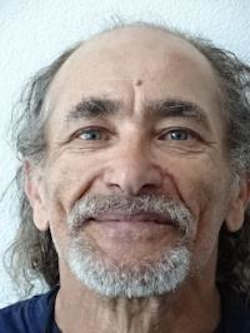
LAKE COUNTY, Calif. — The Lake County Sheriff’s Office is continuing to search for an Upper Lake man who they said assaulted a woman earlier this month.
Arturo Pedro Gutierrez, 62, is wanted in connection to the assault, which took place on Aug. 18.
On Wednesday, the sheriff’s office reported that a $500,000 warrant has been issued for Gutierrez’s arrest.
A registered sex offender, Gutierrez is believed Gutierrez to frequent the Willits area of Mendocino County.
Anyone with any information as to his whereabouts is asked to call the Lake County Sheriff’s Central Dispatch at 707-263-2690.
Email Elizabeth Larson at
- Details
- Written by: CENTER FOR BIOLOGICAL DIVERSITY

PORTLAND, Ore.— The Oregon Department of Fish and Wildlife issued a report on Wednesday announcing video footage of the den site of what could be a relatively new wolf family in southwestern Oregon.
This is the first known modern-day instance of a California wolf dispersing to Oregon and likely starting a family.
The mated pair of radio-collared wolves are Oregon-born female wolf OR-115 and California-born male wolf LAS013, who left his birth pack in Lassen County, California and migrated to Oregon in late 2020.
The video of one of the adult wolves near their den site was captured by aerial surveillance technology and shared on the department’s YouTube page. It can be seen below.
“We’re so glad these wolves found each other,” said Amaroq Weiss, senior wolf advocate at the Center for Biological Diversity. “The thrilling story of wolf recovery in Oregon and California is still in its infancy. Since wolves don’t use dating apps to find each other, they need other wolves in their neighborhood to keep the story going.”
This new wolf family, whose territory includes parts of Klamath and Lake counties, has not yet been given a pack name by the Department of Fish and Wildlife.
Whether they will count as a “successful breeding pair” for purposes of the department’s annual 2022 report depends on whether the pair has at least two pups that survive until the end of December.
Oregon’s wildlife agency issued its annual wolf report in April 2022 for the calendar year 2021. That report estimated the state’s wolf population to be 175 individuals in 21 packs, with a total of 16 successful breeding pairs.
While LAS013 and OR-115 were first observed together in early 2021, they did not count as a breeding pair at that time since the department had no evidence showing the pair had reproduced that year.
This year marks the first time in which the wolves’ radio-collar signals indicated they had localized at a den-site, and this was subsequently confirmed by the aerial video surveillance. Localized radio-collar signals are frequently how wildlife agencies learn that a pair of wolves has made a den, which often indicates they have given birth to pups.
The department’s report indicates the video footage will allow wildlife officials to focus their efforts to find and count any pups.
“The fact that this California-born wolf likely has pups born in Oregon underscores how essential it is for wolf populations to be legally protected and connected, and not simply relegated to isolated, postage-stamp-size recovery areas,” said Weiss. “Fortunately, we’ve managed to get federal protections restored to wolves in this part of Oregon and California, and we’ll work to ensure those protections remain in place.”
Wolves in Oregon once trekked statewide but they had been killed off by the late 1940s to appease agricultural interests. In 1999 wolves from Idaho began to make their way into Oregon, and the state’s first pack was confirmed in 2008.
Wolves from Oregon began to make their way into California in late 2011, and California’s first wolf family was confirmed in 2015. Currently, California has three known wolf packs, including the pack from which LAS013 originated.
- Details
- Written by: Terri Friedline, University of Michigan; Dominique Baker, Southern Methodist University, and John W. Diamond, Rice University
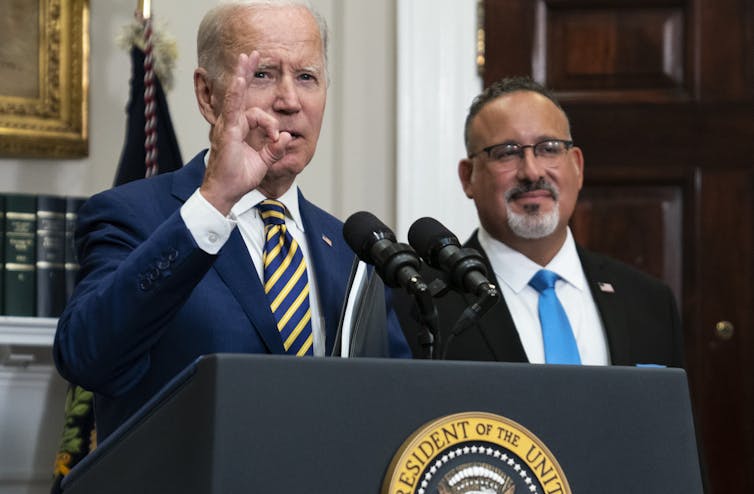
President Joe Biden announced a program to provide student debt relief to millions of borrowers of federal loans. The plan would offer up to US$10,000 in forgiveness for people who earn less than $125,000 – $250,000 for couples – and up to $20,000 for Pell Grant recipients. Biden also extended the pause on repaying federal student loan debt through Dec. 31, 2022, and has proposed a cap on income that can be used to calculate how much borrowers repay through income-driven repayment.
We asked three experts to explain the decision and its impact.
Relief makes real difference but ignores structural issues
Terri Friedline, Associate Professor of Social Work, University of Michigan
The Biden administration’s plan is an important step that I believe will make a real difference in many people’s lives. The White House estimates that about 20 million of the nation’s roughly 43 million student debt holders will see their entire balance canceled.
Despite this considerable impact, the plan is still limited. I hope it’s just the beginning in much-needed policy conversations about debt and education in the United States.
For one thing, Biden’s plan cuts less than 20% of America’s $1.75 trillion student debt tab.
In addition, the income cap of $125,000 focuses on borrowers’ socioeconomic class while ignoring the roles structural racism and sexism play in terms of who borrows and how much. For example, Black women borrow about $38,000 on average to finance their education, compared with $30,000 for white men. And because interest on student loans quickly accumulates, most Black female borrowers still owe their original balance 20 years after enrolling in school. By comparison, most white borrowers have paid off their loans completely within that time period.
The Biden administration will have to do more if it aims to adequately address these and the many other remaining structural problems with debt and education.

Plan extends much-needed relief to Black borrowers
Dominique Baker, Assistant Professor of Education Policy, Southern Methodist University
When approximately 10,000 student loan borrowers had their private student loans randomly canceled from 2010 to 2017, researchers found that it ultimately enabled them to more easily move, change jobs and earn more money. The borrowers were also 11% less likely to default on credit cards or other loans.
I expect similar outcomes will flow from the Biden administration’s decision to cancel federal student loans. And the decision to cancel up to $20,000 for those who received Pell Grants means that even more relief may flow to borrowers who are Black.
From the standpoint of racial justice, I believe this additional relief for Black borrowers is necessary because of centuries of systemic inequities. Such inequities include accumulating education debt through “predatory inclusion,” a practice in which Black people are offered access to things like college or buying a house but on exploitative financial terms that have long-term negative effects.
Black student loan borrowers are also often the most burdened by student loan debt. As one example, Black bachelor’s degree earners are more likely to default on their student loans than white students who earn a bachelor’s degree – 21% versus 4%, respectively. Even more startling, Black bachelor’s degree recipients default at a higher rate than white students who leave college with no degree – 21% versus 18%, respectively.
The Biden administration also has proposed changes to the income-driven repayment plan, which should help future undergraduate borrowers by reducing the monthly percentage of discretionary income borrowers would pay from 10% to 5% and increasing what counts as nondiscretionary income. That means borrowers will have more money that will not be used to calculate the percentage they owe each month.
I’d argue there is still work to be done to create an affordable college education. But today was an excellent start.

Loan forgiveness could fuel inflation
John W. Diamond, Director of the Baker Institute’s Center for Public Finance, Rice University
The price tag for Biden’s debt forgiveness plan is estimated at a little more than $300 billion.
While it will provide direct financial benefits for some people who currently owe money on federal student loans, I believe there will be another cost: higher inflation.
U.S. inflation is already rising at just below the fastest annual pace in 40 years, prompting the Federal Reserve to aggressively hike interest rates to reduce it, even at the risk of recession. Biden’s plan will make the central bank’s job tougher.
The upward pressure on inflation will result from increased spending by those who see their student debts reduced, as well as from the continuing moratorium on federal loan repayments. This higher demand for consumer goods – relative to a world without debt relief or a repayment moratorium – has the effect of driving up prices for current goods and services.
The Committee for a Responsible Federal Budget found that a similar though more modest version of debt forgiveness would lead to a measurable increase in spending on personal consumption, which would have the effect of driving up prices for all consumers. That was based on a plan to spend roughly $230 billion on debt forgiveness – at least $70 billion less than Biden’s plan.
Another side effect could be that Biden’s debt relief offers incentives to students entering or currently in college to take on additional debt in anticipation of future rounds of forgiveness. Economists call this moral hazard. Other research found that increases in student borrowing can result in bigger tuition increases.
Some research has pointed to positive economic outcomes for those who receive debt relief, such as less future indebtedness, greater job mobility and higher salaries. But these effects are based on a full discharge of student debt and not an incremental reduction like the one Biden announced.
Ultimately, loan forgiveness – whatever its merits – will likely lead to larger federal deficits and higher inflation. While it benefits those with student loan debt, those benefits should be weighed against the costs it imposes on others and the economy.
Terri Friedline, Associate Professor of Social Work, University of Michigan; Dominique Baker, Assistant Professor of Education Policy, Southern Methodist University, and John W. Diamond, Director, Center for Public Finance at Rice University's Baker Institute, Edward A. and Hermena Hancock Kelly Fellow in Public Finance, Adjunct Professor of Economics, Rice University
This article is republished from The Conversation under a Creative Commons license. Read the original article.
- Details
- Written by: Elizabeth Larson
Mayor Dirk Slooten and Councilman Russ Cremer filed for reelection, with no other individuals filing to run.
City Clerk/Administrative Services Director Melissa Swanson explained that because there are only two candidates for the two seats, elections code gives the city the option of appointing Slooten and Cremer rather than holding an election in November.
That was the option the city of Lakeport took four years ago, when the Lakeport City Council appointed Stacey Mattina and Mireya Turner, who were seeking reelection.
However, the Clearlake City Council decided against making the appointments due to concerns that it could limit options in the future should a vacancy on the council occur.
That concern is because of Government Code 36512(d), which Swanson said prohibits an appointment that would result in a majority of council members serving by way of appointment.
Swanson said the city already had budgeted the election for November. She said that if the council took no action by Thursday, the election would go forward for the two council seats as well as for the city treasurer’s job.
“I thought this was going to be a pretty simple decision for me,” said Councilman Russ Perdock.
However, he said if another council member left, it would leave the city with no option but to hold a special election, which could be expensive.
Other council members shared that concern. Slooten said he thought they should go forward with an election.
Swanson said no one filed to run for city treasurer, and the council also had the option to make an appointment or let the election go forward.
The city has not had an elected treasurer since 2006, when Elmer Maryatt retired. Since then, the council has appointed a city staffer to hold the job.
In 2016, the city put before voters proposals to make both the city treasurer and city clerk appointed, not elected positions. At that time, voters approved making the clerk an appointed position, but kept the treasurer as an elected job.
Asked by Lake County News during the meeting if the city was considering putting the treasurer selection process back on the ballot, Swanson said the council could approve an ordinance in an upcoming election cycle to put it back before voters.
The council chose to take no action on the appointment, which by default means that the deadline will pass and a municipal election, consolidated with the county’s general election, will take place on Nov. 8.
Swanson said write-in candidates can still seek both the council and treasurer seats.
Registered voters in the city can pick up papers at Swanson’s office and follow a process to become valid write-in candidates. The time frame for registering is Sept. 12 to Oct. 25.
The other item of business on Tuesday was City Manager Alan Flora’s request to immediately start the effort to find the successor to Finance Director Kelcey Young.
Young, who has been with the city just over a year, has accepted a position out of state.
Flora said he didn’t want to wait two more weeks for the next council meeting but asked to get started on the recruitment right away.
Over the weekend, he said some in-county candidates had developed.
He asked for, and received, the council’s unanimous approval to spend up to $30,000 to hire an executive search firm to find a new finance director in the case a local candidate isn’t selected.
Email Elizabeth Larson at