 How to resolve AdBlock issue?
News
- Details
- Written by: California Department of Water Resources
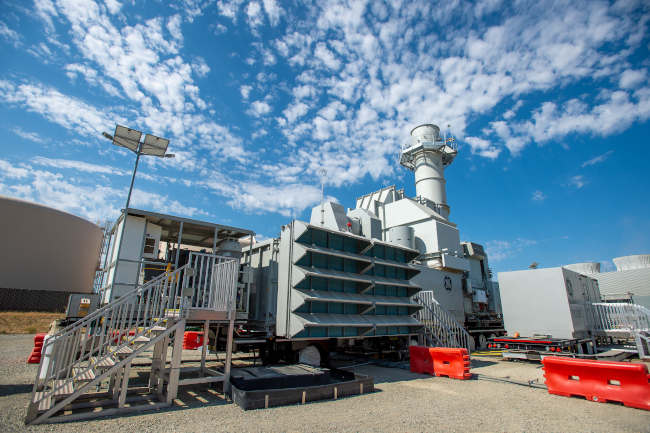
On Monday evening, the California Independent System Operator, or Cal ISO, requested the activation of temporary emergency power generators deployed by the Department of Water Resources, or DWR, in Roseville and Yuba City.
In total, the four generators can provide up to 120 megawatts of electricity to the statewide power grid during extreme heat events like the state is experiencing this week. That’s enough electricity to power up to 120,000 homes.
This was the first time that the generators were activated since they were installed last year.
DWR along with its energy partners at ISO and the California Energy Commission put this plan into motion following Gov. Newsom’s executive order in July 2021.
The agencies were able to deploy these units quickly and have them ready for any extreme heat events, wildfires or other climate-driven energy emergencies.
“DWR has been planning for this moment for months and we’re proud of our role in safeguarding the statewide energy grid. We are doing everything possible to help keep the lights on and the air conditioning running so millions of Californians can stay safe and healthy during this extreme heat event,” said Karla Nemeth, DWR director.
The temporary emergency power generators are powered by natural gas and are equipped with Selective Catalytic Reduction systems to reduce emissions and limit air quality impacts. The program is designed to support a transition to a clean energy future and is temporary in nature.
In addition to the 120 megawatts of generation from the temporary emergency power generators, DWR has coordinated with PG&E and Southern California Edison to procure, install, and operate dozens of backup generators to be operated only during a level 2 power emergency, as declared by ISO.
These backup generators are located in Northern California and Southern California and can provide up to an additional 80 megawatts of electricity into the statewide grid.
DWR is also developing the Strategic Reliability Infrastructure Assets program approved in June as part of the state's Strategic Electricity Reliability Reserve.
Programs under the reserve will result in a diverse set of backup electricity resources to act as an insurance for all utilities and balancing areas in the state as they address this challenge along with increasingly frequent and extreme climate-driven events and supply chain and related issues over the coming years.
- Details
- Written by: Jasmina Burek, UMass Lowell

Energy efficiency can save homeowners and renters hundreds of dollars a year, and the new Inflation Reduction Act includes a wealth of home improvement rebates and tax incentives to help Americans secure those saving.
It extends tax credits for installing energy-efficient windows, doors, insulation, water heaters, furnaces, air conditioners or heat pumps, as well as for home energy audits. It also offers rebates for low- and moderate-income households’ efficiency improvements, up to US$14,000 per home.
Together, these incentives aim to cut energy costs for consumers who use them by $500 to $1,000 per year and reduce the nation’s climate-warming greenhouse gas emissions.
With so many options, what are the most cost-effective moves homeowners and renters can make?
My lab at UMass Lowell works on ways to improve sustainability in buildings and homes by finding cost-effective design solutions to decrease their energy demand and carbon footprint. There are two key ways to cut energy use: energy-efficient upgrades and behavior change. Each has clear winners.
Stop the leaks
The biggest payoff for both saving money and reducing emissions is weatherizing the home to stop leaks. Losing cool air in summer and warm air in winter means heating and cooling systems run more, and they’re among the most energy-intensive systems in a home.
Gaps along the baseboard where the wall meets the floor and at windows, doors, pipes, fireplace dampers and electrical outlets are all prime spots for drafts. Fixing those leaks can cut a home’s entire energy use by about 6%, on average, by our estimates. And it’s cheap, since those fixes mostly involve caulk and weather stripping.

The Inflation Reduction Act offers homeowners a hand. It includes a $150 rebate to help pay for a home energy audit that can locate leaks.
While a professional audit can help, it isn’t essential – the Department of Energy website offers guidance for doing your own inspection.
Once you find the leaks, the act includes 30% tax credits with a maximum of $1,200 a year for basic weatherization work, plus rebates up to $1,600 for low- and moderate-income homeowners earning less than 150% of the local median.
Replace windows
Replacing windows is more expensive upfront but can save a lot of money on energy costs. Leaky windows and doors are responsible for 25% to 30% of residential heating and cooling costs, according to Department of Energy estimates.
Insulation can also reduce energy loss. But with the exception of older homes with poor insulation and homes facing extreme temperatures, it generally doesn’t have as high of a payoff in whole-house energy savings as weatherization or window replacement.
The Inflation Reduction Act includes up to $600 to help pay for window replacement and $250 to replace an exterior door.
Upgrade appliances, especially HVAC and dryers
Buildings cumulatively are responsible for about 40% of U.S. energy consumption and associated greenhouse gas emissions, and a significant share of that is in homes. Heating is typically the main energy use.
Among appliances, upgrading air conditioners and clothes dryers results in the largest environmental and cost benefits; however, HVAC systems – heating, ventilation and air conditioning – come with some of the highest upfront costs.
That includes energy-efficient electric heat pumps, which both heat and cool a home. The Inflation Reduction Act offers a 30% tax credit up to $2,000 available to anyone who purchases and installs a heat pump, in addition to rebates of up to $8,000 for low- and moderate-income households earning less than 150% of the local median income. Some high-efficiency wood-burning stoves also qualify.
The act also provides rebates for low- and moderate-income households for electric stoves of up to $840, heat-pump water heaters of up to $1,750 and heat-pump clothes dryers of up to $840.
Change your behavior in a few easy steps
You can also make a pretty big difference without federal incentives by changing your habits. My dad was energy-efficient before it was hip. His “hobby” was to turn off the lights. This action itself has been among the most cost-saving behavioral changes.
Just turning out the lights for an hour a day can save a home up to $65 per year. Replacing old lightbulbs with LED lighting also cuts energy use. They’re more expensive, but they save money on energy costs.
We found that a homeowner could save $265 per year and reduce emissions even more by adopting a few behavioral changes including unplugging appliances not being used, line-drying clothes, lowering the water heater temperature, setting the thermostat 1 degree warmer at night in summer or 1 degree cooler in winter, turning off lights for an hour a day, and going tech-free for an hour a day.
Some appliances are energy vampires – they draw electricity when plugged in even if you’re not using them. One study in Northern California found that plugged-in devices, such as TVs, cable boxes, computers and smart appliances, that weren’t being used were responsible for as much as 23% of electricity consumption in homes.
Start with a passive solar home
If you’re looking for a home to rent or buy, or even to build, you can make an even bigger difference by looking at how it’s built and powered.
Passive solar homes take advantage of local climate and site conditions, such as having lots of south-facing windows to capture solar energy during cool months to reduce home energy use as much as possible. Then they meet the remaining energy demand with on-site solar energy.
Studies show that for homeowners in cold climates, building a passive design home could cut their energy cost by 14% compared with an average home. That’s before taking solar panels into account.
The Inflation Reduction Act offers a 30% tax credit for rooftop solar and geothermal heating, plus accompanying battery storage, as well as incentives for community solar – larger solar systems owned by several homeowners. It also includes a $5,000 tax credit for developers to build homes to the Energy Department’s Zero Energy Ready Homes standard.
The entire energy and climate package – including incentives for utility-scale renewable energy, carbon capture and electric vehicles – could have a big impact for homeowners’ energy costs and the climate. According to several estimates, it has the potential to reduce U.S. carbon emissions by about 40% by the end of this decade.
Jasmina Burek, Assistant Professor of Engineering, UMass Lowell
This article is republished from The Conversation under a Creative Commons license. Read the original article.
- Details
- Written by: Elizabeth Larson
The council will meet at 6 p.m. Tuesday, Sept. 6, in the council chambers at Lakeport City Hall, 225 Park St.
The agenda can be found here.
The council chambers will be open to the public for the meeting. Masks are highly encouraged where 6-foot distancing cannot be maintained.
If you cannot attend in person, and would like to speak on an agenda item, you can access the Zoom meeting remotely at this link or join by phone by calling toll-free 669-900-9128 or 346-248-7799.
The webinar ID is 973 6820 1787, access code is 477973; the audio pin will be shown after joining the webinar. Those phoning in without using the web link will be in “listen mode” only and will not be able to participate or comment.
Comments can be submitted by email to
Last week, Mayor Pro Tem Mireya Turner accepted the job of Lake County Community Development director on a permanent basis, as Lake County News has reported.
On the same day, Aug. 30, Turner immediately resigned her position on the Lakeport City Council after two terms.
On Tuesday, the council will be asked to direct City Clerk/Administrative Services Director Kelly Buendia to solicit applications to fill Turner’s seat and to work with Mayor Stacey Mattina to set a date and time for interviews at either a regular or special meeting.
At the same time, the council will be asked to nominate and elect a new mayor pro tem.
On Tuesday, the council is set to hold a public hearing for staff to introduce approval of entitlements related to the Parkside Residential Project, proposed by Waterstone Residential.
The newest plans for the property includes 128 new apartment units and 48 cluster homes on the 15-acre site at 1310 Craig Ave.
Staff will introduce the project’s general plan amendment, zoning code amendment and approval of a mitigated negative declaration under the California Environmental Quality Act.
The council will hold the first reading of the zone change ordinance and schedule a public hearing for a second reading of the ordinance for Sept. 20.
The Lakeport Planning Commission considered the project at its Aug. 10 meeting and is recommending the council approve it.
In other business on Tuesday, the council will receive a presentation about the second phase of a feasibility study on a recreation center, will discuss the revised commercial lease agreement with the Lakeport Yacht Club for use of the facility located at 15 Fifth St., and consider approving the associated purchase agreement for the procurement of a 2023 John Deere 310 SL backhoe.
On the consent agenda — items usually accepted as a slate on one vote — are ordinances; minutes of the special and regular meetings on Aug. 16; adoption of a resolution authorizing continued remote teleconference meetings of the Lakeport City Council and its legislative bodies pursuant to Government Code section 54953(e); approval of event application 2022-021, with staff recommendations, for the 2022 Climb Out of the Darkness event; approval of event application 2022-024, with staff recommendations, for the Lore of the Lake event; authorize the city manager to submit city of Lakeport responses to the 2021-2022 Lake County Civil Grand Jury 2021-2022 Final Report to the Lake County Superior Court; and conduct a second reading and adopt the ordinance amending section 17.52.040 of Title 17 of the Lakeport Municipal Code regarding the text of the Sign Ordinance.
The council also will hold a closed session for labor negotiations with the Lakeport Police Officers’ Association.
Email Elizabeth Larson at
- Details
- Written by: John Logan, San Francisco State University

Labor Day 2022 comes smack bang in the middle of what is increasingly looking like a pivotal year in the history of American unions.
The summer has seen a steady stream of workforce mobilizations. Employees at Trader Joe’s locations in Massachusetts and Minneapolis both voted to unionize. Meanwhile, restaurant chain Chipotle saw the first of its stores unionize, following a vote by workers at an outlet in Lansing, Michigan.
It comes on the back of a wave of successful efforts to mobilize at Starbucks and Amazon. The growth of unionized stores at Starbucks in particular has been stunning. Since baristas in Buffalo, New York, became the first at the chain to unionize in December 2021, colleagues at a further 234 outlets have followed suit in recent months.
Likewise, the success of an independent Amazon Labor Union – formed in 2020 by Chris Smalls, an Amazon worker fired for protesting what he saw as inadequate COVID-19 safety precautions – in forming the first plant of the retail giant to have a unionized workforce has inspired others to do likewise.
It comes as polling shows that public support of unions is at its highest since 1965, with the backing of 71% of Americans. Something is definitely happening in the labor movement in 2022.
A different kind of organizing
As a scholar of the labor movement who has observed union drives for two decades, what I find almost as striking as the victories is the unconventional nature of the organizing campaigns.
Workers at Amazon and Trader Joe’s are setting up independent unions, whereas at Starbucks and Chipotle, employees are teaming up with established unions. But that difference apart, the dynamics at play are remarkably similar: The campaigns are being led by determined young workers. For the most part, it is bottom-up unionizing, rather than being driven by official, seasoned union representatives.
Inspired by pro-union sentiment in political movements, such as Bernie Sanders’ presidential bids, Black Lives Matter and the Democratic Socialists of America, individuals are spearheading the efforts for workplace reform rather than professional union organizers. Indeed, one would be hard-pressed to find many experienced organizers among the recent successful campaigns.
Instead, the campaigns have involved a significant degree of “self-organization” – that is, workers “talking union” to each other in the warehouse and coffee shops and reaching out to colleagues in other shops in the same city and across the nation. This marks a sea change from the way the labor movement has traditionally operated, which has tended to be more centralized and led by seasoned union officials.
A labor revival
Perhaps more important than the victories at Starbucks, Amazon, Trader Joe’s and Chipotle themselves is their potential for creating a sense of optimism and enthusiasm around union organizing, especially among younger workers.
The elections follow years of union decline in the U.S., both in terms of membership and influence.
Prior to the COVID-19 pandemic, these recent labor wins would probably have seemed unimaginable. Powerful, wealthy corporations like Amazon and Starbucks appeared invincible then, at least in the context of National Labor Relations Board rules, which are stacked heavily against pro-union workers. Under NLRB rules, employers can – and do – force workers, on the threat of dismissal, to attend anti-union sessions, often led by highly paid external consultants.
Starbucks has said it has been “consistent in denying any claims of anti-union activity. They are categorically false.” But the NLRB has alleged that the coffee chain has fired and coerced workers, placed union supporters under surveillance and retaliated against them.
The NLRB has also filed a complaint against Starbucks for unlawfully withholding wage and benefit increases from pro-union workers, and currently has almost 300 open unfair labor practices charges lodged against Starbucks management. Amazon, which in the past has advertised for analysts to monitor “labor organizing threats,” has said it respects workers’ rights to join or not join unions.
The significance of the recent victories is not primarily about the 8,000 new union members at Amazon or a gradual flow of new union members at Starbucks. It is about instilling in workers the belief that if pro-union workers can win at Amazon and Starbucks, they can win anywhere.
Historic precedents show that labor mobilization can be infectious.
In 1936 and 1937, workers at the Flint plant of General Motors brought the powerful automaker to its knees in a sit-down strike that quickly inspired similar action elsewhere. In the reported words of a Chicago doctor, when explaining a subsequent sit-down strike by wet nurses in the city: “It’s just one of those funny things. They want to strike because everyone else is doing it.”
Seizing the moment
The pandemic has created an opportunity for unions.
After working on the front lines for over two years, many essential workers such as those at Amazon and Trader Joe’s believe they have not been adequately rewarded for their service during the pandemic and have not been treated with respect by their employers.
This appears to have helped spur the popularity of smaller, workplace-specific unions.
The homegrown nature of these campaigns deprives chains of employing a decades-old trope at the heart of corporate anti-union campaigns: that a union is an external “third party” that doesn’t understand or care about the concerns of employees and is more interested in collecting dues.
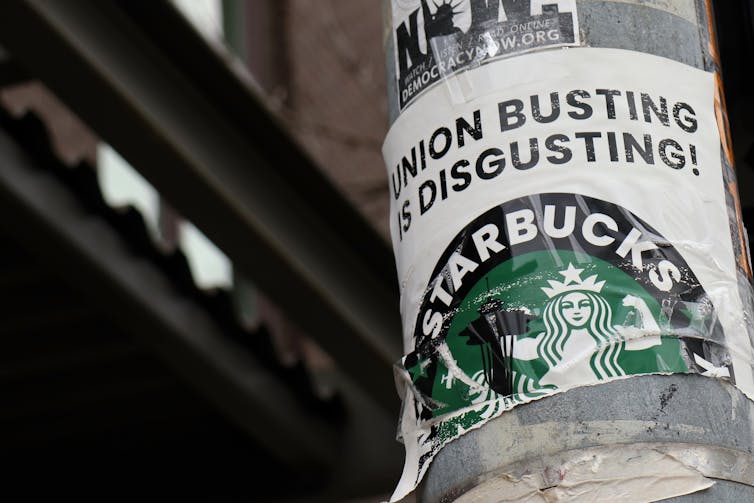
But those arguments mostly ring hollow when the people doing the unionizing are colleagues they work alongside day in and day out.
It has the effect of nullifying that central argument of anti-union campaigns despite the many millions of dollars that companies often pumped into them.
An unfavorable legal landscape
This “self-organization” is consistent with what was envisioned by the authors of the 1935 Wagner Act, the statute that provides the foundation of today’s union representation procedures.
The National Labor Relations Board’s first chair, J. Warren Madden, understood that self-organization could be fatally undermined if corporations were allowed to engage in anti-union pressure tactics:
“Upon this fundamental principle – that an employer shall keep his hands off the self-organization of employees – the entire structure of the act rests,” he wrote.“ Any compromise or weakening of that principle strikes at the root of the law.”
Over the past half century, anti-union corporations and their consultants and law firms – assisted by Republican-controlled NLRBs and right-wing judges – have undermined that process of worker self-organization by enabling union elections to become employer-dominated.
But for the long-term decline in union membership to be reversed, I believe pro-union workers will need stronger protections. Labor law reform is essential if the almost 50% of nonunion American workers who say they want union representation are to have any chance of getting it.
Dispelling fear, futility and apathy
Lack of popular interest has long been an obstacle to labor law reform.
Meaningful labor law reform is unlikely to happen unless people are engaged with the issues, understand them and believe they have a stake in the outcome.
But media interest in the campaigns at Starbucks and Amazon suggests the American public may finally be paying attention.
It isn’t known where this latest labor movement – or moment – will lead. It could evaporate or it may just spark a wave of organizing across the low-wage service sector, stimulating a national debate over workers’ rights in the process.
The biggest weapons that anti-union corporations have in suppressing labor momentum are the fear of retaliation and a sense that unionization is futile. The recent successes show unionizing no longer seems so frightening or so futile.
This is an updated version of an article originally published on April 4, 2022.
John Logan, Professor and Director of Labor and Employment Studies, San Francisco State University
This article is republished from The Conversation under a Creative Commons license. Read the original article.