 How to resolve AdBlock issue?
News
- Details
- Written by: Elizabeth Larson
The National Weather Service’s excessive heat warning for a large swath of California will remain in effect until 10 p.m. Friday.
In Lake County, forecasters are warning of dangerously hot conditions on Friday, with temperatures of up to 110 degrees Fahrenheit.
That’s been the case all this week, with reports of temperatures that topped 110 degrees coming in from around Lake County, peaking midweek.
This week’s hot temperatures have led the California Independent System Operator, or Cal ISO — which operates the state’s energy grid — to issue several energy emergency alerts and flex alerts because of the stress on the power supply as Californians try to stay cool.
Cal ISO said Thursday night that it has issued a flex alert for 4 to 9 p.m. Friday.
“We are grateful to Californians and our many partners across the West who continue to help the #ISO work through this very challenging week,” Cal ISO said in a Thursday night tweet.
While the National Weather Service is anticipating more “unseasonably hot afternoon temperatures” continuing through Friday, there’s hopeful news in the forecast.
The agency said a significant cooling trend will occur this weekend with below normal temperatures likely next week.
Forecasters said temperatures will begin to moderate this weekend as a trough — an area of low pressure in the atmosphere — approaches the North Coast. The National Weather Service said troughs extend toward the equator and usually are associated with cool, wet weather.
Moisture from Hurricane Kay is expected to spread over the North Coast from Saturday night to early Sunday, although the Lake County forecast does not indicate rain will result. However, conditions are expected to be cooler.
“An upper level trough will linger across the area next week resulting in cooler weather and below normal high temperatures,” the National Weather Service said in its long-range forecast.
The specific Lake County forecast calls for daytime temperatures dropping into the high 80s to low 90s on Saturday, and then into the lower 80s through Monday, and into the high 70s through Thursday.
Nighttime temperatures will range from the high 60s over the weekend into the low 50s through late next week.
Email Elizabeth Larson at
- Details
- Written by: US DEPARTMENT OF THE INTERIOR
WASHINGTON, DC — The Department of the Interior on Thursday announced the Board on Geographic Names has voted on the final replacement names for nearly 650 geographic features featuring a derogatory term used to describe Native American women, including 80 in California.
The final vote completes the last step in the historic efforts to remove the word “squaw” — a term that has historically been used as an offensive ethnic, racial and sexist slur, particularly for Indigenous women — from federal use.
“I feel a deep obligation to use my platform to ensure that our public lands and waters are accessible and welcoming. That starts with removing racist and derogatory names that have graced federal locations for far too long,” said Secretary Deb Haaland. “I am grateful to the members of the Derogatory Geographic Names Task Force and the Board on Geographic Names for their efforts to prioritize this important work. Together, we are showing why representation matters and charting a path for an inclusive America.”
Three sites in Lake County are included and are being renamed:
• Big Sq__ Valley will now be known as Habematolel Valley.
• Little Sq__ Valley is now Log Valley.
• Sq__ Valley Creek is now Habematolel Creek.
Among neighboring counties, Mendocino County had five sites renamed, and one each in Colusa, Glenn and Sonoma counties.
The list of new names can be found on the U.S. Geological Survey website with a map of locations, which also can be viewed above.
The final vote reflects a months-long effort by the Derogatory Geographic Names Task Force established by Secretary’s Order 3404, which included representatives from the Department’s Bureau of Indian Affairs, Bureau of Land Management, Bureau of Safety and Environmental Enforcement, National Park Service, Office of Diversity, Inclusion and Civil Rights, Office of Surface Mining Reclamation and Enforcement, and the U.S. Geological Survey and the Department of Agriculture’s U.S. Forest Service.
During the public comment period, the Task Force received more than 1,000 recommendations for name changes. Nearly 70 Tribal governments participated in nation-to-nation consultation, which yielded another several hundred recommendations.
While the new names are immediately effective for federal use, the public may continue to propose name changes for any features — including those announced today — through the regular BGN process.
The renaming effort included several complexities: evaluation of multiple public or Tribal recommendations for the same feature; features that cross Tribal, federal and state jurisdictions; inconsistent spelling of certain Native language names; and reconciling diverse opinions from various proponents. In all cases, the Task Force carefully evaluated every comment and proposal.
In July, the Department announced an additional review by the BGN for seven locations, including in California, that are considered unincorporated populated places. Noting that there are unique concerns with renaming these sites, the BGN will seek out additional review from the local communities and stakeholders before making a final determination.
Secretary's Order 3404 and the Task Force considered only the sq___ derogatory term in its scope. Secretary’s Order 3405 created a Federal Advisory Committee for the Department to formally receive advice from the public regarding additional derogatory terms, derogatory terms on federal land units, and the process for derogatory name reconciliation. Next steps on the status of that Committee will be announced in the coming weeks.
- Details
- Written by: MARIA G. HOFFMAN, MARK A. KLEE AND BRIANA SULLIVAN
Baby boomers, men and non-Hispanic White and Asian individuals are the nation’s most likely to own retirement accounts, according to newly released data from the U.S. Census Bureau.
The 2021 Survey of Income and Program Participation, or SIPP, includes new questions that help shine a light on how people were preparing for retirement in 2020.
It highlights differences in retirement assets by generations, sex, race and ethnicity.
This report also updates similar estimates for 2013 from a recently released paper that used data from the 2014 Social Security Administration Supplement and the 2014 SIPP.
Overall ownership rates
The SIPP has historically asked individuals to report whether they own any retirement accounts, which are categorized into:
• 401(k), 403(b), 503(b), and Thrift Savings Plans: employer-sponsored defined-contribution plans that deliver tax benefits. Employees choose how much to contribute, subject to annual contribution limits, and some employers match employee contributions.
• Individual Retirement Accounts (IRA) and Keogh accounts: defined-contribution plans that also provide tax benefits for retirement savings. Individuals choose how much to contribute, subject to annual contribution limits. The plans have account values that can provide income during retirement.
• Defined-benefit and cash balance plans: plans that typically deliver regular payments to support retirees. Payments from a defined-benefit plan often depend on an employee’s earnings and length of service, while cash balance plans define the benefit in terms of a stated account balance.
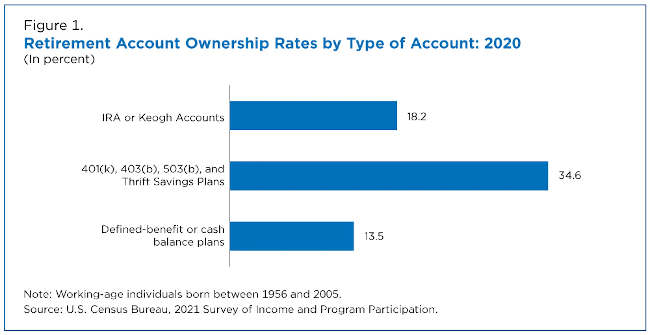
Among working-age individuals (ages 15 to 64), the most common type of retirement accounts in 2020 were 401(k)-style accounts (34.6%). About 18% of working-age individuals had an IRA or Keogh account, and 13.5% had a defined-benefit or cash balance plan.
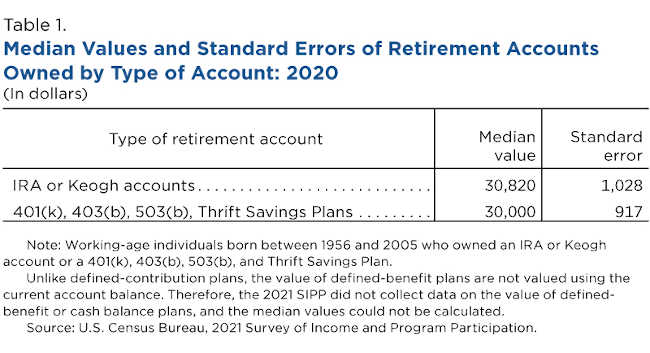
The median value of 401(k)-style accounts was $30,000 and the median IRA or Keogh value was $30,820 — not statistically different.
Demographics of ownership
Overall rates, however, mask substantial inequality among those who own retirement accounts.
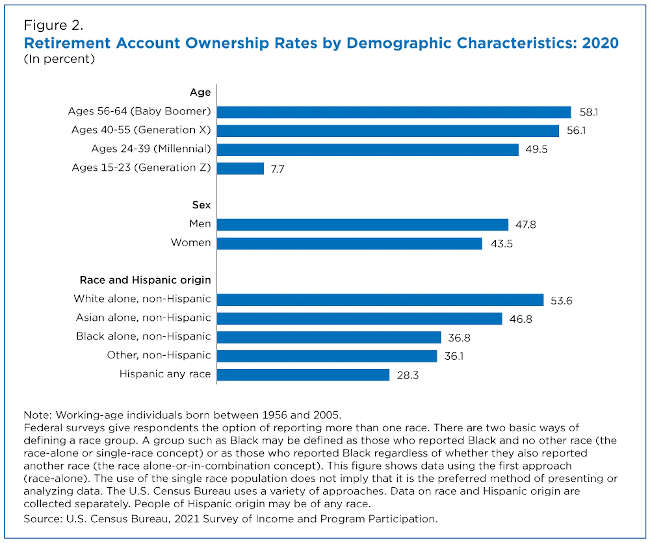
In 2020, working-age baby boomers ages 56 to 64 were the most likely to own at least one type of retirement account (58.1%).
Generation or Gen X members ages 40 to 55 were the next most likely to own retirement accounts (56.1%).
About half (49.5%) of Millennials ages 24 to 39 owned at least one type of retirement account but only 7.7% of Generation or Gen Z members ages 15 to 23 owned a retirement account.
While members of Generation Z were least likely to own a retirement account as of 2020, they also have the most time to accumulate additional retirement savings. According to previous work showing SIPP estimates for 2013, only 17.7% of Millennials owned retirement accounts when they were ages 15 to 31.
Current SIPP estimates show how Millennials’ retirement account ownership grew as they aged and gained labor market experience. Future SIPP estimates will show the evolution of retirement account ownership for Gen Z members as they age and accumulate labor market experience.
Men were slightly more likely (47.8%) than women (43.5%) to own a retirement account in 2020.
There were also differences in ownership by race and Hispanic origin.
About 54% of non-Hispanic White individuals owned a retirement account, and 46.8% of non-Hispanic Asian individuals owned a retirement account.
About 37% of non-Hispanic Black individuals and 36.1% of “Other” non-Hispanic individuals (i.e., American Indian or Alaska Native, Native Hawaiian or Other Pacific Islander or multiracial) owned at least one retirement account but the difference is not statistically significant.
Ownership rates (28.3%) were lowest among Hispanic individuals.
Saving for retirement
The 2021 SIPP featured new questions on employee and employer contributions to retirement accounts sponsored by an individual’s main employer. For each account type, individuals were asked whether they made contributions, and if so, how much.
This article focuses on employee contributions but the SIPP also asked owners of 401(k)-style and IRA or Keogh accounts whether their employer made contributions, and if so, the amount contributed.
The amount individuals receive from their defined-contribution plans (401(k)-style and IRA or Keogh accounts) when they retire is based on contributions and investment gains or losses.
Although employees may contribute to a pension plan, defined-benefit plans guarantee a specified monthly benefit at retirement based on salary history and length of service, rather than total contributions and investment returns.
Some individuals may own retirement accounts without actively making contributions.
Consider an individual who quits a job with an employer-sponsored 401(k) to open their own business. They still have that 401(k) but can no longer contribute. Others may be experiencing financial hardship that prevents them from contributing to their retirement accounts.
So, to understand how people save for retirement, we need to consider not only who owns retirement accounts but also who contributes to their retirement accounts and the value of those contributions.
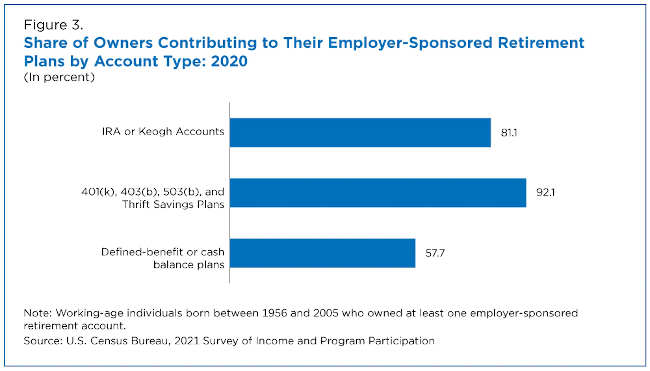
In 2020, 92.1% of 401(k)-style account owners and 81.1% of IRA or Keogh account owners contributed to their employer-sponsored retirement accounts, regardless of the frequency of their contributions. A smaller share (57.7%) of pension holders contributed to their employer-sponsored defined-benefit or cash balance plan.
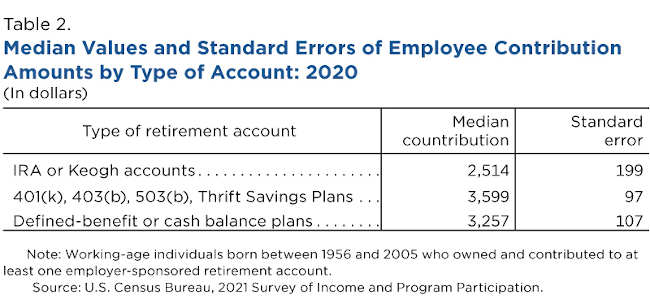
The median total amount employees contributed in 2020 to their own IRA or Keogh account was $2,514. The median amount they contributed to their 401(k)-style accounts ($3,599) and pension plans ($3,257) was slightly higher. Future research will examine employer contributions in combination with employee contributions.
What is the SIPP?
The Survey of Income and Program Participation is a nationally representative longitudinal survey administered by the U.S. Census Bureau that provides comprehensive information on the dynamics of income, employment, household composition and government program participation.
Beginning with the 2021 interview, the SIPP asked a series of questions sponsored by the Social Security Administration (SSA) about employer-sponsored retirement and pension plan coverage. These questions are a revised version of questions included in the 2014 SSA Supplement and the Retirement and Pension Plan Coverage Topical Module administered as far back as the 1984 SIPP panel.
The new questions provide insight into employer-sponsored retirement plans offered by current and prior employers, income withdrawn or received from these accounts and amounts contributed to retirement accounts by employers and employees.
Survey statistics are subject to sampling and nonsampling error. For technical documentation and more information about SIPP data quality, visit the Technical Documentation page.
Maria G. Hoffman and Mark A. Klee are survey statisticians in the Census Bureau’s Social, Economic, and Housing Statistics Division. Briana Sullivan is an economist in the Social, Economic, and Housing Statistics Division.
- Details
- Written by: Elizabeth Larson
The City of Clearlake Animal Association also is seeking fosters for the animals waiting to be adopted.
Call the Clearlake Animal Control shelter at 707-273-9440, or email
Visit Clearlake Animal Control on Facebook or on the city’s website.
The following dogs are available for adoption. New additions are at the top.
‘Bluey’
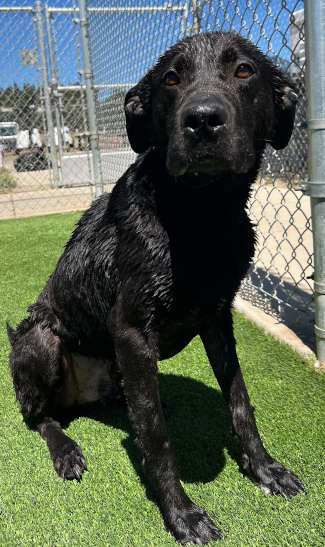
“Bluey” is a male retriever mix with a short black coat.
He has been neutered.
He’s been on a visit with a foster family and enjoys time in the pool.
He is dog No. 50552999.

‘Andy’
“Andy” is a male American pit bull mix with a short gray and white coat.
He is dog No. 48995415.

‘Bear’
“Bear” is a male Labrador retriever-American pit bull mix with a short charcoal and fawn coat.
He has been neutered.
He is dog No. 48443153.
‘Big Phil’
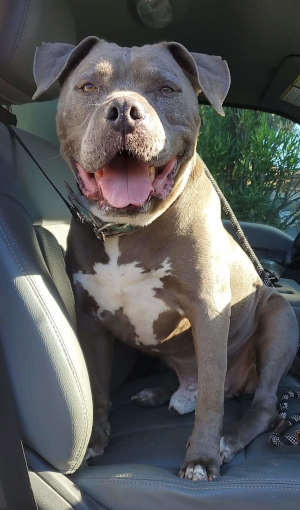
“Big Phil” is a 13-year-old male American pit bull terrier mix with a blue coat.
He has been neutered.
He is dog No. 49951647.

‘Hakuna’
“Hakuna” is a male shepherd mix with a tan coat.
He has been neutered.
He is dog No. 50176912.
‘Hondo’
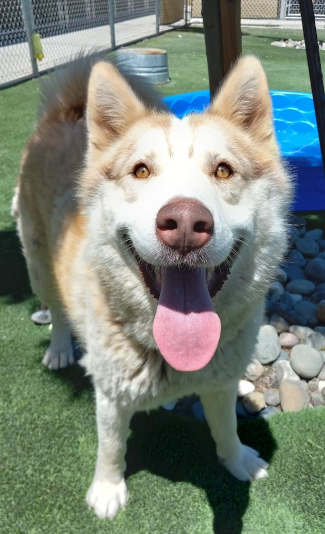
“Hondo” is a male Alaskan husky mix with a buff coat.
He has been neutered.
He’s dog No. 50227693.

‘Kubota’
“Kubota” is a male German shepherd mix with a short tan and black coat.
He has been neutered.
Kubota is dog No. 50184421.
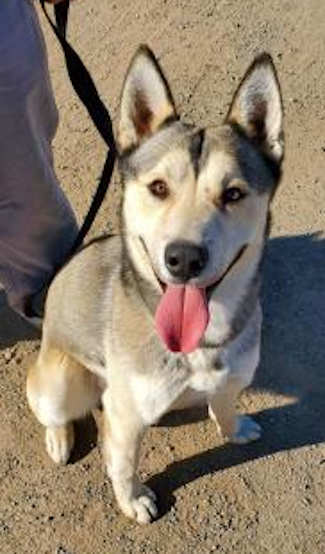
‘Mamba’
“Mamba” is a male Siberian husky mix with a gray and cream-colored coat.
He has been neutered.
He is dog No. 49520569.
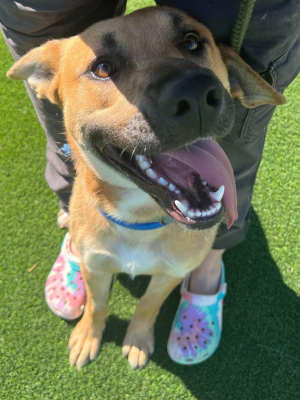
‘Matata’
“Matata” is male shepherd mix with a tan coat.
He has been neutered.
He is dog No. 50176912.
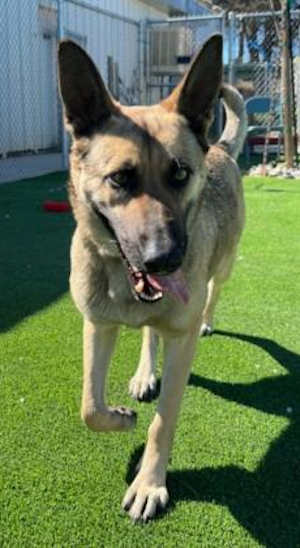
‘Sadie’
“Sadie” is a female German shepherd mix with a black and tan coat.
She has been spayed.
She is dog No. 49802563.
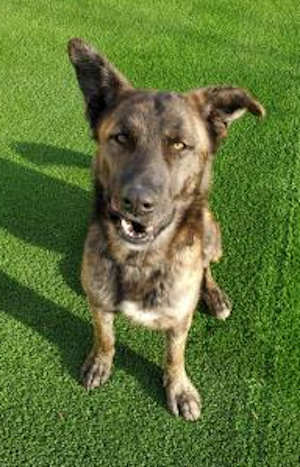
‘Terry’
“Terry” is a handsome male shepherd mix with a short brindle coat.
He gets along with other dogs, including small ones, and enjoys toys. He also likes water, playing fetch and keep away.
Staff said he is now getting some training to help him build confidence.
He is dog No. 48443693.
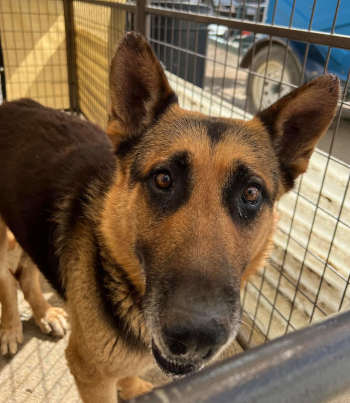
‘Willie’
“Willie” is a male German shepherd mix with a black and tan coat.
He has been neutered.
He is dog No. 50596003.
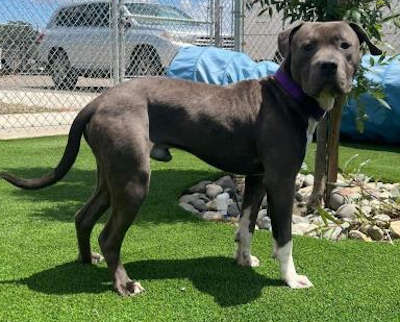
‘Ziggy’
“Ziggy” is a male American pit bull terrier mix with a short gray and white coat.
He has been neutered.
Ziggy is dog No. 50146247
Email Elizabeth Larson at