 How to resolve AdBlock issue?
News
- Details
- Written by: Kara Manke
A new study appearing this week in the journal Science identifies the political factors that allow some countries to take the lead in adopting cleaner sources of energy while others lag behind. The findings offer important lessons as many governments around the world race to reduce greenhouse gas emissions and limit the devastating impacts of climate change.
“We are really interested in understanding how national differences mediate the responses of countries to the same kind of energy challenge,” said study lead author Jonas Meckling, an associate professor of energy and environmental policy at the University of California, Berkeley. “We found that the political institutions of countries shape how much they can absorb costly policies of all kinds, including costly energy policies.”
By analyzing how different countries responded to the current energy crisis and to the oil crisis of the 1970s, the study reveals how the structure of political institutions can help or hinder the shift to clean energy. Meckling carried out the analysis in collaboration with study co-authors Phillip Y. Lipscy of the University of Toronto, Jared J. Finnegan of University College London, and Florence Metz of the University of Twente, in the Netherlands.
Because policies that promote the transition to cleaner energy technologies are often costly in the short-term, they can garner significant political pushback from constituents, including consumers and corporations. The analysis found that the countries that were most successful at pioneering cleaner energy technologies had political institutions that helped absorb some of this pushback — either by insulating policymakers from political opposition or by compensating consumers and corporations for the extra costs associated with adopting new technologies.
For example, Meckling said, many countries in continental and northern Europe have created institutions that allow policymakers to insulate themselves from pushback by voters or lobbyists or to pay off constituencies impacted by the transition. As a result, many of these countries have been more successful at absorbing the costs associated with transitioning to a clean energy system, such as investing in greater wind capacity or upgrading transmission grids.
Meanwhile, countries that lack such institutions, such as the U.S., Australia and Canada, often follow market-driven transitions, waiting for the price of new technologies to drop before adopting them.
“We can expect that countries that can pursue the insulation or compensation path will be early public investors in these very costly technologies that we need for decarbonization, such as hydrogen fuel cells and carbon removal technologies,” Meckling said. “But once these new technologies become cost competitive in the market, then countries like the U.S. can respond relatively rapidly because they are so sensitive to price signals.”
One way to help insulate policymakers from political pushback is to hand over regulatory power to independent agencies that are less subject to the demands of voters or lobbyists. The California Air Resources Board (CARB), a relatively autonomous agency that has been tasked with implementing many of California’s climate goals, is a prime example of such an institution. Thanks in part to CARB, California is often considered a global leader in limiting greenhouse gas emissions, despite being a state within the U.S.
Germany, another global climate leader, is instead using compensation to achieve its ambitious climate goals. For example, the Coal Compromise brought together disparate groups — including environmentalists, coal executives, trade unions and leaders from coal mining regions — to agree on a plan to phase out coal by the year 2038. To achieve this goal, the country will provide economic support to workers and regional economies that are dependent on coal, while bolstering the job market in other industries.
“We want to show that it's not just resource endowments that shape how countries respond to energy crises, it's also politics,” Meckling said.
The U.S., as a whole, does not have strong institutions in place to absorb political opposition to costly energy policies. However, Meckling said that policymakers can still drive the energy transition forward by leveraging the leadership of states like California by focusing on policies that have more dispersed costs and less political opposition — such as support for energy research and development — and by clearing the way for the market to adopt new technologies once the cost has gone done.
“Countries like the U.S. that do not have these institutions should at least focus on removing barriers once these clean technologies become cost competitive,” Meckling said. “What they can do is reduce the cost for market actors.”
Kara Manke writes for the UC Berkeley News Center.
- Details
- Written by: Elizabeth Larson
Dogs available for adoption this week include mixes of border collie, German shepherd, husky, Labrador retriever, pit bull and Rottweiler.
Dogs that are adopted from Lake County Animal Care and Control are either neutered or spayed, microchipped and, if old enough, given a rabies shot and county license before being released to their new owner. License fees do not apply to residents of the cities of Lakeport or Clearlake.
The following dogs at the Lake County Animal Care and Control shelter have been cleared for adoption.
Call Lake County Animal Care and Control at 707-263-0278 or visit the shelter online for information on visiting or adopting.

Male border collie
This 2-year-old male border collie has a black and white coat.
He is in kennel No. 18, ID No. LCAC-A-3995.

Labrador retriever mix
This 2-year-old female Labrador retriever mix has a short black coat.
She is in kennel No. 19, ID No. LCAC-A-3994.
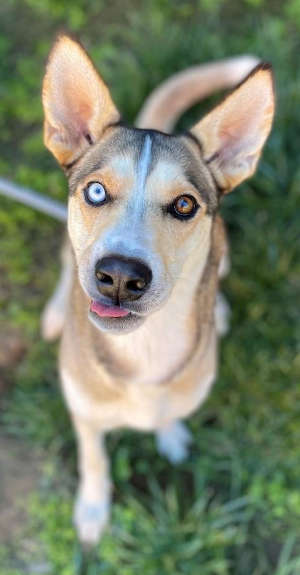
Male husky
This 3-year-old male husky has a short tricolor coat.
He is in kennel No. 22, ID No. LCAC-A-4014.

Male pit mix puppy
This 2-month-old male pit bull terrier mix puppy has a short gray and white coat.
He is in kennel No. 23c, ID No. LCAC-A-4118.

Female pit mix puppy
This 2-month-old female pit bull terrier mix puppy has a short white coat.
He is in kennel No. 24c, ID No. LCAC-A-4122.

Male German shepherd
This 2-year-old male German shepherd has a black and tan coat.
Shelter staff called him a “handsome sweet dude who is motivated by treats and does well walking on a leash.
He is in kennel No. 25, ID No. LCAC-A-3870.

German shepherd mix
This 7-month-old female German shepherd mix has a black and tan coat.
She is in kennel No. 26, ID No. LCAC-A-4011.

Female husky
This 1-year-old female husky has a cream and black coat.
She is in kennel No. 27, ID No. LCAC-A-3893.

German shepherd mix
This 7-month-old male German shepherd mix pup has a black and tan coat.
He is in kennel No. 28, ID No. LCAC-A-4012.

German shepherd-husky
This 1-year-old male German shepherd-husky mix has a short tan coat.
He is in kennel No. 32, ID No. LCAC-A-4079.

Rottweiler mix
This 4-year-old female Rottweiler has a short black and tan coat.
She is in kennel No. 34, ID No. LCAC-A-4013.
Email Elizabeth Larson at
- Details
- Written by: NATIONAL AERONAUTICS AND SPACE ADMINISTRATION
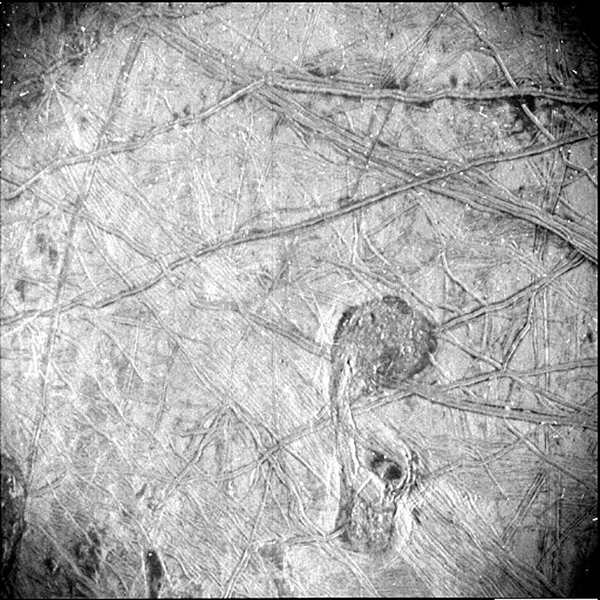
Observations from the spacecraft’s pass of the moon provided the first close-up in over two decades of this ocean world, resulting in remarkable imagery and unique science.
The highest-resolution photo NASA’s Juno mission has ever taken of a specific portion of Jupiter’s moon Europa reveals a detailed view of a puzzling region of the moon’s heavily fractured icy crust.
The image covers about 93 miles by 125 miles of Europa’s surface, revealing a region crisscrossed with a network of fine grooves and double ridges (pairs of long parallel lines indicating elevated features in the ice).
Near the upper right of the image, as well as just to the right and below center, are dark stains possibly linked to something from below erupting onto the surface.
Below center and to the right is a surface feature that recalls a musical quarter note, measuring 42 miles north-south by 23 miles east-west.
The white dots in the image are signatures of penetrating high-energy particles from the severe radiation environment around the moon.
Juno’s Stellar Reference Unit, or SRU – a star camera used to orient the spacecraft – obtained the black-and-white image during the spacecraft’s flyby of Europa on Sept. 29, 2022, at a distance of about 256 miles.
With a resolution that ranges from 840 to 1,115 feet per pixel, the image was captured as Juno raced past at about 15 miles per second over a part of the surface that was in nighttime, dimly lit by “Jupiter shine” — sunlight reflecting off Jupiter’s cloud tops.
Designed for lowlight conditions, the SRU has also proven itself a valuable science tool, discovering shallow lightning in Jupiter’s atmosphere, imaging Jupiter’s enigmatic ring system, and now providing a glimpse of some of Europa’s most fascinating geologic formations.
“This image is unlocking an incredible level of detail in a region not previously imaged at such resolution and under such revealing illumination conditions,” said Heidi Becker, the lead co-investigator for the SRU. “The team’s use of a star-tracker camera for science is a great example of Juno’s groundbreaking capabilities. These features are so intriguing. Understanding how they formed – and how they connect to Europa’s history — informs us about internal and external processes shaping the icy crust.”
It won’t just be Juno’s SRU scientists who will be busy analyzing data in the coming weeks. During Juno’s 45th orbit around Jupiter, all of the spacecraft’s science instruments were collecting data both during the Europa flyby and then again as Juno flew over Jupiter’s poles a short 7 ½ hours later.
“Juno started out completely focused on Jupiter. The team is really excited that during our extended mission, we expanded our investigation to include three of the four Galilean satellites and Jupiter’s rings,” said Juno Principal Investigator Scott Bolton of the Southwest Research Institute in San Antonio. “With this flyby of Europa, Juno has now seen close-ups of two of the most interesting moons of Jupiter, and their ice shell crusts look very different from each other. In 2023, Io, the most volcanic body in the solar system, will join the club.” Juno sailed by Jupiter’s moon Ganymede – the solar system’s largest moon – in June 2021.
Europa is the solar system’s sixth-largest moon with about 90% the equatorial diameter of Earth’s moon. Scientists are confident a salty ocean lies below a miles-thick ice shell, sparking questions about the potential habitability of the ocean.
In the early 2030s, the NASA’s Europa Clipper spacecraft will arrive and strive to answer these questions about Europa’s habitability. The data from the Juno flyby provides a preview of what that mission will reveal.
NASA’s Jet Propulsion Laboratory, a division of Caltech in Pasadena, California, manages the Juno mission for the principal investigator, Scott J. Bolton, of the Southwest Research Institute in San Antonio. Juno is part of NASA’s New Frontiers Program, which is managed at NASA’s Marshall Space Flight Center in Huntsville, Alabama, for the agency’s Science Mission Directorate in Washington. Lockheed Martin Space in Denver built and operates the spacecraft.
More information about Juno is available at https://www.nasa.gov/juno and https://www.missionjuno.swri.edu.
- Details
- Written by: LAKE COUNTY NEWS REPORTS
The ninth annual Heroes of Health & Safety Fair will be held on Saturday, Oct. 15.
It will take place from 10 a.m. to 2 p.m. at the Lake County Fairgrounds, 401 Martin St. in Lakeport.
Admission is free.
The event includes interactive demonstrations for the entire family, including “jaws-of-life” extractions, medical Helicopters, rescue vehicles and cardiopulmonary resuscitation.
There also will be information on boating and car seat safety, and how to administer naloxone in cases of overdose.
Free medical and dental services will be offered, from flu shots to health screenings, A1C blood glucose testing, fluoride dental screenings and trauma education.
There will be free giveaways, including bikes and helmets for children, and naloxone kids.
Organizers ask families to schedule their flu vaccine appointments at the event by visiting www.myturn.ca.gov. Last year they administered an estimated 300 flu vaccines.