 How to resolve AdBlock issue?
News
- Details
- Written by: Elizabeth Larson
Call Lake County Animal Care and Control at 707-263-0278 or visit the shelter online at http://www.co.lake.ca.us/Government/Directory/Animal_Care_And_Control.htm for information on visiting or adopting.
The following cats at the shelter have been cleared for adoption.

‘Mom’
“Mom” is a 2-year-old female domestic shorthair cat with an orange and white coat.
She is in kennel No. 3, ID No. LCAC-A-4080.

‘Mama’
“Mama” is a 2-year-old domestic shorthair cat with an all-black coat.
She is in cat room kennel No. 7, ID No. LCAC-A-3884.

Female domestic shorthair
This 2-year-old female domestic shorthair cat has a gray tabby coat.
“She is an adult cat with some playful kitten tendencies when toys are brought out. She has a sweet little meow and likes to have playful chats with you,” shelter staff said.
She is in cat room kennel No. 10, ID No. LCAC-A-3661.

Male domestic shorthair
This 3-year-old male domestic shorthair cat has an orange tabby coat.
“This guy can be shy at first, but once he knows that you are all about the pets, he will roll right over and start his purr machine. He has a unique curly tail which he flicks around when curious,” shelter staff said.
He is in cat room kennel No. 13, ID No. LCAC-A-4021.

Male domestic shorthair kitten
This 2-month-old male domestic shorthair kitten has a white coat and blue eyes.
He is in cat room kennel No. 36A, ID No. LCAC-A-4081.

Male domestic shorthair kitten
This 2-month-old male domestic shorthair kitten has a light orange coat.
He is in cat room kennel No. 36B, ID No. LCAC-A-4082.

Male domestic shorthair kitten
This 2-month-old male domestic shorthair kitten has an orange coat.
He is in cat room kennel No. 36C, ID No. LCAC-A-4083.

Male domestic longhair cat
This 1-year-old male domestic longhair cat has a black and white coat.
“This guy had a hard start, but has a lot of love to give once he warms up to you,” shelter staff said.
Staff said he also loves brushing and shows his appreciation with purring and head bumps.
He is in kennel No. 107, ID No. LCAC-A-4023.

This 2-month-old female domestic shorthair kitten has a white coat with orange markings.
She is in kennel No. 129a, ID No. LCAC-A-4084.

Female domestic shorthair kitten
This 2-month-old female domestic shorthair kitten has a gray coat with white markings.
She is in kennel No. 129b, ID No. LCAC-A-4085.

Female domestic shorthair kitten
This 2-month-old female domestic shorthair kitten has a tortoiseshell coat.
She is in kennel No. 129c, ID No. LCAC-A-4086.
Email Elizabeth Larson at
- Details
- Written by: Robert Sanders
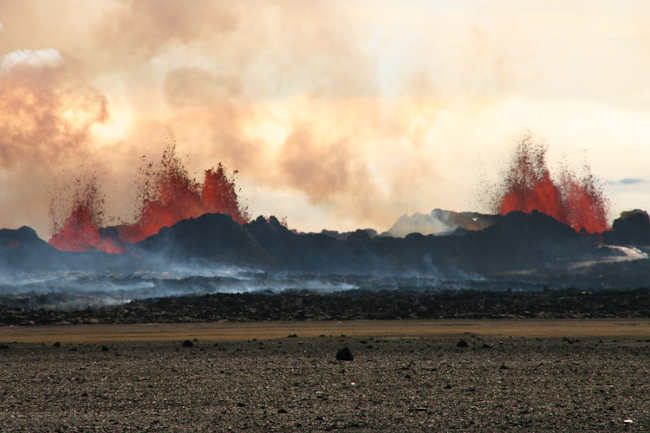
BERKELEY — Mass extinctions litter the history of life on Earth, with about a dozen known in addition to the five largest ones — the last of which, at the end of the Cretaceous Period 66 million years ago, killed off the dinosaurs and 70% of all life on Earth.
A new study, led by scientists at Dartmouth College in New Hampshire, concludes that most of these mass extinctions had one thing in common: They occurred after mega-eruptions that spewed volcanic lava and toxic gases for hundreds of thousands of years, and some for as long as a million years.
The analysis linking mass extinctions throughout Earth’s history with major eruptions, characterized by lava and gas spilling from perhaps dozens of volcanoes and long fissure vents, confirms what many geologists have suspected for years.
The most well-known mass extinction, referred to as the Cretaceous-Paleogene (K-Pg) extinction, was famously tied to a comet or asteroid impact in the Caribbean, but geologists have since found that the impact was preceded by a long period of eruptions in India that left behind flood basalts known today as the Deccan Traps.
Massive amounts of sulfur dioxide emitted during the long-term eruption would have cooled the planet and caused the massive die-off seen in the fossil record.
“It's been obvious to me for some time that there is this correlation between mass extinctions and flood basalt episodes,” said study co-author Paul Renne, professor-in-residence of earth and planetary science at the University of California, Berkeley, and director of the Berkeley Geochronology Center. “But nobody has approached it in the way that’s done in this work, which is to look at the actual rates at which the eruptions happened, which is presumably related to the rate at which climate modifying gases are injected into the atmosphere. And from the analysis, it looks like the rates really matter, especially for the really big ones.”
In fact, he said, there seems to be a threshold “beyond which you're going to get a mass extinction and below which you might get some minor climate perturbations, but not something that extinguishes half of all life on the planet.”
One implication of the study is that the K-Pg extinction was predestined by the Deccan Traps eruptions. The bolide impact was simply the coup de grâce.
“Our results indicate that in all likelihood there would have been a mass extinction at the Cretaceous-Paleogene boundary of some significant magnitude, regardless of whether there was an impact or not, which can be shown more quantitatively now,” Renne said. “The fact that there was an impact undoubtedly made things worse.”
The impact of repeated eruptions over millennia
The new study, publishedin the journal Proceedings of the National Academy of Sciences, shows that four of the five biggest mass extinctions over the past 540 million years — the so-called Phanerozoic Eon — and a handful of other smaller, but still planet-wide, mass extinctions correlate with major lava events that produced large igneous provinces. Known meteor impacts do not correlate with the timeline of mass extinctions.
In the study, a “large” igneous province is one containing at least 100,000 cubic kilometers of magma. For context, the 1980 eruption of Mount St. Helens in Washington involved less than 1 cubic kilometer of magma.
The researchers said that most of the volcanoes represented in the study erupted about a million times more lava than Mount St. Helens did.
The Deccan Traps, for example — traps is an Indian word for steps, because of the step-like structure of overlapping lava flows — erupted over a period of 1 million years and spewed lava flows for distances of at least 500 kilometers, in some places nearly 2 kilometers thick.
“The large, step-like areas of igneous rock from these big volcanic eruptions seem to line up in time with mass extinctions and other significant climactic and environmental events,” said the study’s lead author, Theodore Green, an undergraduate at Dartmouth College who conducted the research as part of the Senior Fellowship program. He now is a graduate student at Princeton University.
The researchers compared the best available estimates of flood basalt eruptions with periods of drastic species die-offs in the geological record. To prove that the correlation was more than chance, they examined whether the eruptions would line up just as well with a randomly generated pattern and repeated the exercise with 100 million such patterns. They determined that the chance that the correlation between eruptions and extinctions was merely random was one in 100.
“While it is difficult to determine if a particular volcanic outburst caused one particular mass extinction, our results make it hard to ignore the role of volcanism in extinction,” said Brenhin Keller, an assistant professor of earth sciences at Dartmouth and senior author of the paper. Keller was a postdoctoral fellow with Renne between 2016 and 2019.
Flood basalt eruptions aren't common in the geologic record, said Green. The last one of comparable, but significantly smaller, scale happened about 16 million years ago in the Pacific Northwest, producing what’s known as the Columbia River Basalt Province. According to Renne, the eruptions are accompanied by massive releases of carbon dioxide, which warms the atmosphere, as well as sulfur dioxide, which cools the atmosphere. Recent evidence indicates that the cooling that leads to a mass extinction is often preceded by warming because the CO2 is emitted first because of its lower solubility in magma than in sulfur.
Renne noted that improved dates for flood basalt events were key to providing better estimates of the rate of eruptions, which enabled the study.
“The punch line is that our ability to draw these kinds of quantitative conclusions have been limited by the availability of high precision geochronology data,” Renne said. “So, this is a poster child for the importance of geochronology.”
Note: Some of this text comes from a press release distributed by Dartmouth’s Office of Communications.
Robert Sanders writes for the UC Berkeley News Center.
- Details
- Written by: Mother-Wise
The evening is set aside to remember all babies lost to miscarriage, stillbirth and neonatal death.
Pregnancy and childbirth are usually joyous, happy and busy times. But when things don’t go as hoped or planned, when the unthinkable happens, families are left with the unimaginable devastation and profound grief that surrounds the loss of a baby.
In 1988 when President Ronald Reagan designated October as national Pregnancy and Infant Loss Awareness Month, he noted that, “When a child loses his parent, they are called an orphan. When a spouse loses her or his partner, they are called a widow or widower. When parents lose their child, there isn’t a word to describe them.”
This is still true, despite the fact that October was set aside to “recognize the loss so many parents experience across the U.S. and around the world.”
Oct. 15 was chosen as a day of remembrance throughout the world.
Since 2003, the global Wave of Light has served as an opportunity for bereaved parents, family and friends to commemorate their babies by lighting a candle at 7 p.m. in their local time zone and leaving it burning for at least one hour.
The result is a continuous “wave of light” spanning the globe for a 24-hour period in remembrance of all loved and longed for babies gone too soon.
Mother-Wise supports Lake County’s expecting and new moms through all transitions that accompany motherhood, including loss, with weekly topic-oriented groups, individualized supportive services, and community resources.
The organization has participated in this special day of remembrance to coincide with similar events worldwide since 2014.
Whether you have endured a loss yourself, or love someone who has, whether this loss was recent or long ago, all are welcome to join in the event.
Participants will meet at Library Park, located at 200 Park St. in Lakeport, and the event will take place from 6 to 8 p.m.
Light refreshments will be offered, as well as community speakers, and remembrance activities. Candles will be provided and lit at 7 p.m.
For any questions, or to RSVP, please contact Mother-Wise at 707-349-1210.
- Details
- Written by: California Highway Patrol
The goal of the Get Educated and Ride Safe, or GEARS, V grant is to decrease the number of motorcycle-involved crashes and victims through education and enforcement efforts across California through Sept. 30, 2023.
From Oct. 1, 2020, to Sept. 30, 2021, there were 7,078 motorcycle-involved crashes resulting in 354 deaths and 6,400 injuries within CHP jurisdiction, an increase of 3% over the previous 12 months.
“Motorcycle riders are statistically more likely to be injured or killed when involved in a crash,” said CHP Commissioner Amanda Ray. “In an effort to ensure every motorist reaches their destination safely, the CHP will continue to use enforcement and nonenforcement strategies, including education and community engagement, to target the leading causes of traffic deaths.”
During the grant period, the CHP will participate in traffic safety education efforts, such as “May is Motorcycle Safety Awareness Month.”
These campaigns will promote the use of U.S. Department of Transportation-compliant helmets for all riders and raise driver awareness of sharing the road with motorcyclists.
The CHP will also increase enforcement in areas with a high number of motorcycle-involved crashes, which resulted from speed, improper turns, and driving under the influence of alcohol and/or drugs.
Funding for this program was provided by a grant from the California Office of Traffic Safety, through the National Highway Traffic Safety Administration.
The mission of the CHP is to provide the highest level of safety, service and security.