 How to resolve AdBlock issue?
News
- Details
- Written by: Elizabeth Larson
The National Weather Service is predicting up to half an inch overnight and into Friday.
Another weather system is expected to arrive on Saturday, bringing with it another three quarters of an inch of rain. For Sunday, forecasters are calling for about a tenth of an inch.
Patchy fog is forecast for Sunday night and Monday morning, to be followed by clear and sunny conditions later in the week.
As for temperatures, nighttime conditions are forecast to be in the low 40s through Saturday, before dropping into the high 30s from Monday through Wednesday.
Daytime temperatures will be in the low to high 50s through Wednesday, with the exception of Sunday, when they drop into the high 40s.
Winds also are in the forecast through Sunday, with gusts of up to 25 miles per hour.
Email Elizabeth Larson at
- Details
- Written by: LAKE COUNTY NEWS REPORTS
Arcata Economic Development Corp. has received $5 million in COVID-19 Relief funding that is administered by the California Economic Development Department through the Community Economic Resilience Fund established by AB 2342 (Cervantes).
Thirteen regions across the state were funded, including the Redwood Coast Region, to support equity-centered carbon neutral economic development.
These planning funds will establish a High Road Transition Collaborative, or HRTC, for Del Norte, Humboldt, Lake and Mendocino counties.
Together, stakeholders will design a blueprint for the region’s recovery from COVID-19 and transition to a carbon-neutral economy.
The project will deploy a community and worker-centered approach to economic planning and development.
This 18-month process is designed to be complementary to existing economic development work within the region.
The local convener is the California Center for Rural Policy, or CCRP, at Cal Poly Humboldt, a research and evaluation center that promotes the health and well-being of people living in rural California.
The local community outreach and engagement partner is North Coast Opportunities, the Community Action Agency for Lake and Mendocino counties.
Recruitment is underway for talent to support communications, outreach, and administration for this new project.
“CCRP is excited to leverage its long history of participatory research and engagement in the region in the service of CERF goals. Our mission is to set a table where people of all backgrounds, workers, business leaders, professionals, and policymakers can collaborate towards a vision of a thriving, carbon neutral, and equitable future,” said CCRP Executive Director Dawn Arledge.
The first step will be to establish the Redwood Coast Region HRTC and begin work on the Regional Plan that is due to the State in March.
The HRTC will meet on Feb. 23 at 11 a.m. For more information about the Redwood Coast Region CERF project contact CCRP at
- Details
- Written by: Elizabeth Larson

CLEARLAKE, Calif. — There are dozens of beautiful dogs of many breeds waiting to be adopted this week at Clearlake Animal Control.
Among this week’s available dogs are two handsome German shepherds, “Evie,” a black female, and Willie, who has a black and tan coat.
There currently are 33 adoptable dogs at the shelter available to be adopted into new homes.

The shelter is located at 6820 Old Highway 53. It’s open from 9 a.m. to 6 p.m. Tuesday through Saturday.
For more information, call the shelter at 707-762-6227, email
This week’s adoptable dogs are featured below.
Email Elizabeth Larson at
- Details
- Written by: William Chittenden, Texas State University
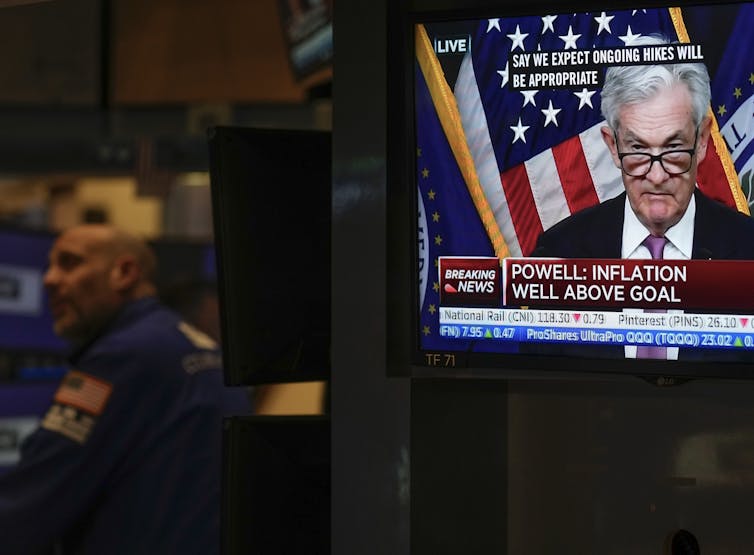
The Federal Reserve’s policy-setting committee lifted interest rates on Feb. 1, 2023, by a quarter of a percentage point to a range of 4.5% to 4.75%. The increase, the smallest since the Fed began an aggressive campaign of rate hikes in March 2022, came amid signs the fastest pace of inflation in decades is cooling. But the Fed also indicated more rate hikes are coming.
So why is the Fed slowing the size of rate increases now, and what does it mean for consumers? We asked finance scholar William Chittenden from Texas State University to explain what’s going on and what comes next.
Why did the Fed raise rates by only a quarter point?
The Fed is trying to figure out whether last year’s rate hikes have slowed the economy enough to get inflation near its target of about 2%.
By raising what’s known as the Fed funds rate, the U.S. central bank makes borrowing more expensive, which means buying large-ticket items, like cars and homes, is more costly. This should lead to fewer people buying cars, which will likely result in lower car prices.
In 2022, the Fed lifted rates eight times by a total of 4.25 percentage points, which helped prompt inflation to drop to an annual pace of 6.5% in December from 9.1% at its peak in June.
To understand why it’s so hard for the Fed to figure out if its rate hikes worked, think of the economy as a fully loaded oil tanker out in the ocean. Naturally, it’s chugging along as fast it can to reach a specific destination, but it takes a long time from the captain “stepping on the brakes” to when the ship actually stops moving forward.
Similarly, the Fed is raising rates to slow the economy – sort of like stepping on the brakes – and bring inflation down to 2%, but there’s often a long delay between the hikes and their impact on the economy.
But if the Fed eases off the brakes too early, inflation could remain high. If it presses on them too hard, unemployment will likely shoot up and the economy will slide into a recession. By increasing interest rates only a quarter-point, the Fed is signaling that it believes the economy has begun to slow down and is on a path to 2% inflation.
Does this mean borrowing costs will start coming down?
The Fed funds rate acts as a base rate for shorter-term interest rates, such as for car loans and credit cards. As it goes up, short-term borrowing rates increase by about the same amount.
The financial markets are predicting about an 80% chance the Fed’s benchmark lending rate will top out around 5% this summer – which means they’re expecting rates to go just a little bit higher.
Rates on shorter-term borrowing are unlikely to come down, but if markets are right, they probably won’t increase much more.
However, for long-term borrowing costs, as on a 30-year mortgage, rates are already coming down and are likely to fall some more – good news for homebuyers.
How about inflation – can consumers expect prices to start falling?
Overall, yes, inflation is already starting to come down – and prices on some items are even falling.
For example, used-car prices, which soared earlier in the COVID-19 pandemic, have dropped in recent months, while prices of dozens of other items, such as flour, clothes and gasoline, have eased.
However, some costs continue to increase. Egg prices soared after the supply was disrupted because of avian flu, which killed off nearly 53 million egg-laying hens. Unfortunately, increasing interest rates will not bring back those birds or help decrease the cost of eggs.
In addition, nothing the Fed does will affect the war in Ukraine, which has led to higher world wheat and energy prices.
The point being, the Fed can’t really address certain types of inflation.
Does all this mean the U.S. will avoid recession?
That’s the trillion-dollar question.
Fed officials have at times sounded hopeful that they can bring down inflation without crashing the economy – a so-called soft landing. During his press conference after the latest announcement Feb. 1, 2023, Fed Chair Jerome Powell was more cautious, saying it’s too soon to declare victory. But he noted: “We can now say for the first time that the disinflationary process has started.”
Economic forecasters have been less confident that the U.S. will avoid a recession. On average, economists surveyed this past month by The Wall Street Journal forecast a 61% probability of a recession in 2023. In addition, key economic indicators point to a recession, while the yield curve – a bond market metric that has been successful at predicting recessions – currently puts the odds at about 47%.
In my view, this all adds up to: Nobody really knows. My best advice to consumers out there is to prepare financially for a recession, but let’s not give up hope that the Fed can slow the economy without crashing it.
William Chittenden, Associate Professor of Finance, Texas State University
This article is republished from The Conversation under a Creative Commons license. Read the original article.