 How to resolve AdBlock issue?
News
- Details
- Written by: Elizabeth Larson
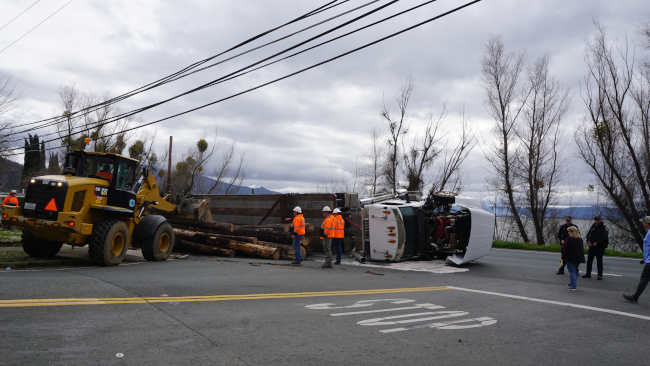
LUCERNE, Calif. — Traffic on a portion of Highway 20 in Lucerne was slowed for several hours on Friday afternoon after a log truck rolled over and spilled its load, blocked a part of the roadway.
The crash occurred just before 1 p.m. in the westbound lane of Highway 20 at Foothill Drive.
California Highway Patrol officers at the scene told Lake County News that the rollover appeared to have occurred due to a weight shift as the tractor trailer — carrying a load of large logs — was coming through a curve.
They said the truck was headed westbound to Ukiah. At that time, they did not have information on where it had traveled from on Friday.
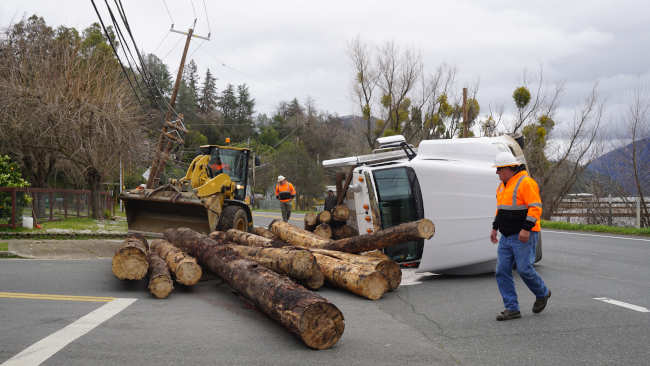
The truck had rolled onto the passenger side and was blocking the road, while the logs were along the shoulder.
The truck’s driver was uninjured but he appeared shaken. He left the scene with individuals who appeared to be coworkers as the cleanup continued. The CHP said no other vehicles were involved.
A team of Caltrans workers were at the scene clearing the logs from the side of the road and using heavy equipment to place them along the chain link fence bordering Lucerne Elementary on Foothill Drive.
The CHP said the logs had damaged a water main and two utility poles. Power was still on but a Mediacom pole was sheared off. Caltrans signs also were damaged.
Once the logs were moved, the CHP said two heavy duty tow trucks that were on scene will move both the tractor trailer and will deliver the logs to their destination in Ukiah.
Officers said the work was expected to continue for a few hours on Friday afternoon, with traffic control to remain in place.
Email Elizabeth Larson at
- Details
- Written by: LAKE COUNTY NEWS REPORTS
Charles Lee Williamson, age 45, of Clearlake pleaded no contest to a charge of lewd acts with a minor, said Deputy District Attorney Rich Watson, who prosecuted the case.
Watson said Williamson also admitted that he had a prior conviction of first degree burglary from 1998 out of Mendocino County which is a strike offense under California sentencing laws.
The charges against Williamson stem from a report that he sexually assaulted a minor multiple times from 2010 through 2020 while living in Clearlake.
The investigation showed that Williamson had access to the minor during the time periods he was not incarcerated.
On Jan. 30, Judge Michael S. Lunas sentenced Williamson to 16 years in state prison.
Lunas’ decision came after denying defense attorney Thomas Feimer’s motion requesting the court dismiss the prior strike allegation.
Even though the prior strike allegation was over 20 years old, Watson argued that the prior strike should still be enforced because Williamson has lived a life of crime since his burglary conviction in 1998.
Williamson’s record included multiple drug and weapons convictions, a felony sexual assault conviction in 2015, and a felony grand theft conviction from 2017.
Conviction for a charge of lewd acts with a minor, which is a violation of Penal Code section 288(b)(1), limits accrual of work time credits to no more than 15% as defined in the penal code.
- Details
- Written by: Elizabeth Larson

CLEARLAKE, Calif. — Clearlake Animal Control continues to have a full shelter of dogs needing to find their new families.
There currently are 34 adoptable dogs at the shelter available to be adopted into new homes.
Among the dogs available is Roman, a 4 year old border collie-German shepherd mix with a black and white coat. He has been neutered.
The shelter is located at 6820 Old Highway 53. It’s open from 9 a.m. to 6 p.m. Tuesday through Saturday.
For more information, call the shelter at 707-762-6227, email
Volunteers also are invited to apply to walk and care for the dogs.
This week’s adoptable dogs are featured below.
Email Elizabeth Larson at
- Details
- Written by: Pengfei Zhang, Penn State
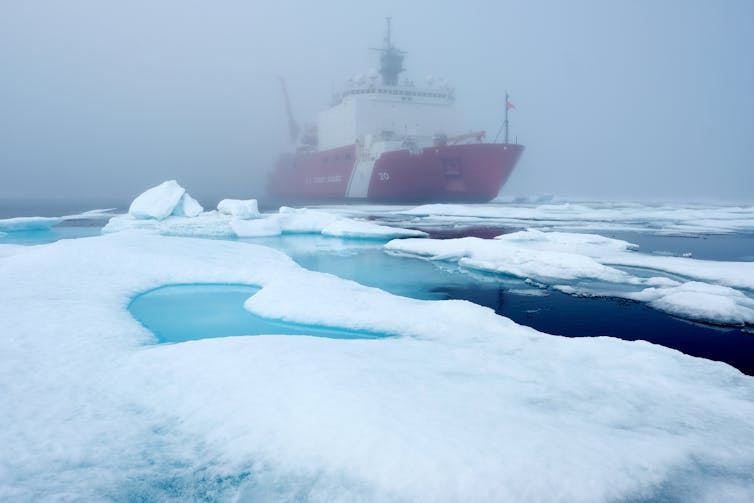
Atmospheric rivers, those long, powerful streams of moisture in the sky, are becoming more frequent in the Arctic, and they’re helping to drive dramatic shrinking of the Arctic’s sea ice cover.
While less ice might have some benefits – it would allow more shipping in winter and access to minerals – sea ice loss also contributes to global warming and to extreme storms that cause economic damage well beyond the Arctic.
I’m an atmospheric scientist. In a new study of the Barents-Kara Seas and the neighboring central Arctic, published Feb. 6, 2023, in Nature Climate Change, my colleagues and I found that these storms reached this region more often and were responsible for over a third of the region’s early winter sea ice decline since 1979.
More frequent atmospheric rivers
By early winter, the temperature in most of the Arctic is well below freezing and the days are mostly dark. Sea ice should be growing and spreading over a wider area. Yet the total area with Arctic sea ice has fallen dramatically in recent decades.
Part of the reason is that atmospheric rivers have been penetrating into the region more frequently in recent decades.
Atmospheric rivers get their name because they are essentially long rivers of water vapor in the sky. They carry heat and water from the subtropical oceans into the midlatitudes and beyond. California and New Zealand both saw extreme rainfall from multiple atmospheric rivers in January 2023. These storms also drive the bulk of moisture reaching the Arctic.
Warm air can hold more water vapor. So as the planet and the Arctic warm, atmospheric rivers and other storms carrying lots of moisture can become more common – including in colder regions like the Arctic.
When atmospheric rivers cross over newly formed sea ice, their heat and rainfall can melt the thin, fragile ice cover away. Ice will start to regrow fairly quickly, but episodic atmospheric river penetrations can easily melt it again. The increasing frequency of these storms means it takes longer for stable ice cover to become established.
As a result, sea ice doesn’t spread to the extent that the cold winter temperature normally would allow it to, leaving more ocean water open longer to release heat energy.
How atmospheric rivers melt sea ice
Atmospheric rivers affect sea ice melting in two primary ways.
More precipitation is falling as rain. But a larger influence on ice loss involves water vapor in the atmosphere. As water vapor turns into rainfall, the process releases a lot of heat, which warms the atmosphere. Water vapor also has a greenhouse effect that prevents heat from escaping into space. Together with the effect of clouds, they make the atmosphere much warmer than the sea ice.
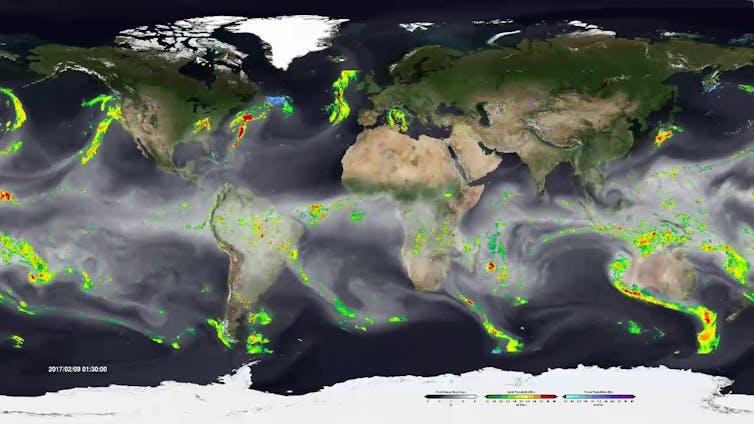
Scientists have known for years that heat from strong moisture transports could melt sea ice, but no one knew to what extent. That’s because it’s nearly impossible to install instruments on wild ice to conduct long-term energy exchange observation.
We looked at it in a different way. We were able to establish a statistical linkage between the amount of ice lost and the average count of atmospheric rivers that arrived. In the Barents-Kara Seas and central Arctic, the Arctic quadrant with the most atmospheric river activity, we found that about 34% of the ice decline from 1979 to 2021 can be attributed to the increased frequency of atmospheric rivers.
Other studies have described increases in atmospheric rivers affecting ice loss on Antarctica, Greenland and across the Arctic during the near-record low-ice winter of 2016-2017.

Anthropogenic warming – temperature rise caused by human activities such as burning fossil fuels – is a key reason for the increase in atmospheric rivers. We also noticed some influence from natural variability in the tropical Pacific, but studies have found that anthropogenic forcing is likely to overwhelm the influence of natural variability by the middle of the 21st century.
Our earlier research has suggested that after the middle of this century, when temperatures are warmer, just about every part of the polar regions should see a substantial increase in atmospheric rivers.
What sea ice decline means for humans
Like just about everything, sea ice loss has both bad and good effects.
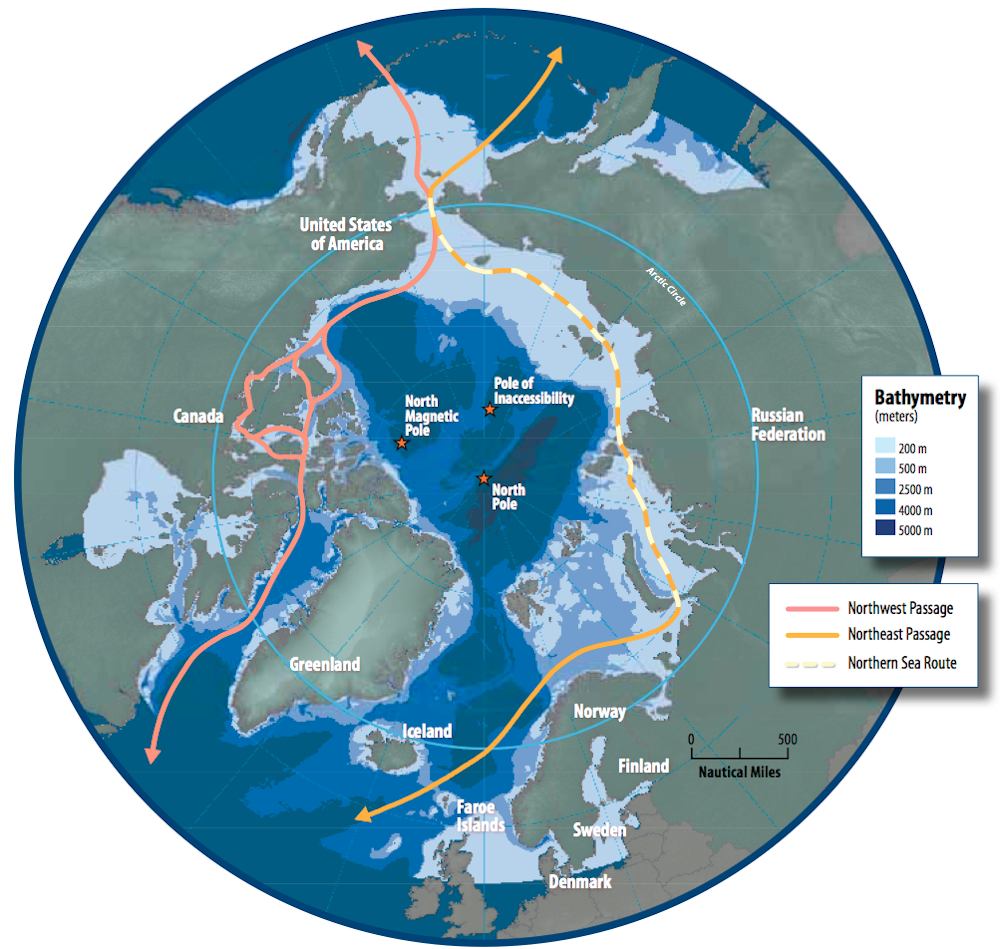
More open water may enable more direct shipping, so ships could sail from Northern Europe to North America and East Asia through the Arctic, which would be much cheaper. It can also increase access to natural resources, including oil, natural gas and minerals crucial for clean energy production.
Of course, atmospheric rivers are also accompanied by strong wind, which can mean more dangerous wind storms for shipping and erosion for coastal areas. For some wildlife, the effects would be a disaster. Polar bears, for example, rely on sea ice to hunt seals. Loss of sea ice also contributes to climate change. Sea ice reflects incoming energy back into space. Without it, the dark oceans absorb more than 90% of that energy, which causes the oceans to heat up, with wide implications.
According to the latest global assessment published by the Intergovernmental Panel on Climate Change, the Arctic could be almost entirely ice-free in summer by the middle of this century. That means thin, fragile ice across almost the entire region in early winter that would be susceptible to increasing storms.
Pengfei Zhang, Assistant Research Professor of Atmospheric Science, Penn State
This article is republished from The Conversation under a Creative Commons license. Read the original article.