 How to resolve AdBlock issue?
News
- Details
- Written by: LAKE COUNTY NEWS REPORTS

LAKE COUNTY, Calif. — California State Parks' Division of Boating and Waterways kicks off the official boating season in California in coordination with National Safe Boating Week held May 20 to 26.
The Division of Boating and Waterways, or DBW, encourages all boaters and outdoor enthusiasts to brush up on boating safety skills and prepare for the boating season.
This observance week is a global awareness effort that encourages boaters to make the most of their boating adventure by being responsible. One of the important safety measures to take while boating is wearing life jackets.
“With the weather warming up, the snow melting from this year’s historic snowpack and boaters heading out to the water, it is crucial that life jackets are worn at all times while boating,” said DBW’s Deputy Director Ramona Fernandez. “Just like you wear your seatbelt in the car, wearing a life jacket while boating is one layer of prevention to avoid unnecessary tragedy.”
U.S. Coast Guard statistics show that drowning was the reported cause of death in four out of every five recreational boating fatalities in 2021 and that 83% of those who drowned were not wearing life jackets.
Newer styles of life jackets are much more comfortable, lightweight and stylish compared to the bulky, orange life jackets that boaters used to know. There are innovative options, such as inflatable life jackets, that are much cooler in the warmer weather and allow mobility and flexibility for activities like boating, fishing, paddling or hunting.
Here are some helpful tips for selecting and maintaining life jackets:
U.S. Coast Guard–Approved: Wear only U.S. Coast Guard-approved life jackets while boating. All life jackets approved by the U.S. Coast Guard will have an approval number located on the inside label.
Proper Fit: Life jackets are sized by weight and chest measurements. An adult-sized life jacket is not suitable for a child, as the life jacket may be too large and may ride up around their face or even slip off. Always check the fit of the child’s life jacket before entering the water. A life jacket too small for the wearer may not keep them afloat.
Intended Boating Activity: Make sure that the life jacket is approved for the specific boating activity in which you plan to participate.
Good condition: Check the life jacket before use to ensure it is in good condition. Replace a life jacket that has faded labels, rips, tears, mildew, loose or missing straps, frayed webbing or broken zippers or buckles. If an inflatable life jacket is used, check recommendations from the manufacturer on the CO2 canister and arming mechanism, and replace as necessary.
Children and life jackets: Under California law, every child under 13 years of age on a moving recreational vessel of any length must wear a U.S. Coast Guard–approved life jacket in serviceable condition and of a type and size appropriate for the conditions and the activity. Many cities and counties also have regulations about children and youth life jacket requirements along rivers and lakes. Always check with local managers about life jacket rules.
Life jacket loaner program: DBW partners with local agencies to ensure boaters have access to life jackets. A life jacket can be borrowed from more than 100 life jacket loaner stations throughout the state. View life jacket loaner stations.
- Details
- Written by: Stephen Buchmann, University of Arizona
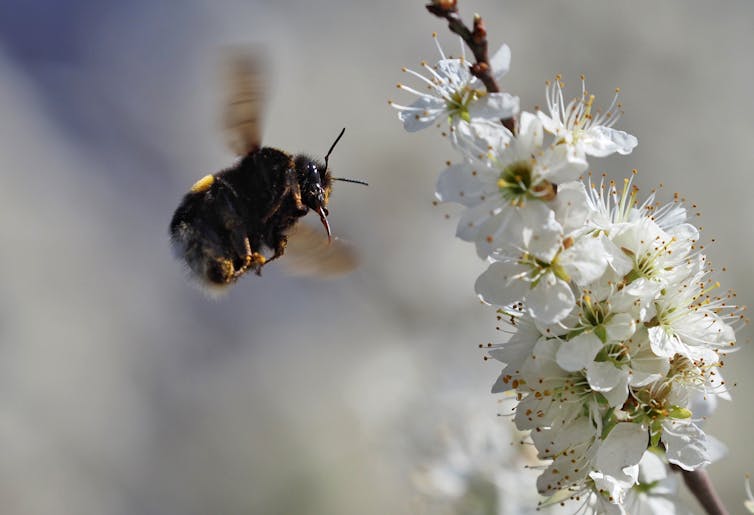
As trees and flowers blossom in spring, bees emerge from their winter nests and burrows. For many species it’s time to mate, and some will start new solitary nests or colonies.
Bees and other pollinators are essential to human society. They provide about one-third of the food we eat, a service with a global value estimated at up to $US577 billion annually.
But bees are interesting in many other ways that are less widely known. In my new book, “What a Bee Knows: Exploring the Thoughts, Memories, and Personalities of Bees,” I draw on my experience studying bees for almost 50 years to explore how these creatures perceive the world and their amazing abilities to navigate, learn, communicate and remember. Here’s some of what I’ve learned.
It’s not all about hives and honey
Because people are widely familiar with honeybees, many assume that all bees are social and live in hives or colonies with a queen. In fact, only about 10% of bees are social, and most types don’t make honey.
Most bees lead solitary lives, digging nests in the ground or finding abandoned beetle burrows in dead wood to call home. Some bees are cleptoparasites, sneaking into unoccupied nests to lay eggs, in the same way that cowbirds lay their eggs in other birds’ nests and let the unknowing foster parents rear their chicks.
A few species of tropical bees, known as vulture bees, survive by eating carrion. Their guts contain acid-loving bacteria that enable the bees to digest rotting meat.
Busy brains
The world looks very different to a bee than it does to a human, but bees’ perceptions are hardly simple. Bees are intelligent animals that likely feel pain, remember patterns and odors and even recognize human faces. They can solve mazes and other problems and use simple tools.
Research shows that bees are self-aware and may even have a primitive form of consciousness. During the six to 10 hours bees spend sleeping daily, memories are consolidated within their amazing brains – organs the size of a poppy seed that contain 1 million nerve cells. There are some indications that bees might even dream. I’d like to think so.
An alien sensory world
Bees’ sensory experience of the world is markedly different from ours. For example, humans see the world through the primary colors of red, green and blue. Primary colors for bees are green, blue and ultraviolet.
Bees’ vision is 60 times less sharp than that of humans: A flying bee can’t see the details of a flower until it is about 10 inches away. However, bees can see hidden ultraviolet floral patterns that are invisible to us, and those patterns lead the bees to flowers’ nectar.
Bees also can spot flowers by detecting color changes at a distance. When humans watch film projected at 24 frames per second, the individual images appear to blur into motion. This phenomenon, which is called the flicker-fusion frequency, indicates how capable our visual systems are at resolving moving images. Bees have a much higher flicker-fusion frequency – you would have to play the film 10 times faster for it to look like a blur to them – so they can fly over a flowering meadow and see bright spots of floral color that wouldn’t stand out to humans.
From a distance, bees detect flowers by scent. A honeybee’s sense of smell is 100 times more sensitive than ours. Scientists have used bees to sniff out chemicals associated with cancer and with diabetes on patients’ breath and to detect the presence of high explosives.
Bees’ sense of touch is also highly developed: They can feel tiny fingerprint-like ridges on the petals of some flowers. Bees are nearly deaf to most airborne sounds, unless they are very close to the source, but are sensitive if they are standing on a vibrating surface.
Problem solvers
Bees can navigate mazes as well as mice can, and studies show that they are self-aware of their body dimensions. For example, when fat bumblebees were trained to fly and then walk through a slit in a board to get to food on the other side, the bees turned their bodies sideways and tucked in their legs.
Experiments by Canadian researcher Peter Kevan and Lars Chittka in England demonstrated remarkable feats of bee learning. Bumblebees were trained to pull a string – in other words, to use a tool – connected to a plastic disk with hidden depressions filled with sugar water. They could see the sugar wells but couldn’t get the reward except by tugging at the string until the disk was uncovered.
Other worker bees were placed nearby in a screen cage where they could see what their trained hive mates did. Once released, this second group also pulled the string for the sweet treats. This study demonstrated what scientists term social learning – acting in ways that reflect the behavior of others.
Pollinating with vibrations
Even pollination, one of bees’ best-known behaviors, can be much more complicated than it seems.
The basic process is similar for all types of bees: Females carry pollen grains, the sex cells of plants, on their bodies from flower to flower as they collect pollen and nectar to feed themselves and their developing grubs. When pollen rubs off onto a flower’s stigma, the result is pollination.
My favorite area of bee research examines a method called buzz pollination. Bees use it on about 10% of the world’s 350,000 kinds of flowering plants that have special anthers – structures that produce pollen.
For example, a tomato blossom’s five anthers are pinched together, like the closed fingers of one hand. Pollen is released through one or two small pores at the end of each anther.
When a female bumblebee lands on a tomato flower, she bites one anther at the middle and contracts her flight muscles from 100 to 400 times per second. These powerful vibrations eject pollen from the anther pores in the form of a cloud that strikes the bee. It all happens in just a few tenths of a second.
The bee hangs by one leg and scrapes the pollen into “baskets” – structures on her hind legs. Then she repeats the buzzing on the remaining anthers before moving to different flowers.
Bees also use buzz pollination on the flowers of blueberries, cranberries, eggplant and kiwi fruits. My colleagues and I are conducting experiments to determine the biomechanics of how bee vibrations eject pollen from anthers.
Planting for bees
Many species of bees are declining worldwide, thanks to stresses including parasites, pesticides and habitat loss.
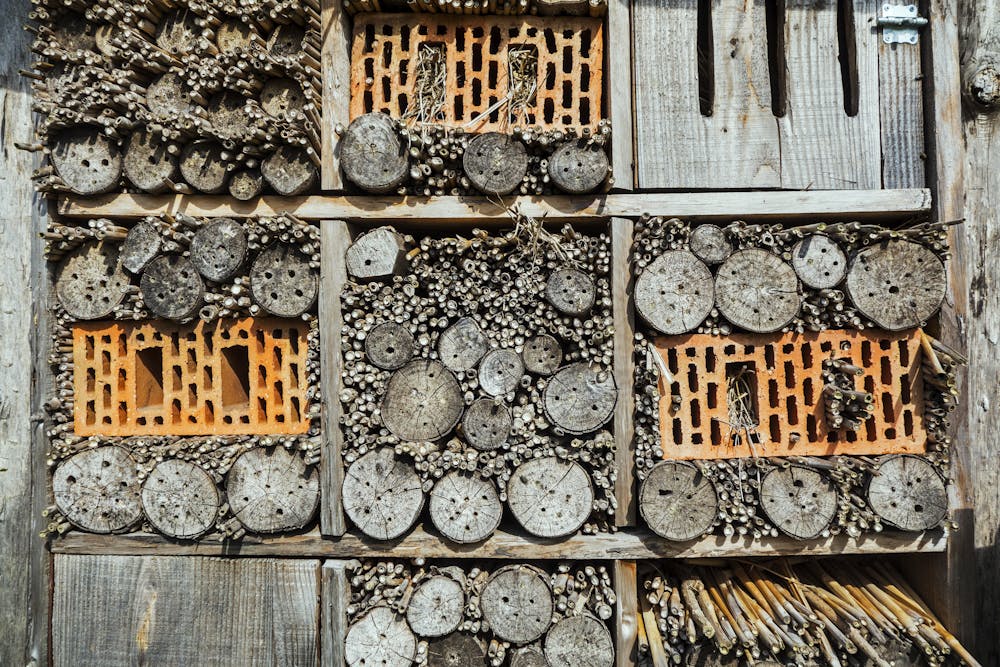
Whether you have an apartment window box or several acres of land, you can do a few simple things to help bees.
First, plant native wildflowers so that blooms are available in every season. Second, try to avoid using insecticides or herbicides. Third, provide open ground where burrowing bees can nest. With luck, soon you’ll have some buzzing new neighbors.
Stephen Buchmann, Adjunct Professor of Entomology and of Ecology and Evolutionary Biology, University of Arizona
This article is republished from The Conversation under a Creative Commons license. Read the original article.
- Details
- Written by: Jeanette Kazmierczak

Astronomers have discovered an Earth-size exoplanet, or world beyond our solar system, that may be carpeted with volcanoes. Called LP 791-18 d, the planet could undergo volcanic outbursts as often as Jupiter’s moon Io, the most volcanically active body in our solar system.
They found and studied the planet using data from NASA’s TESS (Transiting Exoplanet Survey Satellite) and retired Spitzer Space Telescope, as well as a suite of ground-based observatories.
A paper about the planet – led by Merrin Peterson, a graduate of the Trottier Institute for Research on Exoplanets (iREx) based at the University of Montreal — appears in the May 17 edition of the scientific journal Nature.
“LP 791-18 d is tidally locked, which means the same side constantly faces its star,” said Björn Benneke, a co-author and astronomy professor at iREx who planned and supervised the study. “The day side would probably be too hot for liquid water to exist on the surface. But the amount of volcanic activity we suspect occurs all over the planet could sustain an atmosphere, which may allow water to condense on the night side.”
LP 791-18 d orbits a small red dwarf star about 90 light-years away in the southern constellation Crater. The team estimates it’s only slightly larger and more massive than Earth.
Astronomers already knew about two other worlds in the system before this discovery, called LP 791-18 b and c. The inner planet b is about 20% bigger than Earth. The outer planet c is about 2.5 times Earth’s size and more than seven times its mass.
During each orbit, planets d and c pass very close to each other. Each close pass by the more massive planet c produces a gravitational tug on planet d, making its orbit somewhat elliptical. On this elliptical path, planet d is slightly deformed every time it goes around the star. These deformations can create enough internal friction to substantially heat the planet’s interior and produce volcanic activity at its surface. Jupiter and some of its moons affect Io in a similar way.
Planet d sits on the inner edge of the habitable zone, the traditional range of distances from a star where scientists hypothesize liquid water could exist on a planet’s surface. If the planet is as geologically active as the research team suspects, it could maintain an atmosphere. Temperatures could drop enough on the planet’s night side for water to condense on the surface.
Planet c has already been approved for observing time on the James Webb Space Telescope, and the team thinks planet d is also an exceptional candidate for atmospheric studies by the mission.
“A big question in astrobiology, the field that broadly studies the origins of life on Earth and beyond, is if tectonic or volcanic activity is necessary for life,” said co-author Jessie Christiansen, a research scientist at NASA’s Exoplanet Science Institute at the California Institute of Technology in Pasadena. “In addition to potentially providing an atmosphere, these processes could churn up materials that would otherwise sink down and get trapped in the crust, including those we think are important for life, like carbon.”
Spitzer’s observations of the system were among the last the satellite collected before it was decommissioned in January 2020.
“It is incredible to read about the continuation of discoveries and publications years beyond Spitzer’s end of mission,” said Joseph Hunt, Spitzer project manager at NASA’s Jet Propulsion Laboratory in Southern California. “That really shows the success of our first-class engineers and scientists. Together they built not only a spacecraft but also a data set that continues to be an asset for the astrophysics community.”
TESS is a NASA Astrophysics Explorer mission led and operated by MIT in Cambridge, Massachusetts, and managed by NASA's Goddard Space Flight Center. Additional partners include Northrop Grumman, based in Falls Church, Virginia; NASA’s Ames Research Center in California’s Silicon Valley; the Center for Astrophysics | Harvard & Smithsonian in Cambridge, Massachusetts; MIT’s Lincoln Laboratory; and the Space Telescope Science Institute in Baltimore. More than a dozen universities, research institutes, and observatories worldwide are participants in the mission.
The entire body of scientific data collected by Spitzer during its lifetime is available to the public via the Spitzer data archive, housed at the Infrared Science Archive at IPAC at Caltech in Pasadena, California. NASA’s Jet Propulsion Laboratory, a division of Caltech, managed Spitzer mission operations for the agency’s Science Mission Directorate in Washington. Science operations were conducted at the Spitzer Science Center at IPAC at Caltech. Spacecraft operations were based at Lockheed Martin Space in Littleton, Colorado.
Jeanette Kazmierczak works for the NASA's Goddard Space Flight Center in Greenbelt, Maryland.
- Details
- Written by: Elizabeth Larson

LAKEPORT, Calif. — This week the Lakeport Police Department’s K9 officer and his sergeant partner were honored for their graduation from an educational program that expands their crime-fighting capabilities.
The Lakeport City Council hosted the presentation for Sgt. Andrew Welter and K9 Olin at its Tuesday meeting.
Olin is a German shepherd who joined the Lakeport Police Department in the summer of 2021.
Last week, Olin and Welter graduated from a seven-week program with master trainer Frank Romano at Golden Gate K9, said Lakeport Police Chief Brad Rasmussen.
Rasmussen said five weeks of the training were focused on patrol work, including suspect tracking and apprehension.
“Olin can enter buildings or vehicles to search for and apprehend suspects. He can also do these things out on open land. He is trained to also call off and return without biting or apprehending,” Rasmussen told Lake County News. “Of course we would only use him for apprehensions when circumstances justified the use of force, such as serious violent felons that are a danger to the community or officers.”
Rasmussen said the other two weeks of the training were spent on drug odor detection.
Olin is now certified to alert on the odor of methamphetamine, cocaine, heroin and fentanyl, Rasmussen said.
“From here on out they have to continue to train one day every two weeks with Golden Gate,” said Rasmussen.
Olin, who turned 3 years old in February, also went through a previous training program. “So for his age he has quite the extensive training,” Rasmussen said.
Lakeport Police’s K9 program, which was reestablished after more than a decade without a dog, has been funded with donations from the Sean M. Walsh K-9 Memorial Foundation, the United States Department of Agriculture, the Lakeport Police Department and the community, Rasmussen said.
At the Tuesday council meeting, Rasmussen presented Olin with a badge.
Welter attached the badge to his K9 partner’s collar.
Email Elizabeth Larson at
