 How to resolve AdBlock issue?
News
- Details
- Written by: Elizabeth Larson

CLEARLAKE, Calif. — Clearlake Animal Control is featuring new dogs and others that continue to wait to be adopted this week.
The shelter’s website lists 48 dogs waiting for adoption.
The dogs that are available for adoption include “Doc,” a male Rottweiler-pit bull mix.

Another adoptable dog is “Sosa,” a 4-year-old female American Staffordshire terrier mix.
Also up for adoption is “Roman,” a 5-year-old border collie-German shepherd mix with a long black coat and white markings.
He was the featured dog at Thursday’s Clearlake City Council meeting, where it was reported he is a favorite of shelter staff.
Roman is well-mannered and gentle, enjoys long walks and has very good leash skills.
Shelter staff said he is good with other dogs but that they are not sure if he gets along with cats.
He is neutered and up to date on all vaccinations.

The shelter is located at 6820 Old Highway 53. It’s open from 9 a.m. to 6 p.m. Tuesday through Saturday.
For more information, call the shelter at 707-762-6227, email
This week’s adoptable dogs are featured below.
Email Elizabeth Larson at
- Details
- Written by: LAKE COUNTY NEWS REPORTS

Gov. Gavin Newsom on Thursday announced major progress in the state’s efforts to conserve 30% of state lands and coastal waters by 2030.
Since April 2022, California has added approximately 631,000 acres of conserved land — nearly 1,000 square miles — bringing the statewide total to 24.4% of lands and 16.2% of coastal waters. Watch the Governor's video announcing this milestone here.
Known as the 30x30 initiative, Gov. Newsom’s October 2020 Executive Order launched what his office called “a once-in-a-generation opportunity to lead the world protecting and restoring nature as a climate solution.”
It calls for additional protection of 6 million acres of land and 500,000 acres of coastal waters in the next seven years to achieve 30x30.
In 2021, President Biden launched the same initiative at the federal level, putting the U.S. on track to conserve 30% of lands and waters nationally. And last year, world leaders came together to agree to protect 30 percent of land and waters in 190 countries across the world.

“California is setting the bar for conservation for other states and nations around the world,” said Newsom. “Preserving species in peril, breaking down barriers to the outdoors for underserved communities, working alongside native peoples who have stewarded these lands and waters since time immemorial — our 30x30 initiative is restoring and protecting California’s unparalleled natural beauty for generations to come.”
The progress is detailed in an inaugural annual report, “Pathways to 30x30 California,” which highlights significant progress over the last year toward achieving three key objectives: 1) Protecting and restoring biodiversity; 2) Expanding access to nature; and 3) Mitigating and building resistance to climate change.
The report provides specific examples of projects that expanded conserved lands throughout the state, including:
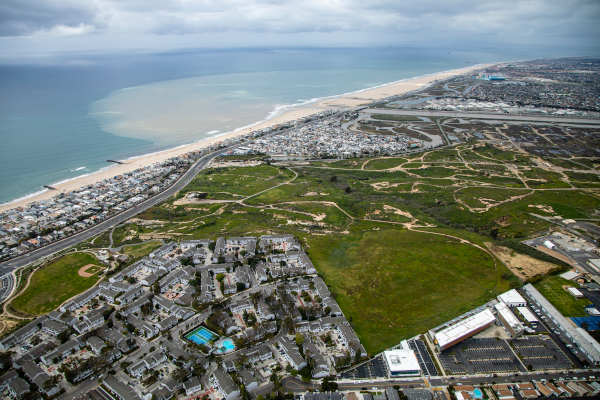
Banning Ranch: This $97 million acquisition consists of 387 acres of lowlands and coastal bluffs in Newport Beach and now connects nearly 1,000 acres of conserved coastal lands and waters. Over the next several years, former oil fields on the property will be converted to a public coastal park.
YMCA Camp Jones Gulch: This voluntary conservation easement conserves 920 forested acres that will continue to host youth development opportunities, environmental education, recreation and community service.
Wildlife Crossings: These crossings enable wildlife to safely traverse busy roadways, as well as find food sources and increase genetic diversity. Two notable crossings include one under construction at over Highway 17 in Santa Cruz County, which will also serve to connect more than 50 miles of previously fragmented regional trails, and the Wallis Annenberg Wildlife Crossing, which is expected to help preserve the mountain lion population in the Santa Monica Mountains (which could become extinct within 50 years without an influx of genetic diversity).
The state’s commitment to equity, tribal partnerships and economic prosperity — pillars of the 30x30 initiative — is backed by more than $100 million in grants for local communities and tribes to implement conservation planning projects.
The funding is part of $1.4 billion the state has directed to nature-based solutions to combat climate change and protect the state’s world-renowned biodiversity.

- Details
- Written by: Jakub Hlávka, University of Southern California and Adam Rose, University of Southern California
The Research Brief is a short take about interesting academic work.
The big idea
The economic toll of the COVID-19 pandemic in the U.S. will reach US$14 trillion by the end of 2023, our team of economists, public policy researchers and other experts have estimated.
Putting a price tag on all the pain, suffering and upheaval Americans and people around the world have experienced because of COVID-19 is, of course, hard to do. More than 1.1 million people have died as a result of COVID-19 in the U.S., and many more have been hospitalized or lost loved ones. Based on data from the first 30 months of the pandemic, we forecast the scale of total economic losses over a four-year period, from January 2020 to December 2023.
To come up with our estimates, our team used economic modeling to approximate the revenue lost due to mandatory business closures at the beginning of the pandemic. We also used modeling to assess the economic blows from the many changes in personal behavior that continued long after the lockdown orders were lifted – such as avoiding restaurants, theaters and other crowded places.
Workplace absences, and sales lost due to the cessation of brick-and-mortar retail shopping, air travel and public gatherings, contributed the most. At the height of the pandemic, in the second quarter of 2020, our survey indicates that international and domestic airline travel fell by nearly 60%, indoor dining by 65% and in-store shopping by 43%.
We found that the three sectors that lost the most ground during the first 30 months of the pandemic were air travel, dining, and health and social services, which contracted by 57.5%, 26.5% and 29.16%, respectively.
These losses were offset to a degree by surges in online purchases, a series of large fiscal stimulus and economic relief packages and an unprecedented expansion of the number of Americans working from home – and thus were able to keep doing jobs that might otherwise have been cut.
From 2020 to 2023, the cumulative net economic output of the United States will amount to about $103 trillion. Without the pandemic, the total of GDP over those four years would have been $117 trillion – nearly 14% higher in inflation-adjusted 2020 dollars, according to our analysis.
We also simulated four different possible economic outcomes had the number of COVID-19 deaths been different because of either more or less successful public health strategies in the first 30 months of the pandemic.
The direct health expenses, driven mostly by hospitalization costs in these scenarios, would have totaled $20 billion in a best-case scenario in which 65,000 Americans would have died from January 2020 to June 2022. In the worst-case scenario, about 2 million would have died during that period, with $365 billion in direct health-related expenses.
Based on our findings, most economic losses were not due to these health care expenditures.
Why it matters
The COVID-19 pandemic’s economic consequences are unprecedented for the U.S. by any measure. The toll we estimate that it took on the nation’s gross domestic product is twice the size of that of the Great Recession of 2007-2009. It’s 20 times greater than the economic costs of the 9/11 terrorist attacks and 40 times greater than the toll of any other disaster to befall the U.S. in the 21st century to date.
Although the federal government has now lifted its COVID-19 Public Health Emergency declaration, the pandemic is still influencing the U.S. economy. The labor force participation rate, which stood at 62.6% in April 2023, has only recently neared the February 2020 level of 63.3%.
What is not known
We modeled only the pandemic’s standard economic effects. We didn’t estimate the vast array of economic costs tied to COVID-19, such as lost years of work after an early death or a severe case of long-COVID-19.
We also didn’t assess the costs due to the many ways that the disease has affected the physical and mental health of the U.S. population or the learning loss experienced by students.
Jakub Hlávka, Research Assistant Professor of Health Policy and Management; Schaeffer Center Fellow, University of Southern California and Adam Rose, Professor of Public Policy, University of Southern California
This article is republished from The Conversation under a Creative Commons license. Read the original article.
- Details
- Written by: Elizabeth Larson
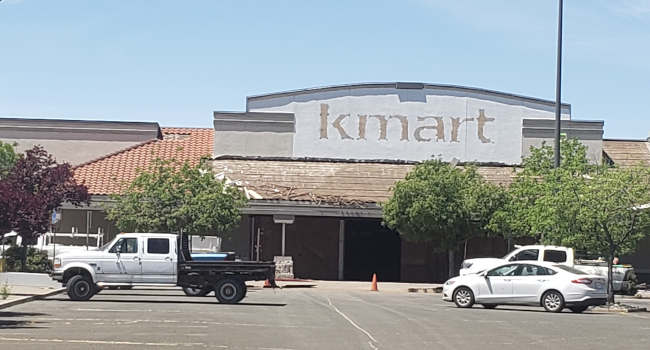
LAKEPORT, Calif. — Work is underway to transform the building that previously housed Kmart into space to house new stores.
On Wednesday, construction workers were busily stripping the facade off the building, removing the Spanish-style tiles and other materials. By that point, the large red Kmart letters already had been removed.
The Kmart store was shuttered at the end of 2019 after more than 20 years in the 90,852-square-foot building, located at 2019 S. Main St.
The city of Lakeport’s consultant, The Retail Coach, has been working since the store closed to help bring new retailers to the site, and last year the company confirmed that new tenants were lined up.
At its Dec. 14 meeting, the Lakeport Planning Commission approved an application from Upward Architects, a Tempe, Arizona-based commercial architecture firm, for a use permit and an architectural and design review for a new commercial project at the building, as Lake County News has reported.
Upward Architects’ plan is to subdivide it into three lease spaces and to increase the building’s height from 29 feet to 32 feet.
So far, two tenants are confirmed — Marshalls, a department store, and Tractor Supply Co., which offers housewares, equipment, tools, food for pets and livestock.
The plans presented to the commission in December called for Tractor Supply to occupy the northern portion of the building and Marshalls the southern space, with a third tenant to occupy the central portion of the structure.
City Associate Planner Victor Fernandez told Lake County News that Tractor Supply has submitted their building permits and is currently working on interior demolition/remodeling, sewer and water line expansion, as well as sidewalk expansion.
“They have also made progress with their fire alarm permits and are expected to commence exterior facade improvements in the near future,” Fernandez said.
Fernandez said Tractor Supply also has submitted a permit for a 35-foot free-standing sign, as well as a smaller monument sign that will serve the shopping center and its tenants.
As of Wednesday, Marshalls had not submitted any plans. “Hopefully, they can get started soon,” Fernandez said.
Fernandez said the project is tentatively scheduled to be discussed at the June 14 Lakeport Planning Commission meeting.
Email Elizabeth Larson at