 How to resolve AdBlock issue?
News
- Details
- Written by: LAKE COUNTY NEWS REPORTS
The Bipartisan Infrastructure Act allocated $62 billion to improve nationwide broadband availability and access, with an emphasis on unserved and underserved communities.
The more input, feedback, and involvement is shown by residents, the more likely California counties will receive the maximum available broadband dollars from the federal government.
Part of the state of California’s community engagement effort involves distribution and participation in a brief digital equity survey.
To meet statewide goals, at least 250 Lake County residents must complete the survey by June 30.
The survey is anonymous and takes about 10 minutes to complete.
To participate, visit the Broadband For All website.
- Details
- Written by: Elizabeth Larson
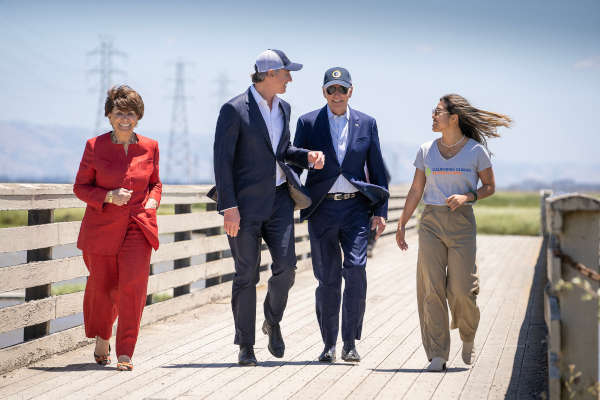
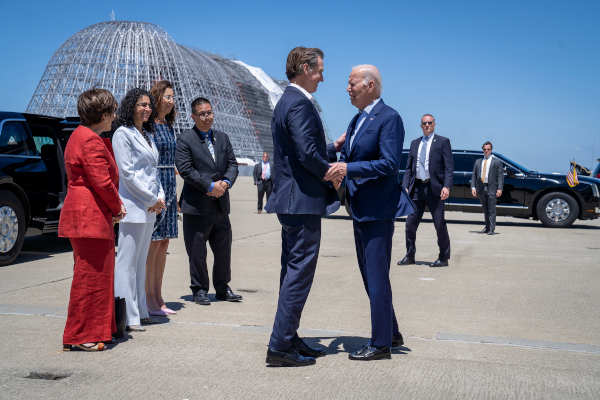
Gov. Gavin Newsom joined President Biden and a California Climate Action Corps volunteer in Palo Alto on Monday for the president’s announcement of more than $600 million in federal grant funding for climate resilience projects across the country.
President Biden also announced that California will receive $67 million in federal funding to help build power lines and transmission infrastructure, supporting the state’s transition to 100% clean electricity by 2045.
President Biden and Governor Newsom visited the Baylands Nature Preserve, one of the largest tracts of undisturbed marshland remaining in the San Francisco Bay.
The preserve is part of the Strategy to Advance Flood protection, Ecosystems and Recreation along the San Francisco Bay, or SAFER Bay, Project, a flood and sea-level resilience project that will protect almost 1,600 properties and will enable the restoration of approximately 600 acres of marsh from former salt ponds.
“California’s wildfires, heat waves, and extreme swings from drought to flooding show how climate change is impacting our communities,” Newsom said. “There is no better partner in the fight against climate change than President Biden, who is making unprecedented investments and approaching this crisis with urgency. This new federal funding will support our ongoing climate action to protect our coastal communities from rising oceans and build the clean energy we need.”
“Throughout our history, we’re the only nation in the world to come out of crisis stronger than we went into it,” President Biden said. “We’re doing it again here on the climate crisis. When I think of climate, I think of jobs. When I think of climate, I think of innovation. When I think of climate, I think of turning peril into progress.”
Historic state investments
California’s Climate Commitment, the $48 billion climate budget, includes $4.1 billion in climate resilience funding:
• $1.4 billion in investments over multiple years for nature-based solutions.
• $1.6 billion in investments over multiple years to promote community resilience.
• $734 million in investments over multiple years for coastal resilience.
• On June 1, the Coastal Conservancy awarded $78 million for climate resilience, public access, habitat restoration and wildfire resilience projects.
• $444 million over multiple years to address extreme heat.
California’s sea level rise action plan
Last year, California finalized an action plan to tackle sea level rise with a coordinated roadmap including priority investments, programs and policies for 17 state agencies and departments.
The State Agency Sea Level Rise Action Plan includes over 80 actions grounded in the best available science, tribal and local partnerships equity, and other guiding principles.
California Climate Action Corps
As a part of California’s comprehensive strategy to address the climate crisis, Governor Newsom launched the country’s first state-level, climate service corps to empower all Californians to take meaningful action to safeguard the climate.
You can take meaningful action today to help communities across our state by serving in a year-long fellowship, volunteering or taking action at home.
Apply here with California Volunteers.
- Details
- Written by: Matt Hitchings, University of Florida and Derek Cummings, University of Florida
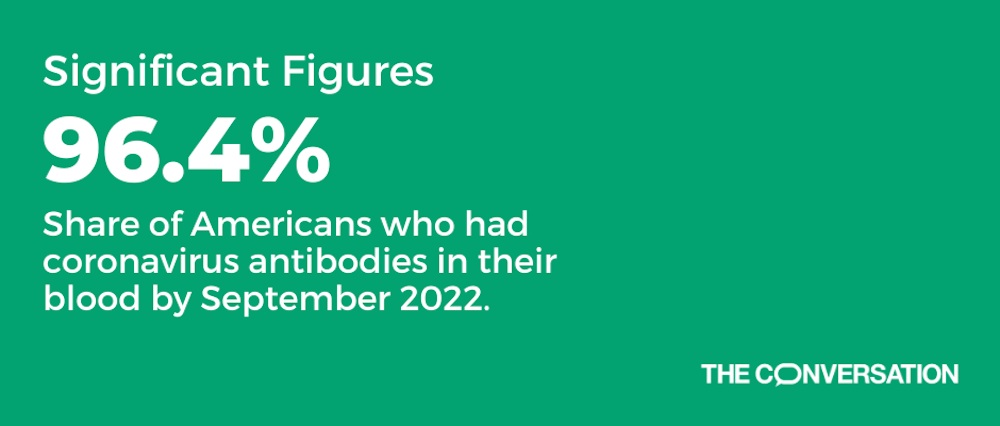
Antibodies to SARS-CoV-2, the virus that causes COVID-19, were present in the blood of 96.4% of Americans over the age of 16 by September 2022. That’s according to a serosurvey – an analysis testing for the presence of these immune defense molecules – conducted on samples from blood donors.
A serosurvey like this one helps researchers estimate how many people have been exposed to any part of the coronavirus, whether via vaccination or infection. Both can trigger the generation of antibodies to SARS-CoV-2. And by identifying which kind of antibodies someone has in their blood, researchers can break down the 96.4% into different types of immunity: infection-derived, vaccine-derived and hybrid.
COVID-19 vaccines used in the United States are based on only one part of the virus – the spike, or S, protein. Researchers can tell that a person has been vaccinated and has not been infected if their blood has only anti-S antibodies that target that spike protein. If someone has anti-N antibodies, which target the virus’s nucleocapsid protein, it’s a sign that they’ve been infected by SARS-CoV-2. To reliably identify someone with hybrid immunity, a researcher would need to match someone who has anti-N antibodies to an official vaccination database.
What about the 3.6% without antibodies?
Immunologists know that antibody levels decrease in the months after a COVID-19 infection or vaccination, and this is true for many pathogens. It’s possible some people did have antibodies at one point, but they’re no longer detectable. And not every infection leads to a detectable antibody response, particularly if the case was mild or asymptomatic.
Another factor is the accuracy of the antibody test. No test is perfect, so a small percentage of people who truly have antibodies might come up negative.
Together, these considerations mean that the 96.4% number is likely an underestimate. It seems reasonable to conclude that almost no one in this population has neither been infected by SARS-CoV-2 nor received a COVID-19 vaccine.
A clearer picture of a virus’s spread
Serosurveys are useful for understanding how likely different types of people – of varying ages or races, for example – were to have been infected. For this purpose, a serosurvey can be much more reliable than using data on people who received a positive PCR test, or who report having had a positive rapid antigen test, because getting a positive test is heavily influenced by access to care, health care behavior and how severe your illness is. These are sources of what is called bias.
This bias has two effects: It leads to large underestimation of the proportion of the overall population infected, and it can lead to spurious differences between groups. For example, people with mild symptoms are less likely to get tested and are also likely to be younger. Researchers might draw the wrong conclusion that because they’re not getting tested these people aren’t actually catching the virus.
Looking at antibodies as a marker of infection is not biased by such behavioral factors. Many serosurveys, including ones that we worked on in Chennai, India, and Salvador, Brazil, found similar or even higher seroprevalence in children compared with young adults, contradicting an early narrative that children were less susceptible to the virus. Instead, our results suggested that infections in children were less likely to be detected.
What does this statistic mean for future waves?
Antibodies are not just a marker of previous infection; part of their job is to help prevent future infection with the same pathogen. So, serosurveys can be used to understand levels of immunity in the population.
For some diseases, like measles, immunity is essentially lifelong, and having antibodies means you are protected. However, for SARS-CoV-2 this is not the case, because the virus has continually evolved new variants that are able to reinfect people despite their antibodies.
Nevertheless, many studies have shown that individuals with hybrid immunity will be more protected against future infection and variants than those with vaccine- or infection-derived immunity alone. It may be useful to know the proportion of the population with single-source immunity in order to target certain groups with vaccination campaigns.
Matt Hitchings, Assistant Professor of Biostatistics, University of Florida and Derek Cummings, Professor of Biology, the Emerging Pathogens Institute, University of Florida
This article is republished from The Conversation under a Creative Commons license. Read the original article.
- Details
- Written by: LAKE COUNTY NEWS REPORTS
The Cal Fire Sonoma-Lake-Napa Unit said the procession for Capt. Ronnie Boyd will take place on Tuesday from the Napa County Coroner’s Office to Jones and Lewis Clear Lake Memorial Chapel in Lower Lake.
Boyd, 51, of Clearlake, died on June 11 following the crash in Napa County. His wife, Dena Boyd, 52, died of her injuries two days later.
Cal Fire’s Sonoma-Lake-Napa Unit, or LNU, will begin the procession for Capt. Boyd at 9:30 a.m. Tuesday at the Napa County Coroner’s Office.
The procession will use Highway 29 through Napa and the city of St Helena, and turn to go through downtown Calistoga on the way to Lake County.
Once they reach Twin Pine Casino in Lake County there will be a procession pass-off by the Napa County resources to Cal Fire LNU’s Lake County Crews, South Lake Fire Protection District, and Lake County Fire District.
Once the procession has transitioned to the Lake County resources it will continue down Highway 29 through Middletown, passing the community of Hidden Valley Lake, and proceeding to the destination in Lower Lake.
Throughout the route you can expect delays and traffic in these areas.
“We ask if you would like to pay your respects to Capt. Boyd, please do not block the road, stay on the sidewalks, and do not approach the procession at any time,” Cal Fire said.
Cal Fire said Boyd started his career with Cal Fire in 2003 as a firefighter I in the Sonoma-Lake-Napa Unit and was promoted to a limited-term fire apparatus engineer in 2007.
In 2009, Capt. Boyd was promoted to a permanent fire apparatus engineer position in the Sonoma-Lake-Napa Unit followed by a promotion to a limited-term fire captain position in the Shasta-Trinity Unit.
In 2016, he was promoted to a permanent fire captain position in the Humboldt-Del Norte Unit where he worked up to his passing.
“Capt. Boyd was well known for his glee for life, contagious smile, and willingness to serve the public,” Cal Fire said.
The statement added, “Please keep Capt. Boyd and his family, and the Cal Fire family that knew him, in your thoughts as they grieve through this tragic loss.”
Information regarding memorial services will be provided by the Boyd family at a later date.