 How to resolve AdBlock issue?
News
- Details
- Written by: LAKE COUNTY NEWS REPORTS
As you gather to celebrate the Fourth of July, make sure your festivities are both enjoyable and safe.
Check your local laws and ordinances to find out if fireworks are illegal where you live, or if certain “safe and sane” fireworks are permitted.
In Lake County, safe and sane fireworks are only allowed in the city of Lakeport and only during a four-day window ending on the July 4 holiday.
In certain areas of California — including all areas of Lake County outside of Lakeport — all fireworks are illegal.
Since 2013, in the state of California, there have been over 20,000 acres burned with fireworks being the ignition source and a total of $59.3 million in property loss, with $25.7 million of that total occurring in 2022 alone.
“Our arson and bomb investigators and law enforcement officers have been busy assisting with numerous illegal fireworks enforcement operations, and members of the Arson and Bomb Unit have successfully seized over 245,000 pounds of illegal fireworks from all over California since July 2022,” said acting State Fire Marshal Daniel Berlant.
“We have a zero tolerance toward the use, transportation, and possession of illegal fireworks. Even ‘safe and sane’ fireworks are banned in many communities and bring large fines for their illegal use,” Berlant said.
It is illegal to sell, transport or use fireworks that do not carry the safe and sane seal, as well as possess or use fireworks in a community where they are not permitted.
Over the past few months Cal Fire-Office of the State Fire Marshal’s specialized arson and bomb investigators have been providing intelligence and support to local and federal illegal fireworks enforcement efforts.
If convicted, a violator could be fined up to $50,000, as well as be sent to jail for up to one year.
Illegal fireworks include:
• Skyrockets;
• Bottle rockets;
• Roman candles;
• Aerial shells;
• Firecrackers;
• Other fireworks that explode, go into the air, or move on the ground in an uncontrollable manner.
“The wet winter has been an anomaly, but any belief of a less intense fire year as a result of the precipitation is a mistake,” said Chief Joe Tyler, Cal Fire director and fire chief. “As the weather conditions continue to get warmer and drier, the vegetation — including grass, brush and timber — will become more susceptible to burning. Make no mistake, fire conditions are elevated, as seen in the increase of wildland fires over the past few weeks, and the 4th of July, along with the use of fireworks, will contribute to the increased risk for wildfires.”
To learn more about fireworks safety, visit https://www.readyforwildfire.org/more/fireworks-safety/.
- Details
- Written by: LAKE COUNTY NEWS REPORTS
The CHP and its public safety partner, the California Office of Traffic Safety, or OTS, are working together ahead of Independence Day to address the crisis on California’s roadways by encouraging safe driving behaviors through education and enforcement.
“Reckless driving is a serious concern on California’s roadways, and it is the responsibility of CHP and OTS to help keep the public safe,” said CHP Commissioner Sean Duryee. “Every year, speed is the leading cause of roadway crashes in our state, resulting in thousands of injuries and hundreds of deaths. Slow down and help us make our roads safer for everyone.”
To help people arrive safely at their destination, the CHP will implement a statewide maximum enforcement period, or MEP, beginning at 6:01 p.m. on Friday, June 30, and continuing through 11:59 p.m. on Tuesday, July 4.
Throughout the extended holiday weekend, all available uniformed members of the Department will be on patrol to enhance public safety, deter unsafe driving behavior, and, when necessary, take appropriate enforcement action.
“Maximum enforcement helps save lives and protects everyone on our roads by holding drivers accountable for dangerous, unlawful behaviors like speeding and impaired driving,” said OTS Director Barbara Rooney. “Whether you are traveling near or far, make a plan to go safely before heading to your destination. We want you and your loved ones to enjoy a safe and happy Fourth of July weekend.”
Forty-four people were killed in crashes in California during last year’s Independence Day weekend.
In addition, CHP made nearly 1,000 arrests for driving under the influence throughout the 78-hour holiday enforcement effort.
Keep yourself and others who are on the road safe by designating a sober driver or using public transit or a ride-share service.
If you see or suspect an impaired driver, call 9-1-1 immediately. Be prepared to provide the dispatcher a description of the vehicle, the license plate number, location, and direction of travel. Your phone call may save someone’s life.
“We encourage you to safely enjoy your holiday weekend,” added Commissioner Duryee. “Travel at a safe speed, avoid distraction behind the wheel, buckle up, and drive sober. Rest assured, CHP officers will be working diligently to protect those who are traveling on California’s roadways.”
- Details
- Written by: Henry L. Chambers Jr., University of Richmond
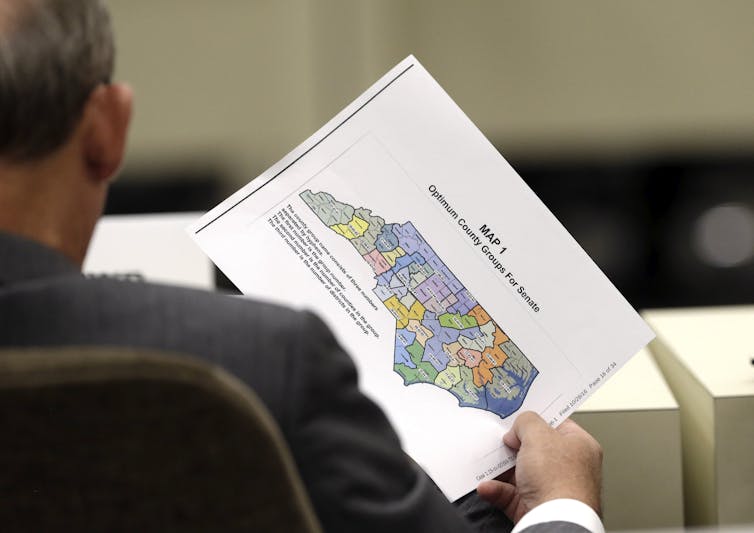
For months, legislators, legal scholars and people simply interested in democracy and elections were fixated on a case before the Supreme Court, Moore v. Harper. Those following the case, which asked the justices to rule on the “independent state legislature doctrine,” have held their collective breath awaiting the outcome, which could have changed fundamental aspects of U.S. elections and politics.
Henry L. Chambers Jr., a law professor at the University of Richmond, wrote earlier for The Conversation about the case, saying “Adoption of a strong independent state legislature doctrine would leave partisan gerrymandering unregulated at both the state and federal levels. State legislatures, unconstrained by state law, could then create aggressively gerrymandered congressional districts, possibly leading to an ever more partisan Congress with accompanying gridlock and policy failures.”
We asked Chambers to help readers understand the court’s opinion, issued on June 27, 2023.
What question did the Supreme Court answer in this opinion?
The court considered whether a state legislature could have the last word, with no review by state courts, regarding gerrymandered congressional districts they created. State legislatures have always been bound by the U.S. Constitution and by federal laws, so they had to draw lines consistent with the federal Voting Rights Act, for example. But the question was whether a state legislature could draw whatever congressional districts it wanted without review by state courts under state law. If so, state legislatures might also have more freedom to affect the choice of state electors in presidential elections.
At issue was a legal theory called the “independent state legislature doctrine,” which the court considered in a dispute over gerrymandered North Carolina congressional districts. In early 2022, North Carolina state courts found the Legislature violated the state constitution when it drew congressional districts favoring Republicans. The Legislature claimed the U.S. Constitution gives it authority, unfettered by state courts’ interpretation of the state constitution or laws, to regulate congressional elections, and asked the Supreme Court to agree.
The court did not agree.
In cases that involve the legislative action, courts typically consider whether the legislature has contravened state law. If the legislature has, it has made a mistake, and the legislative action tends to be reversed.
This decision merely reiterates what most people always thought the law was: Legislatures cannot legislate in ways that are inconsistent with the law that governs their actions and their state. This conclusion seems obvious, like saying the sky is blue or water is wet.
Does this decision apply only to partisan gerrymandering by state legislatures?
This case focused on partisan gerrymandering of congressional districts. However, it may apply more generally to rules for congressional elections, such as where, when and how such elections will be run. If the state constitution explains how congressional elections will be run, the state legislature must abide by those provisions.
What happens next in terms of partisan gerrymanders drawn by state legislatures?
Partisan gerrymanders are subject only to state constitutional and statutory law – the written laws enacted by the legislature. In the 2019 ruling, Rucho v. Common Cause, the Supreme Court deemed partisan gerrymandering a political question, not subject to regulation by the federal Constitution. In that ruling, the court noted state constitutional and statutory law could be used to stop partisan gerrymandering.
However, states need not regulate partisan gerrymandering. A state constitution may allow partisan gerrymandering by failing to prohibit it, essentially saying, “The people don’t care about partisan gerrymandering.”
Racial gerrymandering is still subject to regulation by the U.S. Constitution, federal law, such as the Voting Rights Act, and state law.

Now that the court has clarified that a legislature’s congressional redistricting is subject to review by state courts, the issue will become whether a state court has appropriately interpreted state statutory law or state constitutional law if it strikes down a congressional redistricting plan.
If a court interprets state law reasonably in invalidating a redistricting plan, it acts appropriately. If a court interprets state law too aggressively in invalidating a redistricting plan, it invades the legislature’s prerogatives.
Federal courts will decide when the state courts have gone too far. The less obvious the interpretation used by the court to limit the state legislature, the less likely federal courts will allow that interpretation to constrain the legislature. However, the Supreme Court provided no guidance in this decision on when state courts have gone too far.
Will this ruling affect the 2024 presidential election?
Had the court decided the case differently, bedlam could have ensued. Legislatures might have attempted to circumvent state law that defines how presidential electors are chosen.
Many folks argue such chicanery could never happen, because once presidential electors are chosen on Election Day, then that’s it. But if the court had suggested a legislature is not bound by its state constitution, some people might make arguments to sow discontent during the weeks between the election and the inauguration.
Other safeguards might have stopped the harm, but the fear of trouble would have been real.
Fortunately, that has been avoided.
This story includes material from an earlier story on the case by the same author.
Henry L. Chambers Jr., Professor of Law, University of Richmond
This article is republished from The Conversation under a Creative Commons license. Read the original article.
- Details
- Written by: LAKE COUNTY NEWS REPORTS
The meeting will take place on Thursday, July 6, from 4 to 5 p.m. in the Board of Supervisors chambers, 255 N. Forbes St. in Lakeport and via Zoom.
During the meeting, the sheriff’s office will present its AB 481 military equipment annual report and answer any questions or address any concerns from the community.
The report can be found on https://www.lakecountyca.gov/1462/Transparency.
AB 481 addresses equipment possessed and used by the Sheriff’s Office, which has been identified as “military equipment” by the state of California.
To attend via Zoom, access the meeting via this link. The webinar ID is 960 3350 6755, the passcode is 415115.
To join by phone, dial 669 900 6833 or 669 444 9171. One tap mobile is available at +16699006833,,96033506755#,,,,*415115# US.