 How to resolve AdBlock issue?
News
- Details
- Written by: Elizabeth Larson
Dogs available for adoption this week include mixes of Anatolian shepherd, Belgian malinois, border collie, Chihuahua, German shepherd, hound, mastiff, pit bull, plott hound and terrier.
Dogs that are adopted from Lake County Animal Care and Control are either neutered or spayed, microchipped and, if old enough, given a rabies shot and county license before being released to their new owner. License fees do not apply to residents of the cities of Lakeport or Clearlake.
The following dogs at the Lake County Animal Care and Control shelter have been cleared for adoption.
Call Lake County Animal Care and Control at 707-263-0278 or visit the shelter online for information on visiting or adopting.

German shepherd puppy
This male German shepherd puppy is 7 months old, with a short black and tan coat.
He is in kennel No. 2, ID No. LCAC-A-5315.

Male Great Pyrenees
This 1 and a half year old male Great Pyrenees has a white coat.
He is in kennel No. 3, ID No. LCAC-A-5469.

Female German shepherd
This 3-year-old female German shepherd has a black and tan coat.
She is in kennel No. 4, ID No. LCAC-A-5396.

Anatolian shepherd-mastiff mix
This 3-year-old male Anatolian shepherd-mastiff mix has a short fawn coat.
He is in kennel No. 5, ID No. LCAC-A-5276.

Male Chihuahua
This 5-year-old male Chihuahua has a short tricolor coat.
He is in kennel No. 6, ID No. LCAC-A-5500.

‘Roasie’
“Roasie”is a 2-year-old female pit bull terrier with a short black and white coat.
She is in kennel No. 7, ID No. LCAC-A-5434.

Female pit bull
This 3-year-old female pit bull has a short brown coat.
She is in kennel No. 8, ID No. LCAC-A-5505.

“Trixie” is a 3-year-old female hound with a short brown coat.
She is in kennel No. 9, ID No. LCAC-A-5433.

Female pit bull terrier
This 3-year-old female pit bull terrier has a brown and white coat.
She is in kennel No. 10, ID No. LCAC-A-5400.

Female Chihuahua
This 9-year-old female Chihauhua has a short brown and white coat.
She is in kennel No. 11, ID No. LCAC-A-5511.

Female German shepherd
This 2-year-old female German shepherd has a black and tan coat.
She is in kennel No. 12, ID No. LCAC-A-5488.

Male shepherd
This 2 and a half year old male shepherd has a short black and tan coat.
He is in kennel No. 14, ID No. LCAC-A-5479.

Female border collie
This 2-year-old female border collie has a black and white coat.
She is in kennel No. 15, ID No. LCAC-A-5513.

‘Zeta’
“Zeta” is a 1-year-old female pit bull terrier with a black and tan coat.
She is in kennel No. 16, ID No. LCAC-A-5427.

Male plott hound
This 2-year-old male plott hound has a short brown coat.
He is in kennel No. 18, ID No. LCAC-A-5143.

Male Chihuahua-terrier mix
This 2-year-old male Chihuahua-terrier mix has a short white coat.
She is in kennel No. 20, ID No. LCAC-A-5381.

Female Chihuahua
This 2-year-old female Chihuahua has a short brown and white coat.
She is in kennel No. 21, ID No. LCAC-A-5379.

Male shepherd
This 2-year-old male shepherd has a black and tan coat.
He is in kennel No. 22, ID No. LCAC-A-5423.

Male pit bull
This 3-year-old male American pit bull has a short gray and white coat.
He is in kennel No. 23, ID No. LCAC-A-5499.

Female pit bull terrier
This 6-year-old female pit bull terrier has a short tan coat.
She is in kennel No. 24, ID No. LCAC-A-5410.

Male pit bull terrier
This 4-year-old male pit bull terrier has a short gray coat with white markings.
He is in kennel No. 25, ID No. LCAC-A-5446.

Male shepherd
This 1 and a half year old male shepherd has a short tricolor coat.
He is in kennel No. 26, ID No. LCAC-A-5424.

Female shepherd
This 2-year-old female shepherd has a short yellow and white coat.
She is in kennel No. 27, ID No. LCAC-A-5369.

Male pit bull puppy
This 5-month-old male pit bull puppy has a white coat.
He is in kennel No. 29, ID No. LCAC-A-5325.

Male Belgian malinois
This 1 and a half year old male Belgian malinois has a tan and black coat.
He is in kennel No. 30, ID No. LCAC-A-5409.

Male shepherd
This 2-year-old male shepherd has a short tan coat with white markings.
He is in kennel No. 31, ID No. LCAC-A-5344.

Male shepherd mix puppy
This 6-month-old male shepherd mix puppy has a black coat with white markings.
He is in kennel No. 32, ID No. LCAC-A-5408.

Female shepherd mix
This 2-year-old female shepherd mix has a short yellow coat.
She is in kennel No. 33, ID No. LCAC-A-5277.

Female shepherd
This 10-month-old female shepherd has a tricolor coat.
She is in kennel No. 34, ID No. LCAC-A-5323.

‘Jojo’
“Jojo” is a one and a half year old female pit bull terrier with a short tricolor coat.
She is in kennel foster care, ID No. LCAC-A-5312.
Email Elizabeth Larson at
- Details
- Written by: Nicole A. Cooke, University of South Carolina
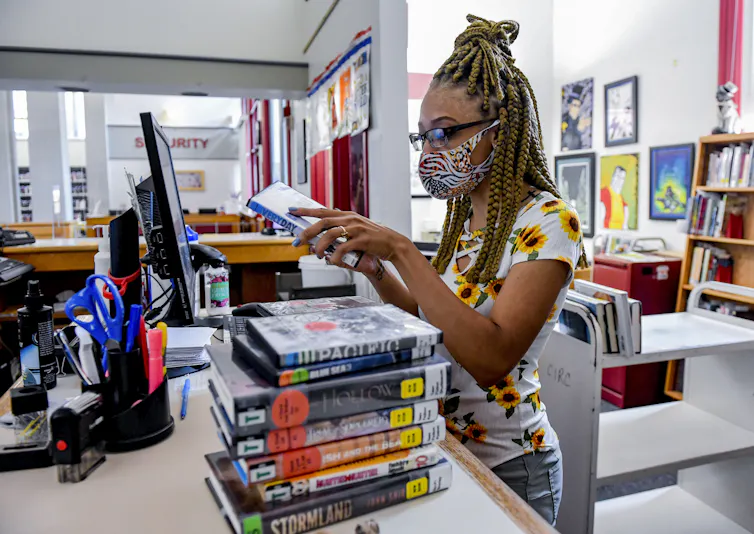
Despite misconceptions and stereotypes – ranging from what librarians Gretchen Keer and Andrew Carlos have described as the “middle-aged, bun-wearing, comfortably shod, shushing librarian” to the “sexy librarian … and the hipster or tattooed librarian” – library professionals are more than book jockeys, and they do more than read at story time.
They are experts in classification, pedagogy, data science, social media, disinformation, health sciences, music, art, media literacy and, yes, storytelling.
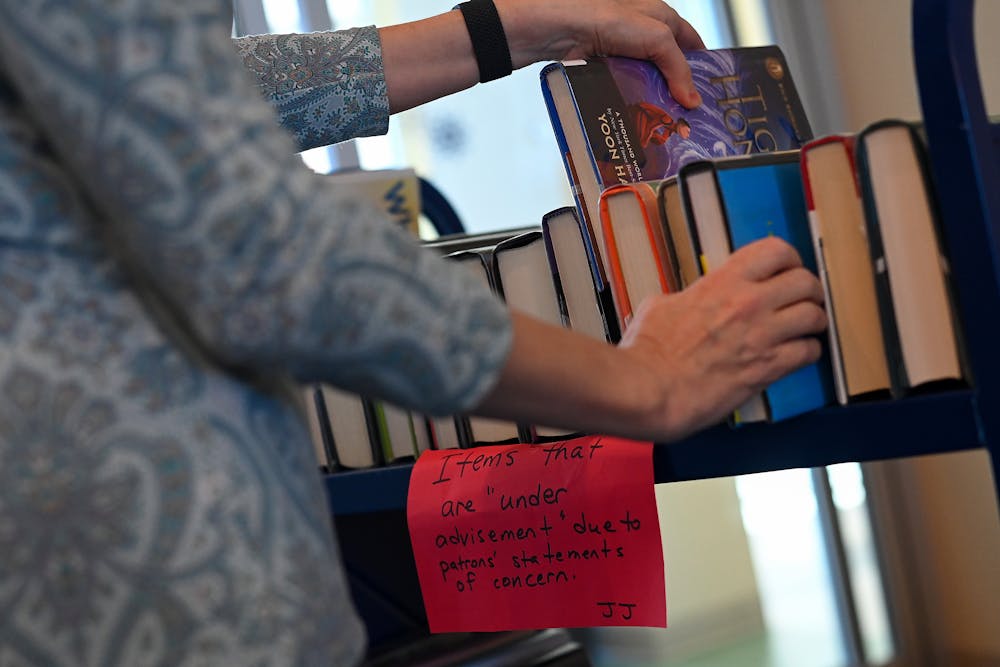
And right now, librarians are taking on an old role. They are defending the rights of readers and writers in the battles raging across the U.S. over censorship, book challenges and book bans.
Book challenges are an attempt to remove a title from circulation, and bans mean the actual removal of a book from library shelves. The current spate of bans and challenges is the most notable and intense since the McCarthy era, when censorship campaigns during that Cold War period of political repression included public book burnings.
But these battles are not new; book banning can be traced back to 1637 in the U.S., when the Puritans banned a book by Massachusetts Bay colonist William Pynchon they saw as heretical.
As long as there have been book challenges, there have been those who defend intellectual freedom and the right to read freely. Librarians and library workers have long been crucial players in the defense of books and ideas. At the 2023 annual American Library Association Conference, scholar Ibram X. Kendi praised library professionals and reminded them that “if you’re fighting book bans, if you’re fighting against censorship, then you are a freedom fighter.”
Library professionals maintain that books are what education scholar Rudine Sims Bishop called the “mirrors, windows and sliding glass doors” that allow readers to learn about themselves and others and gain empathy for those who are different from them.
The drive to challenge, ban or censor books has not only changed the lives of librarians across the nation. It’s also changing the way librarians are now educated to enter the profession. As a library school educator, I hear the anecdotes, questions and concerns from library workers who are on the front lines of the current fight and are not sure how to react or respond.
What once, and still is, a curriculum that includes book selection, program planning and serving diverse communities in the classroom, my faculty colleagues and I are now expanding to include discussions and resources on how students, once they become professional librarians, can physically, legally and financially protect themselves and their organizations.

More than shelving books
Degreed librarians are professionals with master’s degrees from nationally accredited academic programs. I have personally gone through such a program and now teach in one.
In fact, many librarians who work on college and university campuses have subject masters and doctorates, and K-12 librarians must have a valid teaching license or a state endorsement to work in a school library or media center. They know how to select appropriate materials for communities.
Librarians adhere to core values, standards and professional ethics. They see it as their duty to create and maintain a collection that reflects the diverse needs and interests of the entire community, not just for a select, vocal part of the community. The Freedom to Read statement of the American Library Association tells us: “It is the responsibility of publishers and librarians, as guardians of the people’s freedom to read, to contest encroachments upon that freedom by individuals or groups seeking to impose their own standards or tastes upon the community at large; and by the government whenever it seeks to reduce or deny public access to public information.”
Books are challenged and banned for many reasons, including profanity, depictions of sex, LGBTQIA+ content, depictions of sexual abuse, equity, diversity and inclusion content, depictions of drug use and alcoholism, anti-police rhetoric and providing sex education. Reasons for challenges can be personally subjective, and claims that books present divisive topics that should be excluded from collections are increasing.
George Johnson, author of the frequently banned book “All Boys aren’t Blue,” has said that he believes books are challenged to eliminate narratives that elucidate the truths of marginalized groups and depict the everyday diversity of their lives. Johnson believes the stories of the LGBTQIA+ and minoritized communities are specifically under attack.
Johnson is a complainant in a recently filed federal lawsuit against Florida’s Escambia County School District and School Board, which unanimously voted to remove Johnson’s book from their school libraries because of passages that describe a sexual experience.
The new librarians’ education
To balance the needs of everyone in the community, libraries have collection development policies as well as reconsideration and withdrawal policies that guide librarians in selecting new books and materials and removing those that are outdated. These policies are key when facing potential bans and challenges.
But with the current controversies about racially diverse and LGBTQIA+ books, policies are no longer enough to demonstrate the integrity of professionally curated library collections.
Neither policies nor book reviews nor professional expertise are keeping library workers from being called pedophiles, groomers, indoctrinators and pornographers. They are being harassed, receiving death threats and being fired. Libraries have been sued and library workers are so threatened and harassed that they are getting sick and leaving their careers.
The current threats to librarians and the books they circulate are necessitating a shift in the content of graduate library education. Librarians obviously need to know the content of books. But educators like me now know we need to provide graduate students with information about how to physically and legally protect themselves and their organizations.
When we teach intellectual freedom, we also teach students how to prepare for protesters and contentious board meetings. When we teach information professionals how to select materials for their libraries, we emphasize their need to know how to articulate, in writing, the reasons for having a particular book, film or material item in their collection.
I believe that our students now need to consider getting professional liability insurance in case they are sued for buying a contested book. And when we teach story-time planning, we can pair that with strategies to devise a safety plan in case they are threatened or receive a bomb threat because of their work.
Librarians and the future librarians we teach have always loved books and reading. While our work has changed in this era of increasing censorship, in one sense it has not: We’re still devoted to the idea that we serve our communities by providing them with books that open the world to them and give them the opportunity to learn about themselves and others.
Nicole A. Cooke, Baker Endowed Chair and Professor of Library and Information Science, University of South Carolina
This article is republished from The Conversation under a Creative Commons license. Read the original article.
- Details
- Written by: Robert Sanders
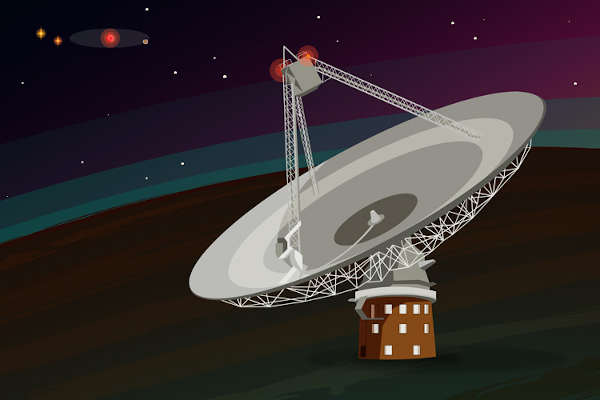
BERKELEY, Calif. — Scientists have devised a new technique for finding and vetting possible radio signals from other civilizations in our galaxy — a major advance in the search for extraterrestrial intelligence, or SETI, that will significantly boost confidence in any future detection of alien life.
Most of today's SETI searches are conducted by Earth-based radio telescopes, which means that any ground or satellite radio interference — ranging from Starlink satellites to cellphones, microwaves and even car engines — can produce a radio blip that mimics a technosignature of a civilization outside our solar system. Such false alarms have raised and then dashed hopes since the first dedicated SETI program began in 1960.
Currently, researchers vet these signals by pointing the telescope in a different place in the sky, then return a few times to the spot where the signal was originally detected to confirm it wasn't a one-off. Even then, the signal could be something weird produced on Earth.
The new technique, developed by researchers at the Breakthrough Listen project at the University of California, Berkeley, checks for evidence that the signal has actually passed through interstellar space, eliminating the possibility that the signal is mere radio interference from Earth.
Breakthrough Listen, the most comprehensive SETI search anywhere, monitors the northern and southern skies with radio telescopes in search of technosignatures. It also targets thousands of individual stars in the plane of the Milky Way galaxy, which is the likely direction a civilization would beam a signal, with a particular focus on the center of the galaxy.
“I think it's one of the biggest advances in radio SETI in a long time,” said Andrew Siemion, principal investigator for Breakthrough Listen and director of the Berkeley SETI Research Center, or BSRC, which operates the world's longest running SETI program. “It's the first time where we have a technique that, if we just have one signal, potentially could allow us to intrinsically differentiate it from radio frequency interference. That's pretty amazing, because if you consider something like the Wow! signal, these are often a one-off.”
Siemion was referring to a famed 72-second narrowband signal observed in 1977 by a radio telescope in Ohio. The astronomer who discovered the signal, which looked like nothing produced by normal astrophysical processes, wrote “Wow!” in red ink on the data printout. The signal has not been observed since.
“The first ET detection may very well be a one-off, where we only see one signal,” Siemion said. “And if a signal doesn't repeat, there's not a lot that we can say about that. And obviously, the most likely explanation for it is radio frequency interference, as is the most likely explanation for the Wow! Signal. Having this new technique and the instrumentation capable of recording data at sufficient fidelity such that you could see the effect of the interstellar medium, or ISM, is incredibly powerful.”
The technique is described in a paper appearing today in The Astrophysical Journal by UC Berkeley graduate student Bryan Brzycki; Siemion; Brzycki's thesis adviser Imke de Pater, UC Berkeley professor emeritus of astronomy; and colleagues at Cornell University and the SETI Institute in Mountain View, California.
Siemion noted that, in the future, Breakthrough Listen will be employing the so-called scintillation technique, along with sky location, during its SETI observations, including with the Green Bank Telescope in West Virginia — the world’s largest steerable radio telescope — and the MeerKAT array in South Africa.
Distinguishing a signal from ET
For more than 60 years, SETI researchers have scanned the skies in search of signals that look different from the typical radio emissions of stars and cataclysmic events, such as supernovas.
One key distinction is that natural cosmic sources of radio waves produce a broad range of wavelengths — that is, broadband radio waves — whereas technical civilizations, like our own, produce narrowband radio signals. Think radio static versus a tuned-in FM station.
Because of the huge background of narrowband radio bursts from human activity on Earth, finding a signal from outer space is like looking for a needle in a haystack.
So far, no narrowband radio signals from outside our solar system have been confirmed, though Breakthrough Listen found one interesting candidate — dubbed BLC1 — in 2020. Later analysis determined that it was almost certainly due to radio interference, Siemion said.
Siemion and his colleagues realized, however, that real signals from extraterrestrial civilizations should exhibit features caused by passage through the ISM that could help discriminate between Earth- and space-based radio signals.
Thanks to past research describing how the cold plasma in the interstellar medium, primarily free electrons, affect signals from radio sources such as pulsars, astronomers now have a good idea how the ISM affects narrowband radio signals.
Such signals tend to rise and fall in amplitude over time — that is, they scintillate.
This is because the signals are slightly refracted, or bent, by the intervening cold plasma, so that when the radio waves eventually reach Earth by different paths, the waves interfere, both positively and negatively.
Our atmosphere produces a similar scintillation, or twinkle, that affects the pinprick of optical light from a star. Planets, which are not point sources of light, do not twinkle.
Brzycki developed a computer algorithm, available as a Python script, that analyzes the scintillation of narrowband signals and plucks out those that dim and brighten over periods of less than a minute, indicating they've passed through the ISM.
“This implies that we could use a suitably tuned pipeline to unambiguously identify artificial emission from distant sources vis-à-vis terrestrial interference,” de Pater said. “Further, even if we didn’t use this technique to find a signal, this technique could, in certain cases, confirm a signal originating from a distant source, rather than locally. This work represents the first new method of signal confirmation beyond the spatial reobservation filter in the history of radio SETI.”
Brzycki is now conducting radio observations at the Green Bank Telescope in West Virginia to show that the technique can quickly weed out Earth-based radio signals and perhaps even detect scintillation in a narrowband signal — a technosignature candidate.
“Maybe we can identify this effect within individual observations and see that attenuation and brightening and actually say that the signal is undergoing that effect,” he said. “It's another tool that we have available now.”
The technique will be useful only for signals that originate more than about 10,000 light years from Earth, since a signal must travel through enough of the ISM to exhibit detectable scintillation.
Anything originating nearby — the BLC-1 signal, for example, seemed to be coming from our nearest star, Proxima Centauri — would not exhibit this effect.
Other co-authors of the paper are James Cordes of Cornell, Brian Lacki of BSRC and Vishal Gajjar and Sofia Sheikh of both BSRC and the SETI Institute. Breakthrough Listen is managed by the Breakthrough Initiatives, a program sponsored by the Breakthrough Prize Foundation.
Robert Sanders writes for the UC Berkeley News Center.
- Details
- Written by: Elizabeth Larson
Police Chief Tim Hobbs noted in his written report to the council that there hadn’t been a school resource officer, or SRO, assigned to the district since October 2020.
Lt. Martin Snyder, who was on hand to give the report on behalf of Hobbs, explained that the Clearlake Police Department’s staffing level now allows for assigning one officer as a full-time SRO.
Under the memorandum of understanding the council approved with Konocti Unified, the district will pay $142,956.32 to fund the cost of a full-time SRO, which includes salary, benefits, overtime, training and vehicle usage costs. The city also can recover additional overtime costs for other officers used at school events, according to Hobbs’ written report.
Konocti Unified’s superintendent, Dr. Becky Salato, told the council that, on behalf of the school district, she was grateful for the council’s consideration.
She said it has been a tough three years since the district last had an SRO in October 2020.
At the same time, she said they truly appreciate the police department. In the interim, even without an SRO, Salato said the police department responds immediately to the district.
She added that the SRO is a “super important” position for the school district.
Councilman Russ Cremer moved to approve the agreement, which was seconded by Councilwoman Joyce Overton and approved by the council 3-0. Council members David Claffey and Russell Perdock were absent.
In other business, the council awarded a $46,715 contract for traffic signal updates at the intersection of Olympic Drive and Old Highway 53 to DC Electric. The funds come from the Coronavirus Response and Relief supplemental appropriations through Caltrans.
The council also awarded a contract for guardrail installation to Midstate Barrier for $46,500.
Email Elizabeth Larson at