 How to resolve AdBlock issue?
News
- Details
- Written by: LAKE COUNTY NEWS REPORTS
A state agency that has a direct impact on Lake County residents and millions of other Californians is celebrating its golden anniversary.
Fifty years ago this month, the state of California established a new Department of Transportation, today known as Caltrans, to unify a wide range of transportation functions under a single entity.
Since July 1973, the department has managed one of the most complex transportation systems in the nation and helped play a vital role in creating the world’s fourth largest economy.
Five decades later, Caltrans continues its mission to deliver a best-in-class experience for all Californians, regardless of the mode of travel they choose.
Additionally, to honor the milestone, Caltrans has released an updated history page on its official website.
This new content traces the state’s transportation roots from 1895 when the Bureau of Highways was formed and chronicles key developments and noteworthy projects spanning to the present day.
Visit the Caltrans Historical Page here.
- Details
- Written by: LAKE COUNTY NEWS REPORTS

CLEARLAKE, Calif. — Earlier this month, the Clearlake Police Department served five search warrants at properties within the city involving illegal marijuana growing operations.
Police said approximately 3,650 marijuana plants and just over one 1,000 pounds of processed marijuana were seized from the five locations.
Additionally, 12 illegally owned firearms and approximately 6,450 rounds of ammunition were seized from four of the locations, officials reported.
The marijuana plants at the properties were mostly outdoors, but several had marijuana growing inside the residences, police said.
Police said none of the properties had licenses allowing the cultivation of marijuana.
Four people were arrested and booked into the Lake County Jail for charges related to illegal marijuana operations and firearms, according to the police report.
- Details
- Written by: Chanell Washington and Lydia Anderson
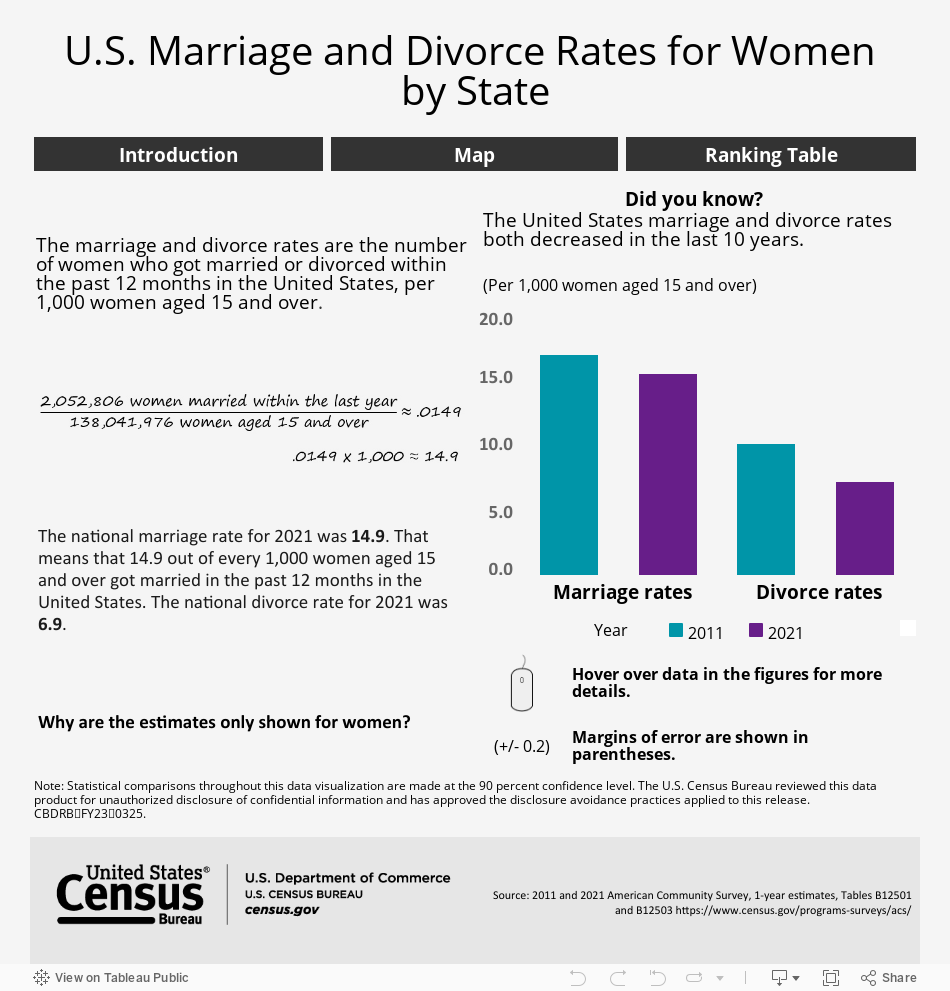
In 2021, the U.S. marriage rate was 14.9 marriages in the last year per 1,000 women, down from 16.3 a decade earlier. And the 2021 divorce rate dropped to 6.9 in the last year from 9.7 divorces per 1,000 women in 2011.
But the rates varied by state during both time periods.
Now, an updated U.S. Census Bureau visualization allows you to rank and compare divorce and marriage rates in your state to those in other states and the nation.
Using data from the 2011 and 2021 American Community Survey 1-year estimates, it provides a state-by-state look at marriage and divorce rates per 1,000 women age 15 and older. Please note that not all differences in state marriage and divorce rates are statistically significant.
While the U.S. Census Bureau publishes estimates for both men and women, we have restricted this visualization to data for women to provide a digestible look at trends in marriage and divorce.
Historically, women’s data have often been presented when a choice needs to be made. Previous research [PDF 2.3 MB] found that women more often report data for themselves and report their marital history more accurately.
According to the data, in 2021:
• Alaska and Utah had among the highest marriage rates, at 23.5 and 22.3, respectively. These rates, however, do not significantly differ from each other.
• Puerto Rico had among the lowest marriage and divorce rates. Its marriage rate was 4.7 and its divorce rate 3.9. Puerto Rico’s low marriage and divorce rates likely resulted, at least in part from the high outmigration of its young adult population, especially after Hurricane Maria.
• Massachusetts had a marriage rate of 11.8, also among the nation’s lowest.
• Idaho and Arkansas had among the highest divorce rates, at 11.1 and 11.0, respectively (not a statistically significant difference).
• New Hampshire had a divorce rate of 4.3, among the lowest in the nation.
There are three components of the visualization: an introductory tab discussing how marriage and divorce rates are calculated; a map tab showing each state’s marriage and divorce rates compared to the national average; and a ranking table tab showing each state’s marriage/divorce rank in 2011 and 2021.
Chanell Washington and Lydia Anderson are family demographers in the Census Bureau’s Social, Economic, and Housing Statistics Division.
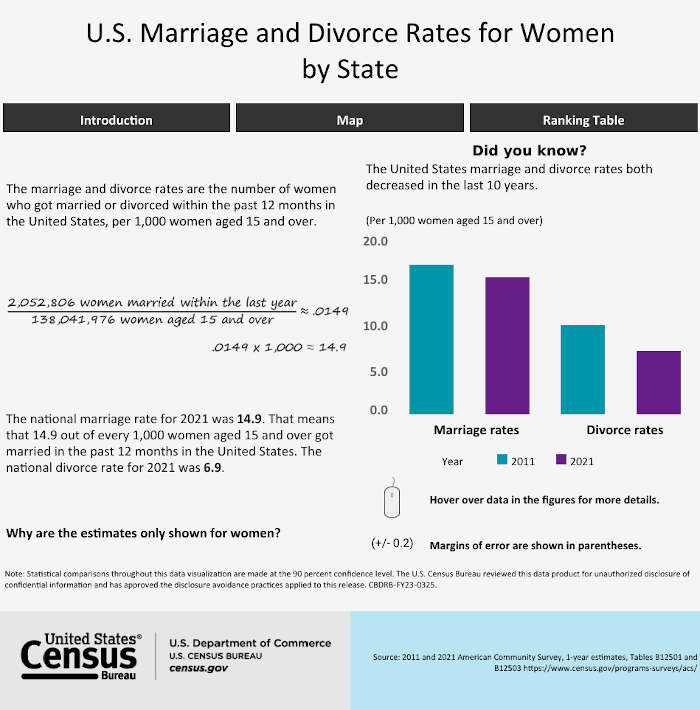
To see the live visualization, visit here.
- Details
- Written by: W. Larry Kenney, Penn State; Daniel Vecellio, Penn State; Rachel Cottle, Penn State, and S. Tony Wolf, Penn State

Extreme heat has been breaking records across Europe, Asia and North America, with millions of people sweltering in heat and humidity well above “normal” for days on end.
Death Valley hit a temperature of 128 degrees Fahrenheit (53.3 degrees Celsius) on July 16, 2023 – not quite the world’s hottest day on record, but close. Phoenix broke a record heat streak with 19 straight days with temperatures above 110 F (43.3 C), and had more in the forecast, accompanied by several nights that never got below 90 F (32.2 C). Globally, Earth likely had its hottest week on modern record in early July.
Heat waves are becoming supercharged as the climate changes – lasting longer, becoming more frequent and getting just plain hotter.
One question a lot of people are asking is: “When will it get too hot for normal daily activity as we know it, even for young, healthy adults?”
The answer goes beyond the temperature you see on the thermometer. It’s also about humidity. Our research is designed to come up with the combination of the two, measured as “wet-bulb temperature.” Together, heat and humidity put people at greatly increased risk, and the combination gets dangerous at lower levels than scientists previously believed.

The limits of human adaptability
Scientists and other observers have become alarmed about the increasing frequency of extreme heat paired with high humidity.
People often point to a study published in 2010 that theorized that a wet-bulb temperature of 95 F (35 C) – equal to a temperature of 95 F at 100% humidity, or 115 F at 50% humidity – would be the upper limit of safety, beyond which the human body can no longer cool itself by evaporating sweat from the surface of the body to maintain a stable body core temperature.
It was not until recently that this limit was tested on humans in laboratory settings. The results of these tests show an even greater cause for concern.
The PSU H.E.A.T. Project
To answer the question of “how hot is too hot?” we brought young, healthy men and women into the Noll Laboratory at Penn State University to experience heat stress in a controlled environmental chamber.
These experiments provide insight into which combinations of temperature and humidity begin to become harmful for even the healthiest humans.

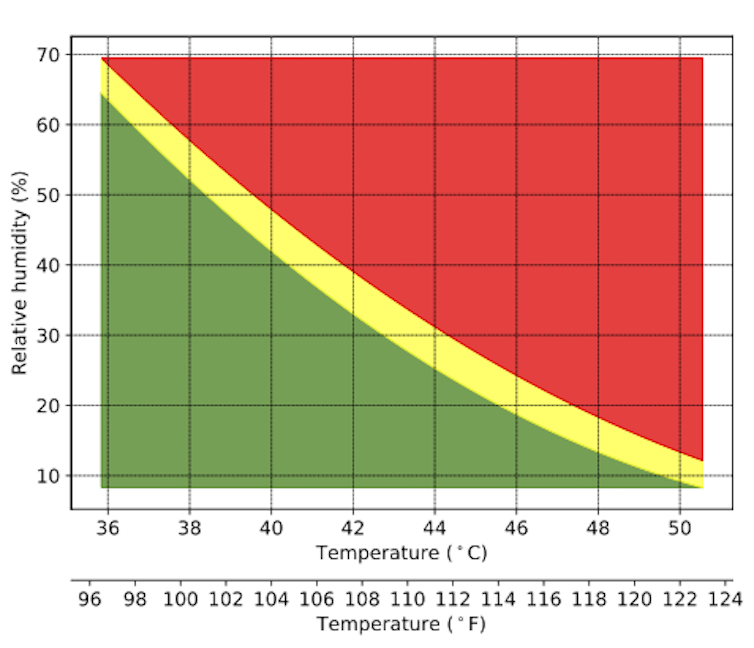
Each participant swallowed a small telemetry pill that continuously monitored their deep body or core temperature. They then sat in an environmental chamber, moving just enough to simulate the minimal activities of daily living, such as showering, cooking and eating. Researchers slowly increased either the temperature in the chamber or the humidity in hundreds of separate experiments and monitored when the subject’s core temperature started to rise.
That combination of temperature and humidity at which the person’s core temperature starts to continuously rise is called the “critical environmental limit.”
Below those limits, the body is able to maintain a relatively stable core temperature over long periods of time. Above those limits, core temperature rises continuously and the risk of heat-related illnesses with prolonged exposures is increased.
When the body overheats, the heart has to work harder to pump blood flow to the skin to dissipate the heat, and when you’re also sweating, that decreases body fluids. In the direst case, prolonged exposure can result in heat stroke, a life-threatening problem that requires immediate and rapid cooling and medical treatment.
Our studies on young healthy men and women show that this upper environmental limit is even lower than the theorized 35 C. It occurs at a wet-bulb temperature of about 87 F (31 C) across a range of environments above 50% relative humidity. That would equal 87 F at 100% humidity or 100 F (38 C) at 60% humidity.
Dry vs. humid environments
Current heat waves around the globe are exceeding those critical environmental limits, and approaching, if not exceeding, even the theorized 95 F (35 C) wet-bulb limits.
In the Middle East, Asaluyeh, Iran, recorded an extremely dangerous maximum wet-bulb temperature of 92.7 F (33.7 C) on July 16, 2023. India and Pakistan have both reached hazardous levels in recent years, as well.
In hot, dry environments, the critical environmental limits aren’t defined by wet-bulb temperatures, because almost all the sweat the body produces evaporates, which cools the body. However, the amount humans can sweat is limited, and we also gain more heat from the higher air temperatures.
Keep in mind that these cutoffs are based solely on keeping your body temperature from rising excessively. Even lower temperatures and humidity can place stress on the heart and other body systems.
A recent paper from our laboratory showed that heart rate begins to increase well before our core temperature does, as we pump blood to the skin. And while eclipsing these limits does not necessarily present a worst-case scenario, prolonged exposure may become dire for vulnerable populations such as the elderly and those with chronic diseases.
Our experimental focus has now turned to testing older men and women, since even healthy aging makes people less heat-tolerant. The increased prevalence of heart disease, respiratory problems and other health problems, as well as certain medications, can put them at even higher risk of harm. People over the age of 65 comprise some 80% to 90% of heat wave casualties.
How to stay safe
Staying well hydrated and seeking areas in which to cool down – even for short periods – are important in high heat.
While more cities in the United States are expanding cooling centers to help people escape the heat, there will still be many people who will experience these dangerous conditions with no way to cool themselves.
Even those with access to air conditioning might not turn it on because of the high cost of energy – a common occurrence in Phoenix – or because of large-scale power outages during heat waves or wildfires, as is becoming more common in the western U.S.
All told, the evidence continues to mount that climate change is not just a problem for the future. It is one that humanity is currently facing and must tackle head-on.
This is an update to an article originally published July 6, 2022.
W. Larry Kenney, Professor of Physiology, Kinesiology and Human Performance, Penn State; Daniel Vecellio, Geographer-climatologist and Postdoctoral Fellow, Penn State; Rachel Cottle, Ph.D. Candidate in Exercise Physiology, Penn State, and S. Tony Wolf, Postdoctoral Researcher in Kinesiology, Penn State
This article is republished from The Conversation under a Creative Commons license. Read the original article.