How to resolve AdBlock issue?
News
- Details
- Written by: Andrew King, The University of Melbourne; Ed Hawkins, University of Reading; Hunter Douglas, Te Herenga Waka — Victoria University of Wellington, and Luke Harrington, University of Waikato
Earth is warming and the signs of climate change are everywhere. We’ve seen it in the past few weeks as temperatures hit record highs around the world – both in the Northern Hemisphere and the warm Australian winter.
Global warming is caused by humanity’s greenhouse gas emissions, which continue at near-record pace. These emissions are predominantly generated by people in the world’s wealthiest regions.
Our world-first analysis, published today, examines the experience of global warming over the lifetimes of people around the world: young and old, rich and poor. We sought to identify who has perceived warmer temperatures most keenly.
We found middle-aged people in equatorial regions have lived through the most perceptible warming in their lifetimes. But many young people in lower-income countries could experience unrecognisable changes in their local climate later in life, unless the world rapidly tackles climate change.
Measuring the climate change experience
We examined temperature data and population demographics information from around the world.
Key to our analysis was the fact that not all warming is due to human activity. Some of it is caused by natural, year-to-year variations in Earth’s climate.
These natural ups and downs are due to a number of factors. They include variations in the energy Earth receives from the sun, the effects of volcanic eruptions, and transfers of heat between the atmosphere and the ocean.
This variability is stronger in mid-to-high-latitude parts of the world (those further from the equator) than in low-latitude areas (in equatorial regions). That’s because the weather systems further away from the equator draw in hot or cold air from neighbouring areas, but equatorial areas don’t receive cold air at all.
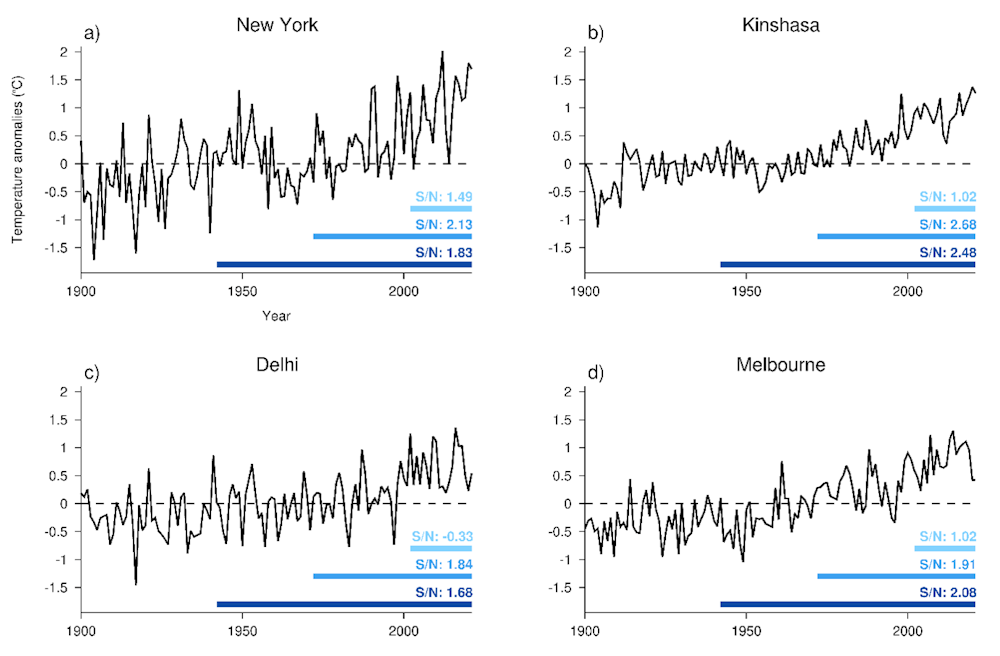
That’s why, for example, the annual average temperature in New York is naturally more variable than in the city of Kinshasa (in the Democratic Republic of Congo).
To account for this, we applied what’s known as the “signal-to-noise ratio” at each location we studied. That allowed us to separate the strength of the climate change “signal” from the “noise” of natural variability.
Making this distinction is important. The less naturally variable the temperature, the clearer the effects of warming. So warming in Kinshasa over the past 50 years has been much more perceptible than in New York.
Our study examined two central questions. First, we wanted to know, for every location in the world, how clearly global warming could be perceived, relative to natural temperature variability.
Second, we wanted to know where this perceived change was most clear over human lifetimes.
Our results
So what did we find? As expected, the most perceptible warming is found in tropical regions – those near the equator. This includes developing parts of the world that constitute the Global South – such as Africa, Latin America and the Caribbean, and Asia.
Household incomes in the Global South are typically lower than in industrialised nations (known as the Global North). We might, then, conclude people in the poorest parts of the world have experienced the most perceptible global warming over their lifetimes. But that’s not always the case.
Why? Because most parts of the Global South have younger populations than wealthier regions. And some people under the age of 20, including in northern India and parts of Sub-Saharan Africa, haven’t experienced warming over their lifetimes.
In these places, the lack of recent warming is likely down to a few factors: natural climate variability, and the local cooling effect of particles released into the atmosphere from pollution and changes in land use.
There’s another complication. Some populated regions of the world also experienced slight cooling in the mid-20th century, primarily driven by human-caused aerosol emissions.
So, many people born earlier than the 1950s have experienced less perceptible warming in their local area than those born in the 1960s and 1970s. This may seem counter-intuitive. But a cooling trend in the first few decades of one’s life means the warming experienced over an entire lifespan (from birth until today) is smaller and less detectable.
So what does all this mean? People in equatorial areas born in the 1960s and 1970s – now aged between about 45 and 65 – have experienced more perceptible warming than anyone else on Earth.
Rich countries must act
Our findings are important, for several reasons.
Identifying who has experienced significant global warming in their lives may help explain attitudes to tackling climate change.
Our findings also raise significant issues of fairness and equity.
Humanity will continue to warm the planet until we reach global net-zero emissions. This means many young people in lower-income countries may, later in life, experience a local climate that is unrecognisable to that of their youth.
Of course, warming temperatures are not the only way people experience climate change. Others include sea-level rise, more intense drought and rainfall extremes. We know many of these impacts are felt most acutely by the most vulnerable populations.
Cumulative greenhouse gas emissions are much higher in the Global North, due to economic development. To address this inequality, rich industrialised nations must take a leading role in reducing emissions to net-zero, and helping vulnerable countries adapt to climate change.
Andrew King, Senior Lecturer in Climate Science, The University of Melbourne; Ed Hawkins, Professor of Climate Science, University of Reading; Hunter Douglas, PhD Candidate, Te Herenga Waka — Victoria University of Wellington, and Luke Harrington, Senior Lecturer in Climate Change, University of Waikato
This article is republished from The Conversation under a Creative Commons license. Read the original article.
- Details
- Written by: Elizabeth Larson
The board will meet beginning at 9 a.m. Tuesday, Aug. 15, in the board chambers on the first floor of the Lake County Courthouse, 255 N. Forbes St., Lakeport.
The meeting can be watched live on Channel 8, online at https://countyoflake.legistar.com/Calendar.aspx and on the county’s Facebook page. Accompanying board documents, the agenda and archived board meeting videos also are available at that link.
To participate in real-time, join the Zoom meeting by clicking this link.
The meeting ID is 990 1778 2374, pass code 737235. The meeting also can be accessed via one tap mobile at +16694449171,,99017782374#,,,,*737235#.
All interested members of the public that do not have internet access or a Mediacom cable subscription are encouraged to call 669-900-6833, and enter the Zoom meeting ID and pass code information above.
On the agenda is an employment agreement between the county of Lake and Noemi C. Doohan, MD, the former Public Health officer of Mendocino County who now is serving as chief medical officer for the Santa Barbara County Public Health Department.
The contract is in the annually renewable not-to-exceed amount of $290,000, plus employee benefits.
In an item timed for 9:45 a.m., the board will consider a resolution supporting the addition of Molok Luyuk (Condor Ridge) to the Berryessa Snow Mountain National Monument.
The full agenda follows.
CONSENT AGENDA
5.1: Sitting as the Lake County Air Quality Management District Board of Directors, consideration of memorandum of understanding by and between county of Mendocino and the Lake County Air Quality Management District for air pollution control officer duties, effective Aug. 1, 2023.
5.2: Adopt resolution approving agreement with California Department of Food Agriculture for Certified Farmer’s Market Program Investigation and Enforcement Agreement No. 23-0040-000-SA in the amount of $1,140 for the period of July 1, 2023, through June 30, 2024.
5.3: Adopt resolution to amend Resolution No. 2023-77, that increased revenue in Fund 200, Lake County Watershed Protection District to appropriate unanticipated revenue.
5.4: Approve agreement between county of Lake and Santa Rosa Behavioral Healthcare Hospital for acute inpatient psychiatric hospital services and professional services associated with acute inpatient psychiatric hospitalizations in the amount of $50,000 for fiscal year 2023-24 and authorize the board chair to sign.
5.5: Approve Board of Supervisors minutes for Aug. 3 and Aug. 8, 2023.
5.6: Approve purchase orders for the purchase of six (6) vehicles for the central garage fleet and authorize the Public Works director/assistant purchasing agent to sign the purchase orders.
5.7: Adopt resolution authorizing the Public Works director to sign the notice of completion for the Cooper Creek at Witter Springs Road Bridge Replacement Project in Lake County; Federal Project No. BRLO-5914(078) Bid No. 22-03.
5.8: Approve the Sun Ridge Systems software support services agreement for the FY 2023/24 in the amount of $ 52,626 for the support of its law enforcement software suite, and authorize the sheriff to issue a purchase order.
5.9: Sitting as the Board of Directors of the Lake County Watershed Protection District, a) waive the formal bidding process, pursuant to Lake County Code Section 38.2 (2) & (3), as competitive bidding is not in the public interest due to the unique nature of the goods and services provided and the bidding process would produce no economic benefit; and b) approve agreement with Alpha Analytical Laboratories Inc. for water and sediment sampling in the amount of $100,000 and authorize the Water Resources director to sign the agreement.
TIMED ITEMS
6.2, 9:07 a.m.: Pet of the Week.
6.3, 9:10 a.m.: Consideration of the June 30, 2023, report of Lake County pooled Investments.
6.4, 9:45 a.m. Consideration of a resolution supporting the addition of Molok Luyuk (Condor Ridge) to the Berryessa Snow Mountain National Monument.
UNTIMED ITEMS
7.2: Consideration of an employment agreement between the county of Lake and Noemi C. Doohan, MD, PhD, MPH, for Public Health officer services in the annually renewable not-to-exceed amount of $290,000, plus employee benefits (item will be taken up following Closed Session Item 8.2).
7.3: Consideration of updated applicant interview travel expense reimbursement policy.
CONSENT AGENDA
8.1: Public employee appointment pursuant to Gov. Code Section 54957(b) (1): Interviews for chief public defender and appointment of chief public defender.
8.2: Public employee appointment pursuant to Gov. Code Section 54957(b) (1): Interviews for Public Health officer and appointment of Public Health officer.
8.3: Conference with legal counsel: Decision whether to initiate litigation pursuant to Gov. Code Sec. 54956.9(d)(4): One potential case.
8.4: Conference with legal counsel: Existing litigation pursuant to Gov. Code sec. 54956.9 (d)(1) - FERC Project No. 77, Potter Valley Hydroelectric Project.
8.5: Public employee discipline/dismissal/release.
Email Elizabeth Larson at
- Details
- Written by: Elizabeth Larson
The council will meet at 6 p.m. Tuesday, Aug. 15, in the council chambers at Lakeport City Hall, 225 Park St.
The agenda can be found here.
The council chambers will be open to the public for the meeting. Masks are highly encouraged where 6-foot distancing cannot be maintained.
If you cannot attend in person, and would like to speak on an agenda item, you can access the Zoom meeting remotely at this link or join by phone by calling toll-free 669-900-9128 or 346-248-7799.
The webinar ID is 973 6820 1787, access code is 477973; the audio pin will be shown after joining the webinar. Those phoning in without using the web link will be in “listen mode” only and will not be able to participate or comment.
Comments can be submitted by email to
On Tuesday the council will meet new Lakeport Police Department officers Austin Eldridge, Jonatan Moreno and Alexis Pizano, and Sgt. Sarah Hardisty, and the council also will present a proclamation recognizing Aug. 31, as International Overdose Awareness Day in the city of Lakeport.
The council is due on Tuesday to hold a public hearing and approve an ordinance adopting a policy for the use of military equipment by the Lakeport Police Department.
Under council business, City Manager Kevin Ingram will present to the council a memorandum of understanding between the city and the Lakeport Main Street Association for the period of July 1, 2023, through June 30, 2024.
Assistant City Manager Nick Walker will seek the council’s approval to execute a contract with R3 for consulting services and a reimbursement agreement with Lakeport Disposal.
Administrative Services Director/City Clerk Kelly Buendia will present a resolution establishing a policy and procedure governing limited term employees.
On the consent agenda — items considered noncontroversial and usually accepted as a slate on one vote — are warrants; minutes of the regular council meeting on Aug. 10; approval of Application 2023-022, with staff recommendations, for the 2023 Harvest Festival; receipt and filing of the Community Development Department activity report for fourth quarter of fiscal year 2022-23; and cancellation of the regular City Council meeting on Oct. 3 and approval of the
participation of the city of Lakeport in the National Night Out event, with street closures and the Library Park Gazebo reserved for the event.
Email Elizabeth Larson at
- Details
- Written by: Evan Brassell
When many people think of vacant homes, they think of houses or apartments on the market for sale or rent. But the largest category of vacant housing in the United States is classified as “seasonal, recreational or occasional use,” commonly referred to as seasonal units.
These vacant structures cover a wide range of housing units, from part-time residences and hunting cabins to beach houses and timeshares.
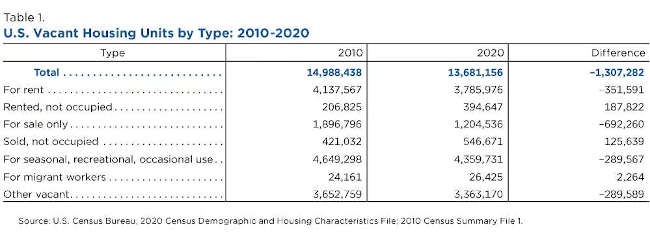
As the nation recovered from the 2007-2008 housing crisis, the vacancy rate decreased from 11.4% in 2010 to 9.7% in 2020, according to 2020 Census Demographic and Housing Characteristics data released today.
The number of units for rent, units for sale, seasonal units and units that were in the vacant for some other reason category all declined during this period.
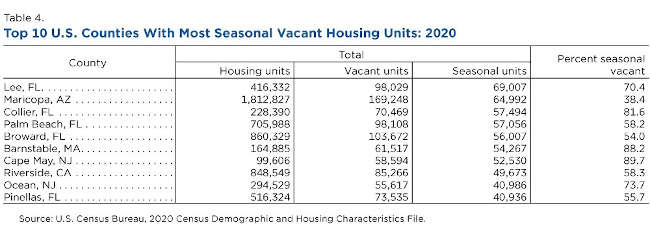
Despite that decline, there were still over 4.3 million vacant seasonal units throughout the country and seasonal units were once again the largest category of vacant housing (Table 1).
The term “seasonal vacant” covers a wide swath of potential situations, so it’s not surprising such vacancies were found in every county in the country.
But while everywhere, seasonal vacants were more common in certain places.
In 645 of the nation’s 3,143 counties, seasonal units made up at least 50% of the vacant housing in the county. In 1,313 counties, seasonal units outnumbered the combined total number of units for rent or sale that were vacant.
While these counties included areas typically known as vacation or second-home destinations, they also included some of the country’s most populous areas.
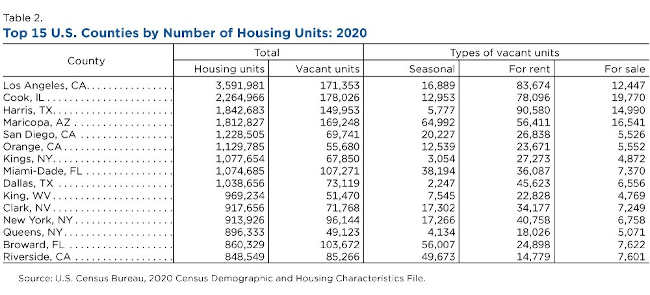
Among the 15 largest counties by number of housing units, 11 had many more vacant units listed for rent than for any other vacant category, including New York County, New York; Harris County, Texas; Cook County, Illinois; and Los Angeles County, California (Table 2).
However, Riverside County, California; Broward County and Miami-Dade County, Florida; and Maricopa County, Arizona, had more vacant units that were for seasonal, recreational or occasional use than vacant units for rent or for sale.
There were also 20 counties where over 90% of the vacant units were seasonal, including six in Wisconsin (Vilas, Burnett, Menominee, Florence, Sawyer, Oneida counties) and three in Colorado (Hinsdale, Mineral and Grand counties) (Table 3).
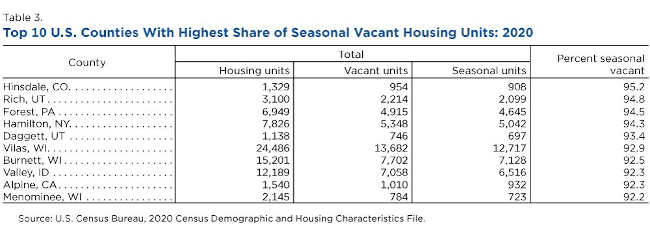
All 20 of these counties also had vacancy rates much higher than the national rate of 9.7%; all but six had a vacancy rate over 50%.
The counties with the largest total number of seasonal units were in seasonal destinations, such as beach towns and ski resort areas.
Five of the top 10 counties were in Florida and two others were in New Jersey. Maricopa County and Riverside County were the only counties in the top 10 not located along a coast (Table 4).
Despite the name, seasonal units cover a wide range of housing, including part-time snowbird housing in Maricopa County; second homes in New York County; hunting cabins in Vilas County, Wisconsin; and beach houses in Cape May County, New Jersey.
While it might seem complicated, the Census Bureau provides guidance to determine if a housing unit is vacant and, if so, how it should be classified.
The decennial census is the primary source of information on the type of vacant housing in your neighborhood but it’s not the only one. The Census Bureau’s Housing Vacancy Survey and American Community Survey monitor trends in vacant housing on a more frequent basis.
Evan Brassell is chief of the Housing Statistics Branch in the Social, Economic and Housing Statistics Division.