 How to resolve AdBlock issue?
News
- Details
- Written by: NATIONAL OCEANIC AND ATMOSPHERIC ADMINISTRATION
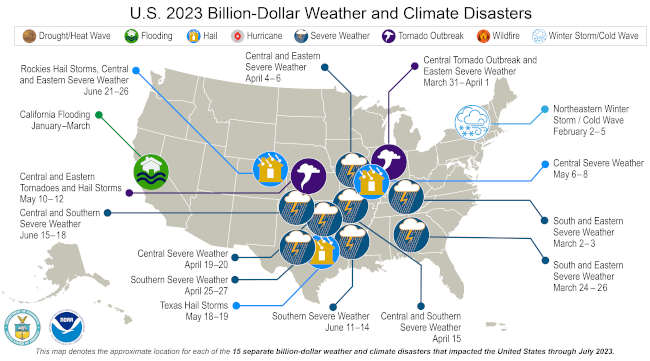
July 2023 was a hot and stormy month for the U.S., with flooding rain and scorching temperatures impacting much of the nation.
The year 2023 is also marked by the most billion-dollar disasters for the first seven months of any year since 1980, according to scientists from NOAA’s National Centers for Environmental Information.
Below are more takeaways from NOAA’s latest monthly U.S. climate report:
Climate by the numbers
July 2023
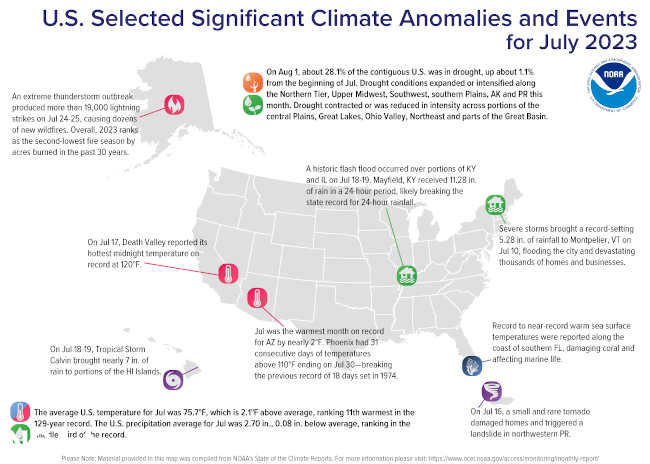
The average temperature across the contiguous U.S. last month was 75.7 degrees F (2.1 degrees above average), with July 2023 ranking as the 11th-hottest July in the 129-year climate record.
Arizona, Florida, Maine and New Mexico had their warmest Julys on record, while an additional 13 states saw their top-10 warmest July on record.
The average July precipitation was 2.70 inches (0.08 of an inch below average), ranking in the middle third of the historical record.
Arizona, Idaho and Minnesota each had their third-driest July on record, while California and New Mexico had one of their top-10 driest Julys on record. Connecticut and Vermont experienced their second-wettest July on record. Massachusetts, Michigan, New Hampshire, New York, Oklahoma, Pennsylvania and Rhode Island all had a July ranking among top-10 wettest on record.
Year to date (YTD, January through July 2023)
The YTD average temperature for the contiguous U.S. was 53.0 degrees F (1.7 degrees above average), ranking as the 16th-warmest such YTD on record.
Florida recorded its warmest such YTD, while Connecticut, Delaware, Louisiana, Maryland, Massachusetts, Mississippi and New Jersey each ranked second-warmest for the January–July period. An additional 20 states had a top-10 warmest such YTD period while no state experienced a top-10 coldest YTD for this seven-month period.
The average precipitation for January-July 2023 was 18.41 inches (0.32 of an inch above average), ranking in the middle third of the record.
New Hampshire had its fifth-wettest such YTD on record, while Massachusetts and Vermont ranked among their top-10 wettest for this period. Conversely, precipitation was below average across parts of the Northwest, eastern Plains, Southwest, central Mississippi Valley, Mid-Atlantic and along parts of the Gulf during the January–July period. Maryland had its 10th-driest January–July on record.
Billion-dollar disasters
There have been 15 individual weather and climate disaster events confirmed for January through July 2023, each with losses exceeding $1 billion. This is the highest number of billion-dollar disasters ever recorded for the first seven months of a year since NOAA began tracking these events in 1980.
The 15 events include:
• 13 severe weather events.
• One winter storm event.
• One flooding event.
These events caused 113 direct and indirect fatalities and produced more than $39.7 billion in damages (Consumer Price Index (CPI)-adjusted).
Since 1980, the U.S. has sustained 363 separate weather and climate disasters where overall damages/costs reached or exceeded $1 billion (including CPI adjustment to 2023). The total cost of these 363 events exceeds $2.590 trillion.
Other notable highlights from this report
Record heat scorched the Southwest in July:
• July was the warmest month on record for the state of Arizona and New Mexico by nearly 2 degrees F. Across the Southwest, 36 counties each had their warmest July on record, while an additional 63 counties ranked in the top-10 warmest for the month.
• Phoenix, Arizona, had an average temperature of 102.8 degrees F for the month of July — the hottest month on record for any U.S. city. Contributing to the record, Phoenix had 31 consecutive days of temperatures above 110 degrees F from June 30 to July 30 — breaking the previous record of 18 days set in 1974.
• On July 16, California’s Death Valley soared to 128 degrees F, setting a daily-temperature record, and reported its hottest midnight temperature on record at 120 degrees F on July 17.
Severe storms, catastrophic flooding struck some communities:
• On July 10, severe storms brought devastation and flooding to portions of the Northeast, as areas reported up to eight inches of rain within a 24-hour period. Montpelier, Vermont, received a record-breaking 5.28 inches of rain, flooding the city and damaging thousands of homes and businesses.
• From July 18-19, a historic flash flood occurred over portions of Kentucky and Illinois after some areas received up to 12 inches of rainfall, causing significant damage and trapping residents in their homes. Mayfield, Kentucky, received 11.28 inches of rain in a 24-hour period, likely breaking the state record for 24-hour rainfall.
• From July 24-25, an extreme thunderstorm outbreak produced more than 19,000 lightning strikes causing dozens of new wildfires in the state of Alaska. Overall, 2023 ranks as the second-lowest fire season, by acres burned, in the past 30 years for the state.
- Details
- Written by: Robert Sanders
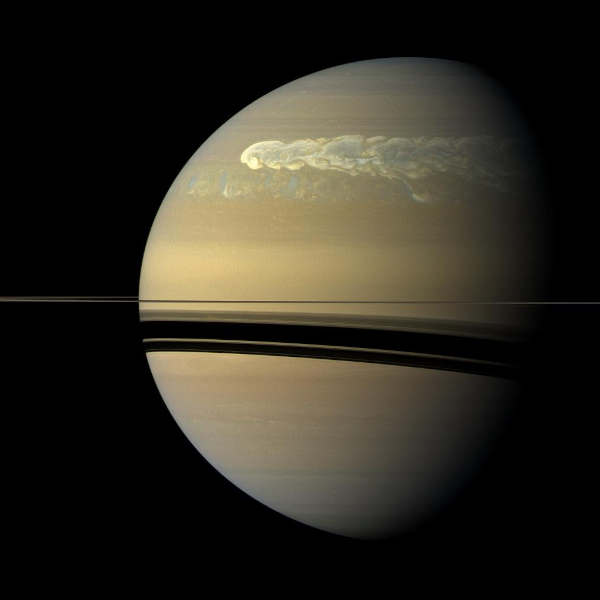
BERKELEY, Calif. — The largest storm in the solar system, a 10,000-mile-wide anticyclone called the Great Red Spot, has decorated Jupiter's surface for hundreds of years.
A new study now shows that Saturn — though much blander and less colorful than Jupiter — also has long-lasting megastorms with impacts deep in the atmosphere that persist for centuries.
The study was conducted by astronomers from the University of California, Berkeley, and the University of Michigan, Ann Arbor, who looked at radio emissions from the planet, which come from below the surface, and found long-term disruptions in the distribution of ammonia gas.
The study was published Aug. 11 in the journal Science Advances.
Megastorms occur approximately every 20 to 30 years on Saturn and are similar to hurricanes on Earth, although significantly larger.
But unlike Earth's hurricanes, no one knows what causes megastorms in Saturn's atmosphere, which is composed mainly of hydrogen and helium with traces of methane, water and ammonia.
“Understanding the mechanisms of the largest storms in the solar system puts the theory of hurricanes into a broader cosmic context, challenging our current knowledge and pushing the boundaries of terrestrial meteorology,” said lead author Cheng Li, a former 51 Peg b Fellow at UC Berkeley who is now an assistant professor at the University of Michigan.
Imke de Pater, a UC Berkeley professor emerita of astronomy and of earth and planetary sciences, has been studying gas giants for over four decades to better understand their composition and what makes them unique, employing the Karl G. Jansky Very Large Array in New Mexico to probe the radio emissions from deep inside the planet.
“At radio wavelengths, we probe below the visible cloud layers on giant planets. Since chemical reactions and dynamics will alter the composition of a planet’s atmosphere, observations below these cloud layers are required to constrain the planet’s true atmospheric composition, a key parameter for planet formation models,” she said. “Radio observations help characterize dynamical, physical and chemical processes including heat transport, cloud formation and convection in the atmospheres of giant planets on both global and local scales.”
As reported in the new study, de Pater, Li and UC Berkeley graduate student Chris Moeckel found something surprising in the radio emissions from the planet: anomalies in the concentration of ammonia gas in the atmosphere, which they connected to the past occurrences of megastorms in the planet’s northern hemisphere.
According to the team, the concentration of ammonia is lower at midaltitudes, just below the uppermost ammonia-ice cloud layer, but has become enriched at lower altitudes, 100 to 200 kilometers deeper in the atmosphere. They believe that the ammonia is being transported from the upper to the lower atmosphere via the processes of precipitation and reevaporation. What’s more, that effect can last for hundreds of years.
The study further revealed that although both Saturn and Jupiter are made of hydrogen gas, the two gas giants are remarkably dissimilar. While Jupiter does have tropospheric anomalies, they have been tied to its zones (whitish bands) and belts (darkish bands) and are not caused by storms like they are on Saturn.
The considerable difference between these neighboring gas giants is challenging what scientists know about the formation of megastorms on gas giants and other planets and may inform how they’re found and studied on exoplanets in the future.
The National Radio Astronomy Observatory (NRAO) is a facility of the National Science Foundation, operated under cooperative agreement by Associated Universities Inc.
Robert Sanders writes for the UC Berkeley News Center.
- Details
- Written by: Sponsoring Survivorship
The event will be held at Silveira Community Center on Main Street in Lakeport.
Registration is from 7 to 8:30 a.m. with a fun program of music, presentations, refreshments, raffles and more.
The event begins at 9 a.m. — rain or shine.
A beautiful birdhouse, handcrafted with love by Shannon Bauman, will be a grand prize for this year’s raffle. Contact Shannon or Julie Kelley (707-972-0286) to get your tickets today.
Sponsoring Survivorship helps women and men in their battle with breast cancer.
Special thanks to all the generous sponsors and individuals who have donated to Sponsoring Survivorship.
You too can get involved in supporting this vital effort.
There will be free t-shirts for all registrants.
For more information visit www.sponsoringsurvivorship.com.
- Details
- Written by: Clearlake Animal Control

CLEARLAKE, Calif. — Clearlake Animal Control has dozens of dogs needing to be adopted.
The Clearlake Animal Control website continues to list 33 dogs for adoption.
This week’s dogs include “Josie,” a 3-year-old female Labrador retriever mix.

There also is “Dennis,” another retriever mix.
The shelter is located at 6820 Old Highway 53. It’s open from 9 a.m. to 6 p.m. Tuesday through Saturday.
For more information, call the shelter at 707-762-6227, email
This week’s adoptable dogs are featured below.
Email Elizabeth Larson at