How to resolve AdBlock issue?
Refresh this page
How to resolve AdBlock issue?
Refresh this page
Lake County News,California
  • Home
    • Registration Form
  • News
    • Education
    • Veterans
    • Community
      • Obituaries
      • Letters
      • Commentary
    • Police Logs
    • Business
    • Recreation
    • Health
    • Religion
    • Legals
    • Arts & Life
    • Regional
  • Calendar
  • Contact us
    • FAQs
    • Phones, E-Mail
    • Subscribe
  • Advertise Here
  • Login
How to resolve AdBlock issue?
Refresh this page

News

CHP Thanksgiving reminder: Click it, don’t risk it

Details
Written by: LAKE COUNTY NEWS REPORTS
Published: 25 November 2025

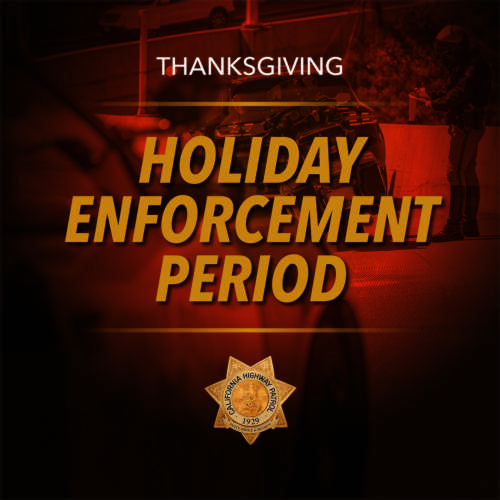
LAKE COUNTY, Calif. — As the holiday season gets underway, the California Highway Patrol reminds motorists that the simplest way to stay safe on the road this Thanksgiving weekend is to buckle up before every trip.

The CHP will begin its Thanksgiving Holiday Enforcement Period, or HEP, at 6:01 p.m. on Wednesday, November 26, and continue through 11:59 p.m. on Sunday, Nov. 30.

Throughout the enforcement period, CHP officers will be on patrol to help ensure everyone obeys traffic laws, wears a seat belt and drives safely.

“Thanksgiving is a time to be with family and friends, not to mourn a preventable tragedy. Seat belts remain one of the most effective tools for saving lives on our roadways. Taking just two seconds to buckle up could be the decision that saves your life or the life of someone you love,” said CHP Commissioner Sean Duryee.

During last year’s Thanksgiving HEP, 36 people died in crashes across California. Within CHP jurisdiction, 14 vehicle occupants were killed and six of them were not wearing a seat belt. CHP officers also made more than 1,100 arrests for driving under the influence during the same 102-hour holiday enforcement effort.

Over the past five years, CHP officers have issued an average of more than 26,000 citations annually for seat belt violations. 

According to the National Highway Traffic Safety Administration, when worn correctly, seat belts reduce the risk of fatal injury for front-seat passengers by 45%.

Whether you’re driving across town or across the state, the CHP urges all motorists and passengers to buckle up, drive sober and obey the speed limit. The holidays are meant for celebration and connection — not loss. Protect yourself and your loved ones by making seat belt use a non-negotiable part of every trip.

State highlights mental health resources for California youth amid changes to access to AI chatbots

Details
Written by: LAKE COUNTY NEWS REPORTS
Published: 25 November 2025

The California Department of Public Health is highlighting the wide range of youth mental health resources and supports available to young people and their families as access to some forms of artificial intelligence companionship changes.

On Tuesday, Nov. 25, the private company character.ai will remove access to its AI companion for youth 18 years and younger. 

AI companions are conversational chatbots that use artificial intelligence to simulate conversation. 

While experts are still assessing the impacts this action may have on mental health, some youth may experience disruption or uncertainty when something they previously interacted with becomes unavailable. 

State leaders are promoting resources that can offer support, if necessary, during this transition.

“The world our youth live in is constantly changing, and the role artificial intelligence plays in their lives is complicated,” said Dr. Rita Nguyen, CDPH assistant state health officer. “While data and science on the topic are still evolving, ongoing reports on youth dependency on this technology are of concern and warrant further research. We encourage families to talk and to take advantage of the numerous resources available to support mental health."

Mental health resources for youth

CDPH remains committed to sharing resources and communication guidance that support suicide prevention and open, honest conversations on mental health between youth and their adult allies, such as parents, caregivers, teachers, and coaches. 

Two of these resources, BrightLife Kids and Soluna, are free behavioral health platforms developed as part of the Children and Youth Behavioral Health Initiative, or CYBHI.

These platforms offer children, youth, young adults, and families access to timely, culturally responsive, and confidential mental health support. They offer coaching sessions, educational content, stress management tools, moderated peer communities, and include crisis and safety protocols for those in emotional distress.

Services are available to all California families, regardless of income, immigration status, or insurance coverage.

The Never a Bother youth suicide prevention campaign, part of the CYBHI, dedicates a portion of the website to guidance on talking to youth about suicide and mental health challenges, and offers a series of print resources for use in home, school, and community settings.

While not specific to AI chatbots, efforts like these to foster connection and supportive relationships with youth help to bring conversations about suicide risk to the forefront and help equip caregivers with meaningful tools to support the young people in their lives.

The 988 Lifeline provides a simple, three-digit point of access for anyone experiencing a suicidal, mental health, or substance use crisis. To reach the Lifeline, people can call or text 988 or chat at Lifeline (988lifeline.org). People who are worried about a loved one who may need crisis support may also use 988 to receive guidance and support. This number is in addition to existing national, state-wide, and local call lines for emergency and non-emergency support.

Emerging science and data

Last month, California passed Senate Bill (SB) 243, creating the nation’s first safeguards for companion chatbots. As part of implementation of SB 243, CDPH will review data submitted by AI chatbot platforms for further policy recommendations.

By providing critical data on protocols and referrals related to suicidal thoughts and self-harm, SB 243 will assist CDPH in tracking and disseminating data on the type of suicide prevention related guidance provided by companion chatbot platforms and the frequency of such guidance. 

This information will allow the department to better understand the scope and nuances of suicide-related issues on companion chatbot platforms.

Retailers are quietly changing their return policies – here’s why you should be on the lookout this Black Friday

Details
Written by: Lauren Beitelspacher, Babson College
Published: 25 November 2025


’Tis the season for giving – and that means ’tis the season for shopping. Maybe you’ll splurge on a Black Friday or Cyber Monday deal, thinking, “I’ll just return it if they don’t like it.” But before you click “buy,” it’s worth knowing that many retailers have quietly tightened their return policies in recent years.

As a marketing professor, I study how retailers manage the flood of returns that follow big shopping events like these, and what it reveals about the hidden costs of convenience. Returns might seem like a routine part of doing business, but they’re anything but trivial. According to the National Retail Federation, returns cost U.S. retailers almost US$890 billion each year.

Part of that staggering figure comes from returns fraud, which includes everything from consumers buying and wearing items once before returning them – a practice known as “wardrobing” – to more deceptive acts such as falsely claiming an item never arrived.

Returns also drain resources because they require reverse logistics: shipping, inspecting, restocking and often repackaging items. Many returned products can’t be resold at full price or must be liquidated, leading to lost revenue. Processing returns also adds labor and operational expenses that erode profit margins.

How e-commerce transformed returns

While retailers have offered return options for decades, their use has expanded dramatically in recent years, reflecting how much shopping habits have changed. Before the rise of e-commerce, shopping was a sensory experience: Consumers would touch fabrics, try on clothing and see colors in natural light before buying. If something didn’t work out, customers brought it back to the store, where an associate could quickly inspect and restock it.

Online shopping changed all that. While e-commerce offers convenience and variety, it removes key sensory cues. You can’t feel the material, test the fit or see the true color. The result is uncertainty, and with uncertainty comes higher rates of returns. One analysis by Capital One suggests that the rate for returns is almost three times higher for online purchases than for in-store purchases.

When the COVID-19 pandemic hit, the move toward online shopping went into overdrive. Even hesitant online shoppers had to adapt. To encourage purchases, many retailers introduced or expanded generous return policies. The strategy worked to boost sales, but it also created a culture of returning.

In 2020, returns accounted for 10.6% of total U.S. retail sales, nearly double the prior year, according to the National Retail Federation data. By 2021, that had climbed to 16.6%. Unable to try things on in stores, consumers began ordering multiple sizes or styles, keeping one and sending the rest back. The behavior was rational from a shopper’s perspective but devastatingly expensive for retailers.

The high cost of convenience

Most supply chains are designed to move in one direction: from production to consumption. Returns reverse that flow. When merchandise moves backward, it adds layers of cost and complexity.

In-store returns used to be simple: A customer would take an item back to the store, the retailer would inspect the product, and, if it was in good condition, it would go right back on the shelf. Online returns, however, are far more cumbersome. Products can spend weeks in transit and often can’t be resold – by the time they arrive, they may be out of season, obsolete or no longer in their original packaging.

Logistics costs compound the problem. During the pandemic, consumers grew accustomed to free shipping. That means retailers now often pay twice: once to deliver the item and again to retrieve it.

Now, in a post-pandemic world, retailers are trying to strike a balance – maintaining customer goodwill without sacrificing profitability. One solution is to raise prices, but especially today, with inflation in the headlines, shoppers are sensitive to price hikes. The other, more common approach is to tighten return policies.

In practice, that’s taken several forms. Some retailers have begun charging small flat fees for returns, even when a customer mails an item back at their own expense. For example, the direct-to-consumer retailer Curvy Sense offers customers unlimited returns and exchanges of an item for an initial $2.98 price. Others have shortened their return windows. Over the summer, for example, beauty retailers Sephora and Ulta reduced their return window from 60 days to 30.

Many brands now attach large, conspicuous “do not remove” tags to prevent consumers from wearing items and then sending them back. And increasingly, retailers are offering store credit rather than cash or credit card refunds, ensuring that returned sales at least stay within their company.

Few retailers advertise these changes prominently. Instead, they appear quietly in the fine print of return policies – policies that are now longer, more specific and far less forgiving than they once were.

As we head into the busiest shopping season of the year, it’s worth pausing before you click “purchase.” Ask yourself: Is this something I truly want – or am I planning to return it later?

Whenever possible, shop in person and return in person. And if you’re buying online, make sure you familiarize yourself with the return policy.The Conversation

Lauren Beitelspacher, Professor of Marketing, Babson College

This article is republished from The Conversation under a Creative Commons license. Read the original article.

Rotary Club of Clear Lake to host 32nd annual Christmas Celebration

Details
Written by: LAKE COUNTY NEWS REPORTS
Published: 24 November 2025

CLEARLAKE, Calif. — The Rotary Club of Clear Lake announced that its 32nd annual Christmas Celebration will take place on Saturday, Dec. 13.

The event will take place from 10 a.m. to 2 p.m. at Burns Valley Elementary School, 3620 Pine St., Clearlake.

The celebration is presented in partnership with Foods, Etc. and the Konocti Unified School District. 

This cherished community tradition welcomes residents of all ages to come together and enjoy the spirit of the season in a warm, joyful and family-friendly environment.

Event highlights include:

• A free holiday meal: A delicious seasonal meal offered at no cost — an opportunity for neighbors and friends to gather and celebrate together.

• Face painting, 11 a.m. to 1 p.m.: Children can embrace the festivities with cheerful and creative face painting.

• Health care screenings: Complimentary health screenings will be available to support the well-being of community members.

• A small toy for every child: Each child attending will receive a small toy, adding a touch of holiday magic to their day.

The Rotary Club of Clear Lake encourages families, friends and community members to join in on the celebration and share the joy of the holiday season.

All are welcome.

The Rotary Club of Clear Lake wishes the community a very Merry Christmas.

  1. County seeks members for Big Valley and animal control advisory boards
  2. Purrfect Pals: Many new cats and kittens
  3. Don’t let food poisoning crash your Thanksgiving dinner
  • 85
  • 86
  • 87
  • 88
  • 89
  • 90
  • 91
  • 92
  • 93
  • 94
How to resolve AdBlock issue?
Refresh this page