 How to resolve AdBlock issue?
News
- Details
- Written by: LAKE COUNTY NEWS REPORTS
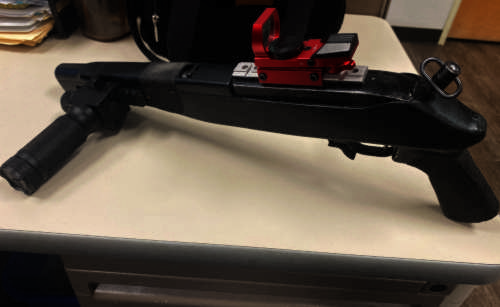
LAKE COUNTY, Calif. — Police arrested a Clearlake man twice over the course of a week after they said he was found to be illegally in possession of firearms and ammunition.
On Nov. 13, Clearlake Police Officer Seng Yang arrested Eric Pearson, 45, following an investigation into an assault involving a firearm.
During the investigation, Officer Yang learned Pearson had allegedly struck a victim in the head with the handgun during an argument.
Officer Yang contacted Pearson and located a loaded handgun concealed in Pearson’s waistband. Pearson is prohibited from possessing firearms or ammunition.
Pearson was arrested for a prohibited person in possession of a firearm, prohibited person in possession of ammunition, carrying a loaded firearm in public, carrying a concealed firearm and assault with a deadly weapon.
He was booked into the Lake County Jail and later bailed out on Nov. 18, police said.
The following day, Clearlake Police Det. Chris Kelleher, with assistance from detectives from the Lake County Sheriff’s Office and the Lakeport Police Department, served a search warrant at Pearson’s residence as part of the ongoing investigation.
During the search, detectives located five additional firearms and ammunition, police said.
Pearson was again arrested for a prohibited person in possession of a firearm and a prohibited person in possession of ammunition. He was booked into the Lake County Jail.
“The Clearlake Police Department is committed to removing illegally possessed and illegal firearms from the community and holding individuals accountable for violent and dangerous behavior,” the agency said.
Anyone with information related to this case is encouraged to contact Officer Yang or Det. Kelleher at 707-994-8251.
- Details
- Written by: LAKE COUNTY NEWS REPORTS
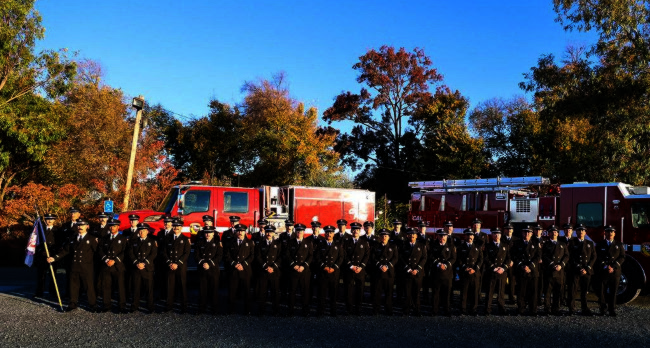
On Friday, Gov. Gavin Newsom announced the graduation of Cal Fire Company Officer Class 25-14, from the Ione Training Center, marking a milestone in Cal Fire’s history, with over 650 new company officers trained in 2025, the most ever.
Cal Fire has successfully trained over 650 new company officers in 2025 with four training centers operating at full capacity.
The newest, the Atwater Training Center in Merced County, opened in July 2025 to meet growing training demands. Additional facilities are in Redding and Riverside.
This historic achievement underscores the department's consistent and sustained commitment to developing highly skilled, professional leaders to serve the State of California.
Director/Fire Chief Joe Tyler acknowledged the efforts required to meet this workforce demand during his keynote address.
“This milestone year of training represents our commitment to the future of Cal Fire and the safety of California,” Tyler said. “We recognize the achievement of these 38 students, as well as the dedication of our training staff who maintained exceptionally high standards while sustaining this record-setting pace.”
Cal Fire celebrates the graduation of this final cohort, Company Officer Academy Class 25-14, marking the successful conclusion of the intensive 2025 training season.
The 38 graduates are now highly trained company officers ready to take on leadership roles across the department.
Top-level department leadership were on hand to see the 38 students graduate, including Director/Fire Chief Joe Tyler, Chief Deputy Director of Operations Anale Burlew, and Cooperative Fire Protection Deputy Director Matthew Sully, alongside numerous Cal Fire Region and Unit Chiefs. Director/Fire Chief Tyler administered the official oath to the graduating class.
Academy rigor and standards
The rigorous 10-week curriculum began with a four-week Firefighter Academy, immediately followed by a six-week Company Officer Academy. The Training Center maintains a high standard of excellence, particularly for those aspiring to achieve Top Academic Honors.
The comprehensive assessment for the class includes a total of 13 examinations: Six written examinations, six manipulative skills examinations and one comprehensive final examination.
Earning top academic distinction is demanding and requires near-perfect performance across the curriculum; a single error — such as one missed question on a written exam or one technical fault, like a "bumped cone" during a manipulative skills test — can disqualify a student from this prestigious recognition.
With all four training centers scheduled to be operating at full capacity, Cal Fire is well-positioned to meet the department's training requirements for 2026 and beyond.
- Details
- Written by: LAKE COUNTY NEWS REPORTS
NORTH COAST, Calif. — Authorities this week arrested a Mendocino College English professor who they said was having a sexual relationship with an underage female student.
The Ukiah Police Department said Jason Christopher Davis, 54, of Ukiah, was arrested on Thursday after an investigation found he was having sex with a student who was 15 years old.
In September, the Mendocino County Sheriff's Office referred an investigation to the Ukiah Police Department regarding a possible unlawful sexual relationship between a professor at the Mendocino College and an underage female student.
Ukiah Police began an investigation and confirmed that Davis had been in a dating relationship with a student. It was also learned that Davis was the subject of a civil suit in the Superior Court of San Francisco, in which two former students had accused Davis of sexual abuse.
Ukiah Police detectives obtained search warrants for Davis’ residence and electronic devices and confirmed that Davis had been in a sexual dating relationship and cohabitating with a former student who was 15 years old.
Detectives located photographs and videos on Davis’ electronic devices that confirmed that the sexual relationship began when the child was 13 years old.
On Thursday, a Mendocino County Superior Court judge signed an arrest warrant for Davis’ arrest for five felony charges involving sexual abuse of a minor with multiple special allegations based on the age of the victim.
At approximately 3 p.m. Thursday, Ukiah Police detectives located Davis and took him into custody without incident.
Davis was transported to the Mendocino County Jail and booked for lewd or lascivious acts with a child under 14 years of age, lewd or lascivious acts with a child under 15 years of age, oral copulation with person under 16 years of age, unlawful sexual intercourse with an under age female and possession of material depicting sexual conduct of a person under 18.
Mendocino Jail records indicated Davis remained in custody on Saturday, with bail set at $1 million.
The Ukiah Police Department thanked the Mendocino County District Attorney’s Office for its assistance in the investigation.
On Friday, Mendocino College issued the following statement about the case in which it said that Davis has been placed on administrative leave.
The college’s full statement follows.
“Mendocino College is committed to fostering a safe, respectful, and supportive environment for our students, employees, and the broader community. This commitment guides every action we take as an institution.
“On November 20, 2025, Mendocino College was informed that Jason Davis, a faculty member, was taken into custody by the Ukiah Police Department on charges involving unlawful conduct with a minor. Mr. Davis is presumed innocent until proven guilty. While the College cannot discuss personnel matters or share details related to ongoing investigations, we can confirm that Mr. Davis was placed on administrative leave when the initial allegations surfaced. This step was taken in accordance with College policy and reflects our priority to ensure the safety and well-being of our campus community while the College conducts its own internal review.
Mendocino College is fully cooperating with law enforcement as this matter proceeds. Because this is an active legal case, the College will not be providing further comment at this time.”
- Details
- Written by: Dennis Fordham
This means reinstating the associated resource limits, and exemptions and asset counting rules.
This applies to all Medi-Cal recipients except the Medi-Cal recipients enrolled under the Affordable Care Act which uses the applicant’s Modified Adjusted Gross Income (“MAGI Medi-Cal”) to determine eligibility.
Hence in 2026 Medi-Cal’s 30 month look back period and its associated asset transfer Medi-Cal eligibility penalties will resume relevance both to new Medi-Cal applications, to annual renewals and redeterminations of existing Medi-Cal beneficiaries.
Meanwhile, 2025 is a quickly vanishing opportunity for anyone already on Medi-Cal, or expecting to need Medi-Cal, to act proactively by removing any excess assets that may otherwise disqualify them in 2026.
That is, transfers made in 2025 do not count for eligibility purposes after Jan. 1, 2026. Transfers made on and after Jan. 1, 2026, however, may count.
An extra $65,000 for each additional dependent family member up to ten dependents is allowed (See Department of Health Care Services, www.dhcs.ca.gov and California Advocates for Nursing Home Reform, www.canhr.org).
Dependent family members include a person’s disabled and minor child at home. The foregoing limits when applied are subject to possible increase on a case by case basis due to a claim and showing of spousal impoverishment.
If the Medi-Cal recipient is in a skilled nursing facility, then that person has a $130,000 resource limit and the at-home / community spouse, who does not receive Medi-Cal, is also allowed a so-called “Community Spouse Resource Allowance” (“CSRA”). The CSRA for 2026 has not yet been established but it is expected to be around $160,000.
That means that the well spouse at home can have up to $160,000 in otherwise countable assets in addition to the institutionalized spouse having up to $130,000 in otherwise countable assets. Again, the CSRA can be enlarged based on spousal impoverishment of the well / stay at home spouse. Alternatively, the well spouse may be entitled to some or all of the institutionalized spouse’s income.
That said, now in 2025, a person with excess assets has a soon vanishing opportunity either to spend down to the 2026 asset limits and/or to gift those assets to a trusted relative or friend. The trusted relative or friend could in turn establish a special needs trust for the same person with such assets.
Besides the personal resource exemption, Medi-Cal beneficiaries still enjoy the longstanding exemptions for a person’s home, ordinary household contents, a car, a burial policy, and retirement plans (subject to rules). So long as a Medi-Cal recipient checks the box that they intend to return home (if they were ever to become well again), the home is an exempt asset for Medi-Cal eligibility.
The soon to be restored Medi-Cal Asset Test rejoins Medi-Cal’s continuing Share of Cost (i.e., income) and estate recovery rules. That is, first, depending on the situation, a person’s income is often required to pay a share of cost for Community Based and Long Term Care Medi-Cal programs.
Moreover, second, since 2017, Medi-Cal Estate recovery is infrequent — and avoidable — as it only applies when a deceased Medi-Cal recipient’s estate is subject to a probate, and then only if there is also no surviving spouse.
Taking any appropriate action now depends on a Medi-Cal recipient seeing a need to do so and acting quickly before Jan. 1, 2026. An agent under a power of attorney might also have the necessary authority, but only if and to the extent that the power of attorney expressly allows for gifting of assets.
Dennis A. Fordham, attorney, is a State Bar-Certified Specialist in estate planning, probate and trust law. His office is at 870 S. Main St., Lakeport, Calif. He can be reached at
- Space News: SETI’s ‘Noah’s Ark’ – a space historian explores how the advent of radio astronomy led to the USSR’s search for extraterrestrial life
- Supervisors add $60,000 for hunger relief amid surging demand for food
- Thompson leads 34 members of Congress to demand reversal of cancellation of bike and pedestrian infrastructure grants