
How to resolve AdBlock issue?
Refresh this page
How to resolve AdBlock issue?
Refresh this page
Lake County News,California
  • Home
    • Registration Form
  • News
    • Education
    • Veterans
    • Community
      • Obituaries
      • Letters
      • Commentary
    • Police Logs
    • Business
    • Recreation
    • Health
    • Religion
    • Legals
    • Arts & Life
    • Regional
  • Calendar
  • Contact us
    • FAQs
    • Phones, E-Mail
    • Subscribe
  • Advertise Here
  • Login
How to resolve AdBlock issue?
Refresh this page

News

Want to make America healthy again? Stop fueling climate change

Details
Written by: Jonathan Levy, Boston University; Howard Frumkin, University of Washington; Jonathan Patz, University of Wisconsin-Madison, and Vijay Limaye, University of Wisconsin-Madison
Published: 19 November 2025

Extreme heat can threaten human health, but it’s only one way climate change puts lives at risk. Drew Angerer/Getty Images

If you’ve been following recent debates about health, you’ve been hearing a lot about vaccines, diet, measles, Medicaid cuts and health insurance costs – but much less about one of the greatest threats to global public health: climate change.

Anybody who’s fallen ill during a heat wave, struggled while breathing wildfire smoke or been injured cleaning up from a hurricane knows that climate change can threaten human health. Studies show that heat, air pollution, disease spread and food insecurity linked to climate change are worsening and costing millions of lives around the world each year.

The U.S. government formally recognized these risks in 2009 when it determined that climate change endangers public health and welfare.

However, the Trump administration is now moving to rescind that 2009 endangerment finding so it can reverse U.S. climate progress and help boost fossil fuel industries, including lifting limits on greenhouse gas emissions from vehicles and power plants. The administration’s arguments for doing so are not only factually wrong, they’re deeply dangerous to Americans’ health and safety.
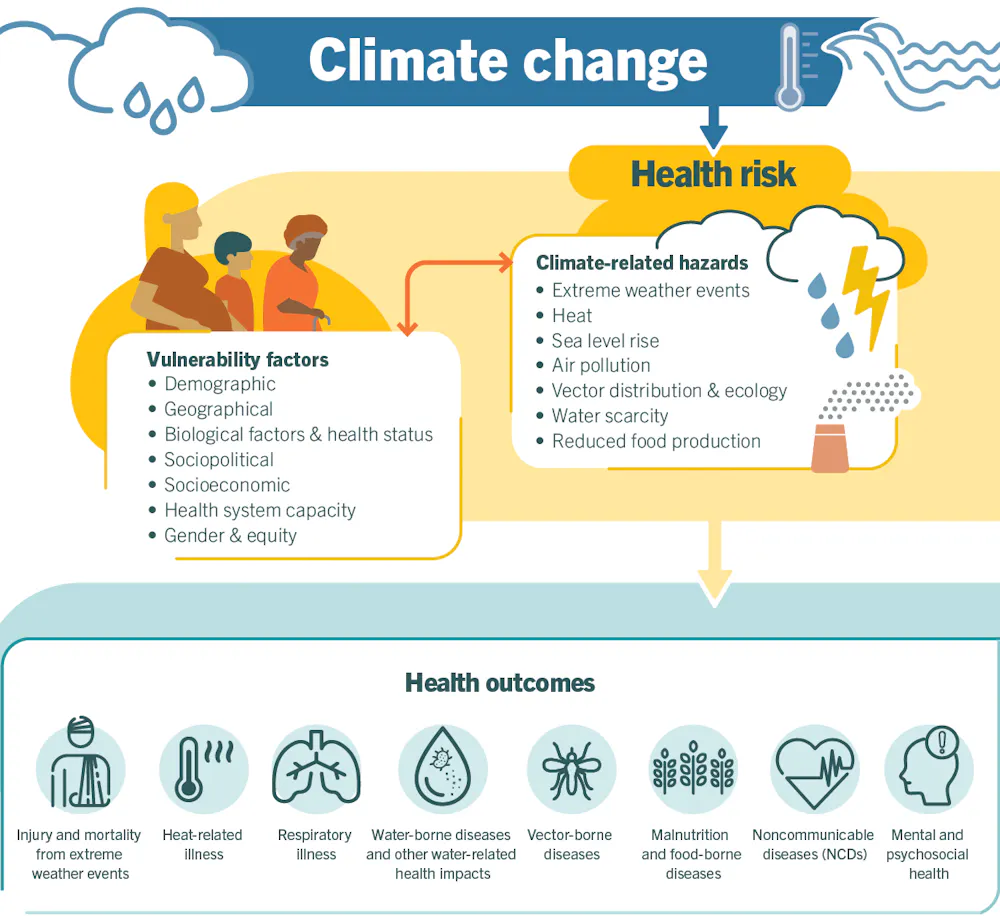
Health risks and outcomes related to climate change.
Health risks and outcomes related to climate change. World Health Organization

As physicians, epidemiologists and environmental health scientists who study these effects, we’ve seen growing evidence of the connections between climate change and harm to people’s health. More importantly, we see ways humanity can improve health by tackling climate change.

Here’s a look at the risks and some of the steps individuals and governments can take to reduce them.

Extreme heat

Greenhouse gases from vehicles, power plants and other sources accumulate in the atmosphere, trapping heat and holding it close to Earth’s surface like a blanket. Too much of it causes global temperatures to rise, leaving more people exposed to dangerous heat more often.

Most people who get minor heat illnesses will recover, but more extreme exposure, especially without enough hydration and a way to cool off, can be fatal. People who work outside, are elderly or have underlying illnesses such as heart, lung or kidney diseases are often at the greatest risk.

Heat deaths have been rising globally, up 23% from the 1990s to the 2010s, when the average year saw more than half a million heat-related deaths. Even in the U.S., the Pacific Northwest heat dome in 2021 killed hundreds of people.

Climate scientists predict that with advancing climate change, many areas of the world, including U.S. cities such as Miami, Houston, Phoenix and Las Vegas, will confront many more days each year hot enough to threaten human survival.

Extreme weather

Warmer air holds more moisture, so climate change brings increasing rainfall and storm intensity, worsening flooding, as many U.S. communities have experienced in recent years. Warm ocean water also fuels more powerful hurricanes.

Increased flooding carries health risks, including drownings, electrocution and water contamination from human pathogens and toxic chemicals. People cleaning out flooded homes also face risks from mold exposure, injuries and mental distress.

A man carries boxes out of a house that flooded up to its second story.
Flooding from hurricanes and other extreme storms can put people at risk of injuries during the cleanup while also triggering dangerous mold growth on wet wallboard, carpets and fabric. This home flooded up to its second flood during Hurricane Irma in 2017. Sean Rayford/Getty Images

Climate change also worsens droughts, disrupting food supplies and causing respiratory illness from dust and dry conditions as well as wildfires. And rising temperatures and aridity dry out forest and grasslands, making them more vulnerable to catching fire, which creates other health risks.

Air pollution

Wildfires, along with other climate effects, are also worsening air quality around the country.

Wildfire smoke is a toxic soup of microscopic particles (known as fine particulate matter, or PM2.5) that can penetrate deep in the lungs and hazardous compounds such as lead, formaldehyde and dioxins generated when homes, cars and other materials burn at high temperatures. Smoke plumes can travel thousands of miles downwind and trigger heart attacks and elevate lung cancer risks, among other harms.

Meanwhile, warmer conditions favor the formation of ground-level ozone, a heart and lung irritant. Burning of fossil fuels also generates dangerous air pollutants that cause a host of health problems, including heart attacks, strokes, asthma flare-ups and lung cancer.

Infectious diseases

Because they are cold-blooded organisms, insects are directly influenced by temperature. So as temperatures have risen, mosquito biting rates have risen as well. Warming also shortens the development time of disease agents that mosquitoes transmit.

Mosquito-borne dengue fever has turned up in Florida, Texas, Hawaii, Arizona and California. New York state just saw its first locally acquired case of chikungunya virus, also transmitted by mosquitoes.

A world map shows where mosquitos are most likely to transmit the dengue virus
As global temperatures rise, regions are becoming more suitable for mosquitoes to transmit dengue virus. The map shows a suitability scale, with red areas already suitable for dengue transmissions and yellow areas becoming more suitable. Taishi Nakase, et al., 2022, CC BY

And it’s not just insect-borne infections. Warmer temperatures increase diarrhea and foodborne illness from Vibrio cholerae and other bacteria and heavy rainfall increases sewage-contaminated stormwater overflows into lakes and streams. At the other water extreme, drought in the desert Southwest increases the risk of coccidioidomycosis, a fungal infection known as valley fever.

Other impacts

Climate change can threaten health in numerous other ways. Longer pollen seasons can increase allergen exposures. Lower crop yields can reduce access to nutritious foods.

Mental health can also suffer, with anxiety, depression and post-traumatic stress following disasters, and increased rates of violent crime and suicide tied to high-temperature days.

A older man holds a door for a woman at a cooling center.
New York and many other cities now open cooling centers during heat waves to help residents, particularly older adults who might not have air conditioning at home, stay safe during the hottest parts of the day. Angela Weiss/AFP via Getty Images

Young children, older adults, pregnant women and people with preexisting medical conditions are among the highest-risk groups. Often, lower-income people are also at greater risk because of higher rates of chronic disease, higher exposures to climate hazards and fewer resources for protection, medical care and recovery from disasters.

What can people and governments do?

As an individual, you can reduce your risk by following public health advice during heat waves, storms and wildfires; protecting yourself against tick and mosquito bites; and spending time in green space that improves your mental health.

You can also make healthy choices that reduce your carbon footprint, such as:

  • Walking, biking or using public transit instead of driving, since more physical activity reduces chronic disease risks.

  • Rebalancing your diet from meat-heavy to plant-forward, which can cut your risk of heart disease and lower greenhouse gas emissions from meat production.

  • Making your home more energy-efficient and opting for electric rather than gas- or oil-powered heating and cooking, which can reduce emissions while improving indoor air quality.

However, there are limits to what individuals can do alone.

Actions by governments and companies are also necessary to protect people from a warmer climate and stop the underlying causes of climate change.

Workplace safety can be addressed through rules to reduce heat exposure for people who work outdoors in industries such as agriculture and construction. Communities can open cooling centers during heat waves, provide early warning systems and design drinking water systems that can handle more intense rainfall and runoff, reducing contamination risks.

Governments can ensure that public transit is available and not overly expensive to reduce the number of vehicles on the road. They can promote clean energy rather than fossil fuels to cut emissions, which can also save money since the cost of solar energy has dropped spectacularly. In fact, both solar and wind energy are less expensive than fossil fuel energy.

Yet the U.S. government is currently going in the opposite direction, cutting support for renewable energy while subsidizing the fossil fuel industries that endanger public health.

To really make America healthy, in our view, the country can’t ignore climate change.The Conversation

Jonathan Levy, Professor and Chair, Department of Environmental Health, Boston University; Howard Frumkin, Professor Emeritus of Environmental and Occupational Health Sciences, University of Washington; Jonathan Patz, Professor of Environmental Medicine, University of Wisconsin-Madison, and Vijay Limaye, Adjunct Associate Professor of Population Health Sciences, University of Wisconsin-Madison

This article is republished from The Conversation under a Creative Commons license. Read the original article.


Community choice aggregation plan to reduce energy costs stalls due to Clearlake City Council vote, supervisors’ stance

Details
Written by: Lingzi Chen
Published: 18 November 2025

LAKE COUNTY, Calif. — Lake County’s bid to seek alternative power options is in limbo after more than six months of talks, with Clearlake rejecting the offer from Sonoma Clean Power, the Board of Supervisors choosing not to cast a formal vote and Lakeport left without an offer on the table.

It is less disputed that Lake County needs additional electricity options than which path to take. 

Still, joining Sonoma Clean Power, or SCP, to implement a community-based electricity procurement program called community choice aggregation, has remained the only option local jurisdictions have seriously explored so far this year. 

Yet after months of discussion from April through October, the three local governments have ended up collectively, de facto, saying no to signing the agreement at this moment.

Supporters of the deal emphasize the urgent need for alternative options to address soaring utility rates and limited choice in Lake County, while opponents — including most supervisors and some councilmembers — raise concerns about local authority and future decision-making under SCP’s governing structure.

On Oct. 2, the Clearlake City Council voted 3-2 against joining SCP, two days after a joint workshop where the 15 elected officials of all three jurisdictions met together on the matter for the first time. Mayor Ross Creamer and Vice Mayor Dirk Slooten voted in favor, with councilmembers Tara Downey, Jessica Hooten and Mary Wilson opposed.

On Oct. 21, the Board of Supervisors did not take a formal vote on the matter, but there was an apparent lack of majority support to move forward. Supervisors Brad Rasmussen and Jessica Pyska expressed support, while Bruno Sabatier, Helen Owen and Eddie Crandell raised doubts. 

The board discussion concluded with direction to staff to explore other service providers. It was brought up during the meeting that statewide there are 26 service providers of community choice aggregation, or CCA. 

“Exploration of further CCA options and development of an energy policy were among the next steps favored by individual supervisors,” County Administrative Analyst Trevor Mockel, who handles media inquiries, said in an email response to Lake County News on Oct 24. “Admin’s next step will be facilitating consideration of options; we anticipate general board discussion will occur before the end of the year in open session.”

However, Mockel did not address Lake County News’ questions about if the county reached out to other service providers when they contacted SCP — and why there wasn’t a request for proposals issued at the beginning of the process. 

“I will say that that was my mistake throughout this whole process — I should have asked that to happen when we agreed to reach out to Sonoma Clean Power,” Supervisor Bruno Sabatier told Lake County News during a phone interview on Oct. 27, when asked about reaching to other CCAs at an earlier time. “So I don't think that I was perfect in my process.”

Because SCP’s offer was intended for all three jurisdictions, and two chose not to advance it, by the evening of Oct. 21 when Lakeport was set to vote on the item, the offer no longer existed. Action by the Lakeport City Council to join, therefore, would have been moot, Lakeport City Manager Kevin Ingram told Lake County News in an email. 

Although no formal vote was taken, the majority of Lakeport City Council members expressed frustration at the Oct. 21 council meeting. 

“I wish we were a larger city where we could just go at it ourselves and not need the county support and the city of Clearlake support,” said Lakeport Mayor Pro Tem Brandon Disney.

This round of negotiation with SCP spanning more than half a year reached a formal pause following Lakeport Mayor Kim Costa calling the process “embarrassing” at the end of the council discussion. 

“It would be safe to summarize that the Lakeport City Council was disappointed in the outcome and feel that not joining SCP at this time represents a missed opportunity,” said Ingram in an email, adding that he had been instructed to continue talks with SCP and the county in exploring other CCA options. 

Supervisors have split views

SCP’s offer to Lake County includes lower utility costs, voluntary participation from residents, mandatory participation in their geothermal zone efforts that seek to develop geothermal projects in the future, and two seats for Lake County — one for the county and one for the city — on its governing board. 

While the SCP feasibility study suggests potential bill savings to be 4.2% to 12.9%, Supervisor Sabatier told Lake County News that his calculation shows the savings are about 2% over a course of 10 years. “So $2 out of every $100 you spend on energy,” he said.

Concerns raised during the three jurisdictions’ September joint workshop continued into the ensuing decision-making meetings in October. 

Those concerns include geothermal zone participation, lack of sufficient representation of Lake County voices on the SCP board, lack of formal tribal participation and record of SCP supporting Assembly Bill 531 regarding geothermal development that allows the state to bypass local authority. 

“It’s like a roulette bet,” said Supervisor Crandell at the Oct. 21 board meeting, likening the game to what SCP does by simultaneously supporting the legislative bill and promising Lake County strong local control. 

“I don't mean that in a negative way. I'm saying that any business or entity would basically bet on the number 21 and then put red just in case they hit both — either or,” Crandell added. “That's just what happens; that's just the way life is.”

Crandell also frowned upon the uncertainties of how the tribes would fit in the governance structure of SCP. 

The current 11 seats on the SCP board does not include any tribal representatives. 

SCP Chief Executive Officer Geof Syphers explained at the joint workshop that it was because the state law forming the CCA program did not consider tribes and decisions were made based on votes of the counties and cities involved. 

As Lake County continues to fight against decommissioning the Potter Valley Project, concerns were raised about Sonoma County Water Agency being one of the two “parties” in the joint party agreement along with County of Sonoma. In the meantime, Lake County is listed as a “participant” among other cities in the program.

The water agency is a key player of “Two-basin Solution Partnership” which local leaders believe seeks to exclude Lake County’s interests from the beginning for the Potter Valley situation.

“I have issues with Sonoma Water,” Supervisor Sabatier said at the meeting, pointing toward the conflicting interests. “I feel uncomfortable in building that relationship right now. It's bad timing.”

“I think there's been times we've worked okay with them, but most of the time it's been we haven't really had a voice,” Crandell later said. 

Supervisor Owen said she wanted more research, more options on the table and did not want to be locked into a 20-year commitment. 

“I don't want to hinder what else might be on the horizon,” Owen said. 

Many of those who spoke against joining SCP’s geothermal zone during public comment cited that the SCP would be able to bypass local authorization and get approval from the state, as the new law permits. 

Whereas Supervisor Rasmussen said joining SCP now would give Lake County an advantage instead, in the face of the new legislation.

“Geothermal is going to happen here, no matter what it is,” Rasmussen said. 

“Somebody is going to propose projects, try to put projects in and with the current state law — there's projects that the state can approve that we have no say in,” he said. “So if we have a partnership with somebody such as Sonoma Clean Power, who has the expertise for this kind of development, I think that puts us in a better position to drive what geothermal projects we would want in our community.”

Supervisor Pyska emphasized the importance and urgency of developing an option outside of Pacific Gas and Electric, with the cost of life in all aspects on the rise, including energy. 

“So we look at all these compounding costs for our residents — it is crushing, and it will continue to crush,” she said. “And so if we were to join this, maybe the first year or two, it's not a significant saving. Maybe it is, if we are able to produce more energy here, and that is what this geo zone opportunity is.”

A decade of search meets another delay

In the span of a decade, Lake County has requested three times to join the SCP. In 2015, the SCP said it was not ready for expansion. In 2019, the SCP conducted a feasibility study that showed unfavorable market conditions, concluding that it was not able to offer a competitive rate. 

Finally this year, the updated feasibility study SCP conducted in May showed market and regulatory conditions had improved and rates might go down. 

“This has been a long time coming,” said former Supervisor Denise Rushing during public comment.

Rushing was among the few who showed up in strong support of closing the deal at the board meeting. “It's a quiet decision with enormous opportunity for us. It could shape our energy future.”

“This is a conversation that predates all of us on this board,” Pyska said. “ It does seem new, and it could seem rushed, but it's not.”

Pyska added, “We could kick it down the road and say, maybe we'll get a better deal — but maybe we won't. This is the deal that we've been working on for a really long time. I think we just need to make this decision and move forward.”

However, the deal with SCP wasn’t closed. The supervisors decided not to vote so that conversations could stay open and explorations with other agencies may go on. 

Syphers of SCP, who had engaged in trips and presentations in Lake County over the past months, expressed frustration. 

“I don't want to sugarcoat it. It does matter to get some closure on it. And I don't want to be spending another year going through and having multiple staff coming over the hill and going over the hill while you're exploring things with other organizations and things like that,” he said. 

At the Lakeport City Council meeting, Syphers said SCP had spent about $90,000 in two feasibility studies they conducted and made 15 to 20 trips to Lake County this year. 

If Lake County did decide to join SCP in October, service would not begin until May 2027. 

So now what does the timeline may look like for Lake County residents to have alternative power options? 

“Well, let’s hope that within the year that we get good information back and good opportunities and see if we have an alternative that we want to go with,” Sabatier told Lake County News. 

Editor's note: A previous version of this story incorrectly stated that the Clearlake City Council vote was 3-0. It was in fact 3-2.

Email staff reporter Lingzi Chen at This email address is being protected from spambots. You need JavaScript enabled to view it..

Missing person alert: Timothy Reed

Details
Written by: LAKE COUNTY NEWS REPORTS
Published: 18 November 2025
Timothy Reed. Courtesy photo.

CLEARLAKE, Calif. — The Clearlake Police Department is asking for the community’s help in locating a missing man.

Timothy Reed, 34, was last seen in the Clearlake area.

Reed is a white male adult, standing 5 feet 6 inches tall and weighing 154 pounds. He has brown hair and brown eyes. Police do not have a description of his clothing when he was last seen. 

If you have information regarding his whereabouts please contact the Clearlake Police Department at 707-994-8251, Extension 1 for dispatch. 

Little Hoover Commission plans virtual hearing on data centers and California electricity policy

Details
Written by: LITTLE HOOVER COMMISSION
Published: 18 November 2025

The Little Hoover Commission invites the public to join them on Thursday, Nov. 20, at 2 p.m. for a hearing on data centers and California electricity policy.

This hearing will focus on framing the landscape around data centers and California's electricity system, and will feature expert testimony from academic, technological, ratepayer, energy and environmental perspectives.

The full agenda, along with the background materials provided to commissioners can be accessed here.
 
Join online or by phone via Zoom; the Webinar ID is 948 7155 8985, passcode 234306, phone 888-788-0099.

Though not the main focus of this hearing, the commission will also consider a draft report on state grantmaking and contracting with nonprofits. 

The following commissioners will attend the hearing remotely: Pedro Nava, Anthony Cannella, Dion Aroner, David Beier, Senator Christopher Cabaldon, Assemblymember Phillip Chen, Gil Garcetti, José Atilio Hernández, Jason Johnson, Gayle Miller, Senator Roger Niello, Assemblymember Liz Ortega and Janna Sidley.

The hearing will also be accessible at 925 L St., Suite 175, Sacramento. No commissioners or witnesses will be present at this location. 
 
Witnesses will include Elise Torres, energy team assistant managing attorney, The Utility Reform Network, or TURN; Liang Min, managing director of Bits & Watts Initiative, Precourt Institute for Energy [Stanford University]; Linda Taub Gordon, climate researcher and supervising attorney, UC Berkeley Human Rights Center; Masheika Allgood, founder, AllAI Consulting LLC; and Natalie Mims Frick, department leader and energy policy researcher, Lawrence Berkeley National Laboratory.

Members of the public will have the opportunity to make comment at the end of the hearing. If you would like to make a public comment please use the "raise hand" feature in Zoom or email This email address is being protected from spambots. You need JavaScript enabled to view it. with your question and the phone number from which you joined the hearing.

The Little Hoover Commission is America’s only permanent, independent citizens commission working to improve state government. A nonpartisan oversight agency created in 1962, the commission includes 13 commissioners appointed by the governor and legislative leaders. The commission’s mission is to investigate state operations and promote efficiency, economy and improved service.

  1. What America’s divided and tumultuous politics of the late-19th century can teach us
  2. Supervisors to consider hunger relief actions and $390,000 loan request to county department
  3. Lakeport City Council to review first-quarter finances, consider new vehicle purchase
  • 92
  • 93
  • 94
  • 95
  • 96
  • 97
  • 98
  • 99
  • 100
  • 101
How to resolve AdBlock issue?
Refresh this page