 How to resolve AdBlock issue?
News
- Details
- Written by: Lake County News reports
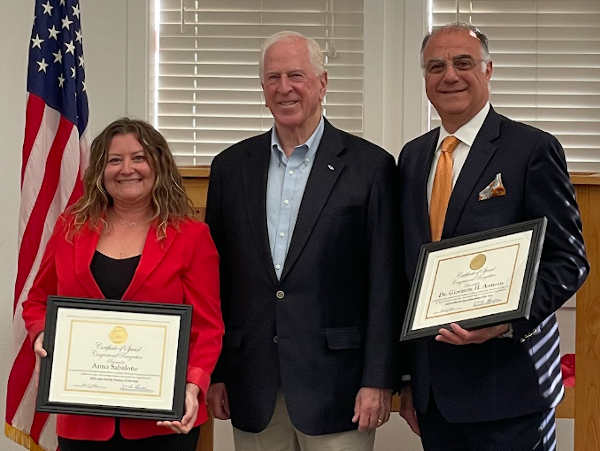
UPPER LAKE, Calif. — Two outstanding Lake County educators recently received a visit from Congressman Mike Thompson, who honored them for achievements in their field.
On Monday, Oct. 30, Congressman Mike Thompson presided over a ceremony honoring Upper Lake Unified School District’s Superintendent Dr. Giovanni Annous and Dean of Students Anna Sabalone for their extraordinary achievements in service to the district and the Northshore Community.
Both received a “Certificate of Special Congressional Recognition” presented by Thompson.
Dr. Annous was recently recognized by the Small School Districts Association as 2023 California Superintendent of the Year, and Sabalone was recognized as 2023 Lake County Teacher of the Year.
During the event, Congressman Thompson praised the efforts of Dr. Annous for implementing positive change while solidifying a strong sense of community and belonging at the district.
He noted that Dr. Annous’ dedication to excellence in educational leadership and for his going above and beyond for students every day.
Congressman Thompson also hailed his support of empowering the next generation of adults.
In addition to the accolades directed to Dr. Annous, Sabalone also was congratulated on her various achievements as a teacher in the district, having taught and shepherded students of the Northshore for nearly 20 years.
Sabalone, a very creative artist at heart, would lead her students from the linear to the abstract as applied to both thinking and artistic talent.
Well respected by her peers and the Northshore Community, Sabalone embodies education excellence.
After the presentation of the Congressional Recognition certificate, Dr. Annous thanked the Congressman for his support in the arena of education and his dedication to those in his district.
Annous continued and thanked Lake County Supervisor Eddie (EJ) Crandell for his support over the years, working on behalf of students to increase services and provide access for all students.
Dr. Annous also thanked the Habematolel-Pomo of Upper Lake and Robinson Rancheria for their partnership over the years, whether it had been in the area of facility and program improvements, as well as student engagement.
In attendance were Upper Lake Unified School District Board President Diane Plante and Vice President Joanne Breton, and Lake County Office of Education Superintendent Brock Falkenberg, who received recognition from Dr. Annous for their support and continued service to the public of Lake County.
Sabalone expressed her gratitude for her fellow staff members and the school district’s administration for supporting her over the years she had been teaching, and commented further about how she had benefited from the core friendships she had established during her tenure.
Annous thanked the school district staff and community noting that none of the achievements would have been possible without their support. Although a laborious journey, he said it was one of camaraderie with a focus on community and collective growth.
The ceremony concluded with a quick word by Plante and Breton who said that they weren’t completely surprised at the recognition as it was simply an acknowledgment of what the school board had known for years.
They closed by expressing their gratitude for the servant leadership they provide, not only to the school community, but also to the greater community of Lake County.
- Details
- Written by: Elizabeth Larson

CLEARLAKE, Calif. — Clearlake Animal Control has new dogs ready for new homes this week.
The Clearlake Animal Control website lists 48 adoptable dogs.
This week’s dogs include “Jupiter,” a male German shepherd mix with a black and tan coat.
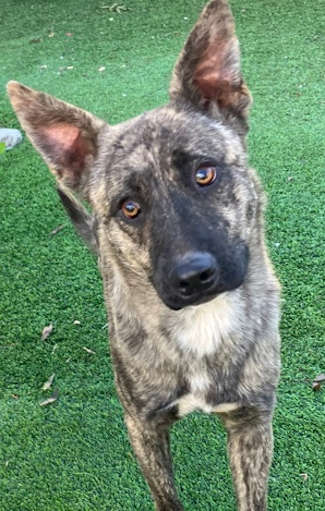
Another adoptable dog is “Truffles,” a German shepherd mix with a brown brindle coat.
The shelter is located at 6820 Old Highway 53. It’s open from 9 a.m. to 6 p.m. Tuesday through Saturday.
For more information, call the shelter at 707-762-6227, email
This week’s adoptable dogs are featured below.
Email Elizabeth Larson at
- Details
- Written by: LAKE COUNTY NEWS REPORTS
Federal funding awarded to the California Highway Patrol will help implement safety measures to reduce dangerous driving behaviors statewide.
The $2.5 million Speed Prevention, Education and Enforcement Deterrence, or SPEED II, grant aims to reduce the number of fatal and injury crashes related to speed and the number of victims killed and injured in these crashes.
To achieve this, the CHP will deploy enhanced enforcement and public awareness campaigns statewide.
Speeding and aggressive driving behaviors are a significant danger to the motoring public, pedestrians, and individuals using alternate forms of transportation.
In federal fiscal year 2021-2022, speed was a factor in nearly 40% of all fatal and injury crashes in California.
During this period, there were in excess of 28,000 speed-related crashes, resulting in over 400 deaths and more than 42,000 injuries.
“The receipt of this grant will enable the CHP to reinforce our commitment to road safety,” said CHP Commissioner Sean Duryee. “Through a combination of proactive enforcement and community education, we aim to eliminate the threat of speed and aggressive driving, while making our roads safer for everyone.”
During April 2021 to July 2023, the CHP used federal funding to employ educational and enforcement efforts to combat dangerous driving behaviors.
The federal funding allowed the CHP to conduct enhanced speed enforcement operations on state routes with increasingly speed related incidents.
During this period, the CHP issued over 48,000 citations to motorists exceeding 100 miles per hour; collaborated with allied law enforcement agencies and posted anti-speeding and aggressive driving behavior ads on social media.
Funding for this program was provided by a grant from the California Office of Traffic Safety, through the National Highway Traffic Safety Administration.
- Details
- Written by: Grace Melo, Texas A&M University; Andrea Leschewski, South Dakota State University, and Kyle Jones, University of Kentucky

The share of low-income U.S. families experiencing food insufficiency – sometimes or often not having enough food to eat – fell from 24.5% to 22.5% at the outset of the COVID-19 pandemic in 2020, we found in a new study published in the November 2023 issue of Food Policy.
This 2 percentage-point decline coincided with the rapid expansion of a pilot program that allows the purchase of groceries online with benefits from the Supplemental Nutrition Assistance Program, also known as SNAP.
First mandated by the farm bill Congress passed in 2014, the SNAP Online Purchasing Pilot was initially rolled out on a limited basis in 2019.
Once COVID-19 arrived in the U.S. in early 2020, the pilot was rapidly expanded nationwide because the pandemic disrupted schooling, child care, transportation and in-person retail shopping. All of those changes curtailed access to food – especially for people with low incomes.
Nationally, SNAP online grocery purchases soared to US$155 million in June 2020, from less than $3 million in January of that year.
To investigate whether the rapid rollout of the Online Purchasing Pilot played a role in the food insufficiency decline at that time, we teamed up with Jordan Jones, a U.S. Department of Agriculture economist. We analyzed 12 weeks of data covering April 23, 2020, to July 21, 2020, from the Household Pulse Survey involving aproximately 10,000 low-income households.
Because the pilot was rolled out gradually in different states, we were able to leverage the differences in the timing using a two-way fixed-effects model. This method made it possible to determine that SNAP’s online purchasing program contributed to the decline in food insufficiency.
The prevalence of very low food security – a condition in which people may skip meals – increased for families with children in 2020. But the impact of the Online Purchasing Pilot was not larger for these households as opposed to those without any kids.
We believe this suggests that the ability to use SNAP benefits online does not resolve some food-related problems, such as those that arise because of school closures.
Low-income children are eligible for free meals at school. While many school districts found creative ways to distribute grab-and-go meals when school buildings were closed in 2020 and 2021, not all families were able to take advantage of those opportunities.
Why it matters
SNAP benefits currently help more than 42 million Americans buy food. The maximum monthly amount for a family of four in the 2024 fiscal year, which began on Oct. 1, 2023, is $973 in the 48 mainland states and the District of Columbia.
Online options for using these benefits vary by state. In many locations, they include big stores that sell groceries, such as Walmart, Target, Whole Foods and Safeway, and some popular online retailers like Amazon.
Buying groceries online makes life easier for anyone who has trouble purchasing food in person, including people with disabilities, those with limited transportation access or those living in remote locations.
About 1 in 6 Americans pay for groceries online every week, and more than half have done so in the past 12 months.
What other research is being done in this field
This is one of several studies that have evaluated the impact of temporary food assistance policies at the height of the COVID-19 pandemic. One member of our group, Grace Melo, conducted research with a different team that found that the mental health of children in low-income families that got a boost in SNAP benefits did not decline, even though they were disproportionately affected by the pandemic.
What’s next
Another member of our research team, Kyle Jones, is now researching how this pilot affects what kinds of groceries Americans are buying with SNAP benefits. He also plans to analyze how using the benefits for online purchases changes how much time people with these benefits spend on grocery shopping.
The Research Brief is a short take on interesting academic work.
Grace Melo, Assistant professor of Agricultural Economics, Texas A&M University; Andrea Leschewski, Associate Professor of Applied Economics, South Dakota State University, and Kyle Jones, PhD Candidate in Economics, University of Kentucky
This article is republished from The Conversation under a Creative Commons license. Read the original article.