 How to resolve AdBlock issue?
News
- Details
- Written by: Lake County News reports
The CHP has partnered with the California Office of Traffic Safety, or OTS, to implement the “California Restraint Safety Education and Training” — CARSEAT for short — campaign, boosted by a $850,000 federal grant.
The yearlong CARSEAT campaign focuses on reducing the number of children injured or killed in traffic crashes throughout California.
To help accomplish this goal, the CHP will host educational seminars, classes, and child safety seat inspections.
These efforts will highlight the importance of child passenger restraint by providing education on the proper installation of child passenger safety seats.
“Ensuring the safety of our youngest passengers begins with a simple but critical act — securing them in properly installed child safety seats,” said CHP Commissioner Sean Duryee. “It is the single most effective way to protect a child in a vehicle crash.”
California law requires a child to be properly restrained in an appropriate child safety seat in the rear seat of a vehicle until they are at least 8 years of age.
Children under 2 years of age should ride in a rear-facing car seat unless the child weighs 40 or more pounds or is 40 or more inches tall.
For more information regarding child passenger safety, child safety seats, and seat belt regulations, please contact your local CHP Area office.
The Clear Lake Area Office can be reached at 707-279-0103.
Funding for this program was provided by a grant from the California Office of Traffic Safety through the National Highway Traffic Safety Administration.
- Details
- Written by: Paul Schofield, Bates College
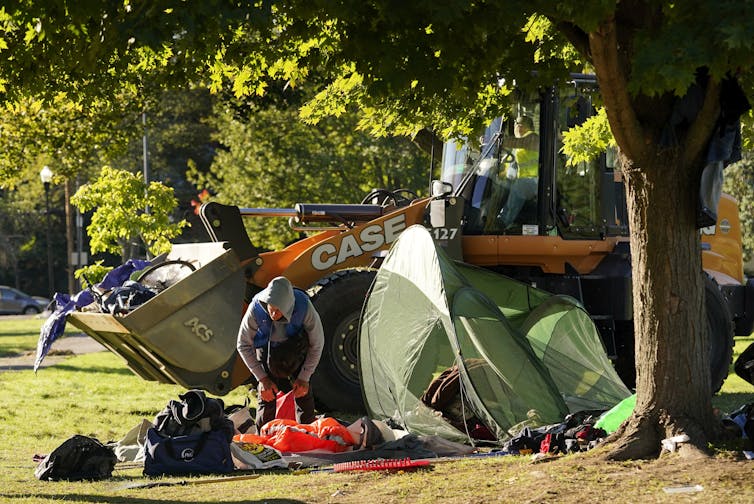
Homelessness is a state of deprivation. Those who are homeless need shelter to be safe; they don’t have it. They need a toilet for basic bodily functions; they don’t have one. They need a shower to keep clean; they don’t have that, either.
Because such deprivation dramatically affects the well-being of people who are homeless, public discussion of homelessness tends to focus on whether and to what extent the government should carry out anti-homelessness policy as a way of improving people’s overall quality of life.
Some philosophers have argued that while homelessness is clearly a state of deprivation, it is also a condition in which a person’s freedom is profoundly compromised.
These theorists insist a society that cherishes freedom – such as the U.S. – must implement anti-homelessness policy as a way of liberating people who lack housing.
Because the number of people experiencing homelessness continues to rise at a record rate, these academic ideas have become increasingly relevant to the real world. I am a philosopher interested in exploring the moral dimensions of homelessness, as well as shining a light on underdiscussed aspects of it. I believe that public debate would benefit greatly from increased attention to the ways homelessness limits Americans’ freedom.
Freedom to be somewhere
Since homelessness is usually discussed in terms of deprivation, the claim that homelessness has much to do with freedom can seem surprising.
Freedom is commonly understood as the ability to do what one chooses without being interfered with. My freedom is limited if you lock me in a cell or place a boulder on the street I want to drive down.
Homelessness, on the other hand, seems at first glance like a condition in which a person is mostly able to do as they choose, albeit without important resources that would make their life better.

The philosopher and legal theorist Jeremy Waldron sees things differently. Waldron says that private property often serves to interfere with people’s choices. If a person wants to walk in New York City from midtown Manhattan to Harlem, others’ property interferes with their ability to choose the most direct route. If a person wants to see a particular Andy Warhol painting, the fact that it is kept at a private residence interferes with their ability to choose to view it.
In itself, this isn’t a problem, as no one should be free to go anywhere and do anything they want. The trouble, says Waldron, comes when a person who is homeless does not have private property that they are able to occupy, free from interference. In such instances, the person will be confined to public spaces, such as sidewalks and parks.
But public spaces themselves are highly regulated through local ordinances, limiting who may use them and for what purposes.
A person who is homeless and sleeps on a public bench will often be told by the police to move. Someone who sets up a tent on a sidewalk will usually have it confiscated. Someone who urinates or defecates in a park can be arrested.
Now you can see why some think that homelessness compromises a person’s freedom. Sleeping and relieving oneself are necessary, life-sustaining tasks.
But as Waldron points out, “Everything that is done has to be done somewhere. No one is free to perform an action unless there is somewhere he is free to perform it.”
Given the way society protects private property and regulates public spaces, it seems that people who are homeless are left with no space at all in which they are free to do the things they need to do in order to live. This is about as severe an infringement on freedom as you can imagine, and Waldron’s point is that a society that loves freedom simply cannot tolerate it.
Anti-homelessness is not just about benevolence and generosity, then. It is about protecting liberty.
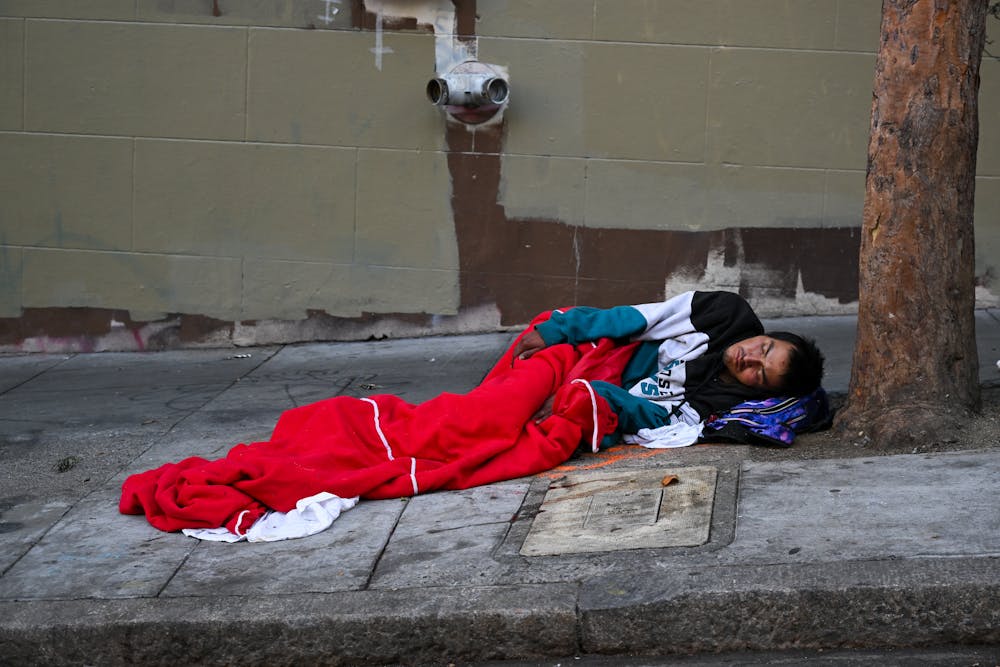
Freedom from others
Of course, people who are homeless do sleep and relieve themselves. So, in what sense do they actually lack the freedom to do so?
The political philosopher Christopher Essert argues that Waldron’s analysis should be taken one step further by considering its implications for interpersonal relations.
Since a person who is homeless has nowhere to freely perform life-sustaining tasks, typically they will either seek permission from someone to use their property, use the property and hope to not be noticed or, at worst, seek forgiveness. Either way, they depend upon the grace of another in order to do the things they need to do.
This puts people who are homeless at the mercy of those who have property.
Whether a homeless person has a place to sleep or whether they are arrested for sleeping somewhere without permission is completely determined by the wishes of others. Keesha might sleep on Felix’s couch for a few nights. But as soon as Felix is in a bad mood, he can throw her out. Or Felix might make access to his couch conditional upon her attending church services, supporting his preferred political candidate or performing sexual acts. What she does and does not do is now up to Felix.
Essert connects this set of observations to what is called a “republican” conception of freedom. This way of understanding freedom is less about whether a person is actually interfered with and more about the way they are placed under the arbitrary power of another.
The intuitive idea is that if someone else always has the power to determine your choices, then you aren’t free. Since a homeless person is always on property over which someone else has authority, they are always, writes Essert, “under the power of others, dependent on them, dominated by them, unfree.”
In the U.S. especially, arguments that appeal to freedom are taken very seriously. Even those who insist that it is not the government’s job to ensure everyone a good quality of life believe that it must ensure freedom. Even those whose ears close when they hear calls for charity and beneficence seem to pay attention when freedom is at stake.
By proposing this way of seeing the life of someone who is homeless, then, philosophers have raised the possibility that allowing homelessness to persist contradicts values that are, at heart, fundamentally American.
Paul Schofield, Associate Professor of Philosophy, Bates College
This article is republished from The Conversation under a Creative Commons license. Read the original article.
- Details
- Written by: Tammy Brigham
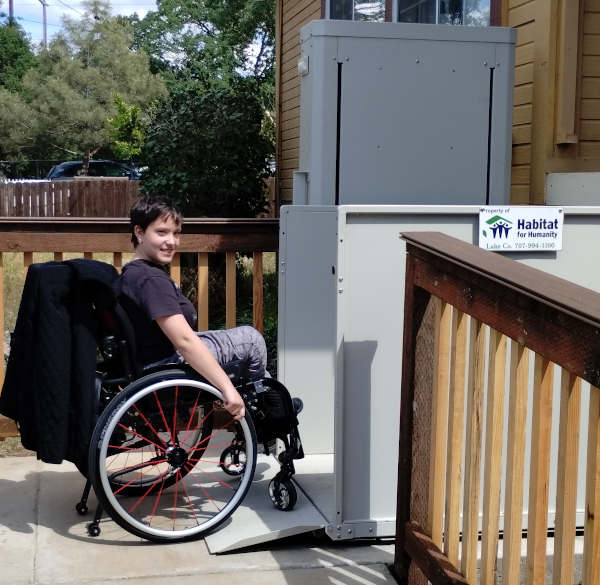
LAKE COUNTY, Calif. — Fourteen-year-old Alyssa Arledge has lived in a wheelchair her entire life.
Born with spina bifida, a condition doctors warned her mother would offer little or no quality of life, Alyssa has defied the odds to become a vibrant, outgoing young woman eager for independence.
The home she lives in with her parents and younger brother, however, provides little opportunity for that.
As she is unable to easily leave the house without assistance, and had difficulty maneuvering her wheelchair around the home, Alyssa’s mother Sarah reached out to Habitat for Humanity Lake County to learn if there was any way they could help.
After a thorough evaluation of the home and discussing Alyssa’s needs with Sarah Arledge, Habitat for Humanity Lake County, as part of their Critical Home Repair Brush of Kindness Program, was happy to be able to come to their aid.
The program provides an array of repairs to low-income households throughout Lake County.
To date, they have assisted more than 300 households with health and safety and accessibility-related repairs In addition to providing qualified families with homeownership opportunities, helping families like the Arledges is one of Habitat for Humanity Lake County’s primary missions and goals.
A new sink was installed to accommodate Alyssa’s wheelchair and the bathtub has been adapted for accessibility.
One interior doorway was widened to provide access to the rear entrance where a handicap ramp was installed to give Alyssa access to the garden she has planted and loves to tend.
Best of all, a wheelchair lift has been installed at the main entrance of the home so that Alyssa can come and go as she pleases without relying on someone else to carry her chair up and down the stairs.
On the day the lift was installed, Habitat staff was present when Alyssa arrived home from school to see it and use it for the first time. The delight on her face as she maneuvered into the lift and rode it up to the front door on her own, without needing the aid of family to do so, was a joy to behold.
“You guys have helped me so much,” Alyssa said to Habitat’s staff. “You were always rushing to help and I am so thankful for all you have done. It has changed my life so much and I will be forever thankful. Thanks to you, I can be more independent and can go outside without needing help. I hope other people find you guys and see how wonderful you are. Knowing you were there to help me makes me very happy.”
Alyssa and her family expressed their ongoing gratitude throughout the entire process. It is that gratitude, and the happiness on Alyssa’s face, that fuels Habitat’s commitment to continuing their efforts in bettering the lives of Lake County’s families.
For a short video of the celebration and unveiling of the lift, or for more information about the work Habitat for Humanity Lake County offers, please visit http://www.lakehabitat.org.
If you or someone you know might benefit from Habitat for Humanity’s home repair services or are in need of housing, please contact the office at 707-994-1100, Extension 108, or stop by and talk with us about your needs and to pick up an application.
Additionally, there is an ongoing need for buildable property and for wheelchair ramps and lifts to assist people like Alyssa.
If you or someone you know are able to help, please contact Habitat for Humanity to discuss how you can help.
Tammy Brigham is administrator for Habitat for Humanity Lake County.
- Details
- Written by: Lake County News reports
Just in time for the Thanksgiving holiday, California State Parks, in partnership with First Partner Jennifer Siebel Newsom and the California Natural Resources Agency, is expanding its popular California State Park Adventure Pass from 19 select state parks to 54.
The pilot program, currently in its third year, allows California fourth graders and fourth-grade teachers free admission to participating parks until Aug. 31, 2024.
The public can find a park near them here.
In Lake County, both Anderson Marsh State Historic Park and Clear Lake State Park are participating in the program.
The Adventure Pass is one part of the First Partner’s California for All Kids initiative, which seeks to put children and families on a path to a healthier future.
“We launched the California State Park Adventure Pass in 2021 to provide fourth graders and their families with more opportunities to reap the mental, physical, and social-emotional health benefits of time spent outdoors,” said Siebel Newsom. “Now, we’re expanding the Adventure Pass– nearly tripling the number of gorgeous California State Parks and historic sites fourth graders are able to visit and increasing their access to valuable hands-on, experiential learning opportunities in the process. By growing this program, we’re doubling down on our commitment to ensure California kids have access to the resources they need to get the best start in life.”
The California State Park Adventure Pass program, made possible by Assembly Bill 148, was signed by Gov. Gavin Newsom in July 2021.
The pass is valid for the one-year period during which the child is a fourth grader or fourth grade equivalent, from Sept. 1 to Aug. 31 of that year.
Any fourth grader who lives in California is eligible for the California State Park Adventure Pass, no matter how they attend school or how old they are. If they are a fourth grader or fourth-grade equivalent, they qualify.
To date, more than 50,000 passes have been provided to families.
For full terms and conditions, click here.
“We are thrilled to expand the California State Park Adventure Pass from 19 to 54 participating state parks, including beaches and historic parks,” said State Parks Director Armando Quintero. “The curriculum being taught in fourth grade about history, natural, and social sciences make providing fourth graders with free state park access a great supplement to the lessons being taught to them in school.”
Obtaining a free pass online is simple.
Have a parent and/or guardian go to ReserveCalifornia.com or call 800-444-7275 (Spanish-speaking customer service available). All they have to do is set up a profile by providing their name, address, phone number and email address, and a free pass will be sent to their email right away.
Individuals who do not have access to a smartphone, computer or printer, and/or do not have an email address, can still request a pass by visiting a State Parks Pass Sales Office — click here for a list of locations — or by calling 800-444-7275.
“Expanding this Adventure Pass is great news for families across the state and another way our State Parks are expanding outdoor access,” said California Natural Resources Secretary Wade Crowfoot. “As the parent of a fourth grader myself, I know how much kids love exploring new places. Now more kids and families will be able to experience a broader range of our natural places across California, helping us achieve the goal of building an Outdoors for All.”
The State of California champions the right of all Californians to have access to recreational opportunities and enjoy the cultural, historic, and natural resources found across the state. Too many Californians cannot access neither public outdoor spaces nor the state’s array of museums, and cultural and historical sites.
The state is prioritizing efforts to expand all Californians’ access to parks, open space, nature and cultural amenities. This priority requires focusing funding and programs to expand opportunities to enjoy these places. Doing so advances Gov. Gavin Newsom’s strong personal commitment to building a “California for All.”
Outdoors for All Pass Programs
In addition to the California State Park Adventure Pass, all Californians can check out a California State Parks Library Pass by using their library cards to access more than 200 participating state park units. The Library Pass program is also available to tribal libraries throughout the state.
Families receiving California Work Opportunity and Responsibility for Kids, or CalWORKs, individuals receiving Supplemental Security Income (SSI), and income-eligible Californians 62 and over can apply for the Golden Bear Pass with their smartphone or other web-based device in just minutes and have access to more than 200 California state park units.
The Golden Bear Pass is also available to participants of California’s Tribal Temporary Assistance for Needy Families, or TANF, program.
For more information on all three State Park Pass programs, please visit http://parks.ca.gov/?page_id=30641.
To start exploring 54 state parks for free, visit http://parks.ca.gov/AdventurePass.