 How to resolve AdBlock issue?
News
- Details
- Written by: Ryan Keeley, University of California, Merced
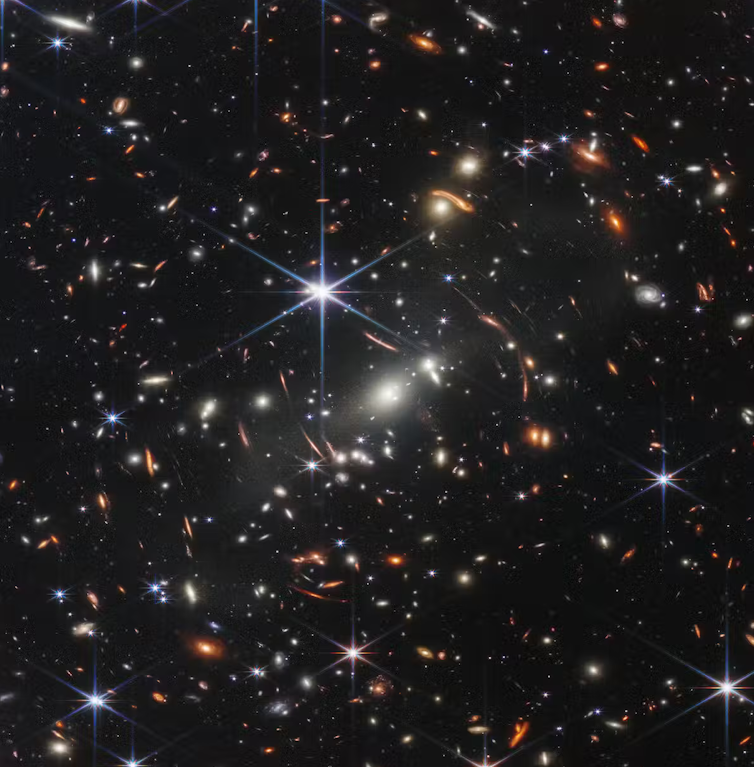
Astronomers have known for decades that the universe is expanding. When they use telescopes to observe faraway galaxies, they see that these galaxies are moving away from Earth.
To astronomers, the wavelength of light a galaxy emits is longer the faster the galaxy is moving away from us. The farther away the galaxy is, the more its light has shifted toward the longer wavelengths on the red side of the spectrum – so the higher the “redshift.”
Because the speed of light is finite, fast, but not infinitely fast, seeing something far away means we’re looking at the thing how it looked in the past. With distant, high-redshift galaxies, we’re seeing the galaxy when the universe was in a younger state. So “high redshift” corresponds to the early times in the universe, and “low redshift” corresponds to the late times in the universe.
But as astronomers have studied these distances, they’ve learned that the universe is not just expanding – its rate of expansion is accelerating. And that expansion rate is even faster than the leading theory predicts it should be, leaving cosmologists like me puzzled and looking for new explanations.
Dark energy and a cosmological constant
Scientists call the source of this acceleration dark energy. We’re not quite sure what drives dark energy or how it works, but we think its behavior could be explained by a cosmological constant, which is a property of spacetime that contributes to the expansion of the universe.
Albert Einstein originally came up with this constant – he marked it with a lambda in his theory of general relativity. With a cosmological constant, as the universe expands, the energy density of the cosmological constant stays the same.
Imagine a box full of particles. If the volume of the box increases, the density of particles would decrease as they spread out to take up all the space in the box. Now imagine the same box, but as the volume increases, the density of the particles stays the same.
It doesn’t seem intuitive, right? That the energy density of the cosmological constant does not decrease as the universe expands is, of course, very weird, but this property helps explain the accelerating universe.
A standard model of cosmology
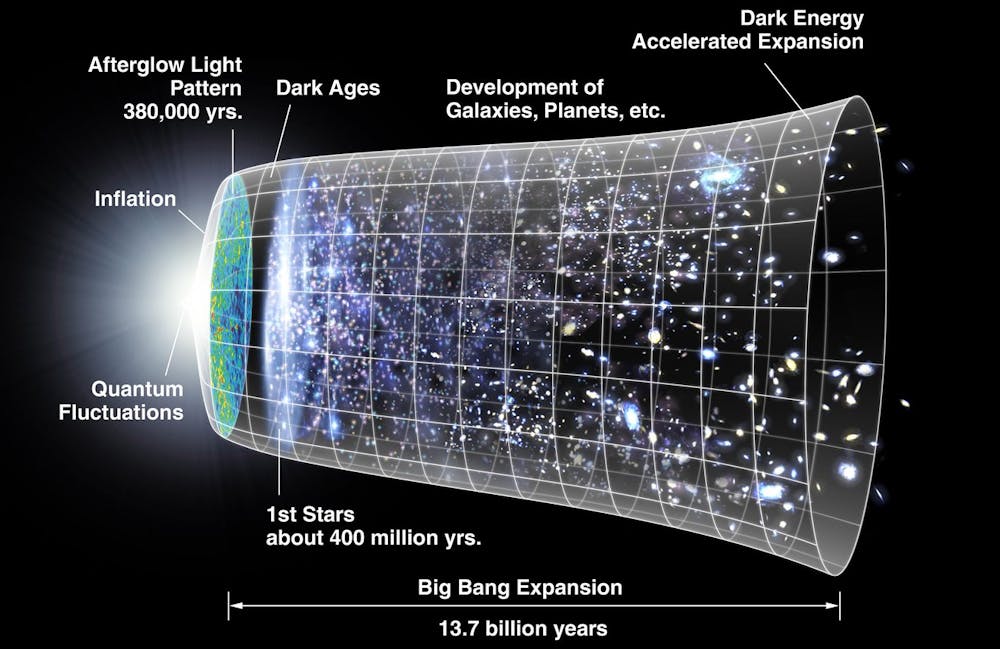
Right now, the leading theory, or standard model, of cosmology is called “Lambda CDM.” Lambda denotes the cosmological constant describing dark energy, and CDM stands for cold dark matter. This model describes both the acceleration of the universe in its late stages as well as the expansion rate in its early days.
Specifically, the Lambda CDM explains observations of the cosmic microwave background, which is the afterglow of microwave radiation from when the universe was in a “hot, dense state” about 300,000 years after the Big Bang. Observations using the Planck satellite, which measures the cosmic microwave background, led scientists to create the Lambda CDM model.
Fitting the Lambda CDM model to the cosmic microwave background allows physicists to predict the value of the Hubble constant, which isn’t actually a constant but a measurement describing the universe’s current expansion rate.
But the Lambda CDM model isn’t perfect. The expansion rate scientists have calculated by measuring distances to galaxies, and the expansion rate as described in Lambda CDM using observations of the cosmic microwave background, don’t line up. Astrophysicists call that disagreement the Hubble tension.
The Hubble tension
Over the past few years, I’ve been researching ways to explain this Hubble tension. The tension may be indicating that the Lambda CDM model is incomplete and physicists should modify their model, or it could indicate that it’s time for researchers to come up with new ideas about how the universe works. And new ideas are always the most exciting things for a physicist.
One way to explain the Hubble tension is to modify the Lambda CDM model by changing the expansion rate at low redshift, at late times in the universe. Modifying the model like this can help physicists predict what sort of physical phenomena might be causing the Hubble tension.
For instance, maybe dark energy is not a cosmological constant but instead the result of gravity working in new ways. If this is the case, dark energy would evolve as the universe expands – and the cosmic microwave background, which shows what the universe looked like only a few years after its creation, would have a different prediction for the Hubble constant.
But, my team’s latest research has found that physicists can’t explain the Hubble tension just by changing the expansion rate in the late universe – this whole class of solutions falls short.
Developing new models
To study what types of solutions could explain the Hubble tension, we developed statistical tools that enabled us to test the viability of the entire class of models that change the expansion rate in the late universe. These statistical tools are very flexible, and we used them to match or mimic different models that could potentially fit observations of the universe’s expansion rate and might offer a solution to the Hubble tension.
The models we tested include evolving dark energy models, where dark energy acts differently at different times in the universe. We also tested interacting dark energy-dark matter models, where dark energy interacts with dark matter, and modified gravity models, where gravity acts differently at different times in the universe.
But none of these could fully explain the Hubble tension. These results suggest that physicists should study the early universe to understand the source of the tension.
Ryan Keeley, Postdoctoral Scholar in Physics, University of California, Merced
This article is republished from The Conversation under a Creative Commons license. Read the original article.
- Details
- Written by: Lake County News reports
The festivities will be held on Saturday, Dec. 9, from 4 to 8 p.m.
Since 1988 the town Christmas festival has been growing and evolving. Starting as a vendor craft fair, it grew to include our storefront merchants, community service groups, food vendors, fundraising youth groups and more.
This year’s schedule of events includes the following:
4:30 to 6 p.m.: Santa will be at Middletown Mail and More for children and photo opportunities.
5:30 p.m.: Christmas tree lighting ceremony.
5:30 to 7 p.m.: Children’s activities at the library in the community room.
7:30 p.m.: Posada pinata breaking at the Middletown Art Center
This year the event will feature:
• Food court in central downtown
• Vendors.
• Passport to Fun Game with prizes for the lucky winners.
• Car show at the town park.
• Posada singing procession throughout the event sponsored by Middletown Art Center.
• Street decorated with donated Christmas trees with decorations made by local school children that will be given to local families in need.
• Maker’s Faire at Middletown Art Center.
• Businesses will be open into the evening.
• South Lake County Fire District’s Candy Can Run.
The Middletown Area Merchants Association sponsors this event.
“We are hoping for community and business support to decorate the town in a festive spirit. This is a great way to keep your dollars local and to explore all this sweet town has to offer,” the association said.
This annual event is always the second Saturday in December, rain or shine.
They always need volunteers to make this a successful event for all. Contact the association at
- Details
- Written by: Elizabeth Larson

The Clearlake Animal Control website lists 45 adoptable dogs.
They include “Smiley,” a male pit bull terrier mix with a gray and white coat.

Also available for adoption is “Monkey,” a 1-year-old female pit bull mix.
The shelter is located at 6820 Old Highway 53. It’s open from 9 a.m. to 6 p.m. Tuesday through Saturday.
For more information, call the shelter at 707-762-6227, email
This week’s adoptable dogs are featured below.
Email Elizabeth Larson at
- Details
- Written by: Lake County News reports
The Bicycle and Pedestrian Safety, Education, Enforcement, and Awareness Program II, which continues through Sept. 30, 2024, is designed to help educate and enforce traffic safety laws for drivers, bicyclists, and pedestrians.
“Safe streets are built on shared responsibility, where motorists, bicyclists, and pedestrians all play a key role in ensuring each trip ends with a safe arrival,” said CHP Commissioner Sean Duryee. “This grant is an investment in helping improve the safety of California’s most vulnerable roadway users.”
In California, pedestrian and bicyclist fatalities account for 20 percent of all traffic-related deaths in CHP jurisdiction.
Pedestrians and bicyclists make up 1,519 of the 7,559 people killed in crashes between 2020 and 2022 throughout CHP jurisdiction.
In the spirit of sharing the road, the CHP offers the following suggestions:
Drivers
• Adhere to the posted speed limit and exercise caution on busy streets with more bicyclists and pedestrians.
• Stay focused on driving and eliminate distraction behind the wheel.
• Yield to pedestrians and stop for people walking at marked and unmarked crosswalks.
• Show consideration for cyclists by maintaining 3 feet of distance when safely passing them. Change lanes when possible.
Pedestrians
• Stay alert to oncoming vehicles.
• Use crosswalks when available, especially at stop signs or signals. Exercise caution when crossing at night or when navigating busier streets with multiple lanes and higher speed limits as visibility may be reduced.
• Increase your visibility by wearing light-colored clothing, reflective material, and carrying a flashlight during nighttime or dawn/dusk hours.
Bicyclists
• Ride in the same direction of traffic. Bicyclists must adhere to the same rules and regulations as any slow-moving vehicle.
• Employ hand signals and use bike lanes, when accessible.
• Wear a helmet and ensure your bike is equipped with lights when riding at night.
Additional specialized enforcement operations will be conducted during the year focusing on areas with higher bicyclist and pedestrian traffic and crashes, and officers will also conduct public awareness campaigns in communities throughout the state.
This grant also funds bicycle safety training and educational presentations to promote safe and courteous traffic safety behaviors by drivers and bicyclists, as well as safety publications, bicycle helmets, reflective gear, and other vital safety equipment.
Funding for this program was provided by the California Office of Traffic Safety through a grant from the National Highway Traffic Safety Administration.