How to resolve AdBlock issue?
Refresh this page
How to resolve AdBlock issue?
Refresh this page
Lake County News,California
  • Home
    • Registration Form
  • News
    • Education
    • Veterans
    • Community
      • Obituaries
      • Letters
      • Commentary
    • Police Logs
    • Business
    • Recreation
    • Health
    • Religion
    • Legals
    • Arts & Life
    • Regional
  • Calendar
  • Contact us
    • FAQs
    • Phones, E-Mail
    • Subscribe
  • Advertise Here
  • Login
How to resolve AdBlock issue?
Refresh this page

News

Americans love nature but don’t feel empowered to protect it, new research shows

Details
Written by: Jessica Eise, Indiana University
Published: 02 September 2024


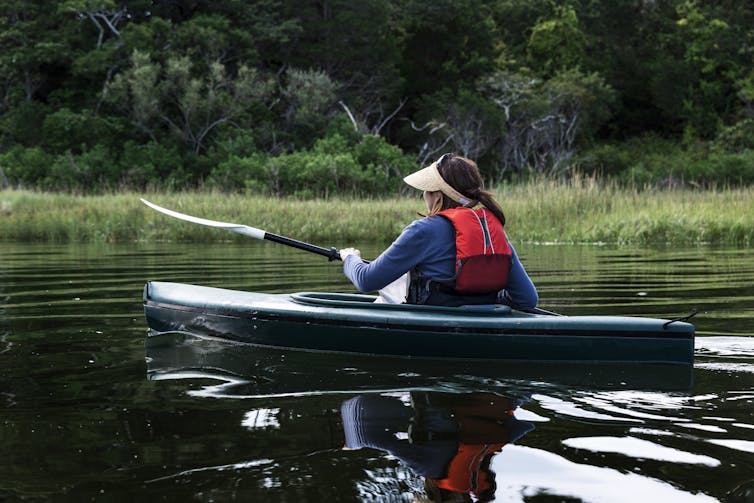
People enjoy spending time in nature but don’t always feel they have the ability to protect it. John Greim/LightRocket via Getty Image

Climate change has been in the news for more than 40 years. It’s typically covered as a scientific or political issue. However, social scientists like me have found that feelings and values are what drive people toward broad, collective change – not charts, graphs or images.

Surveys confirm that the majority of Americans now believe that climate change is real. But many adults seem to feel too exhausted, defeated or powerless to do anything about it.

I am leading a large multiyear research project funded by the National Science Foundation that examines how to tap into morals, ethics and spirituality to create enduring behavioral shifts on this issue. In the pilot study for this project, which has not been published yet, we recently surveyed 275 U.S. adults to understand their relationship with and feelings toward the natural world.

This is a first step toward understanding how to start communicating differently about climate change. Climate change is altering weather patterns, temperatures and seasons, which people are now beginning to feel in nearly all locations in the world.

Many people said that when they thought of nature, it raised happy memories of climbing trees, stomping in puddles or watching sunsets. But underneath, they described fraught relationships with the environment – a tense blend of love, longing, guilt and worry.

Climate change threatens the famed cherry trees around the Tidal Basin in Washington. Warmer spring weather is accelerating bloom dates, and climate-driven flooding is damaging the park.

No predetermined answers

We used an open-ended survey that allowed respondents to answer however they wished, without predetermined choices. For example, we asked “What is your personal relationship with nature?” and gave respondents a blank box to write down their own interpretation.

Open-ended questions are coded line by line by a team of researchers – a time-consuming process that limits the number of survey participants. Large surveys typically use close-ended questions that are more straightforward to analyze and are easier to administer to larger numbers of people.

However, using this approach meant that responses were not limited or prompted by a researcher’s ideas. The themes we found arose out of participants’ own thoughts and feelings.

How do people think about and engage with nature?

To understand people’s relationships with nature, we asked several questions. In one set we asked, “How are humans and nature related? What is the role of humans in nature?” Over half of respondents (53%) noted that we should care for and preserve Earth. Some 45% explicitly mentioned the benefits of nature for human health and well-being. And 27% discussed how humans depend on Earth and its resources.

About a quarter of responses (26%) mentioned that humans can choose to be positive or negative forces in nature. This was closely followed by statements that humans take too much from nature (23%).

People with cameras, looking out to sea
Visitors to Maine’s Acadia National Park gather to watch the sunrise from Cadillac Mountain. Acadia and other parks have adopted timed-entry reservation systems to manage crowding. AP Photo/Robert F. Bukaty

When analyzing another question, “What is your personal relationship with nature?” we noted prominent themes and how participants tended to connect them to one another. For instance, participants reported that, to them, nature represented beauty, health, joy, childhood and escape.

To connect with nature, respondents said they commonly engaged in activities such as taking walks outdoors, going camping, watching sunsets or gardening. However, many said that barriers – such as time constraints, lack of physical access or being distracted by technology – prevented them from connecting with nature in the ways they wanted.

Wanting to do better

Underlying all of this were strong feelings of love, longing, worry and guilt. These emotions showed up most commonly in responses – usually through a literal statement, although sometimes by alluding to the emotion.

When discussing love, participants were most direct. They usually simply said, “I love it, honestly” or “Love it.” Longing was often expressed in slightly more varied ways, such as stating “It makes me sad to not be outside as much as I would hope to,” or “Wish I could go hiking and other things to get closer.”

Worry and guilt emerged in responses such as: “I try my best to respect the environment and take care of it. I know I can do better”; “I take care of it the best I can, but I wouldn’t say I make any large gestures either”; and “I don’t appreciate it enough.” One person simply responded: “Appreciation, respect, care, sadness.”

This question had asked, “What is your personal relationship with nature?” We did not guide respondents to list their feelings. Yet, the responses were laden with emotions.


No sense of how to help

The way in which people talk about or portray an issue – their words, symbols, phrases or images – is called a frame. Frames highlight a subset of an issue, which then generally becomes people’s primary way of thinking about something.

Positive self-efficacy frames – in other words, a belief that people can make a difference – have been largely absent from conversations about climate change. Political or distant environmental frames are more common.

For example, prominent images typically contain political figures or distant environmental impacts, such as smokestacks or melting ice. These tend to leave people feeling powerless or feeling that they have little to offer.

Our survey findings reflect these frames. People feel longing, guilt and worry toward the environment, with virtually no mention of hope, excitement or empowerment.

From paralysis to engagement

Social scientists have been learning through climate change research that some emotions paralyze and others catalyze. Is it possible to reduce paralysis and match love for nature with hope?

Other surveys show that Americans’ concern for future generations is rising, that they are worried about harm to plants and animals and that nearly all groups see human actions as the cause of these concerns. However, as long as people lack a personal sense that they have the ability to make change, they won’t take steps such as telling political leaders to act.

Our next phase of research will build on findings from this survey by examining how ethical, moral and spiritual considerations influence behavior. We want to know what’s required for these ideas to invoke a sense of personal empowerment that’s necessary to take action.

When someone focuses on their connection with one another and future generations, it draws on a different set of ethics and sense of self – and that can motivate action.The Conversation

Jessica Eise, Assistant Professor, Indiana University

This article is republished from The Conversation under a Creative Commons license. Read the original article.
EcoArts Sculpture Walk returns to Middletown’s Trailside Park

Details
Written by: Esther Oertel
Published: 01 September 2024
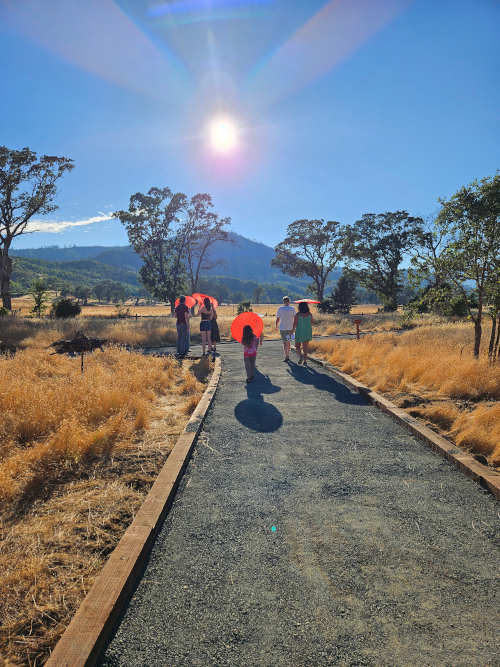
Red parasols were distributed to participants during the grand opening of the EcoArts Sculpture Walk at Middletown Trailside Nature Preserve in Middletown, California, on Aug. 10, 2024. Photo by Esther Oertel.

MIDDLETOWN, Calif. — For the first time since the COVID-19 pandemic, an EcoArts Sculpture Walk is open to the public at the Middletown Trailside Nature Preserve.

The sculptures, 15 in all, are fashioned from natural materials, which, in some cases, were gathered from the park itself. The pieces are scattered along meandering paths within a space that is resiliently recovering from, but still reflects, damage from the 2015 Valley fire.

The EcoArts Sculpture Walk was initially the brainchild of contributing artist Karen Turcotte and her husband, John Williams, and was inspired by the work of British environmental artist Andy Goldsworthy.

The first sculpture walk opened in 2003, and new walks were installed yearly until the Valley fire destroyed the 2015 installation. The walk was briefly resurrected in 2019, and now, after a hiatus of four years, has returned to the park.

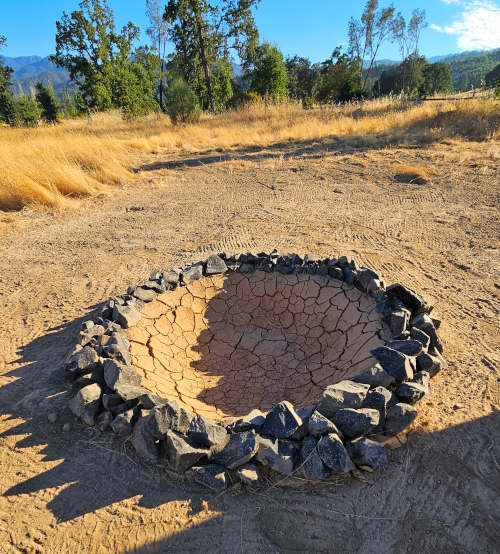
"Obsidian Bowl" by Karen Turcotte is a nod to the geology of Lake County, as well as a symbol of dealing with or overcoming illness. Photo by Esther Oertel, Middletown Trailside Nature Preserve in Middletown, California, on Aug. 10, 2024.

The works are intended to engage the observer in a dialog with nature. Some are designed to enhance the existing environment by attracting beneficial fauna such as birds or native bees.

There have been 15 such exhibits at Trailside Park, and the current one, as well as numerous past installations, have been managed by the Middletown Art Center and its executive director, Lisa Kaplan.

Said Kaplan, “There is so much to say about this awesome project, from what we have learned about the imperative for a reciprocal relationship with nature and each other, to local natural history from descendants of the original peoples of this place, to our collective recovery post-Valley fire, which is also reflected in the park’s growth and resilience.”

She added, “The purpose of this project is to raise awareness about social justice and ecological issues, to provide access to all, for collaboration in co-creating artwork, and to provide a place to experience wonder and facilitate learning for visitors.”

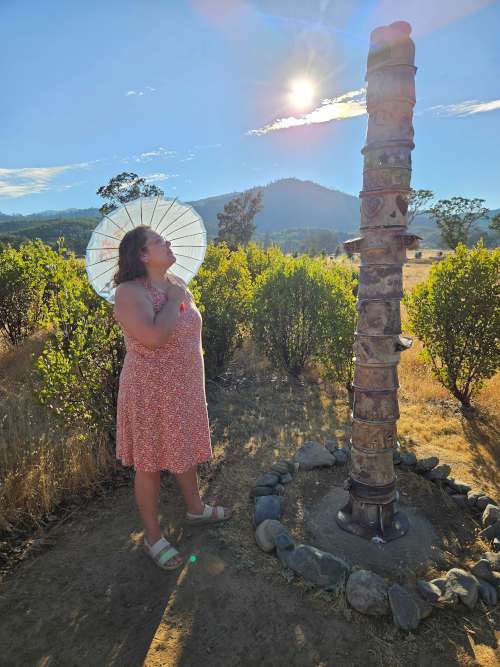
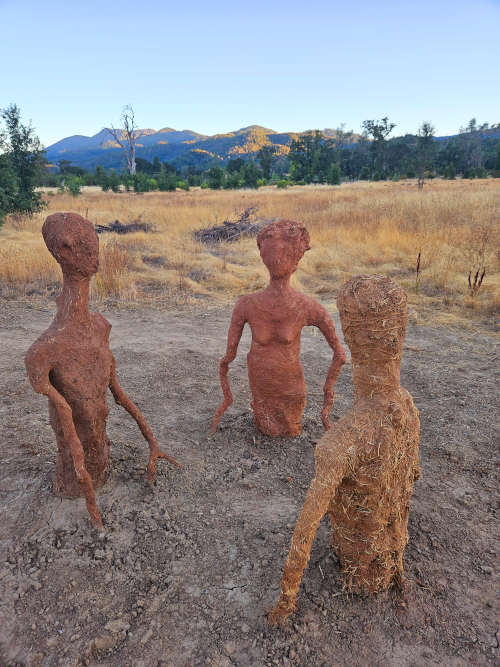
Earth clay as well as natural materials from Middletown Trailside Nature Preserve in Middletown, California, form "From Earth to Earth" by Lisa Kaplan. Photo by Esther Oertel, on Aug. 10, 2024.

Many of the works are collaborations between artists or with members of the community at large.

Emily Scheibel, for example, was assisted by Lower Lake High School students in her creation of “Anulus Unitatus” (or “Rings of Creation”).

“From Earth to Earth,” Kaplan’s piece, was created and installed with help from the youth of Jack’s Lavender Farm, an organization which “cultivates opportunities” for Lake County teens.

Cancer patients and their caregivers contributed to the installation of Turcotte’s piece, “Obsidian Bowl,” which, in part, is representative of dealing with, or coming through, illness. Turcotte herself has survived lung cancer.

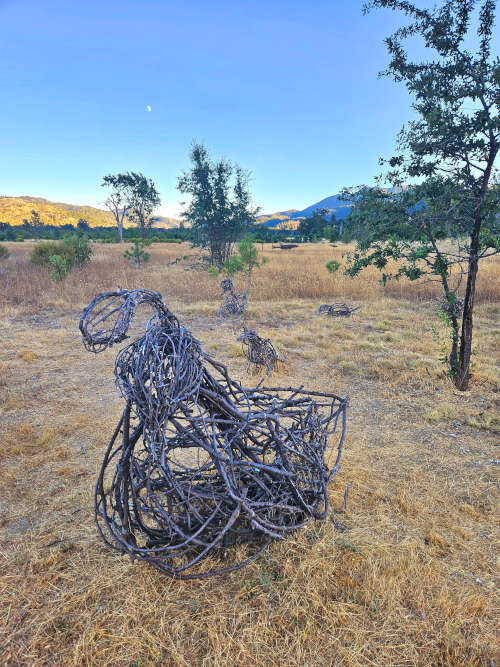
"Sika-ka" ("Quails") was created by Corine Pearce and Laura Kennedy using, in part, bent and woven oak cuttings from the park. Photo by Esther Oertel, Middletown Trailside Nature Preserve in Middletown, California, on Aug. 10, 2024.

Reciprocity was funded by the California Arts Council, with funding administered and supported regionally by the Upstate California Creative Corps.

Numbers of local agencies, organizations and individuals contributed support to the project, including Lake County Public Services, Lake County Parks, Trails and Recreation, District 1 Supervisor Moke Simon, the Sierra Club Lake Group, attorney Dennis Fordham and Barbara Clark of the Lake County Arts Council.

Middletown Trailside Nature Preserve is open from dawn until dusk and is located at 21436 Dry Creek Cutoff, off Highway 175. The exhibit can be found by entering the park on the south side of the parking lot.

"Shade," a structure by Greg Clouse, provides a space to display "Web of Life" by Alicia Farnsworth, an intricate mosaic mural depicting a collage of species (both animal and plant) that can be found in the park at various times of the year. Photo by Esther Oertel, Middletown Trailside Nature Preserve in Middletown, California, on Aug. 10, 2024.

The Middletown Art Center, in addition to their coordination of the EcoArts Sculpture Walk, offers art and writing classes, hosts exhibitions and cultural events, and is a locus for Lake County artists.

To learn more about this valuable Lake County resource and to consider a membership, please visit their Web site at www.middletownartcenter.org.

Esther Oertel is a freelance correspondent for Lake County News.

Alexis Haylock of Angwin, California views Emily Scheibel's "Anulus Unitatis" ("Rings of Creation"), which provides reed tubes for the propagation of native Mason bees and nesting spaces for birds. Photo by Esther Oertel, Middletown Trailside Nature Preserve in Middletown, California, on Aug. 10, 2024.

Multicolored stone sculpture "Mestizaje Germination" by Jaymie Hernandez de la Torre represents the creation of something new. Photo by Esther Oertel, Middletown Trailside Nature Preserve in Middletown, California, on Aug. 10, 2024.


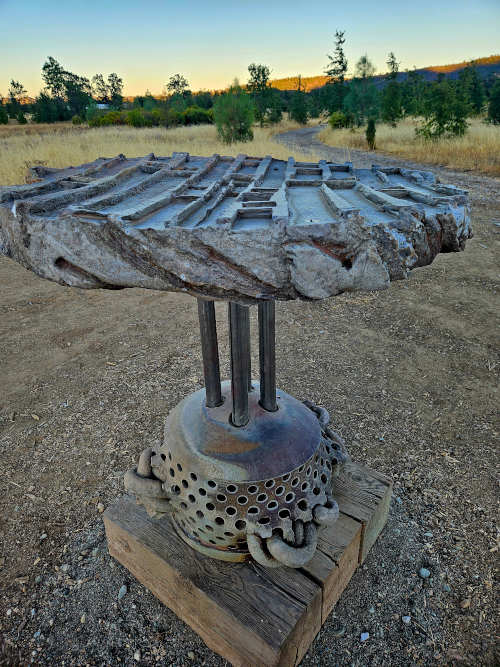
"Great Basin," a work in ceramic by Scott Parady, represents, among other things, the wheel and its impact on human development. Photo by Esther Oertel, Middletown Trailside Nature Preserve in Middletown, California, on Aug. 10, 2024.

Firefighters contain Hill fire in Lakeport

Details
Written by: Elizabeth Larson
Published: 01 September 2024
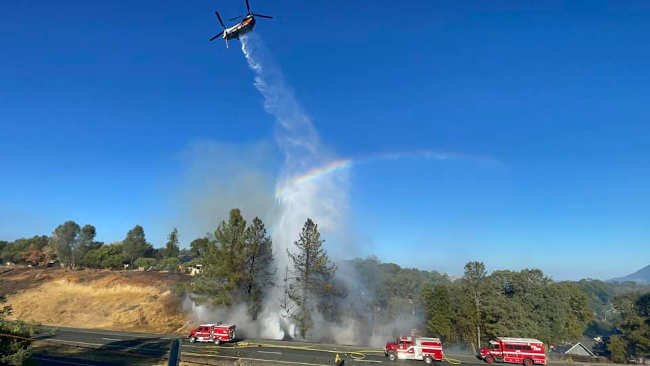
A Cal Fire helicopter drops water on the Hill fire in Lakeport, California, on Saturday, Aug. 31, 2024. Photo by Russell Bishop.

LAKE COUNTY, Calif. — Firefighters were able to fully contain a Lakeport blaze that burned in a neighborhood on Saturday afternoon.

The Hill fire was first reported shortly after 4:45 p.m. Saturday in the area of 11th Street and Highway 29, and caused multiple spot fires.

Burning in a neighborhood, it prompted immediate mandatory evacuations from the area of 19th Street north to Park Way, which remained in effect until late Saturday.

A temporary evacuation point was activated Saturday evening at Lakeport City Hall.

At least one home was reported to have burned in the fire.

Firefighters from around Lake County as well as from Mendocino County were part of the response. Some of those resources needed to be diverted to other incidents out of the county, according to radio traffic.

Power lines were down in the area and propane tanks were reported to be exploding.

Both the northbound and southbound lanes of Highway 29 at 11th Street also were temporarily closed while firefighters worked in the area.

Radio reports said the fire was contained, but not fully out, shortly after 6 p.m.

By the time the incident was terminated shortly after 9:45 p.m., it had burned two and three quarter acres, according to a report over the air by Lakeport Fire Chief Patrick Reitz.

Information on the fire’s cause was not available by the time of publishing.

Email Elizabeth Larson at This email address is being protected from spambots. You need JavaScript enabled to view it.. Follow her on Twitter, @ERLarson, or Lake County News, @LakeCoNews.

Got an unaffordable or incorrect medical bill? Calling your hospital billing office will usually get you a discount

Details
Written by: Erin Duffy, University of Southern California
Published: 01 September 2024


Disagree with that medical bill? It might be worth calling your hospital billing office. damircudic/E+ via Getty Images

What do you do when you disagree with or can’t afford a medical bill?

Many Americans struggle to pay medical bills, avoid care because of cost worries or forgo other needs due to health care cost burdens.

It can be hard to understand what you’re being charged for on a medical bill. I’m a health policy and economics researcher who studies insurance and out-of-pocket health care expenses, and even I sit at my kitchen table trying to wrap my head around bills and explanations of benefits.

In my newly published research, I surveyed a nationally representative sample of 1,135 American adults – a subset of participants from the University of Southern California’s Understanding America Study – to find out how they handle troubling medical bills. I learned that advocating for yourself can pay off when it comes to medical bills, and you may be missing out on financial relief when you don’t pick up the phone.

Squeaky wheel gets the grease

My team and I found that 1 in 5 patients had received a health care bill in the prior year that they disagreed with or couldn’t afford. Nearly 35% of the bills came from doctor’s offices, nearly 20% from emergency rooms or urgent care and over 15% from hospitals. Other sources of bills included labs, imaging centers and dental offices.

A little over 61% of respondents contacted the billing office about a troubling bill, but 2 in 5 did not. Why not? About 86% of patients said they did not think it would make a difference.

Person paying with credit card at front desk of medical office
It’s worth making sure you’re being billed correctly for medical services. Fly View Productions/E+ via Getty Images

But reaching out got results. Nearly 76% of patients who reached out got financial relief for an unaffordable bill. Nearly 74% who spoke up about a potential billing mistake received bill corrections. For those who negotiated their bills, nearly 62% saw a price drop.

Additionally, 18% of patients who reached out got a better understanding of their bill, 16% set up payment plans and a little over 7% got the bill canceled altogether. Nearly 22% said their issue was unresolved, and 24% reported no change.

The majority of people who reached out about their medical bills reported that it took less than one hour to handle their issue.

Picking up the phone

We found that people with a more extroverted and less agreeable personality – based on the Big Five Personality Test – were more likely to reach out about a medical bill. People without a college degree, with lower financial literacy or with no health insurance were less likely to reach out to a billing office.

Differences in who does and doesn’t call about a medical bill may be exacerbating inequalities in how much people end up paying for health care and who has medical debt.

Many Americans are in health plans with high out-of-pocket cost sharing, including high-deductible plans. This so-called consumer-directed health care paradigm is intended to motivate consumers to be more cost-conscious when seeking care and navigating their bills. But by design, it puts the burden on patients to deal with billing issues.

Another recent study my team and I conducted found that 87% of U.S. hospitals offer their own payment plans, but only 22% of these put plan details on their websites. You have to call for more information.

Close-up of medial bill with a credit card and pen on top
Health plans with high out-of-pocket costs put the burden of dealing with billing issues on patients. DNY59/iStock via Getty Images Plus


In another recent study, my team called hospitals as “secret shoppers” planning an elective knee surgery. We sought information critical to assessing affordability: financial assistance, payment plans and payment timing options. While the information was often available, it was hard to access. We couldn’t reach a representative with information at about 18% of hospitals, even after calling on three different days. We were typically directed to three different offices to get all the information we wanted.

Policymakers have made strides in price transparency in recent years. For example, hospitals are required to post prices for their products and services. Practices and policies that further reduce the administrative burden of accessing aid and navigating troubling bills.

Pro tip: Make the call

Patients who make the call are benefiting when it comes to medical bills.

A colleague who knew I was working on this study asked me for advice about a $425 bill her household had received for a lab test at an urgent care center. The bill seemed inflated and unfair, forcing an unexpected stretch to her budget.

I told her it was worth a call to the billing office to express her feelings about the bill and see whether any adjustments could be made to the amount owed or the timing of payment.

It was worth the call. The billing office representative offered three options on the spot: a.) a payment plan, b.) a prompt payment of $126 paid immediately over the phone to settle the account, or c.) financial assistance if eligible based on income.

My colleague chose option b and paid less than one-third of the original bill amount.

The next time you get a medical bill that troubles you, pick up the phone or ask a disagreeable extrovert to make the call for you.The Conversation

Erin Duffy, Research Scientist and Director of Research Training in Health Policy and Economics, University of Southern California

This article is republished from The Conversation under a Creative Commons license. Read the original article.
  1. Helping Paws: Many shepherds and heelers
  2. Space News: 2 solar probes are helping researchers understand what phenomenon powers the solar wind
  3. Fire in Lakeport burns homes, prompts evacuations
  • 561
  • 562
  • 563
  • 564
  • 565
  • 566
  • 567
  • 568
  • 569
  • 570
How to resolve AdBlock issue?
Refresh this page