How to resolve AdBlock issue?
Refresh this page
How to resolve AdBlock issue?
Refresh this page
Lake County News,California
  • Home
    • Registration Form
  • News
    • Education
    • Veterans
    • Community
      • Obituaries
      • Letters
      • Commentary
    • Police Logs
    • Business
    • Recreation
    • Health
    • Religion
    • Legals
    • Arts & Life
    • Regional
  • Calendar
  • Contact us
    • FAQs
    • Phones, E-Mail
    • Subscribe
  • Advertise Here
  • Login
How to resolve AdBlock issue?
Refresh this page

News

Guilt over kids’ screen time is common, uncomfortable and can stress family relationships − but it can have a silver lining

Details
Written by: Robin Nabi, University of California, Santa Barbara
Published: 06 September 2024


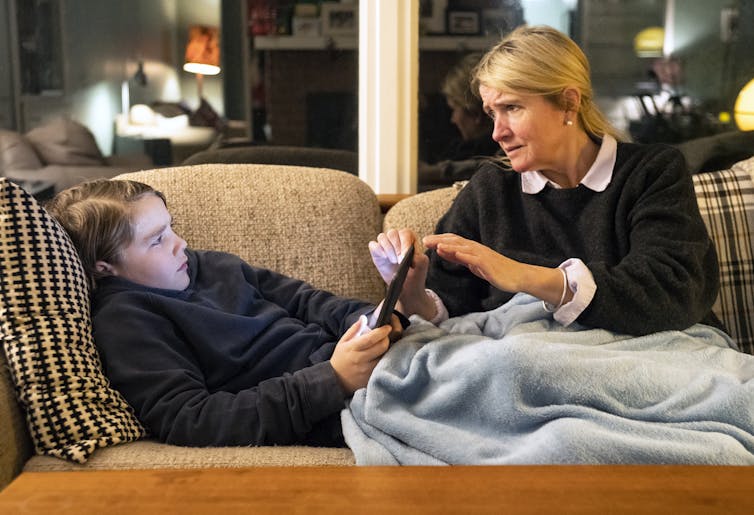
Screen time can be a major point of contention for parents and children. Fertnig/E+ via Getty Images

What parent hasn’t been there? It’s been a long day, you still have dinner to make, maybe lunches for tomorrow too, and you just don’t have the energy to wrangle your kids into a new art project or plead with them to pick up a book.

Instead, you give in when they beg for more iPad time. Or maybe they promise they’ll do their homework after just a few more YouTube videos, and it’s easier to agree than have another argument. Now you’re not only exhausted, you feel like a bad parent too.

If this resonates with you, you’re not alone. Concern over how – and how much – their children are using media is a common source of parental guilt, which makes sense given the reputation of screen use as a frivolous waste of time, with no intrinsic value. So even if people are on their screens for a great reason – to relax, for example, or otherwise manage their moods – they are inclined to feel guilty about it. And this guilt undermines any stress-reducing benefit they might have otherwise enjoyed.

But as unpleasant as this guilt is, the good news is that those feelings, if you listen to them, can help encourage healthier choices for you and your kids.

man and woman on smartphones sit on couch with two kids using laptops, all engrossed in screens
Screen use is a part of modern life for most people. PixelsEffect/E+ via Getty Images

Parental guilt over child screen use

Studies, including from my own media research group, have found that screen media use is among the most common tools that people of all ages use to decompress, relax and enjoy themselves.

But parents worry about their kids’ screen use and for good reason. Without adequate management, screen time can too easily get out of hand, raising concerns about negative outcomes, such as compromised sleep, increased obesity risk, reduced academic performance and mental health challenges.

So here’s the dilemma. Well-meaning parents set various rules to protect their children from the harms associated with too much screen time. But research shows that most parents break those rules. If a child is sick, why not let them play several hours of video games? Maybe you plop your child in front of the TV to keep them busy while you sort laundry or hop on a work call.

So what happens when you break your own rules – especially when those rules are in place to protect your children? You’re primed to feel guilt, and because guilt is its own form of stress, this dynamic sets up tension that can be unhealthy for both parents and kids.

The downside of parental screen guilt

The COVID-19 pandemic, when media use of all sorts increased among all demographics in the U.S. and internationally, gave my research team a unique opportunity to study the guilt that parents feel over their children’s screen use.

Our research considered how the sudden and substantial increase in screen use at the onset of the pandemic affected how parents felt about their relationships with their children. We surveyed parents in March 2020 and another group of parents in both April and May of 2020. We asked about their child’s amount of screen time, their feelings of guilt about their child’s screen use, the stress they felt about it and how satisfied they were with their relationship with their child.

We found that 73% of parents experienced at least some guilt, and 48% felt moderate to intense guilt over their child’s use of screens. So, parental screen guilt was quite common.

We also found that parents who felt more guilt about their child’s screen use also experienced greater stress about that screen use, and that greater stress was linked to feeling less satisfied with their relationship with their child. Importantly, parents’ initial screen guilt in April predicted higher stress about screen use in May, but initial screen stress in April did not predict screen guilt in May. What does this mean? Screen guilt was, in fact, increasing stress, and not the other way around.

What about the amount of time kids spent on screens? Is that the reason why parents felt guilty and stressed? It turns out: not really. In our research, we found little to no relationship between how long children used screens and parents’ screen guilt, screen stress or relationship satisfaction. In other words, it was the feelings of guilt over children’s use of screens, regardless of the amount of use itself, that was problematic for the parents and, by extension, their children.

man and child at kitchen counter making lemonade
You can view guilty feelings as a signal to find something else to do together. shironosov/iStock via Getty Images Plus

Turning guilt lemons into lemonade

So, what can a parent do? Rather than berating yourself over perceived mistakes or misjudgments regarding media choices, it would be far more productive to find the value and deeper lessons in your screen guilt.

People feel guilt when they see their actions conflict with their internalized belief systems or standards of behavior. And as uncomfortable as guilty feelings may be, that guilt can be useful in helping you repair any harms you think you may have caused, particularly within relationships.

In other words, screen guilt can be useful information, nudging you to reflect on and adjust your own rules or choices. Was there a good reason to relax your usual limits on screen use, like when trying to comfort your child when they are sick? On the other hand, is your child suffering negative consequences, for example, not completing homework or getting exercise, because of leniency with screens? Or do you simply feel like a bad parent because you’ve internalized the belief that good parents don’t let their children use screens?

Such reflection can be an opportunity to consider not only how your family is using screens but, importantly, what guardrails you might need to put in place, or adjust, to support family wellness.

Although you might not hear this sentiment often, not all screen media use is bad. There is, in fact, evidence that screen use and content can contribute to a range of wonderful outcomes, including learning, social connection, inspiration and, yes, relaxation and stress relief.

Although guilt may not be pleasant, if you take a moment to understand why you feel it, it can help guide you in creating not only a more balanced diet of media and real-world experiences for you and your family, but also more satisfying relationships with your kids.The Conversation

Robin Nabi, Professor of Communication, University of California, Santa Barbara

This article is republished from The Conversation under a Creative Commons license. Read the original article.

Yuba College faculty members plan rally ahead of district board meeting

Details
Written by: Elizabeth Larson
Published: 05 September 2024
NORTHERN CALIFORNIA — As the Yuba Community College District appeals a state administrative law judge’s ruling that it has violated labor law and workers’ rights, the union representing faculty is planning a rally next week ahead of the district board meeting.

The Faculty Association of Yuba Community College District, or FAYCCD, said its members will gather for a community informational rally at 3:30 p.m. Thursday, Sept. 12, outside the Starbucks at the Costco Shopping Center in Woodland, 2021 Bronze Star Drive.

The union’s members work across both Yuba Community College and Woodland Community College on campuses located in several counties, and include the Lake County Campus in Clearlake.

Organizers said the event’s goal is to advocate for fair working conditions, fair wages and better benefits.

After passing out informational fliers and talking with members of the community, FAYCCD and supporters will march to Woodland Community College's main campus, where the Yuba College Board of Trustees meeting will begin at 5 p.m. in Community Room 800.

At the board meeting, FAYCCD leadership, faculty, students and community advocates will speak to the board to emphasize the importance of fair labor practices and the impact of the district’s decisions on faculty and students.

FAYCCD said the rally is in response to ongoing negotiations as well as the district's plan to appeal a July decision that found the district engaged in unfair labor practices.

"We believe that the hard work and dedication of Yuba Community College District faculty deserve to be recognized and compensated fairly," said Travis Smith, FAYCCD President. "Our members demand a fair contract now, and we hope this rally sends a strong message that we stand united in our pursuit."

The Public Employment Relations Board, or PERB, handed down a July decision in which it concluded that the district violated the Educational Employment Relations Act by eliminating the right of first refusal and so changing the procedure for assigning classes to full-time faculty without giving FAYCCD the opportunity to bargain the decision or effects of the change, as Lake County News has reported.

As a result, PERB ordered the district to take corrective actions, including ceasing its existing procedures for course assignments and interfering with the association’s representation rights; rescinding its Sept. 1, 2022, elimination of the right of first refusal and reinstate the previous procedures; bargaining in good faith with the association over the relevant articles of the collective bargaining agreement; and compensating the association and affected employees for any losses incurred as a result of the violations, with interest.

Chancellor Dr. Shouan Pan confirmed that the district is appealing the decision.

FAYCCD said its members are seeking to secure a new contract that addresses key issues such as seniority rights and cost of living increases.

Participants in the rally will include FAYCCD employees, FAYCCD representatives, students and community members.

Attendees are encouraged to wear black and red shirts in a sign of solidarity and bring signs to show their support.

Email Elizabeth Larson at This email address is being protected from spambots. You need JavaScript enabled to view it.. Follow her on Twitter, @ERLarson, or Lake County News, @LakeCoNews.

Hess, Owens discuss issues, answer questions in District 1 candidates’ forum

Details
Written by: Lake County News reports
Published: 05 September 2024


LOWER LAKE, Calif. — The two candidates seeking to be the next District 1 supervisor met Aug. 21 to answer nearly two dozen questions from community members.

The Lower Lake Community Action Group hosted the forum featuring candidates John Hess and Helen Owen at the Russell Rustici County Park clubhouse.

Elizabeth Larson, editor and publisher of Lake County News, will moderate the forum.

The video of the event was produced by PEG TV 8 and can be viewed above.

Governor ends drought emergency in 19 counties, continues it in 39 others, including Lake

Details
Written by: Lake County News reports
Published: 05 September 2024
With California’s water year drawing to a close later this month, Gov. Gavin Newsom on Wednesday took action to adapt the state’s response to the historic drought and flooding that Californians have experienced in recent years.

In response to improved water conditions following two wet winters, the governor ended the drought state of emergency in 19 counties while maintaining it in the remaining 39 counties where it continues to support long-term recovery from the three driest years on record.

This action builds on the rollback of some drought emergency provisions in March last year and is in keeping with how the state entered the drought state of emergency in phases by region.

The governor also rescinded certain provisions of prior executive orders related both to the drought and to flooding caused by 2023’s late winter storms which are no longer necessary under current conditions.

As California grapples with more extreme cycles of wet and dry, the state remains ready to respond to changing water conditions.

“As this week’s weather makes clear, California and the West experience extreme weather swings that exacerbate our water challenges and make it more important than ever that we build a climate-resilient water system. This targeted action is responsive to current conditions while continuing the tools and support for work underway to help future-proof water supplies in the most impacted communities,” Newsom said.

The Governor has terminated the drought state of emergency in 19 coastal and desert counties that are collectively home to 70% of the state’s population: Imperial, Inyo, Los Angeles, Marin, Mendocino, Mono, Monterey, Orange, Riverside, San Bernardino, San Diego, San Francisco, San Luis Obispo, San Mateo, Santa Barbara, Santa Clara, Santa Cruz, Sonoma, and Ventura counties.

The state of emergency remains in effect in California’s remaining 39 counties, where significant impacts from the multi-year drought — including depleted groundwater supplies, domestic well failures and harm to native fish — persist in the Sacramento and San Joaquin River basins, the Tulare Lake basin, the Scott, Shasta and Klamath River watersheds, and the Clear Lake watershed.

The executive order rolling back several provisions of prior drought- and flood-related executive orders further narrows the drought state of emergency in the 39 counties where it remains in effect, while also rescinding orders related to flooding following the 2023 winter storms in 53 counties.

The executive order rescinds provisions that are no longer necessary to respond to those emergencies without disrupting state agencies’ legal authority and funding to continue expedited work to improve access to clean drinking water and ongoing drought resilience planning work.

As California approaches the beginning of a new water year, the state remains ready to respond to changing water conditions, including the potential return of dry conditions.

With estimates that hotter, drier conditions could reduce California’s water supply by up to 10% by the year 2040, the state is implementing an all-of-the-above approach to safeguard and boost water supplies as outlined in the California Water Plan, Water Supply Strategy and Water Resilience Portfolio.
  1. Poor people are business owners, too – but myths around poverty and entrepreneurship hold them back
  2. Lakeport City Council approves solid waste rate increase
  3. State releases annual job market briefing on labor trends, forecasts
  • 557
  • 558
  • 559
  • 560
  • 561
  • 562
  • 563
  • 564
  • 565
  • 566
How to resolve AdBlock issue?
Refresh this page