How to resolve AdBlock issue?
Refresh this page
How to resolve AdBlock issue?
Refresh this page
Lake County News,California
  • Home
    • Registration Form
  • News
    • Education
    • Veterans
    • Community
      • Obituaries
      • Letters
      • Commentary
    • Police Logs
    • Business
    • Recreation
    • Health
    • Religion
    • Legals
    • Arts & Life
    • Regional
  • Calendar
  • Contact us
    • FAQs
    • Phones, E-Mail
    • Subscribe
  • Advertise Here
  • Login
How to resolve AdBlock issue?
Refresh this page

News

Retirement doesn’t just raise financial concerns – it can also mean feeling unmoored and irrelevant

Details
Written by: Marianne Janack, Hamilton College
Published: 03 September 2024


Retirement doesn’t just lead to concerns about money. It also raises questions about one’s usefulness in the world. LaylaBird/E+ via Getty images

Most discussions of retirement focus on the financial aspects of leaving the workforce: “How to save enough for retirement” or “How do you know if you have enough money for retirement?”

But this might not be the biggest problem that potential retirees face. The deeper issues of meaning, relevance and identity that retirement can bring to the fore are more significant to some workers.

Work has become central to the modern American identity, as journalist Derek Thompson bemoans in The Atlantic. And some theorists have argued that work shapes what we are. For most people, as business ethicist Al Gini argues, one’s work – which is usually also one’s job – means more than a paycheck. Work can structure our friendships, our understandings of ourselves and others, our ideas about free time, our forms of entertainment – indeed our lives.

I teach a philosophy course about the self, and I find that most of my students think of the problems of identity without thinking about how a job will make them into a particular kind of person. They think mostly about the prestige and pay that come with certain jobs, or about where jobs are located. But when we get to existentialist philosophers such as Jean-Paul Sartre and Simone de Beauvoir, I often urge them to think about what it means to say, as the existentialists do, that “you are what you do.”

How you spend 40 years of your life, I tell them, for at least 40 hours each week – the time many people spend at their jobs – is not just a financial decision. And I have come to see that retirement isn’t just a financial decision, either, as I consider that next phase of my life.

Usefulness, tools and freedom

For Greek and Roman philosophers, leisure was more noble than work. The life of the craftsperson, artisan – or even that of the university professor or the lawyer – was to be avoided if wealth made that possible.

The good life was a life not driven by the necessity of producing goods or making money. Work, Aristotle thought, was an obstacle to the achievement of the particular forms of excellence characteristic of human life, like thought, contemplation and study – activities that express the particular character of human beings and are done for their own sake.

And so, one might surmise, retirement would be something that would allow people the kind of leisure that is essential to human excellence. But contemporary retirement does not seem to encourage leisure devoted to developing human excellence, partly because it follows a long period of making oneself into an object – something that is not free.

German philosopher Immanuel Kant distinguished between the value of objects and of subjects by the idea of “use.” Objects are not free: They are meant to be used, like tools – their value is tied to their usefulness. But rational beings like humans, who are subjects, are more than their use value – they are valuable in their own right, unlike tools.

And yet, much of contemporary work culture encourages workers to think of themselves and their value in terms of their use value, a change that would have made both Kant and the ancient Greek and Roman philosophers wonder why people didn’t retire as soon as they could.

A couple sit at their kitchen table with a laptop open and their bills spread out in front of them.
Retiring could also mean giving up an identity. FatCamera/ E+ via Getty images

‘What we do is what we are’

But as one of my colleagues said when I asked him about retirement: “If I’m not a college professor, then what am I?” Another friend, who retired at 59, told me that she does not like to describe herself as retired, even though she is. “Retired implies useless,” she said.

So retiring is not just giving up a way of making money; it is a deeply existential issue, one that challenges one’s idea of oneself, one’s place in the world, and one’s usefulness.

One might want to say, with Kant and the ancients, that those of us who have tangled up our identities with our jobs have made ourselves into tools, and we should throw off our shackles by retiring as soon as possible. And perhaps from the outside perspective, that’s true.

But from the participant perspective, it’s harder to resist the ways in which what we have done has made us what we are. Rather than worry about our finances, we should worry, as we think about retirement, more about what the good life for creatures like us – those who are now free from our jobs – should be.The Conversation

Marianne Janack, John Stewart Kennedy Professor of Philosophy, Hamilton College

This article is republished from The Conversation under a Creative Commons license. Read the original article.

Lucerne man held on $1 million bail for assaulting and injuring police officers

Details
Written by: Elizabeth Larson
Published: 02 September 2024
Cletus Manuel Rouillard. Lake County Jail photo.

LAKEPORT, Calif. — A Lucerne man has been arrested and is being held in the Lake County Jail on $1 million bail after he assaulted two Lakeport Police officers on Saturday.

Cletus Manuel Rouillard, 21, was taken into custody on three felonies and two misdemeanors on Saturday evening following the incident.

Lakeport Police Chief Dale Stoebe told Lake County News that shortly before 7:15 p.m. Saturday, officers contacted two people in a domestic argument for the second time in approximately 20 minutes.

During this second contact, Rouillard — who had been consuming alcohol prior to the officers’ arrival — became very agitated and confrontational with the other party, in violation of a peaceful contact restraining order, Stoebe said.

Stoebe said the officers attempted to handcuff Rouillard after advising that he was being arrested, at which time he became physically combative with the officers.

During the physical resistance to the arrest, Rouillard choked and caused head trauma to one of the officers, Stoebe said.

“Another officer suffered a head laceration before Rouillard was handcuffed and transported away from the scene,” Stoebe said.

A medical call was dispatched shortly before 7:30 p.m. Saturday in the area of Lakeshore Boulevard at Green Street on the report of multiple people with injuries, according to radio traffic.

Stoebe said Rouillard and one police officer received treatment for minor injuries and were released.

“The officer is recovering away from work for a few days,” Stoebe said.

Rouillard was booked into the Lake County Jail on attempted second-degree murder on a peace officer, which is the charge for which the $1 million bail is set; along with felony battery on a police officer with injury, and obstructing or resisting an officer.

He also was arrested on misdemeanors of contempt of court for disorderly behavior and obstructing or resisting a peace officer or emergency medical technician.

He is due to appear in Lake County Superior Court for arraignment on Wednesday.

Email Elizabeth Larson at This email address is being protected from spambots. You need JavaScript enabled to view it.. Follow her on Twitter, @ERLarson, or Lake County News, @LakeCoNews.

Bill requiring teaching about impact on Indigenous people during Spanish mission and gold rush eras heads to governor

Details
Written by: Lake County News reports
Published: 02 September 2024
When teaching about the Spanish mission and gold rush eras, California public schools would be required to teach the true history of the impact on California Native Americans during those periods if AB 1821 — now headed to the governor — is approved.

The full Assembly passed the bill Saturday night.

Assemblymember James C. Ramos authored the legislation.

“This bill builds upon my previous legislation, the California Indian Education Act, approved in 2022,” Ramos said. “For far too long California’s First People and their history have been ignored or misrepresented. Classroom instruction about the Mission and Gold Rush periods fails to include the loss of life, enslavement, starvation, illness and violence inflicted upon California Native American people during those times. These historical omissions from the curriculum are misleading.”

“I am proud to have co-sponsored AB 1821 by Assembly Ramos, and to see this important legislation pass the Senate floor,” said State Superintendent of Public Instruction Tony Thurmond, a bill sponsor. “This legislation will help ensure curriculum on California’s Spanish mission and Gold Rush Era accurately captures the treatment and impact of Native Americans during these significant eras in state history. This initiative supports California’s diverse students to be seen, heard, and understood in their instructional materials, and to foster a deeper appreciation for our Native communities’ history and cultures.”

In sponsoring the measure, San Manuel Band of Mission Indians Tribal Council Chairwoman Lynn Valbuena stated, “I am proud to have co-sponsored AB 1821 by Assembly Ramos, and to see this important legislation pass the Senate floor. This legislation will help ensure curriculum on California’s Spanish mission and Gold Rush Era accurately captures the treatment and impact of Native Americans during these significant eras in state history. This initiative supports California’s diverse students to be seen, heard, and understood in their instructional materials, and to foster a deeper appreciation for our Native communities’ history and cultures.”

Late last year, a poll released by the Institute of Governmental Studies showed strong support to require California schools to incorporate teaching about Native American tribes’ history and culture. An overwhelming 80% of respondents were in support of a requirement such as AB 1821.

In 2022, Gov. Gavin Newsom signed AB 1703 — the California Indian Education Act — into law. It encourages local educational agencies to create California Indian Education Task Forces to develop curriculum about the history and culture of tribes native or residing in their region. Although AB 1703 was a significant step toward inclusion of native voices, it stopped short of requiring the change in curriculum. AB 1821 would take that extra step.

A third bill sponsor is the Soboba Band of Luiseno Indians. A partial list of other supporters include the Santa Ynez Band of Chumash Indians, Tule River Tribe, California Teachers Association, California Tribal Business Alliance, California State PTA, ACLU California Action, Los Angeles County Office of Education, California Association for Bilingual Education and California Charter Schools Association.

Governor convenes special session to prevent gas price spikes

Details
Written by: Lake County News reports
Published: 02 September 2024
Gov. Gavin Newsom has called for a special session of the Legislature to address the pernicious problem of gasoline price spikes at the pump — and save Californians hundreds of millions of dollars annually.

Price spikes on consumers are profit spikes for oil companies, and Newsom’s office said they’re overwhelmingly caused by refiners not backfilling supplies when they go down for maintenance.

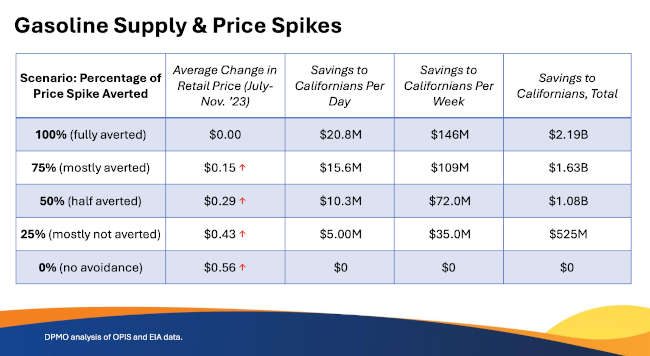
If this proposal had been in effect last year, the Governor’s Office said Californians could have saved hundreds of millions — if not billions — of dollars at the pump as evidenced by a Division of Petroleum Market Oversight, or DPMO, analysis, shown in the chart below.


“It should be common sense for gas refineries to plan ahead and backfill supplies when they go down for maintenance to avoid price spikes,” Newsom said. “But these price spikes are actually profit spikes for Big Oil, and they’re using the same old scare tactics to maintain the status quo. We look forward to working with our Legislative partners during the special session to act on this urgently needed legislation. Calling the session now allows the Legislature to begin that work immediately so that the state can resolve this important matter to establish the necessary rules to prevent price spikes next year and beyond.”

Senate President pro Tempore Mike McGuire (D-North Coast) said the Legislature has been working on this California Made and Clean Energy Package for months, and some of these proposals have been in discussions for the better part of a year.

“The Senate always had the votes and was ready to get these important measures across the finish line this legislative year and deliver the relief Californians need at the pump and on their electricity bills. We won’t be convening a special session this fall, but we look forward to continuing conversations with the governor and speaker about this critical issue in the days and weeks to come,” McGuire said.

Preventing gas price spikes

The governor’s special session is set to focus on passing his plan to save Californians money at the pump.

It would authorize the California Energy Commission, or CEC, to require petroleum refiners to maintain a minimum inventory of refined fuel throughout the distribution chain to avoid supply shortages that create higher prices at the pump for consumers.

It would also authorize the CEC to require refiners to plan for resupply during scheduled refiner maintenance. Text of the proclamation calling for a special session is available here.

Following gasoline price spikes in 2022, Governor Newsom called for a special session and worked in partnership with the Legislature to sign into law a package of reforms holding Big Oil accountable. California’s new watchdog found that higher gasoline prices were caused by a suspicious market transaction, refinery maintenance without properly preparing for it, and more.

In January of this year, the watchdog sent Gov. Newsom and the legislature a letter outlining specific proposals to reform California’s gasoline spot market, which included a minimum inventory requirement to prevent price spikes due to lack of stable supply.

The state’s gasoline price watchdog also found that, in 2023, gasoline prices spiked largely due to refineries going offline without adequately planning to backfill supplies, which caused refining margins to spike as spot and retail prices jumped — indicating that refinery margins made up the largest proportion of the price spikes between July and September 2023.
  1. Americans love nature but don’t feel empowered to protect it, new research shows
  2. EcoArts Sculpture Walk returns to Middletown’s Trailside Park
  3. Firefighters contain Hill fire in Lakeport
  • 560
  • 561
  • 562
  • 563
  • 564
  • 565
  • 566
  • 567
  • 568
  • 569
How to resolve AdBlock issue?
Refresh this page