How to resolve AdBlock issue?
Refresh this page
How to resolve AdBlock issue?
Refresh this page
Lake County News,California
  • Home
    • Registration Form
  • News
    • Education
    • Veterans
    • Community
      • Obituaries
      • Letters
      • Commentary
    • Police Logs
    • Business
    • Recreation
    • Health
    • Religion
    • Legals
    • Arts & Life
    • Regional
  • Calendar
  • Contact us
    • FAQs
    • Phones, E-Mail
    • Subscribe
  • Advertise Here
  • Login
How to resolve AdBlock issue?
Refresh this page

News

Medieval peasants probably enjoyed their holiday festivities more than you do

Details
Written by: Bobbi Sutherland, University of Dayton
Published: 27 December 2025

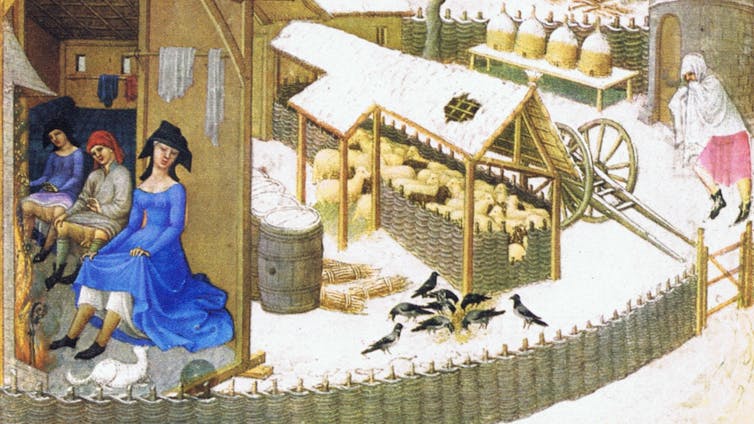
Winter in a peasant village, painted by the Limbourg brothers and published in the medieval illuminated manuscript ‘Très Riches Heures du Duc de Berry.’ Pierce Archive LLC/Buyenlarge via Getty Images

When people think of the European Middle Ages, it often brings to mind grinding poverty, superstition and darkness. But the reality of the 1,000-year period from 500 to 1500 was much more complex. This is especially true when considering the peasants, who made up about 90% of the population.

For all their hard work, peasants had a fair amount of downtime. Add up Sundays and the many holidays, and about one-third of the year was free of intensive work. Celebrations were frequent and centered around religious holidays like Easter, Pentecost and saints’ days.

But the longest and most festive of these holidays was Christmas.

As a professor of medieval history, I can assure you the popular belief that the lives of peasants were little more than misery is a misconception. They enjoyed rich social lives – maybe richer than ours – ate well, celebrated frequently and had families not unlike our own. For them, holiday festivities didn’t begin with Christmas Eve and end with New Year’s.

The party was just getting started.

Daily life in a peasant village

A peasant was not simply a low-class or poor person. Rather, a peasant was a subsistence farmer who owed their lords a portion of the food they grew. They also provided labor, which might include bridge-building or farming the lord’s land.

In return, a lord provided his peasants with protection from bandits or invaders. They also provided justice via a court system and punished people for theft, murder and other crimes. Typically, the lord lived in the village or nearby.

Peasants lived in the countryside, in villages that ranged from a few houses to several hundred. The villages had communal ovens, wells, flour mills, brewers or pubs, and blacksmiths. The houses were clustered in the center of the village along a dirt street and surrounded by farmland.

A photo of a primitive stone house with a thatched roof.
A 14th-century thatched cottage in what is now West Sussex, England. David C. Tomlinson/The Image Bank via Getty Images

By today’s standards, a peasant’s house was small – in England, the average was around 700 square feet (65 square meters). Houses might be made of turf, wood, stone or “waddle-and-daub,” a construction very similar to lathe and plaster, with beamed roofs covered in straw. Houses had front doors, and some had back doors. Windows were covered with shutters and, rarely, glass. Aside from the fireplace, only the Sun, Moon or an oil lamp or candle provided light.

Strange sleep habits and sex without privacy

The day was dictated by seasons and sunlight. Most people rose at dawn or a bit before; men went out to their fields soon after to grow grains like wheat and barley. Women worked in the home and yard, taking care of children, animals and vegetable gardens, along with the spinning, sewing and cooking. Peasants didn’t have clocks, so a recipe might recommend cooking something for the time it took to say the Lord’s Prayer three times.

Around midday, people usually took a break and ate their largest meal – often a soup or stew. The foods they ate could include lamb and beef, along with cheese, cabbage, onions, leeks, turnips and fava beans. Fish, in particular freshwater fish, were also popular. Every meal included bread.

A historical photo shows peasants dancing around a tree.
15th-century peasants in France celebrate May Day. Hulton Archives via Getty Images

Beer and wine were major components of the meal. By our standards, peasants drank a lot, although the alcohol content of the beer and wine was lower than today’s versions. They often napped before returning to work. In the evening, they ate a light meal, perhaps only bread, and socialized for a while.

They went to bed within a few hours of darkness, so how long they slept depended on the season. On average, they slept about eight hours, but not consecutively. They awoke after a “first sleep” and prayed, had sex or chatted with neighbors for somewhere between half an hour and two hours, then returned to sleep for another four hours or so.

Peasants did not have privacy as we think of it; everyone often slept in one big room. Parents made love with one another as their children slept nearby. Married couples shared a bed, and one of their younger children might sleep with them, though infants had cradles. Older children likely slept two to a bed.

A colorful illustration of a musician playing an instrument before a small audience.
A musician entertains a group of peasant farmers. duncan1890/DigitalVision Vectors via Getty Images

Dreaming of a medieval Christmas

Life certainly wasn’t easy. But the stretches of time for rest and leisure were enviable.

Today, many people start thinking about Christmas after Thanksgiving, and any sort of holiday spirit fizzles by early January.

In the Middle Ages, this would have been unheard of.

Advent – the period of anticipation and fasting that precedes Christmas – began with the Feast of St. Martin.

Back then, it took place 40 days before Christmas; today, it’s the fourth Sunday before it. During this period, Western Christians observed a fast; while less strict than the one for Lent, it restricted meat and dairy products to certain days of the week. These protocols not only symbolized absence and longing, but they also helped stretch out the food supply after the end of the harvest and before meats were fully cured.

Christmas itself was known for feasting and drunkenness – and it lasted nearly six weeks.

Dec. 25 was followed by the 12 Days of Christmas, ending with the Epiphany on Jan. 6, which commemorates the visit of the Magi to Jesus, Mary and Joseph. Gifts, often in the form of food or money, were exchanged, though this was more commonly done on New Year’s Day. Game birds, ham, mince pies and spiced wines were popular fare, with spices thought to help warm the body.

Though Christmas officially celebrates the birth of Jesus, it was clearly associated with pre-Christian celebrations that emphasized the winter solstice and the return of light and life. This meant that bonfires, yule logs and evergreen decorations were part of the festivities. According to tradition, St. Francis of Assisi created the first nativity scene in 1223.

Christmas ended slowly, with the first Monday after Epiphany being called “Plough Monday” because it marked the return to agricultural work. The full end of the season came on Feb. 2 – called Candlemas – which coincides with the older pagan holiday of Imbolc. On this day, candles were blessed for use in the coming year, and any decorations left up were thought to be at risk of becoming infested with goblins.

Many people today gripe about the stresses of the holidays: buying presents, traveling, cooking, cleaning and bouncing from one obligation to the next. There’s a short window to get it all done: Christmas Day is the only day many workplaces are required to give off.

Meanwhile, I’ll be dreaming of a medieval Christmas.The Conversation

Bobbi Sutherland, Associate Professor, Department of HIstory, University of Dayton

This article is republished from The Conversation under a Creative Commons license. Read the original article.
Estate Planning: The return of Medi-Cal gifting provisions

Details
Written by: DENNIS FORDHAM
Published: 27 December 2025
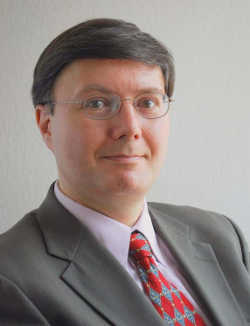
Dennis Fordham. Courtesy photo.
With the restoration of the Medi-Cal eligibility asset test on Jan. 1, 2026 (back to where it existed in July 2022), some people may want to consider whether to include specific gifting provisions in their power of attorney and in their living trust for Medi-Cal eligibility purposes.

Such provisions authorize the person’s trustee or agent under the power of attorney to gift assets subject to their control in order to allow the person’s remaining assets to be within the asset limits for Medi-Cal eligibility, as relevant to either the community based or the long term care Medi-Cal programs (excluding Medi-Cal under the Affordable Care Act).

On Jan. 1, 2026, a single person can have up to $130,000 in available, countable non exempt assets. This threshold does not include exempt assets, such as, the home, the car, the retirement account. A married couple can have an additional $65,000 in non exempt assets and be eligible for Community Based Medi-Cal. With long term care Medi-Cal, the stay at home spouse can have almost $160,000 in his or her own countable assets in addition to the institutionalized spouse’s $130,000.

Achieving the foregoing results often requires gifting by the Medi-Cal applicant to his or her spouse or children. Such gifting may not be possible if the applicant does not have capacity to make gifts due, such as to dementia. People, therefore, may want to include gifting provisions inside of their estate planning documents (trust and power of attorney) so that such gifts can be made on their behalf when the time comes.

Gifting is more complicated when the person is seeking eligibility for long term Medi-Cal for residential care at a skilled nursing home. California still has a thirty (30) month look back period prior to applying for Medi-Cal.

Any gifts of non-exempt assets in such a look back period carry a Medi-Cal ineligibility transfer penalty that is computed based on the size of the gift. Such ineligibility period commences as of the transfer date and may cause the applicant to not be eligible for long term care Medi-Cal.

Fortunately, such ineligibility transfer penalties can often be avoided with appropriate gifting techniques. Again, if the applicant does not have the capacity to make gifts then it is very important that the applicant’s estate planning include such gifting authorization.

Typically, the gifting is to the applicant’s spouse or else to their children. Also, the person with the authorization is typically also a beneficiary of such gifting. For such gifting to be valid it is important that the authorization waives the legal conflict of interest created by a person with representative authority making a gift of assets to themselves. Otherwise, such gifting could be determined to be criminally abusive as it violates the duty of self dealing that prohibits an agent or a trustee from gifting the person’s assets to themselves, at least during the person’s lifetime.

Otherwise, the person’s family may have to petition the court for a gift of assets to the well spouse. Gifting to children, without such legal authority, is more complicated as it involves a conservatorship and a substituted judgment petition to authorize the gift.

The foregoing is not legal advice. Anyone confronting the Medi-Cal issues discussed above should consult an attorney for guidance.

Dennis A. Fordham, attorney, is a State Bar-Certified Specialist in estate planning, probate and trust law. His office is at 870 S. Main St., Lakeport, Calif. He can be reached at This email address is being protected from spambots. You need JavaScript enabled to view it. and 707-263-3235.

Space News: How are dark matter and antimatter different?

Details
Written by: Dipangkar Dutta, Mississippi State University
Published: 27 December 2025

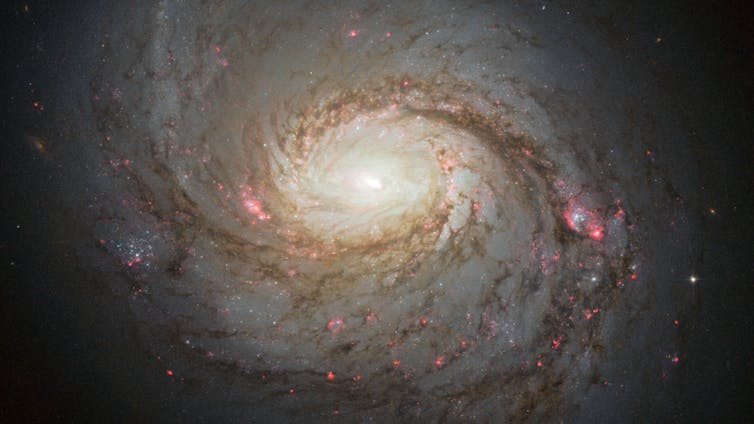
Spiral galaxies, like Messier 77 shown here, helped astronomers learn about the existence of dark matter. NASA, ESA & A. van der Hoeven, CC BY

Curious Kids is a series for children of all ages. If you have a question you’d like an expert to answer, send it to This email address is being protected from spambots. You need JavaScript enabled to view it..


What is dark matter and what is antimatter? Are they the same or different? – Namrata, age 13, Ghaziabad, India


Imagine an epic video game with your favorite hero as a character. Another character is a mirror-image twin who shows up occasionally, exploding everything they touch. And, to add an extra level of difficulty, the game includes a mysterious hive of minions hiding at every corner, changing the rules of the game, but never showing themselves.

If you think of these characters as types of matter, this video game is basically how our universe works.

The hero is regular matter, which is everything we can see around us. Antimatter is the mirror-image explosive twin that scientists understand well but can barely find. And dark matter is the invisible minions. It is everywhere, but we cannot see it, and scientists have no idea what it is.

Despite having similar-sounding names, dark matter and antimatter aare completely different. Interestingly, physicists like me know exactly what antimatter is, but there is almost none of it around. On the other hand, we have no idea what dark matter is, but there is a lot of it everywhere.

Antimatter: The mirror-image twin

All the regular matter around you is made of basic building blocks called atoms. Atoms have positively charged particles called protons surrounded by tiny negatively charged electrons.

Think of antimatter as regular matter’s oppositely charged twin.

All particles, like protons and the electrons, have antimatter siblings. Electrons have positrons, which are anti-electrons, while protons have antiprotons. Antiprotons and positrons make up antimatter atoms, or anti-atoms. They’re like mirror images, but with their electric charges flipped. When matter and antimatter meet, they destroy each other in a flash of light and energy and vanish.

Luckily, antimatter is very rare in our universe. But some special regular matter atoms, such as potassium, can decay to produce antimatter. For example, when you eat a banana, or any food rich in potassium, you are eating tiny amounts of these antimatter-producing atoms. The amount is too small to affect your health.

Antimatter was discovered almost 100 years ago. Today, scientists can create, store and study antimatter in the laboratory. They understand its properties very well. Doctors even use it for PET scans. They inject tiny amounts of antimatter-producing atoms into your body, and as these atoms travel through your body, the scan takes pictures of the flashes of light from the annihilation of the antimatter and regular matter in your body. This process lets doctors see what is happening inside your body.

Scientists have also figured out that when the universe was born, there were almost equal amounts of matter and antimatter. They met and annihilated each other. Fortunately, just a tiny bit more regular matter survived to make stars, planets and all of us.

If matter and antimatter annihilate each other when they touch, and there were once equal amounts of each, how is it possible that there is now so much more matter than antimatter in the universe?

Dark matter: The invisible minions

Dark matter is far more mysterious. Have you ever spun very fast on a merry-go-round? If so, you know how hard it is to stay on it without getting thrown off, especially if you’re the only one on the merry-go-round.

Now imagine there are a bunch of invisible minions on that merry-go-round with you. You can’t see them and you can’t touch them, but they hold you and keep you from flying off as it spins super-fast. You know they’re there because the merry-go-round is heavier than it looks, and it is harder to push and get it spinning. The invisible minions don’t play or talk to anybody; they just hang around, adding their weight to everything.

About 50 years ago, astronomer Vera Rubin discovered a similar mystery in spiral galaxies. She looked at spinning galaxies, which are like cosmic merry-go-rounds, and noticed something strange: The outer stars in these galaxies were spinning much faster than they should. They should have gone flying off into space like sparks from a firework display. But they did not.

It was like watching kids on a merry-go-round move at incredible speed but somehow stay perfectly in place.

A woman adjusting a large piece of equipment.
The astronomer Vera Rubin discovered a strong mismatch in spiral galaxies that scientists now understand as dark matter. Carnegie Institution for Science, CC BY

The only explanation? There must be a sea of invisible “stuff” holding everything together with their extra gravity. Scientists called this mystery material “dark matter.”

Since then, astronomers have observed similar strange behavior happening throughout the universe. Galaxies within large clusters move in unexpected ways. Light gets bent around galaxies more than it should be. Galaxies stick together far more than the visible matter alone can explain.

It is as if our cosmic playground has swings moving by themselves, and seesaws tipping with nobody visible sitting on them.

Dark matter is just a placeholder name until scientists figure out what it is. For the past 50 years, many scientists have been running experiments that are trying to detect dark matter or produce it in the lab. But so far, they have come up empty-handed.

We don’t know what dark matter is, but it’s everywhere. It could be unusual particles scientists have not discovered yet. It could be something completely unexpected. But astronomers can tell by observing how fast galaxies rotate that there is about five times more dark matter than all the regular matter in the entire universe.


Hello, curious kids! Do you have a question you’d like an expert to answer? Ask an adult to send your question to This email address is being protected from spambots. You need JavaScript enabled to view it.. Please tell us your name, age and the city where you live.

And since curiosity has no age limit – adults, let us know what you’re wondering, too. We won’t be able to answer every question, but we will do our best.The Conversation

Dipangkar Dutta, Professor of Nuclear Physics, Mississippi State University

This article is republished from The Conversation under a Creative Commons license. Read the original article.

Rain gives boost to lake level; conditions set to clear into next week

Details
Written by: Elizabeth Larson
Published: 26 December 2025

LAKE COUNTY, Calif. — After the first week of winter saw a steady amount of rainfall in Lake County, the forecast for the last days of 2025 calls for clearer conditions.

On Friday, the National Weather Service’s flood watch and wind advisory for Lake County will end.

After several days and more than half a dozen inches of rain, Clear Lake’s level has risen by about 1 foot Rumsey, the special measure for the lake, according to the United States Geological Survey.

The lake’s early Friday level, at just under 4 feet Rumsey, puts Clear Lake’s depth at well above the historical average, according to Lake County Water Resources data.

While concerns about further flooding appear to be reduced for now, the potential for showers will continue through Saturday, at which point sunny and clear conditions are expected to return.

Chances for showers are again forecast on New Year’s Eve and New Year’s Day.

Temperatures are expected to be in the high 40s during the day and high 30s at night through the weekend, rising to daytime temperatures into the low 50s and low 40s at night into the middle of next week.

Email Elizabeth Larson at This email address is being protected from spambots. You need JavaScript enabled to view it.. Follow her on Twitter, @ERLarson, and on Bluesky, @erlarson.bsky.social. Find Lake County News on the following platforms: Facebook, @LakeCoNews; X, @LakeCoNews; Threads, @lakeconews, and on Bluesky, @lakeconews.bsky.social. 

  1. Clearlake Police seek missing man
  2. Clearlake Animal Control: ‘Banjo’ and the dogs
  3. America’s teachers are being priced out of their communities − these cities are building subsidized housing to lure them back
  • 52
  • 53
  • 54
  • 55
  • 56
  • 57
  • 58
  • 59
  • 60
  • 61
How to resolve AdBlock issue?
Refresh this page