How to resolve AdBlock issue?
Refresh this page
How to resolve AdBlock issue?
Refresh this page
Lake County News,California
  • Home
    • Registration Form
  • News
    • Education
    • Veterans
    • Community
      • Obituaries
      • Letters
      • Commentary
    • Police Logs
    • Business
    • Recreation
    • Health
    • Religion
    • Legals
    • Arts & Life
    • Regional
  • Calendar
  • Contact us
    • FAQs
    • Phones, E-Mail
    • Subscribe
  • Advertise Here
  • Login
How to resolve AdBlock issue?
Refresh this page

News

New in 2026: California laws taking effect in the new year

Details
Written by: Lake County News reports
Published: 31 December 2025

Several key laws will take effect in 2026 that officials said reflect California’s continued focus on public safety, affordability, transparency and accountability.

The Governor’s Office said the new laws lower prescription drug costs, increase oversight of large corporations, strengthen consumer and worker protections, and protect California’s diverse communities. 

“California is proving once again that progress isn’t something we talk about, it’s something we build. While some in Washington remain stuck debating yesterday’s problems, we’re focused on delivering real solutions for today’s families. These new laws reflect who we are: a state that protects workers, respects students, puts people before politics, and isn’t afraid to hold powerful interests accountable,” said Gov. Gavin Newsom.

EDUCATION

Expanding mental health resources for LGBTQ youth
AB 727 (Gonzalez): Requires that student ID cards issued by public middle and high schools, and public colleges/universities include a 24/7 hotline for the Trevor Project. The hotline provides crisis and suicide prevention support to LGBTQ youth. It ensures state education agencies publish and maintain resources for students who face discrimination or harassment based on sexual orientation, gender identity, or expression.

Ban on ultra-processed foods in schools
AB 1264 (Gabriel): California’s first-in-the-nation law will remove the most concerning ultra-processed foods from being served at public schools, giving students healthier, real-food meals to improve nutrition and overall health.

Supporting student literacy
AB 1454 (Rivas): Provides educators and school leaders greater access to the tools, training, and resources needed to help students become better readers.

Streamlining college admissions
SB 640 (Cabaldon): Establishes a California State University (CSU) direct admissions process by notifying eligible high school students of automatic admission to participating CSU campuses. It also requires California Community Colleges to create programs that will support a smoother transfer for community college students to a four-year university.

HEALTH

Alternative birth centers: licensing and Medi-Cal reimbursement
AB 55 (Bonta): Ensures that licensure of alternative birth centers is more accessible to midwives in California by amending or deleting onerous and unnecessary requirements.

State emergency food ban reserve program
AB 798 (Calderon): Expands the state emergency food bank program to include diapers and wipes for families with young children.

Midwifery Workforce Training Act
AB 836 (Stefani): Requires the Department of Health Care Access and Information to administer funding for a statewide midwifery education. 

Capping insulin costs
SB 40 (Wahab and Wiener): Beginning Jan. 1, 2026, large state-related health insurers must cap insulin copays at $35 for a 20-day supply, improving affordability for Californians who rely on insulin.

Access to prenatal multivitamins
SB 646 (Weber-Pierson): Expands access to prenatal multivitamins to support healthy pregnancies and infant development.

Perinatal services in rural hospitals
SB 669 (McGuire): Requires, by July 1, 2026, the establishment of a 10-year pilot project within up to 5 critical access hospitals on an application basis to establish standby perinatal services.

IMMIGRATION

Students – know your rights
AB 419 (Connolly): Requires schools to post information about students’ rights regarding immigration enforcement in administrative offices and on school websites, helping families understand that all children have the right to a free public education.

Family Preparedness Act
AB 495 (Rodriguez): Strengthens protections for parents and children by helping families in emergencies, protecting family privacy, and preventing child facilities from collecting immigration-related information, especially if a parent is detained or separated.

HOUSING

Protecting renters
AB 628 (McKinnor): Requires landlords to provide working refrigerators in rental units beginning Jan. 1, ensuring tenants have access to essential appliances.

Transit-oriented housing development
SB 79 (Wiener): Requires each county and city to adopt a comprehensive, long-term general plan for the development of the county or city, and specified land outside its boundaries, that contains certain mandatory elements, including a housing element.

ANIMAL WELFARE

Statewide ban on cat declawing
AB 867 (Lee): Bans non-therapeutic cat declawing statewide. Only medically necessary procedures performed by a licensed veterinarian remain allowed.

Addressing the puppy mill pipeline
AB 506 (Bennett): Holds pet sellers accountable, requiring them to disclose the pet’s origin and health information.
AB 519 (Berman): Prohibits third-party pet brokers, particularly online pet brokers, from selling cats, puppies, and rabbits bred by others for profit in California.
SB 312 (Umberg): requires dog importers to submit health certificates electronically to the California Department of Food & Agriculture (CDFA) within 10 days of shipment, and requires CDFA to provide those certificates upon request.

WORKPLACE RIGHTS AND PROTECTIONS

Supporting survivors of workplace sexual assault cover-ups
AB 250 (Aguiar-Curry)- Temporarily lifts the statute of limitations for adult survivors of workplace-related sexual assault cover-ups. From Jan. 1, 2026 through Dec. 21, 2027, survivors may file civil claims regardless of when the incident occurred.

Strengthening equal pay enforcement
SB 642 (Limón): Expands California's equal pay laws by broadening key definitions, extending the statute of limitations to three years (with recovery for up to six years), and clarifying categories of unlawful pay practices.

TECHNOLOGY, AI SAFETY AND DIGITAL RIGHTS

Preventing AI from posing as licensed professionals
AB 489 (Bonta): Prohibits AI chatbots from presenting themselves as doctors, nurses, or other licensed professionals to increase transparency and prevent misrepresentation by AI chatbots.

Addressing artificially generated pornography
AB 621 (Bauer-Kahan and Berman): Strengthens protections against digital sexual exploitation by targeting the creation and distribution of AI-generated sexual content.

Risk-mitigation requirements for large AI companies
SB 53 (Wiener): Requires large AI developers to maintain documented risk-mitigation strategies to improve safety and transparency in the deployment of emerging technologies.

Safeguards for minors using AI chatbots
SB 243 (Padilla): Requires AI companies to include disclaimers that chatbots are not real people when used by minors and mandates safety protocols to prevent chatbots from encouraging self-harm.

Transparency in police reports drafted with AI 
SB 524 (Arreguin): Requires law enforcement agencies to disclose when AI tools are used to draft official police reports. 

Food delivery platforms: customer service
AB 578 (Bauer-Kahan): Strengthens consumer and worker protection on food platforms by prohibiting companies from using tips to offset base pay, requiring clear and itemized pay breakdowns for delivery workers, mandating access to a real customer-service representative when automated systems cannot resolve an issue, and guaranteeing refunds when orders are undelivered, incorrectly or only partially fulfilled.

CLIMATE AND ENVIRONMENT

Updated plastic bag regulations
SB 1053 (Allen and Blakespear): Strengthens California’s plastic bag ban by closing loopholes that allowed thicker plastic film bags to be distributed as “reusable” bags. The law eliminates plastic film checkout bags altogether and requires retailers to transition to truly reusable bags that meet higher durability standards or to paper bags with recycled-content requirements, reducing plastic waste and improving statewide recycling efforts.

2025 AgVenture class wraps for the year 

Details
Written by: Lake County News reports
Published: 31 December 2025

LAKE COUNTY, Calif. — Lake County’s chapter of California Women for Agriculture, or CWA, wrapped another successful AgVenture class series with a morning visit to Chacewater Winery and Olive Mill to learn about olive growing from pruning to harvest. 

Proprietor Paul Manuel greeted the participants and led them through the groves explaining the cultivation of the different varieties followed by Emilio de la Cruz, mill master, giving an in-depth tour of the milling process. The visit finished with an olive oil tasting. 
 
After transferring to the Finley Grange Hall, Lake County Agricultural Commissioner Katherine Vanderwall opened the rest of the program, explaining the importance of agriculture in Lake County’s economy. 

Kaela Cooper, from Trans Ova Genetics, followed, captivating all with how modern biotechnology is improving genetics in beef and dairy cows, thus increasing food production.  

An immigration and ag labor panel comprised of Bryan Little, chief operating officer of Farm Employers Labor Service; David Weiss, farm labor contractor and owner/operator of Bella Vista Farming Co.; Bonnie Sears, office manager at Beckstoffer Vineyards Red Hills; and Robert Irwin, owner/operator of Kaos Sheep Outfit gave an overview of seasonal guest worker programs and regulatory challenges, and the ongoing need for skilled agricultural workers in California.  

Farm labor panel members Octavio Jimenez, a foreman at Scully Packing Co.; Juan Cardenas, a supervisor at Beckstoffer Vineyards Red Hills; and Enrique Arroyo, a supervisor at Scully Packing Co., shared their journeys to the US and their road to legality as well as how they each worked their way up in their companies to positions of leadership and great responsibility.  

Recurring themes throughout the day were the increasingly restrictive regulatory environment and the misconception that farm work is not skilled labor, when in fact farms and ranches rely on able, experienced help to produce food for the state and nation.  
  
CWA said feedback from this year’s participants for the entire program was universal: all gained a broader perspective of the scope of Lake County’s agriculture industry and of its economic importance. Many will be applying their new knowledge in their own departments or spheres of influence and to interact with farmers and ranchers more effectively. 

“The AgVenture Program helped me understand the challenges in agriculture; I didn’t know what I didn’t know,” said Becky Salato, superintendent of the Konocti Unified School District.

Participation in AgVenture is by application and invitation. Please email This email address is being protected from spambots. You need JavaScript enabled to view it. to be put on a waitlist if you are interested in receiving an application and being considered. 

The planning process will begin in March of 2026.

West Coast levee failures show growing risks from America’s aging flood defenses

Details
Written by: Farshid Vahedifard, Tufts University
Published: 31 December 2025
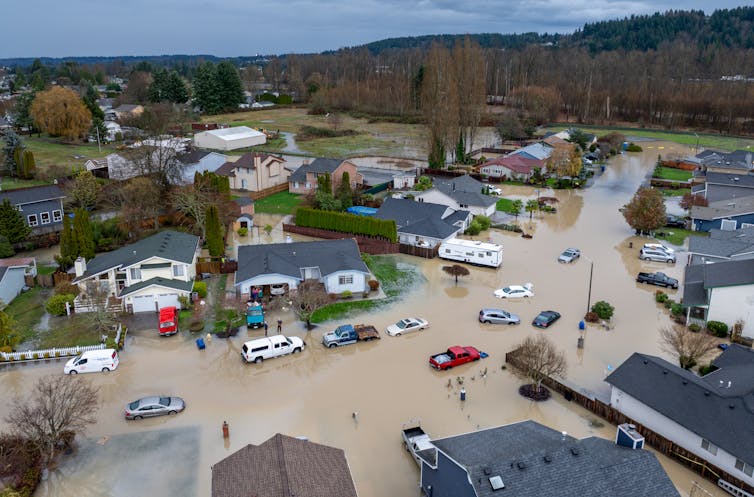
Days of heavy rain caused a levee on the White River to breach, sending water into Pacific, Wash., on Dec. 16, 2025. Brandon Bell/Getty Images

In recent weeks, powerful atmospheric river storms have swept across Washington, Oregon and California, unloading enormous amounts of rain. As rivers surged, they overtopped or breached multiple levees – those long, often unnoticed barriers holding floodwaters back from homes and towns.

Most of the time, levees don’t demand attention. They quietly do their job, year after year. But when storms intensify, levees suddenly matter in a very personal way. They can determine whether a neighborhood stays dry or ends up underwater.

The damage in the West reflects a nationwide problem that has been building for decades. Across the U.S., levees are getting older while weather is getting more extreme. Many of these structures were never designed for the enormous responsibility they now carry.

A paved bicycling path atop a levee is broken and slabs of asphalt pavement are tilted into a breach where water poured through.
Crews inspect damage to a Green River levee in the Seattle suburbs on Dec. 15, 2025. Thousands of people were urged to evacuate during a series of atmospheric river storms, and the National Guard was sent to monitor and reinforce several levees considered at risk. AP Photo/Manuel Valdes

As a civil engineer at Tufts University, I study water infrastructure, including the vulnerability of levees and strategies for making them more resilient. My research also shows that when levees fail, the consequences don’t fall evenly on the population.

Levees became critical infrastructure almost by accident

Many people assume levees were built as part of modern, carefully engineered flood-control systems. In reality, many of the levees still in use today began much more humbly.

Decades ago, farmers built simple earthen embankments to protect their fields and livestock from seasonal flooding. These early levees were practical solutions, shaped by experience rather than formal engineering. They were not constructed using rigorous design standards, and they did not follow consistent construction or maintenance guidelines.

Over time, the landscape around these levees changed. Farmland gave way to neighborhoods. Roads, railways, factories and ports expanded into floodplains. Populations grew. What were once modest, local structures protecting farms gradually became the first line of defense for millions of people in homes and workplaces.

During the Great Mississippi Flood of 1927, the river poured over and broke through levees, flooding thousands of square miles of land. Both overtopping and a breach are visible in this photo. National Weather Service Archival Photography by Steve Nicklas, NOS, NGS

Without much public debate or planning, these semi-engineered levees took on a critical and unintended role. The question that still lingers is whether they were ever prepared for it.

Vast, aging levee system now protecting millions

Today, the National Levee Database counts more than 24,000 miles (38,600 kilometers) of levees in the U.S., with an average age of about 61 years and many of them much older. Together, they protect over 23 million people, around 7 million buildings and nearly US$2 trillion in property value.

That’s an extraordinary level of responsibility for a system that is unevenly maintained with varying oversight. Some levees are inspected regularly. Others are owned by small local agencies or private entities with limited funding. In some cases, responsibility is unclear or fragmented.

One levee that was breached along the Green River in Washington state during storms in mid-December 2025 had been due for repairs for several years, but disagreements among governments had recently held up needed work, The Seattle Times reported. The breach forced thousands of people to evacuate

A map shows many breaches in the Midwest, as well as in Washington state and the Northeast.
Many states have at-risk levees. The map shows all levees in the U.S. National Levee Database (in red) and 478 levee segments where overtopping is known to have occurred in the previous 15 years (in blue). S. Flynn, et al., 2025

The American Society of Civil Engineers’ 2025 Report Card for American Infrastructure, which I contributed to, gave the nation’s levees a D-plus grade, citing aging infrastructure, inconsistent monitoring and long-term underinvestment. A new dataset that colleagues and I created of levee damage includes 487 cases where rivers poured over levees, known as overtopping, in the past 15 years. That doesn’t mean levees are failing everywhere; it means that many are operating with little margin for error.

How levees fail

Levee failures are rarely sudden collapses. More often, they start quietly.

The most common reason levees fail is overtopping, when water from a river, stream or lake behind the levee flows over the top. Once that happens, erosion can begin on the landward side, weakening the structure from behind. What starts as a slow trickle can quickly grow into a breach, creating a large gap in the levee where water can pour in.

Two illustrations. One of overtopping points out that age, height and the materials used can weaken the levee, leading to a breach, which cuts into the levee allowing a faster, deeper steam of water to pour through.
An illustration shows the difference between overtopping and a breach, and some of the reasons a levee can fail. S. Flynn et al., 2025

Atmospheric river storms make the risk of overtopping and breaches much higher. These storms deliver enormous amounts of rainfall across wide areas in a matter of hours, often combined with snowmelt. Rivers rise faster and stay high longer. Many levees were never designed for that kind of sustained pressure.

When a levee breaches, flooding can be rapid and deep, leaving little time for evacuation and causing damage that spreads far beyond the floodplain.

Who relies on levees today?

Millions of Americans live and work in area protected by levees, often without realizing it. Homes, schools, highways, rail corridors, ports and power facilities depend on the integrity of these structures.

A recent national study found that across the contiguous U.S., urban expansion into floodplains occurred more than twice as fast after levee construction as it did in surrounding counties, highlighting how levees can affect communities’ perception of danger.

In fact, when levees fail, flooding can be worse than in areas without levees, because water rushes in quickly and drains slowly.

The risks are also uneven, shaped by history, economics and policy decisions.

That reality became painfully clear during an atmospheric river storm in March 2023 when a levee along California’s Pajaro River failed, flooding the town of Pajaro. Pajaro is home to many low-income farmworkers. Floodwaters forced hundreds of residents to evacuate, and some people were trapped as water levels rose.

How the Pajaro Valley flooded after intense rainfall from an atmospheric river in March 2023, breaching a levee protecting a small California town.

What made the disaster especially troubling was what emerged afterward. Officials and engineers had known for decades that the Pajaro River levee was vulnerable. Reports documented its weaknesses, but repairs were repeatedly delayed.

Interviews by The Los Angeles Times and public records showed that part of the reason was financial. Decision-makers did not prioritize investing in a levee system protecting the low-income community. The risk was known, but the protection was deferred.

Pajaro is not an isolated case. Across the country, disadvantaged communities and communities of color are more likely to rely on older levees or levees that are not part of major federal programs. Rural towns often depend on agricultural levees. Urban neighborhoods may rely on structures built for a much smaller population.

When levees fail, the impacts cascade, closing roads, knocking out power, contaminating water supplies and disrupting lives for years.

A map shows highest disparities in Idaho, Utah, Colorado, Iowa, Ohio, Tennessee, Georgia, North Carolina, Virginia, Maine, Massachusetts and Vermont.
Disparity refers to the percentage of each state’s residents protected by levees who are considered disadvantaged, based on the U.S. Council on Environmental Quality’s Climate and Economic Justice Screening Tool. All levees in the National Levee Database are counted. F. Vahedifard et al., 2023

Why this moment matters

Advances in engineering, monitoring and risk assessment have improved how levees are evaluated and designed.

Hurricane Katrina marked a turning point in 2005 when its storm surge broke through levees protecting New Orleans. Hundreds of people died in the flooding. The disaster exposed the consequences of neglect and fragmented responsibility for levee upkeep.

At the same time, there has been real progress. Over the past two decades, significant federal investments have strengthened the condition and management of many of the nation’s levees, particularly through the work of federal agencies such as the U.S. Army Corps of Engineers.

Still, the legacy of decisions made decades ago remains, and climate change is raising the risks. Heavier rainfall, fast snowmelt and rising seas are pushing water control systems beyond what many levees were designed to handle. Events once considered rare are becoming more frequent.

As atmospheric rivers test levees in the West and flood risks grow nationwide, the challenge is no longer just technical. It’s about how society values protection, communicates risk and decides whose safety is prioritized.

Levees will continue to play a vital role in protecting communities. Understanding their history, and their limits, is essential as the storms of the future arrive.The Conversation

Farshid Vahedifard, Professor of Civil and Environmental Engineering, Tufts University

This article is republished from The Conversation under a Creative Commons license. Read the original article.

More atmospheric river storms to arrive midweek

Details
Written by: Elizabeth Larson
Published: 30 December 2025

LAKE COUNTY, Calif. — The National Weather Service said a new round of atmospheric river storms will arrive this week, bringing the chances for heavy rain and flooding.

The series of storms, which follows atmospheric rivers that hit last week, is expected to start on Wednesday night and Thursday morning.

The forecast calls for light to moderate rainfall amounts during the first days of the storm series.

By Friday, the forecast anticipates possible heavy rain and road flooding in southern Lake County. The local forecast calls for a potential thunderstorm that day before 1 p.m.

Conditions into next week will be breezy and cold, although slightly warmer than in recent days, according to the forecast. 

The National Weather Service said temperatures at night will be in the low 40s, ranging up into the low 50s during the day into early next week.

Email Elizabeth Larson at This email address is being protected from spambots. You need JavaScript enabled to view it.. Follow her on Twitter, @ERLarson, and on Bluesky, @erlarson.bsky.social. Find Lake County News on the following platforms: Facebook, @LakeCoNews; X, @LakeCoNews; Threads, @lakeconews, and on Bluesky, @lakeconews.bsky.social. 

  1. CHP rings in the New Year with holiday enforcement period
  2. City of Lakeport welcomes applicants for Lakeport FIre District Board of Directors
  3. How your electric bill may be paying for big data centers’ energy use
  • 48
  • 49
  • 50
  • 51
  • 52
  • 53
  • 54
  • 55
  • 56
  • 57
How to resolve AdBlock issue?
Refresh this page