How to resolve AdBlock issue?
Refresh this page
How to resolve AdBlock issue?
Refresh this page
Lake County News,California
  • Home
    • Registration Form
  • News
    • Education
    • Veterans
    • Community
      • Obituaries
      • Letters
      • Commentary
    • Police Logs
    • Business
    • Recreation
    • Health
    • Religion
    • Legals
    • Arts & Life
    • Regional
  • Calendar
  • Contact us
    • FAQs
    • Phones, E-Mail
    • Subscribe
  • Advertise Here
  • Login
How to resolve AdBlock issue?
Refresh this page

News

Supervisors ratify Glenhaven fire emergency declaration

Details
Written by: Elizabeth Larson
Published: 09 October 2024
LAKE COUNTY, Calif. — The Board of Supervisors on Tuesday ratified a local emergency declaration Sheriff Rob Howe issued on Friday in response to the Glenhaven fire.

As of 9 a.m. Tuesday, ahead of the board’s action, the Lake County Sheriff’s Office had lifted the final evacuation warnings for the fire, which has burned a total of 417 acres, and destroyed two homes and damaged another.

Sheriff Howe thanked the board for adding the emergency proclamation to its agenda that morning as an extra item.

During the discussion, it was noted that the sheriff’s office brought Starlink to the scene to help with internet connectivity, which Supervisor Jessica Pyska said was a “gamechanger.”

“That was a critical investment that made a really big difference,” Pyska said.

Howe said the sheriff’s office immediately had help from other agencies in responding to the incident.

Supervisor EJ Crandell said Northshore Fire used a special hose to bring water directly from the lake in fighting the fire. That equipment was funded by the Habematolel Pomo of Upper Lake.

Crandell moved to approve the proclamation, which the supervisors approved unanimously.

The fire was at 70% containment at the time of the board meeting. By nightfall, the fire’s containment was up to 90%.

Email Elizabeth Larson at This email address is being protected from spambots. You need JavaScript enabled to view it.. Follow her on Twitter, @ERLarson, or Lake County News, @LakeCoNews.

Blue Zones Project – Lake County reaches community engagement goal two years ahead of schedule

Details
Written by: LAKE COUNTY NEWS REPORTS
Published: 09 October 2024
LAKE COUNTY, Calif. — Blue Zones Project – Lake County reported that it has successfully reached its community engagement goal two years ahead of schedule, demonstrating the community’s strong commitment to creating a healthier, more vibrant county.

This milestone is the result of widespread participation in a variety of programs designed to inspire lasting change and well-being throughout Lake County.

Since the project’s launch in 2021, with Adventist Health sponsorship, residents have eagerly joined walking moais, cooking demonstrations, and purpose workshops, each of which has helped deepen engagement and foster healthier habits.

Local organizations working toward Blue Zones Project approval have also contributed by hosting events that educate participants on the origins of the Blue Zones and highlight the project’s mission to transform Lake County.

Over 65 local organizations have joined the project in striving to create positive change in the health and well-being of the community. Their collaboration and dedication have been key to the project's success, making a lasting impact on the lives of Lake County residents.

“We’ve listened closely to the needs and aspirations of our community, and their passion for improving well-being has truly driven this success,” said April Strait, engagement lead for Blue Zones Project – Lake County. “Reaching our engagement target two years ahead of schedule shows the power of community involvement and the willingness of Lake County residents to embrace healthier ways of living.”

Executive Director Jamey Gill echoed this sentiment, saying, “Partnering with Adventist Health Clear Lake during our community kickoff gave us a significant early boost, and the ongoing efforts of our schools, businesses, and local organizations have kept the momentum going. Adventist Health Clear Lake is committed to achieving Blue Zones worksite certification by the Fall of 2025, and Konocti Unified School District’s commitment to becoming the first Blue Zones Certified School District in the nation has been especially impactful, providing unique engagement opportunities for employees and setting an example for the community.”

While this milestone marks an important achievement, the work of Blue Zones Project – Lake County is far from complete. The initiative will continue to offer diverse programs and events aimed at helping residents live longer, healthier, and more purposeful lives.

“We may have hit our goal early, but this is just the beginning,’ added Strait. “We’re committed to keeping the momentum going by continuing to bring health and well-being focused engagement opportunities to every corner of Lake County.”

To learn more about how you can get involved, visit the Blue Zones website.

Lake County 2050 seeks community input

Details
Written by: LAKE COUNTY NEWS REPORTS
Published: 09 October 2024
LAKE COUNTY, Calif. — Do you love Lake County? Do you want to make a difference in the future of your community?

The Lake County 2050 Project is working to update general and area plans within the jurisdiction of the county of Lake right now.

Local Area Plan Advisory Committees, or LAPACs, will hold meetings in October and November to hear public input and discuss visions for each community over the next 10 to 20 years.

Two virtual meetings will be held to gather input from each planning area.

Additionally, two in-person meetings will take a county-wide focus. The virtual meeting schedule is listed below.

Microsoft Teams links to the meetings are available at https://LakeCounty2050.org/ and https://www.lakecountyca.gov/AgendaCenter.

Cobb Mountain
Virtual meeting No. 1: Monday, Oct. 21, 11 a.m. to 12:30 p.m.
Virtual meeting No. 2: Wednesday, Oct. 30, 2 to 3:30 p.m.

Kelseyville
Virtual meeting No. 1: Friday, Oct. 25, 2:30 to 4 p.m.
Virtual meeting No. 2: Thursday, Oct. 31, 2 to 3:30 p.m.

Lakeport
Virtual meeting: To be announced.

Lower Lake
Virtual meeting No. 1: Friday, Oct. 11, 10:30 a.m. to noon.
Virtual meeting No. 2: Monday, Oct. 14, 10 to 11:30 a.m.

Middletown
Virtual meeting No. 1: Wednesday, Oct. 9, 3:30 to 5 p.m.
Virtual meeting No. 2: To be announced.

Rivieras
Virtual meeting No. 1: Friday, Oct. 11, 2 to 3:30 p.m.
Virtual meeting No. 2: Friday, Oct. 18, 10 to 11:30 a.m.

Shoreline Communities (Lucerne, Glenhaven, Clearlake Oaks, Double Eagle, Spring Valley, Clearlake outside city limits)
Virtual meeting No. 1: Wednesday, Oct. 9, 1 to 2:30 p.m.
Virtual meeting No. 2: Wednesday, Oct. 16, 10 to 11:30 a.m.

Upper Lake/Nice
Virtual meeting No. 1: Tuesday, Oct. 14, 4 to 5:30 p.m.
Virtual meeting No. 2: Wednesday, Nov. 6, 1 to 2:30 p.m.

The in-person meetings regarding all County of Lake jurisdictions will be held Thursday, Oct. 17, and Monday, Oct. 21, from 5 p.m. to 6:30 p.m., in the Board of Supervisors Chambers, Lake County Courthouse, 255 N. Forbes St., Lakeport.

For more information, please contact the Community Development Department's Planning Division at 707-263-2221.

Why wildfires started by human activities can be more destructive and harder to contain

Details
Written by: Virginia Iglesias, University of Colorado Boulder
Published: 09 October 2024


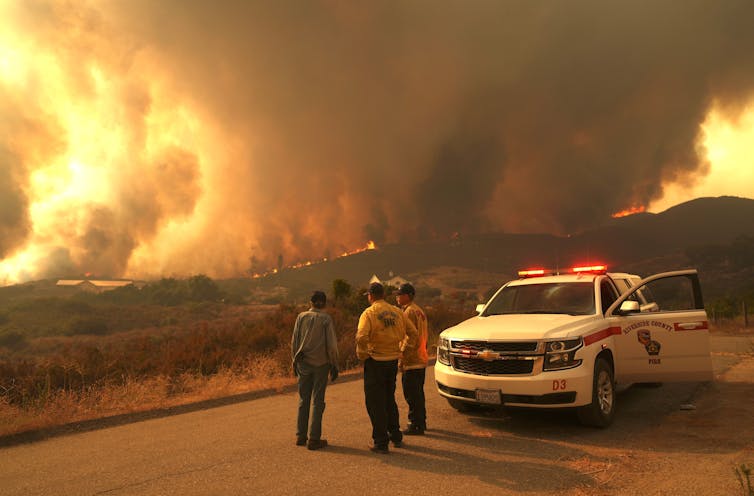
Heavy equipment working near dry brush sparked a destructive wildfire near Riverside, Calif., in September 2024. AP Photo/Eric Thayer

Wildfires are becoming increasingly destructive across the U.S., as the country is seeing in 2024. Firefighters were battling large blazes in several states from California to North Dakota in early October 2024, including fires burning near homes and communities.

Research shows wildfires are up to four times larger and three times more frequent than they were in the 1980s and ‘90s, with some consuming hundreds of thousands of acres in a single blaze.

Lightning strikes are one cause, but the majority of wildfires that threaten communities are sparked by human activities.

Metal from cars or mowers dragging on the ground can spark fires. So can power lines touching trees. Officials confirmed on Oct. 2 that a broken power line started the deadly 2023 Maui fire that destroyed the town of Lahaina, Hawaii. California’s largest fire in 2024 started when a man pushed a burning car into a ravine near Chico. The fire destroyed more than 700 homes and buildings.

Although the number of fires in 2024 has not been unusually high, the acreage burned has far surpassed the 10-year average, displacing thousands of people, destroying homes and straining firefighting resources.

What makes these wildfires so destructive and difficult to contain?

The answer lies in a mix of changing climate, the legacy of past land-management practices, and current human activities that are reshaping fire behavior and increasing the risk they pose.

Fire’s perfect storm

Wildfires rely on three key elements to spread: conducive weather, dry fuel and an ignition source. Each of these factors has undergone pronounced changes in recent decades. While climate change sets the stage for larger and more intense fires, humans are actively fanning the flames.

Climate and weather

Extreme temperatures play a dangerous role in wildfires. Heat dries out vegetation, making it more flammable. Under these conditions, wildfires ignite more easily, spread faster and burn with greater intensity. In the western U.S., aridity attributed to climate change has doubled the amount of forestland that has burned since 1984.

Compounding the problem is the rapid rise in nighttime temperatures, now increasing faster than daytime temperatures. Nights, which used to offer a reprieve with cooler conditions and higher humidity, do so less often, allowing fires to continue raging without pause.
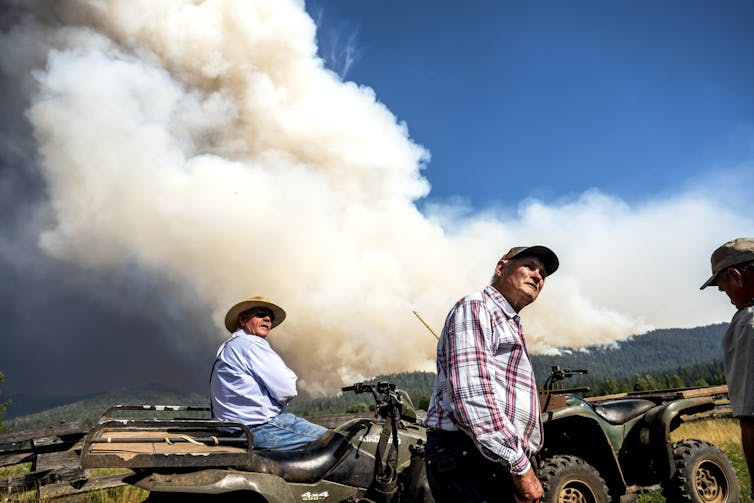
Two older men on ATVs watch the sky as a cloud of smoke rises behind them.
Ranchers watch as firefighting planes battle the Park Fire, which was fueled by extremely hot, dry conditions in Butte County, Calif. AP Photo/Noah Berger

Fuel

Fire is a natural process that has shaped ecosystems for over 420 million years. Indigenous people historically used controlled burns to manage landscapes and reduce fuel buildup. However, a century of fire suppression has allowed vast areas to accumulate dense fuels, priming them for larger and more intense wildfires.

Invasive species, such as certain grasses, have exacerbated the issue by creating continuous fuel beds that accelerate fire spread, often doubling or tripling fire activity.

Additionally, human development in fire-prone regions, especially in the wildland-urban interface, where neighborhoods intermingle with forest and grassland vegetation, has introduced new, highly flammable fuels. Buildings, vehicles and infrastructure often ignite easily and burn hotter and faster than natural vegetation. These changes have significantly altered fuel patterns, creating conditions conducive to more severe and harder-to-control wildfires.

Ignition

Lightning can ignite wildfires, but humans are responsible for an increasing share. From unattended campfires to arson or sparks from power lines, over 84% of the wildfires affecting communities are human-ignited.

Human activities have not only tripled the length of the fire season, but they also have resulted in fires that pose a higher risk to people.
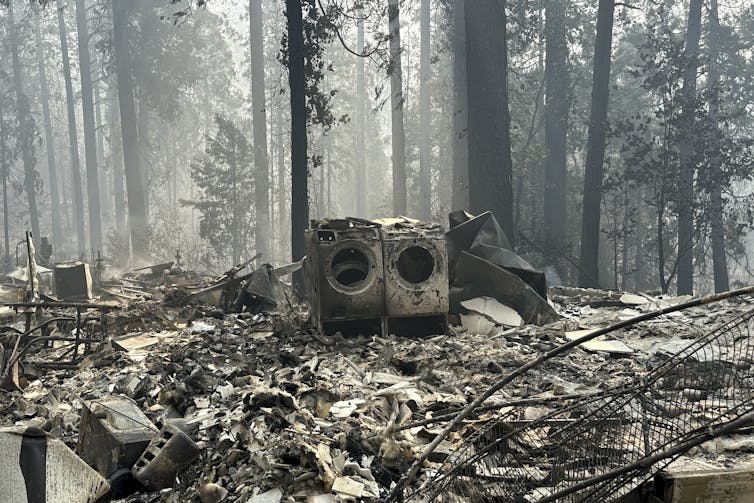
A burned-out washer and dryer are all that remain recognizable in the debris of what was once a home. Burned tree trunks are in the background.
More than 600 homes and buildings burned in the Park Fire, one of California’s largest fires on record. Officials say the fire was started by a man pushing a burning car into a ravine near Chico. AP Photo/Eugene Garcia

Lightning-started fires often coincide with storms that carry rain or higher humidity, which slows fires’ spread. Human-started fires, however, typically ignite under more extreme conditions – hotter temperatures, lower humidity and stronger winds. This leads to greater flame heights, faster spread in the critical early days before crews can respond, and more severe ecosystem effects, such as killing more trees and degrading the soil.

Human-ignited fires often occur in or near populated areas, where flammable structures and vegetation create even more hazardous conditions. As urban development expands into wildlands, the probability of human-started fires and the property potentially exposed to fire increase, creating a feedback loop of escalating wildfire risk.

2024 fire season’s whiplash weather

The record-breaking summer heat in 2024 intensified fire hazards, with vegetation rapidly drying out and leaving landscapes parched in many areas. In addition, a phenomenon known as whiplash weather, marked by unusually wet winters and springs followed by extreme summer heat, has been especially pronounced in Southern California.

A wet spring fostered vegetation growth, which then dried out under scorching summer temperatures, turning into highly combustible fuel. Severe heat waves, along with the associated lack of nighttime cooling, created conditions where fires not only spread faster, but were also more difficult to contain.

This cycle has fueled some of the biggest fires of the 2024 season, several of which were started by humans. Atmospheric instability during some of these fires also led to the formation of pyrocumulonimbus clouds – massive, fire-fueled thunderheads that can generate their own weather, including lightning and tornado-like winds that drive flames even further.

As these factors converge, the potential for increasingly severe wildfires looms ever larger. Severe fires also release large amounts of carbon from trees, vegetation and soils into the atmosphere, increasing greenhouse gas emissions and exacerbating climate change, contributing to more extreme fire seasons.The Conversation

Virginia Iglesias, Interim Earth Lab Director, University of Colorado Boulder

This article is republished from The Conversation under a Creative Commons license. Read the original article.

  1. Clearlake woman ordered to stand trial for shooting death of boyfriend
  2. Middletown Area Town Hall to meet Oct. 10
  3. Oct. 16 public Zoom meeting planned on new Clearlake Oaks park plan
  • 521
  • 522
  • 523
  • 524
  • 525
  • 526
  • 527
  • 528
  • 529
  • 530
How to resolve AdBlock issue?
Refresh this page