How to resolve AdBlock issue?
Refresh this page
How to resolve AdBlock issue?
Refresh this page
Lake County News,California
  • Home
    • Registration Form
  • News
    • Education
    • Veterans
    • Community
      • Obituaries
      • Letters
      • Commentary
    • Police Logs
    • Business
    • Recreation
    • Health
    • Religion
    • Legals
    • Arts & Life
    • Regional
  • Calendar
  • Contact us
    • FAQs
    • Phones, E-Mail
    • Subscribe
  • Advertise Here
  • Login
How to resolve AdBlock issue?
Refresh this page

News

Fast-moving Glenhaven fire leads to evacuation of thousands of Northshore residents; local emergency declared

Details
Written by: Elizabeth Larson
Published: 04 October 2024
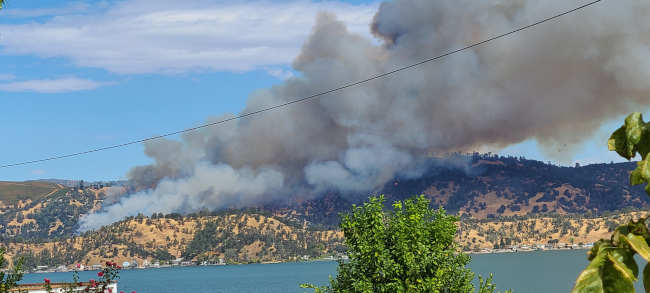
The Glenhaven fire moves along the ridge on Friday, Oct. 4, 2024. Photo by James Rexrode.

GLENHAVEN, Calif. — A fire that began near Glenhaven on Friday morning quickly grew in size and moved toward Clearlake Oaks, leading to the evacuation of thousands of Northshore residents, prompting temporary road closures and resulting in the sheriff’s declaration of a local emergency.

Cal Fire said the Glenhaven fire began at approximately 11:37 a.m. Friday at Hillcrest and Henderson drives.

Shortly before 1 p.m., when the fire was still at an estimated 50 acres, the Lake County Sheriff’s Office began issuing mandatory evacuation orders, one each in Glenhaven and Clearlake Oaks, and also issuing two warnings in the two communities. Another half-dozen evacuation zones were added in Clearlake Oaks by 3 p.m.

The county opened temporary evacuation points at the Lucerne Alpine Senior Center and the former Pearce Field airport in Clearlake. An evacuation shelter was set up at Twin Pine Casino in Middletown.

Meanwhile, observers said the fire appeared to be moving along the ridge line as it moved toward High Valley and Clearlake Oaks.

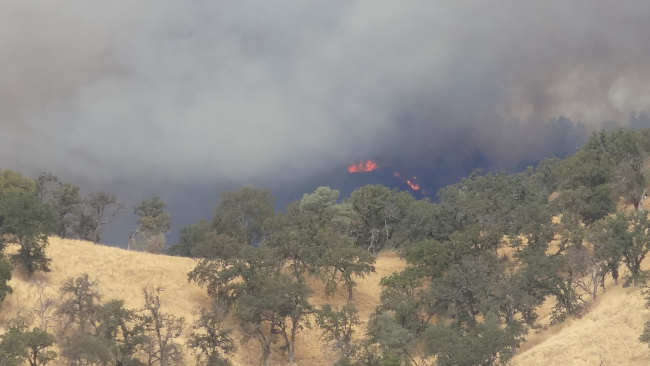
Flames from the Glenhaven fire on Friday, Oct. 4, 2024. Photo by Mark Burkdoll.

Gusty winds on Friday afternoon appeared to be driving the flames, and there were numerous reports of spot fires. Cal Fire noted concern about additional spotting as the westerly winds continued through the day.

The situation led to authorities closing Highway 20 at Clearlake Oaks for several hours. However, by nightfall, the highway had been reopened through the fire area.

Cal Fire assigned a large number of aircraft to work the fire. Additional ground resources also were requested to respond.

By early evening, shortly after 5 p.m., the fire was reported to have burned 300 acres, growing by another 100 acres over the course of another hour.

Just before 7 pm. Friday, the Lake County Office of Emergency Services reported that Sheriff Rob Howe had declared a local emergency in response to the fire. That declaration is expected to be ratified by the Board of Supervisors next week.

As of 8 pm. Friday, the fire remained at 403 acres, with no containment.

Cal Fire reported that two structures had been destroyed, with 2,553 structures threatened and 3,475 people evacuated.

On Friday night, at least one helicopter appeared to be continuing to work on the fire.

By that point, the fire was continuing to put off a large amount of smoke, some of which had crossed over into the Sacramento Valley by evening.

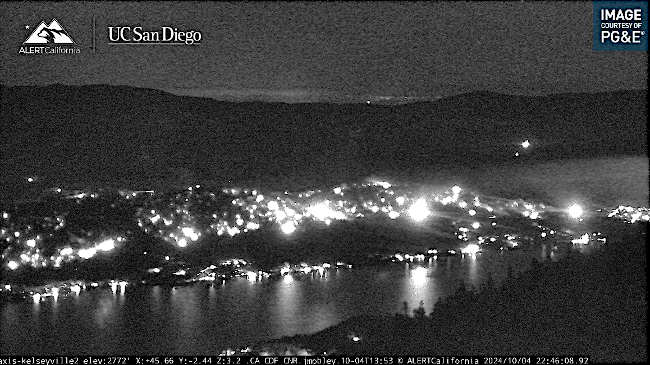
An AlertCalifornia camera showing the Glenhaven fire area at 10:46 p.m. Friday, Oct. 4, 2024.

A lengthy row of flashing red lights revealed fire vehicles lining a road at the top of a hill overlooking Clearlake Oaks, and more units were staged at Lakeview Drive and Highway 20.

Cal Fire said Friday night that the fire’s most active area was near Cerritos Drive. It was continuing to put off spot fires to the north towards High Valley and the east towards Clearlake Oaks.

Cal Fire said air and ground resources are working on picking up the spot fires as well as fortifying control lines mid-slope to keep the fire from backing down towards Highway 20.

A total of 25 engines, four water tenders, five helicopters, five dozers and four hand crews have been assigned to the incident, Cal Fire said.

In a report issued just after 10 p.m., Cal Fire said forward progress on the fire had been stopped as of 9:40 p.m., with containment at 10%.

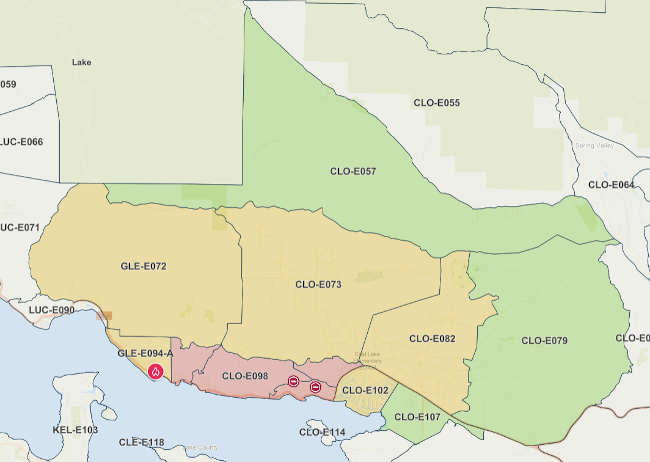
By 11 p.m., four zones remained under mandatory evacuation — one in Glenhaven and three in Clearlake Oaks: Zones GLE-E094-B, CLO-E098, CLO-E099 and CLO-E106. That area is located north of Highway 20, west of High Valley Road, south of Cerritos Road and east of Harvey Boulevard.

Evacuation orders have been lifted for three other zones in Clearlake Oaks and warnings were in effect in three zones in Clearlake Oaks and two in Glenhaven. The zones can be seen in real time here.

Officials have so far said the Glenhaven fire’s cause remains under investigation.

The fire follows by less then a month the Boyles fire in Clearlake, which burned an estimated 35 homes and another 32 outbuildings.

Lingzi Chen contributed to this report.

Email Elizabeth Larson at This email address is being protected from spambots. You need JavaScript enabled to view it.. Follow her on Twitter, @ERLarson, or Lake County News, @LakeCoNews.

Evacuation zones for the Glenhaven fire as of 8:30 p.m. Friday, Oct. 4, 2024. Red denotes mandatory evacuation, yellow is for warning and green is areas where evacuation orders have been lifted. To see the zones in real time visit https://protect.genasys.com/.

Sheriff Howe declares local emergency due to Glenhaven fire

Details
Written by: LAKE COUNTY NEWS REPORTS
Published: 04 October 2024
LAKE COUNTY, Calif. — Sheriff Rob Howe has declared a local emergency in response to the Glenhaven fire, which began on Friday.

The fire led to the evacuation of residents, threatened more than 2,000 structures, and resulted in road closures impacting residents and travelers throughout Lake County, the Lake County Sheriff’s Office of Emergency Services, or OES, reported.

OES said that in the early hours of the fire, fire and law enforcement agencies quickly focused on fire suppression, safeguarding life and property, and evacuating residents.

Simultaneously, numerous county departments and local agencies mobilized to support the response to include temporary evacuation points, overnight shelter for evacuees and their pets, transportation out of the evacuation zone, and deployment of additional supportive resources.

OES said it is coordinating these efforts to ensure comprehensive and unified support to the response to the Glenhaven fire.

Public information is available at:

• Protect.Genasys.com: Evacuation zone status and more.
• lakesheriff.com: View previously issued LakeCoAlerts (Nixles) and register to receive LakeCoAlerts if needed.
• https://Ready.LakeCountyCA.gov : A comprehensive preparedness, response and recovery site with information specific to the Glenhaven fire.
• Lake County Sheriff’s Facebook page: https://www.facebook.com/lakesheriff. 

OES said donations are not needed at this time.

With low humidity expected through the weekend, fire risks remain elevated. The Sheriff’s OES is actively monitoring conditions and coordinating with responders.

Residents are highly encouraged to avoid spark producing activities, maintain a go-bag, ensure LakeCoAlert registration information is up to date and share information with neighbors.

Estate Planning: Holding personal property in further trust

Details
Written by: DENNIS FORDHAM
Published: 04 October 2024
Dennis Fordham. Courtesy photo.

People have special, even valuable, personal property that they wish to hold in further trust after they die for the benefit of their family.

Examples include paintings, books, tools, guns and vehicles.

How are such items legally controlled and managed to achieve the owner’s intended purpose(s) after the owner’s death?

Also, who gets to make discretionary decisions when foreseen and unforeseen situations arise that necessitate such decisions to be made?

When will the trust terminate and how will the assets be distributed (or sold)? Let’s discuss.

Consider a person who is a professional artist and wants to keep his valuable artwork (paintings) and art book collections in further trust for his grandchildren, who have artistic talents.

Second, consider a mechanic who wants to keep his special tradesman tools for shared use by his two children (also mechanics).

Third, consider a hunter who wants to keep his hunting rifles for his children.

Lastly, consider a person who owns one or more collectible vehicles (e.g., a Ford Model T) that he brings to car festivals.

In each example, the owner sees the value in not selling such valuables immediately or giving them to one family member but instead wants them kept for the shared use by certain relatives.

In California, a trust can hold assets for up to 90 years after the death of the settlor or owner.

At death, the trust is irrevocable and cannot be amended unless another person is given a power of revocation or amendment. The terms of the trust must be carried out strictly according to its own terms. Such terms can give discretion to the trustee or another person.

The trust assets are assigned and titled (if title and/or registration are involved) in the name of the trustee. The trustee controls and manages the custody and the use of the trust assets. How trust assets are allowed to be used vary according to the assets involved and the settlor’s intentions.

For example, the paintings might be held as a single collection at a specific location (like an art studio), to be sold gradually and the sale proceeds distributed to help pay higher education expenses of the trust beneficiaries (e.g., grandchildren).


Next, when foreseen and unforeseen situations arise that required discretionary decisions to be made, the trust may either authorize the trustee to use his or her own judgment or else, under recent California law, may appoint a trust director to make such discretionary decisions.

The trust will provide the trust director with a power of direction (authority) to direct the directed trustee — with custodial control and administrative duties respecting the trust assets — when decisions are made that are within the scope of the trust director authority.

For example, the trust director may have authority to direct the sale of paintings and authority to direct the use of the sale proceeds.

The directed trustee is required to follow such directions unless to do so would be a willful breach of the trustee’s own duty to the settlor and to the beneficiaries.

For example, if the trust director were to direct that the paintings be sold for well below their value then the directed trustee may see this as a willful breach of trust and petition the court for instructions on whether to obey such direction.

Lastly, the personal property trusts will say when the trust terminates and what then happens to the trust assets.

For example, the art trust may terminate when the last painting is sold and the sale proceeds fully distributed for the education of the grandchildren. The conditions for trust termination vary with the type of assets administered and the trust’s purpose. The trust, of course, will say whether assets are sold and who receives the trust assets or their sale proceeds.

The foregoing discussion is not legal advice. Consult a qualified attorney for guidance.

Dennis A. Fordham, attorney, is a state bar-certified specialist in estate planning, probate and trust law. His office is at 870 S. Main St., Lakeport, Calif. He can be reached at This email address is being protected from spambots. You need JavaScript enabled to view it. and 707-263-3235.

Space News: Nuclear rockets could travel to Mars in half the time − but designing the reactors that would power them isn’t easy

Details
Written by: Dan Kotlyar, Georgia Institute of Technology
Published: 04 October 2024


Nuclear-powered rockets could one day enable faster space travel. NASA

NASA plans to send crewed missions to Mars over the next decade – but the 140 million-mile (225 million-kilometer) journey to the red planet could take several months to years round trip.

This relatively long transit time is a result of the use of traditional chemical rocket fuel. An alternative technology to the chemically propelled rockets the agency develops now is called nuclear thermal propulsion, which uses nuclear fission and could one day power a rocket that makes the trip in just half the time.

Nuclear fission involves harvesting the incredible amount of energy released when an atom is split by a neutron. This reaction is known as a fission reaction. Fission technology is well established in power generation and nuclear-powered submarines, and its application to drive or power a rocket could one day give NASA a faster, more powerful alternative to chemically driven rockets.

NASA and the Defense Advanced Research Projects Agency are jointly developing NTP technology. They plan to deploy and demonstrate the capabilities of a prototype system in space in 2027 – potentially making it one of the first of its kind to be built and operated by the U.S.

Nuclear thermal propulsion could also one day power maneuverable space platforms that would protect American satellites in and beyond Earth’s orbit. But the technology is still in development.

I am an associate professor of nuclear engineering at the Georgia Institute of Technology whose research group builds models and simulations to improve and optimize designs for nuclear thermal propulsion systems. My hope and passion is to assist in designing the nuclear thermal propulsion engine that will take a crewed mission to Mars.

Nuclear versus chemical propulsion

Conventional chemical propulsion systems use a chemical reaction involving a light propellant, such as hydrogen, and an oxidizer. When mixed together, these two ignite, which results in propellant exiting the nozzle very quickly to propel the rocket.
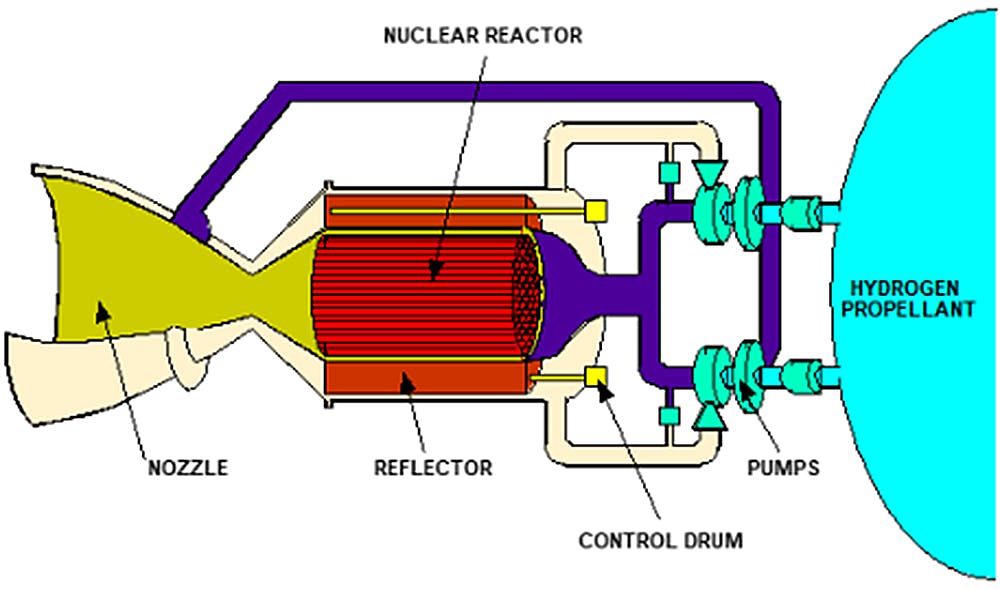
A diagram showing a nuclear thermal propulsion system, with a chamber for hydrogen connected to several pumps, a reactor chamber and a nozzle that the propellant is ejected from.
Scientists and engineers are working on nuclear thermal propulsion systems that would take hydrogen propellant, pump it into a nuclear reactor to generate energy and expel propellant out the nozzle to lift the rocket. NASA Glenn Research Center

These systems do not require any sort of ignition system, so they’re reliable. But these rockets must carry oxygen with them into space, which can weigh them down. Unlike chemical propulsion systems, nuclear thermal propulsion systems rely on nuclear fission reactions to heat the propellant that is then expelled from the nozzle to create the driving force or thrust.

In many fission reactions, researchers send a neutron toward a lighter isotope of uranium, uranium-235. The uranium absorbs the neutron, creating uranium-236. The uranium-236 then splits into two fragments – the fission products – and the reaction emits some assorted particles.

Fission reactions create lots of heat energy.

More than 400 nuclear power reactors in operation around the world currently use nuclear fission technology. The majority of these nuclear power reactors in operation are light water reactors. These fission reactors use water to slow down the neutrons and to absorb and transfer heat. The water can create steam directly in the core or in a steam generator, which drives a turbine to produce electricity.

Nuclear thermal propulsion systems operate in a similar way, but they use a different nuclear fuel that has more uranium-235. They also operate at a much higher temperature, which makes them extremely powerful and compact. Nuclear thermal propulsion systems have about 10 times more power density than a traditional light water reactor.

Nuclear propulsion could have a leg up on chemical propulsion for a few reasons.

Nuclear propulsion would expel propellant from the engine’s nozzle very quickly, generating high thrust. This high thrust allows the rocket to accelerate faster.

These systems also have a high specific impulse. Specific impulse measures how efficiently the propellant is used to generate thrust. Nuclear thermal propulsion systems have roughly twice the specific impulse of chemical rockets, which means they could cut the travel time by a factor of 2.

Nuclear thermal propulsion history

For decades, the U.S. government has funded the development of nuclear thermal propulsion technology. Between 1955 and 1973, programs at NASA, General Electric and Argonne National Laboratories produced and ground-tested 20 nuclear thermal propulsion engines.

But these pre-1973 designs relied on highly enriched uranium fuel. This fuel is no longer used because of its proliferation dangers, or dangers that have to do with the spread of nuclear material and technology.

The Global Threat Reduction Initiative, launched by the Department of Energy and National Nuclear Security Administration, aims to convert many of the research reactors employing highly enriched uranium fuel to high-assay, low-enriched uranium, or HALEU, fuel.

High-assay, low- enriched uranium fuel has less material capable of undergoing a fission reaction, compared with highly enriched uranium fuel. So, the rockets needs to have more HALEU fuel loaded on, which makes the engine heavier. To solve this issue, researchers are looking into special materials that would use fuel more efficiently in these reactors.

NASA and the DARPA’s Demonstration Rocket for Agile Cislunar Operations, or DRACO, program intends to use this high-assay, low-enriched uranium fuel in its nuclear thermal propulsion engine. The program plans to launch its rocket in 2027.

As part of the DRACO program, the aerospace company Lockheed Martin has partnered with BWX Technologies to develop the reactor and fuel designs.

The nuclear thermal propulsion engines in development by these groups will need to comply with specific performance and safety standards. They’ll need to have a core that can operate for the duration of the mission and perform the necessary maneuvers for a fast trip to Mars.

Ideally, the engine should be able to produce high specific impulse, while also satisfying the high thrust and low engine mass requirements.

Ongoing research

Before engineers can design an engine that satisfies all these standards, they need to start with models and simulations. These models help researchers, such as those in my group, understand how the engine would handle starting up and shutting down. These are operations that require quick, massive temperature and pressure changes.

The nuclear thermal propulsion engine will differ from all existing fission power systems, so engineers will need to build software tools that work with this new engine.

My group designs and analyzes nuclear thermal propulsion reactors using models. We model these complex reactor systems to see how things such as temperature changes may affect the reactor and the rocket’s safety. But simulating these effects can take a lot of expensive computing power.

We’ve been working to develop new computational tools that model how these reactors act while they’re starting up and operated without using as much computing power.

My colleagues and I hope this research can one day help develop models that could autonomously control the rocket.The Conversation

Dan Kotlyar, Associate Professor of Nuclear and Radiological Engineering, Georgia Institute of Technology

This article is republished from The Conversation under a Creative Commons license. Read the original article.

  1. Yuba Community College District doesn’t file appeal of labor decision; union plans Oct. 10 protest over lack of contract
  2. Lake County Probation Department to host Resilient Re-entry event
  3. Clearlake Animal Control: ‘Baxter’ and the dogs
  • 525
  • 526
  • 527
  • 528
  • 529
  • 530
  • 531
  • 532
  • 533
  • 534
How to resolve AdBlock issue?
Refresh this page