How to resolve AdBlock issue?
Refresh this page
How to resolve AdBlock issue?
Refresh this page
Lake County News,California
  • Home
    • Registration Form
  • News
    • Education
    • Veterans
    • Community
      • Obituaries
      • Letters
      • Commentary
    • Police Logs
    • Business
    • Recreation
    • Health
    • Religion
    • Legals
    • Arts & Life
    • Regional
  • Calendar
  • Contact us
    • FAQs
    • Phones, E-Mail
    • Subscribe
  • Advertise Here
  • Login
How to resolve AdBlock issue?
Refresh this page

News

Lake County Microenterprise Business Assistance Program reinstated

Details
Written by: LAKE COUNTY NEWS REPORTS
Published: 14 January 2025
LAKE COUNTY, Calif. — The Lake County Microenterprise Business Technical Assistance Program, funded through the State of California’s Community Development Block Grant program, has officially been reinstated.

This program offers no-cost technical business assistance to existing and aspiring low and moderate income entrepreneurs in the unincorporated areas of Lake County. Income criteria are set by the California Housing and Community Development Department, or HCD.

Assistance includes business and marketing plan development, market analysis, budgeting, financial forecasting, preparations to access business capital, credit building, networking, site selection and more.

These services are provided through both workshops and one-on-one consultations.

Program updates will be provided with dates and times for upcoming workshops and events.

If you would like more information on this valuable program, please reach out to the program operator, Community Development Services, or CDS.

CDS’ point person is Andy Lucas, 3895 Main St., Kelseyville, telephone 707-279-1540, Extension 1, email This email address is being protected from spambots. You need JavaScript enabled to view it..

State attorney general issues medical debt consumer alert

Details
Written by: LAKE COUNTY NEWS REPORTS
Published: 14 January 2025
California Attorney General Rob Bonta on Monday issued a consumer alert informing Californians that it is now illegal for most forms of medical debt to appear on credit reports.

Senate Bill 1061 (SB 1061), authored by Sen. Monique Limón (D- Santa Barbara) and sponsored by Attorney General Bonta, went into effect on Jan. 1, and protects consumers from having their credit ruined by medical debt appearing on credit reports.

Medical debt is often unforeseen and not a reliable indicator of financial risk, yet it can unfairly prevent consumers from getting loans, renting an apartment, or getting a job.

“California banned medical debt from appearing on credit reports because we recognized this practice as harmful, unnecessary, and hurting the people already struggling the most. I am proud to have sponsored this law and now urge consumers to be aware of their new rights under California law to protect their financial future,” said Bonta. “The best tool to ensure medical debt does not appear on your credit report is to check your credit report regularly; this can also help identify other errors and illegal activity, like identity theft. Consumers are entitled to one free credit report a year from each of the three national credit bureaus. As we ring in a new year and adopt resolutions, I urge Californians to keep up or start the important practice of monitoring their credit reports.”

“I am proud to author legislation to provide relief to Californians suffering from the burden of medical debt,” said Sen. Limón. “Now, with the federal government following California’s lead, consumers across the country will no longer be impacted by the effects of medical debt on their credit scores.”

Nationally, medical debt continues to rise, creating significant barriers to employment, housing, and equitable access to healthcare.

People with medical debt are more likely than those with student loans or credit card debt to report being denied a rental or mortgage, increasing their risk of homelessness or forcing them into substandard housing.

Medical debt can hinder employment opportunities, as employers often rely on credit reports in hiring decisions, further complicating efforts to repay the debt.

Many consumers also delay essential medical care due to financial burdens, which can result in worsening health conditions.

At the federal level, the Consumer Financial Protection Bureau (CFPB) has finalized banning medical bills from consumers' credit reports, and in August 2024, Attorney General Bonta sent a letter to CFPB in support of this rule.

Monitoring your credit report

The best way to ensure medical debt has not appeared on your credit report is by regularly checking your credit report for inaccuracies or changes. Consumers are entitled to one free credit report per year from each of the three national credit bureaus. Those bureaus are Equifax, Experian, and TransUnion. You have the option of requesting all three reports at once or staggering them.

Checking your credit reports at least once a year is a good way to discover errors, like the inclusion of medical debt or even identity theft. These errors could raise your cost of credit or cut you off from credit. The sooner these errors are discovered, the easier they are to clear up.

You can order your free annual credit reports through a toll-free phone number (1-877-322-8228), online, at www.annualcreditreport.com/cra/index.jsp, or by mailing the order form here to the following address:

Annual Credit Report Request Service
P. O. Box 105281
Atlanta, GA 30348-5281

For more information on how to order, read, and correct your credit report, please visit here.

If you find medical debt on your credit report

If consumers find medical debt on their credit report, they should notify the medical provider’s office, debt holder, and credit agency to allow them an opportunity to quickly remove the information from their credit report.

If the issue persists after providing notice to the medical provider, debt holder or credit bureau, consumers may consider consulting a private attorney or legal aid.

Consumers who find medical debt on their credit report can also file a complaint with our office by going to https://oag.ca.gov/report.

2024’s extreme ocean heat breaks records again, leaving 2 mysteries to solve

Details
Written by: Annalisa Bracco, Georgia Institute of Technology
Published: 14 January 2025


The global ocean’s surface temperature was still well above average going into 2025. Meaghan Skinner Photography/Moment via Getty Images

The oceans are heating up as the planet warms.

This past year, 2024, was the warmest ever measured for the global ocean, following a record-breaking 2023. In fact, every decade since 1984, when satellite recordkeeping of ocean temperatures started, has been warmer than the previous one.

A warmer ocean means increased evaporation, which in turn results in heavier rains in some areas and droughts in others. It can power hurricanes and downpours. It can also harm the health of coastal marine areas and sea life – coral reefs suffered their most extensive bleaching event on record in 2024, with damage in many parts of the world.

Warming ocean water also affects temperatures on land by changing weather patterns. The EU’s Copernicus Climate Change Service announced on Jan. 10 that data showed 2024 had also broken the record for the warmest year globally, with global temperatures about 2.9 degrees Fahrenheit (1.6 Celsius) above pre-industrial times. That would mark the first full calendar year with average warming above 1.5 C, a level countries had agreed to try to avoid passing long-term.

Map shows surface air temperature anomalies in 2024, with extreme heat over Canada, Europe and the polar regions, and just about everywhere well above average.
Many regions of the world were much warmer than the 1991-2020 average in 2024, including large areas of ocean. C3S / ECMWF, CC BY

Climate change, by and large, takes the blame. Greenhouse gases released into the atmosphere trap heat, and about 90% of the excess heat caused by emissions from burning fossil fuels and other human activities is absorbed by the ocean.

But while it’s clear that the ocean has been warming for quite some time, its temperatures over the past two years have been far above the previous decades. That leaves two mysteries for scientists.

It’s not just El Niño

The cyclic climate pattern of the El Niño Southern Oscillation can explain part of the warmth over the past two years.

During El Niño periods, warm waters that usually accumulate in the western equatorial Pacific Ocean move eastward toward the coastlines of Peru and Chile, leaving the Earth slightly warmer overall. The latest El Niño began in 2023 and caused global average temperatures to rise well into early 2024.
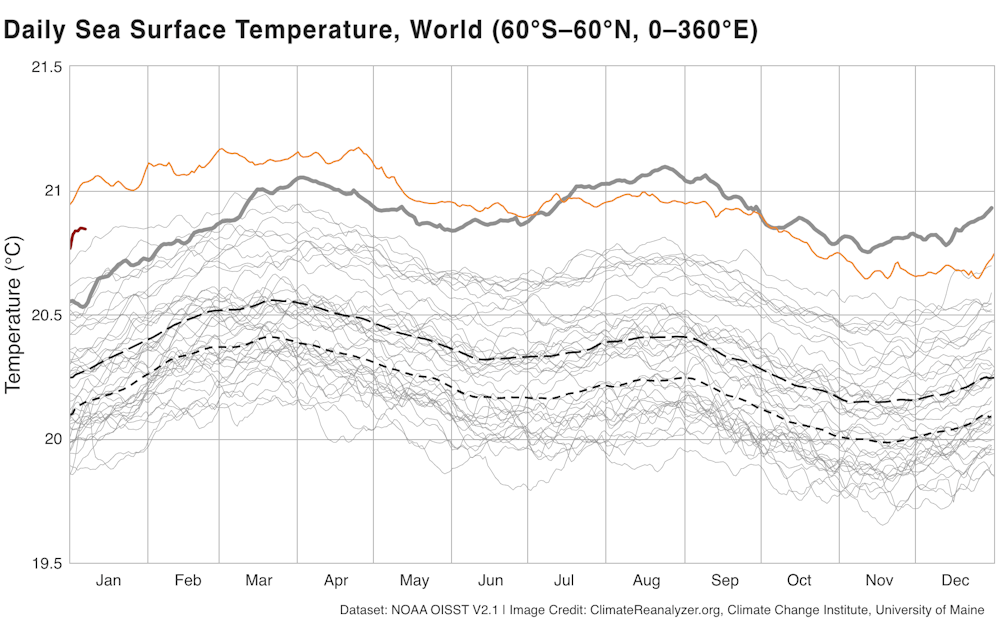
A chart shows ocean temperatures in 2023 and 2024 well above all other years since records began, and 2025 is also starting high.
Sea surface temperatures have been running well above average when compared with all years on record, starting in 1981. The orange line is 2024, dark grey is 2023, and red is 2025. The middle dashed line is the 1982-2011 average. ClimateReanalyzer.org/NOAA OISST v2.1, CC BY

But the oceans have been even warmer than scientists expected. For example, global temperatures in 2023-2024 followed a similar growth and decline pattern across the seasons as the previous El Niño event, in 2015-2016, but they were about 0.36 degrees Fahrenheit (0.2 Celsius) higher at all times in 2023-2024.

Scientists are puzzled and left with two problems to solve. They must figure out whether something else contributed to the unexpected warming and whether the past two years have been a sign of a sudden acceleration in global warming.

The role of aerosols

An intriguing idea, tested using climate models, is that a swift reduction in aerosols over the past decade may be one of the culprits.

Aerosols are solid and liquid particles emitted by human and natural sources into the atmosphere. Some of them have been shown to partially counteract the impact of greenhouse gases by reflecting solar radiation back into space. However, they also are responsible for poor air quality and air pollution.

Many of these particles with cooling properties are generated in the process of burning fossil fuels. For example, sulfur aerosols are emitted by ship engines and power plants. In 2020, the shipping industry implemented a nearly 80% cut in sulfur emissions, and many companies shifted to low-sulfur fuels. But the larger impact has come from power plants reducing their emissions, including a big shift in this direction in China. So, while technologies have cut these harmful emissions, that means a brake slowing the pace of warming is weakened.

Is this a warming surge?

The second puzzle is whether the planet is seeing a warming surge or not.

Temperatures are clearly rising, but the past two years have not been warm enough to support the notion that we may be seeing an acceleration in the rate of global warming.

Analysis of four temperature datasets covering the 1850-2023 period has shown that the rate of warming has not shown a significant change since around the 1970s. The same authors, however, noted that only a rate increase of at least 55% – about half a degree Celsius and nearly a full degree Fahrenheit over one year – would make the warming acceleration detectable in a statistical sense.

From a statistical standpoint, then, scientists cannot exclude the possibility that the 2023-2024 record ocean warming resulted simply from the “usual” warming trend that humans have set the planet on for the past 50 years. A very strong El Niño contributed some natural variability.

From a practical standpoint, however, the extraordinary impacts the planet has witnessed – including extreme weather, heat waves, wildfires, coral bleaching and ecosystem destruction – point to a need to swiftly reduce carbon dioxide emissions to limit ocean warming, regardless of whether this is a continuation of an ongoing trend or an acceleration.

This article has been updated with Copernicus Climate Change Service’s global 2024 temperature data.The Conversation

Annalisa Bracco, Professor of Ocean and Climate Dynamics, Georgia Institute of Technology

This article is republished from The Conversation under a Creative Commons license. Read the original article.

Yuba College Board approves contract with full-time faculty union

Details
Written by: Elizabeth Larson
Published: 13 January 2025
NORTHERN CALIFORNIA — The Yuba Community College District Board has ratified a new employment contract with its faculty union, the final step in a years-long process that at one time had appeared headed for a strike.

The Board of Trustees voted unanimously in favor of the contract agreement with the Faculty Association of the Yuba Community College District, or FAYCCD, at its Thursday evening meeting.

“This agreement represents a significant step forward for our institution, our faculty, and, most importantly, our students,” said Chancellor Shouan Pan in a statement released by the district. “It reflects the shared commitment of both parties to fostering excellence in education, advancing equity, and ensuring the success of every student we serve.”

The agreement with FAYCCD, whose membership also ratified it, represents the district’s full-time faculty and covers the 2022-23 through 2025-26 academic years.

The district said the agreement “lays the foundation for continued partnership, collaboration and progress together as 2025-26 contract negotiations get underway.”

“After three years of negotiations and being without a contract for over two and a half years, FAYCCD is pleased to finally have a new collective bargaining agreement,” said FAYCCD President Travis Smith. “Although our members will only be receiving 80% of the state-provided cost of living adjustment and significant compromises were necessary to finally reach an agreement, some of our long-held rights were protected and the impact inflation has had on our membership has been somewhat mitigated.”

During the board meeting, Dr. Pan acknowledged “a lot of difficult moments” in the negotiations, which in the late fall had appeared to have broken down. At that time, the union had been preparing for a possible strike that could have spilled over into the spring semester.

The contract requires revising the district budget which, in turn, stretches the budget “in some ways that makes us uncomfortable,” Pan said during the meeting.

“My fellow board members and I are very pleased that the district and the faculty union leadership finally reached an agreement after a lengthy negotiation process,” said District Board President Richard Teagarden in the district’s statement on the ratification. “The approved agreement recognizes the important roles the full-time faculty plays in serving the district mission of student and community success and reinforces our shared commitment to pay equity and system sustainability.”

Smith said communication was key to the agreement being reached.

“The breakthrough in these negotiations largely came from increased communication with the members of the Board of Trustees, Chancellor Pan and FAYCCD leaders,” said Smith. “My sincere hope is that this improvement in communication will continue and the next round of negotiations, which begin in about a year, will prove to be less contentious and lengthy. All said and done, I am optimistic going forward.”

Email Elizabeth Larson at This email address is being protected from spambots. You need JavaScript enabled to view it.. Follow her on Twitter, @ERLarson, and on Bluesky, @erlarson.bsky.social. Find Lake County News on the following platforms: Facebook, @LakeCoNews; X, @LakeCoNews; Threads, @lakeconews, and on Bluesky, @lakeconews.bsky.social.
  1. Supervisors to consider appeal of cannabis operation next to Highland Springs
  2. Wind advisory in effect until midday Monday
  3. Purrfect Pals: This week’s cats and kittens
  • 417
  • 418
  • 419
  • 420
  • 421
  • 422
  • 423
  • 424
  • 425
  • 426
How to resolve AdBlock issue?
Refresh this page
