How to resolve AdBlock issue?
Refresh this page
How to resolve AdBlock issue?
Refresh this page
Lake County News,California
  • Home
    • Registration Form
  • News
    • Education
    • Veterans
    • Community
      • Obituaries
      • Letters
      • Commentary
    • Police Logs
    • Business
    • Recreation
    • Health
    • Religion
    • Legals
    • Arts & Life
    • Regional
  • Calendar
  • Contact us
    • FAQs
    • Phones, E-Mail
    • Subscribe
  • Advertise Here
  • Login
How to resolve AdBlock issue?
Refresh this page

News

How America courted increasingly destructive wildfires − and what that means for protecting homes today

Details
Written by: Justin Angle, University of Montana
Published: 18 January 2025


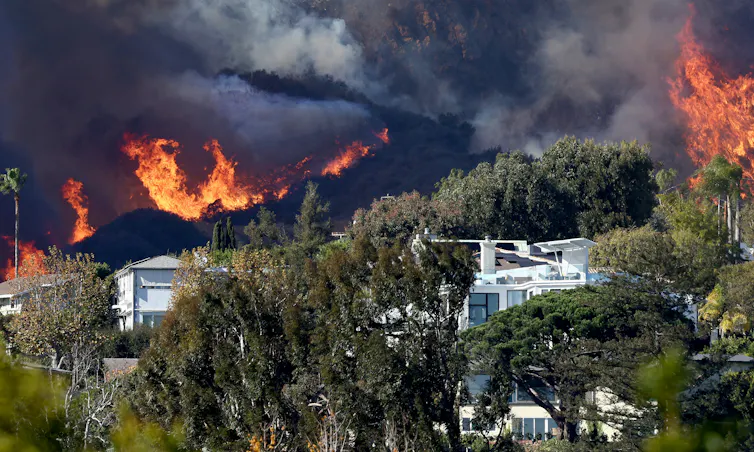
The Palisades Fire spreads near homes amid a powerful windstorm on Jan. 7, 2025. Mario Tama/Getty Images

The fires burning in the Los Angeles area are a powerful example of why humans have learned to fear wildfire. Fires can level entire neighborhoods in an instant. They can destroy communities, torch pristine forests and choke even faraway cities with toxic smoke.

Over a century of fire suppression efforts have conditioned Americans to expect wildland firefighters to snuff out fires quickly, even as people build homes deeper into landscapes that regularly burn. But as the LA fires show, and as journalist Nick Mott and I explored in our book “This Is Wildfire: How to Protect Your Home, Yourself, and Your Community in the Age of Heat” and 2021 podcast “Fireline,” this expectation and our society’s relationship with wildfire need to change.

Over time, extensive fire suppression, home construction in high fire-risk areas and climate change have set the stage for the increasingly destructive wildfires we see today.

The legacy of fire suppression

The way the U.S. deals with wildfires today dates back to around 1910, when the Great Burn torched about 3 million acres across Washington, Idaho, Montana and British Columbia. After watching the fire’s swift and unstoppable spread, the fledgling U.S. Forest Service developed a military-style apparatus built to eradicate wildfire.

The U.S. got really good at putting out fires. So good that citizens grew to accept fire suppression as something the government simply does.
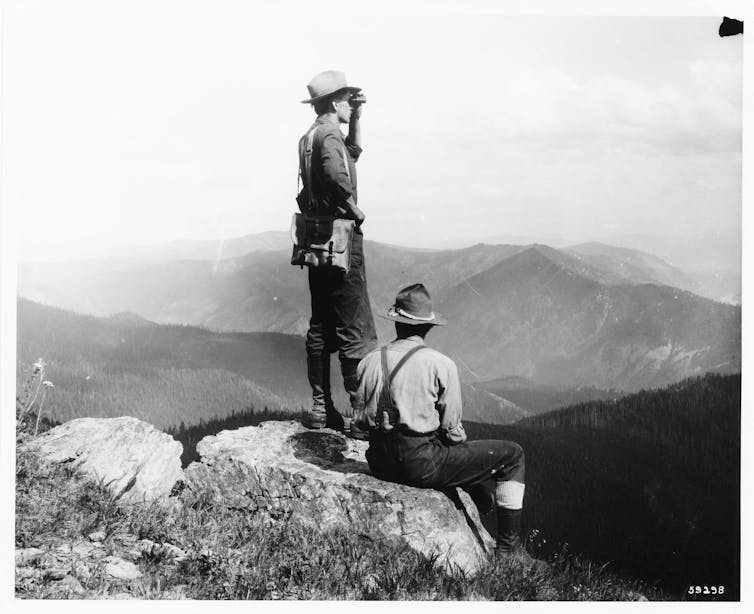
A black and white photo shows a man standing on a mountaintop rock looking through binoculars, with mountains in the background. Another sits on the rock beside him.
A ranger and forest guard on fire patrol duty near Thompson Falls, Mont., in 1909. Forest Service photo by W.J. Lubken

Today, state, federal and private firefighters deploy across the country when fires break out, along with tankers, bulldozers, helicopters and planes. The Forest Service touts a record of snuffing out 98% of wildfires before they burn 100 acres (40 hectares).

One consequence in a place like Los Angeles is that when a wildfire enters an urban environment, the public expects it to be put out before it causes much damage. But the nation’s wildland firefighting systems aren’t designed for that.

Wildland firefighting tactics, such as digging lines to stop a fire from spreading and steering fires toward natural fuel breaks, don’t work in dense neighborhoods like Pacific Palisades. Aerial water and retardant drops can’t happen when high winds make it unsafe to fly. At the same time, the region’s municipal firefighting forces and water systems weren’t designed for this sort of fire – a conflagration engulfing entire neighborhoods quickly overwhelms the system.

Long ago, Southern California’s scrub-forest ecosystems would periodically burn, limiting fuel for future fires. But aggressive fire suppression and inattention to urban overgrowth have left excessive, easy-to-ignite vegetation in many areas. It’s unclear, however, whether prescribed burning could have prevented this catastrophe.

This is primarily a people problem. People have built more homes and cities in fire-prone areas and done so with little regard for wildfire resilience. And the greenhouse gases released by decades of burning fossil fuels to run power plants, industries and vehicles have caused global temperatures to rise, compounding the threat.
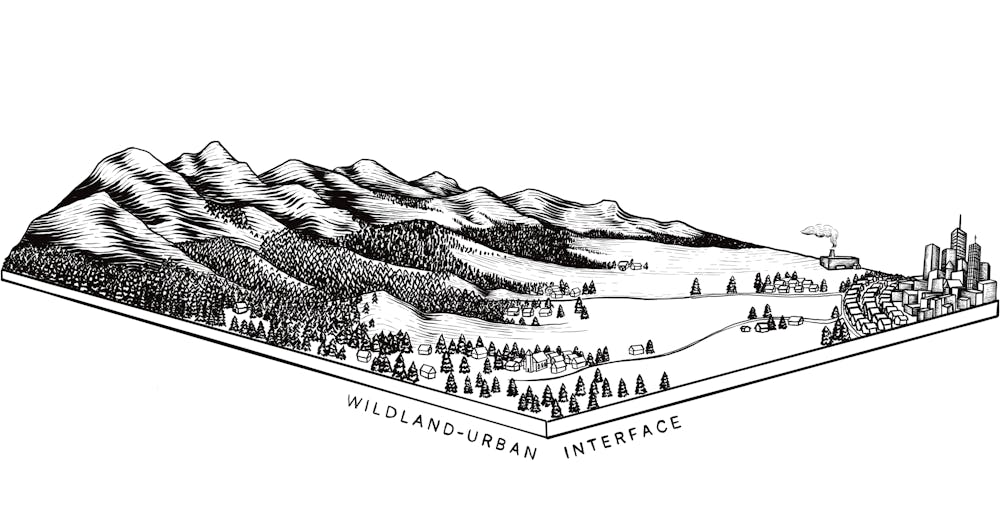
An illustration of the wildland urban interface, showing homes in the mountain foothills next to a city in a valley.
The wildland-urban interface starts on the edges of cities where homes are built closer to forests and grasslands. Courtesy of Jessy Stevenson

Climate change and wildfires

The relationship between climate and wildfire is fairly simple: Higher temperatures lead to more fire. Higher temperatures increase moisture evaporation, drying out plants and soil and making them more likely to burn. When hot, dry winds are blowing, a spark in an already dry area can quickly blow up into dangerous wildfire.

Given the rise in global temperatures that the world has already experienced, much of the western U.S. is actually in a fire deficit because of the practice of suppressing most fires. That means that, based on historical data, we should expect far more fire than we’re actually seeing.

Fortunately, there are things everyone can do to break this cycle.

What fire managers can do

First, everyone can accept that firefighters can’t and shouldn’t put out every low-risk wildfire.

Remote fires that pose little threat to communities and property can breathe life into ecosystems. Frequent, natural fires can also help avoid catastrophic fires that occur when too much underbrush has built up for fuel. And they create fuel breaks on the landscape that could halt the advance of future flames.
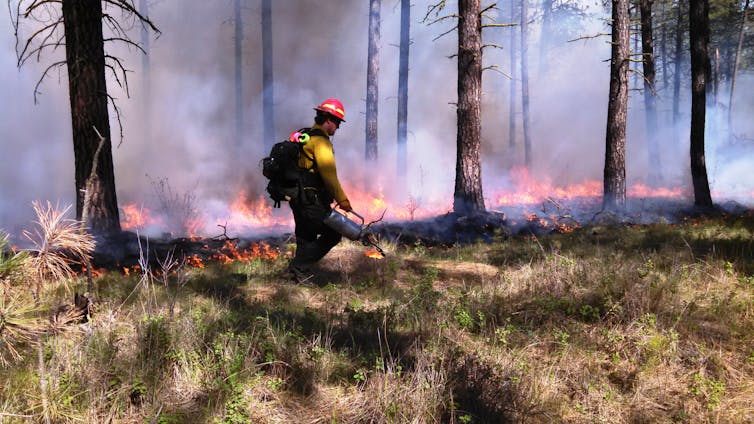
A firefighter walks beside a line of low-level flames in a forest. The tree canopies aren't burning, only the ground-level vegetation is.
Controlled burns are used to clear out undergrowth that can fuel catastrophic blazes under dry, windy conditions. U.S. Forest Service

Fire managers have advanced mapping technology that can help them decide when and where forests can burn safely. Thoughtful prescribed burning – meaning low-intensity fires intentionally set by professionals – can offer many of the same benefits as the flames that historically burned in forests and grasslands.

The Forest Service is aiming to ramp up its prescribed burning on more acres in more areas across the country. However, the agency struggles to train adequate staff and pay for the projects, and environmental reviews sometimes cause yearslong delays. Other groups offer beacons of hope. Indigenous groups across the country, for example, are returning fire to the landscape.

Adapting homes to fire risk

More than one-third of U.S. homes are in what’s known as the wildland-urban interface – the zone where houses and other structures intermingle with flammable vegetation. This zone now includes many urban areas where wildfire risk was not considered when their cities were developed.

The biggest risk to homes comes from burning embers blowing on the wind and landing in weak spots that can set a house ablaze. Those embers can ride high winds for multiple miles to nestle in dry leaves or pine needles clogging a gutter, a wood-shingle roof, or shrubs, trees and other flammable vegetation close to a structure.
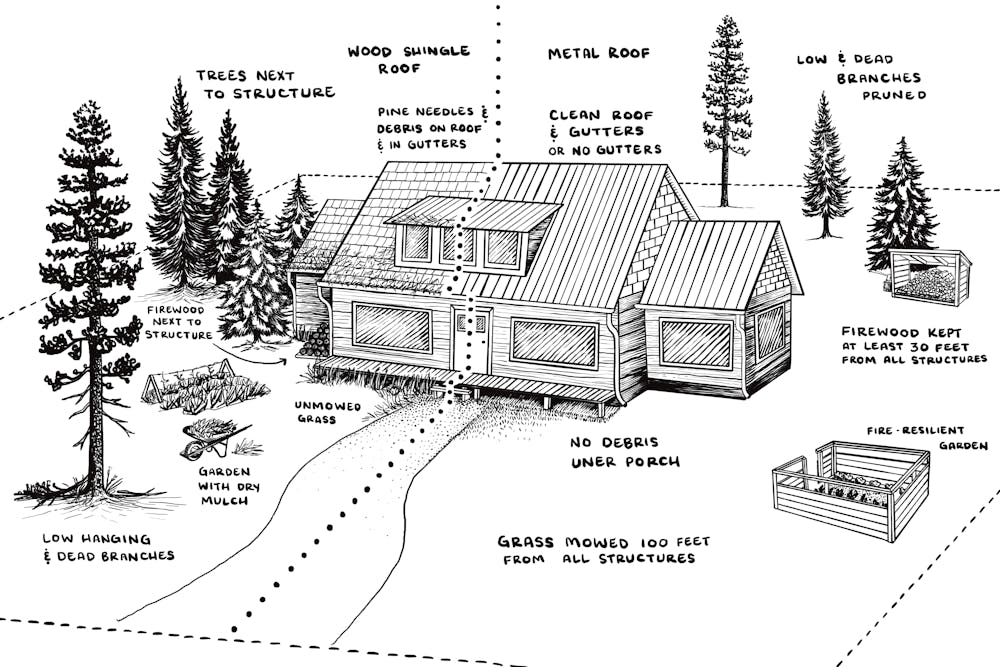
An illustration of a house with trees certain distances and advice on how to keep the home safe from fires.
Owning a home in the wildland-urban interface means paying attention to fire risks. Risks are highlighted on the left and solutions on the right. Courtesy of Jessy Stevenson

Some of these vulnerabilities are easy to fix. Cleaning a home’s gutters or trimming back too-close vegetation requires little effort and tools already around the house.

Grant programs exist to help harden homes against wildfire. But enormous investment is needed to get the work done at the scale the fire risk requires. For example, nearly 1 million U.S. homes in wildfire-prone areas have highly combustible wooden roofs. Retrofitting those roofs will cost an estimated US$6 billion, but that investment could save lives and property and reduce wildfire management costs in the future.

Homeowners can look to resources such as Firewise USA to learn about the “home ignition zone.” It describes the types of vegetation and other flammable objects that become high risks at different distances from a structure and steps to make properties more fire resilient.

The fire chief for Spokane, Wash., explains ways to protect your property from wildfires.

For example, homes should not have flammable plants, firewood, dried leaves or needles, or anything burnable, on or under decks and porches within 5 feet (1.5 meters) of the house. Between 5 and 30 feet (9 meters), grasses should be mowed short, and the tree canopy should be at least 10 feet (3 meters) from the structure.

The key takeaway is that homeowners must begin to view their homes as potential fuel for a wildfire.

Rebuilding right

A possible outcome of California’s devastating fires is that states and communities could enact forward-looking wildfire resilience policies. These can include developing zoning rules and regulations that require developers to build with fire-resistant materials and designs. Or they might prohibit building in areas where the risk is too high.

California’s move to fast-track reconstruction, if it isn’t planned with wildfire safety requirements, will just set up the state for more fire disasters. The International Wildland-Urban Interface Code, which provides guidance for safeguarding homes and communities from wildfire, has been adopted in jurisdictions in at least 24 states. California is not one of them.
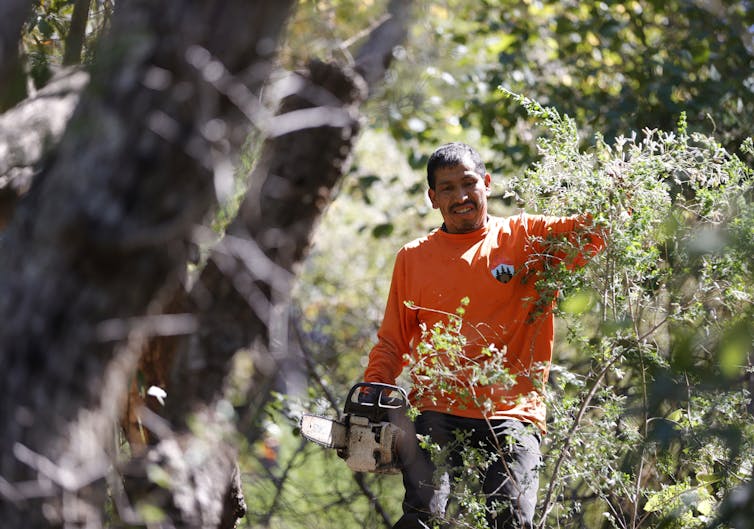
A man carries a chain saw through an overgrown area with trees behind him.
Protecting homes from wildfires includes maintaining a safe perimeter clear of potential fuel for a fire. Justin Sullivan/Getty Images

Living in a world with wildfire

Prevention and suppression will always be critical pieces of wildfire strategy. Though promising new firefighting technologies are being developed, adapting to a fiery future means everyone has a role.

Educate yourself on how wildfire is managed in your area. Understand and address risks to your home and community. Help your neighbors. Advocate for better wildfire planning, policy and resources.

Living in a world where more wildfire is inevitable requires that everyone see themselves as part of solving the problem. It means we must accept that some fire is natural and essential and that some places we love might be too dangerous to protect.

This is an updated version of an article originally published Aug. 22, 2023.The Conversation

Justin Angle, Professor of Marketing, University of Montana

This article is republished from The Conversation under a Creative Commons license. Read the original article.
Space News: NASA’s Pandora Mission one step closer to probing alien atmospheres

Details
Written by: Francis Reddy
Published: 18 January 2025


Pandora, NASA’s newest exoplanet mission, is one step closer to launch with the completion of the spacecraft bus, which provides the structure, power, and other systems that will enable the mission to carry out its work.

“This is a huge milestone for us and keeps us on track for a launch in the fall,” said Elisa Quintana, Pandora’s principal investigator at NASA’s Goddard Space Flight Center in Greenbelt, Maryland. “The bus holds our instruments and handles navigation, data acquisition, and communication with Earth — it’s the brains of the spacecraft.”

Pandora, a small satellite, will provide in-depth study of at least 20 known planets orbiting distant stars in order to determine the composition of their atmospheres — especially the presence of hazes, clouds, and water. This data will establish a firm foundation for interpreting measurements by NASA’s James Webb Space Telescope and future missions that will search for habitable worlds.

“We see the presence of water as a critical aspect of habitability because water is essential to life as we know it,” said Goddard’s Ben Hord, a NASA Postdoctoral Program Fellow who discussed the mission at the 245th meeting of the American Astronomical Society in National Harbor, Maryland. “The problem with confirming its presence in exoplanet atmospheres is that variations in light from the host star can mask or mimic the signal of water. Separating these sources is where Pandora will shine.”

Funded by NASA’s Astrophysics Pioneers program for small, ambitious missions, Pandora is a joint effort between Lawrence Livermore National Laboratory in California and NASA Goddard.

“Pandora’s near-infrared detector is actually a spare developed for the Webb telescope, which right now is the observatory most sensitive to exoplanet atmospheres,” Hord added. “In turn, our observations will improve Webb’s ability to separate the star’s signals from those of the planet’s atmosphere, enabling Webb to make more precise atmospheric measurements.”

Astronomers can sample an exoplanet’s atmosphere when it passes in front of its star as seen from our perspective, an event called a transit. Part of the star’s light skims the atmosphere before making its way to us. This interaction allows the light to interact with atmospheric substances, and their chemical fingerprints — dips in brightness at characteristic wavelengths — become imprinted in the light.

But our telescopes see light from the entire star as well, not just what’s grazing the planet. Stellar surfaces aren’t uniform. They sport hotter, unusually bright regions called faculae and cooler, darker regions similar to sunspots, both of which grow, shrink, and change position as the star rotates.

Using a novel all-aluminum, 45-centimeter-wide (17 inches) telescope, jointly developed by Livermore and Corning Specialty Materials in Keene, New Hampshire, Pandora’s detectors will capture each star’s visible brightness and near-infrared spectrum at the same time, while also obtaining the transiting planet’s near-infrared spectrum. This combined data will enable the science team to determine the properties of stellar surfaces and cleanly separate star and planetary signals.

The observing strategy takes advantage of the mission’s ability to continuously observe its targets for extended periods, something flagship missions like Webb, which are in high demand, cannot regularly do.

Over the course of its year-long prime mission, Pandora will observe at least 20 exoplanets 10 times, with each stare lasting a total of 24 hours. Each observation will include a transit, which is when the mission will capture the planet’s spectrum.

Pandora is led by NASA’s Goddard Space Flight Center. Lawrence Livermore National Laboratory provides the mission’s project management and engineering. Pandora’s telescope was manufactured by Corning and developed collaboratively with Livermore, which also developed the imaging detector assemblies, the mission’s control electronics, and all supporting thermal and mechanical subsystems.

The infrared sensor was provided by NASA Goddard. Blue Canyon Technologies provided the bus and is performing spacecraft assembly, integration, and environmental testing. NASA’s Ames Research Center in California’s Silicon Valley will perform the mission’s data processing. Pandora’s mission operations center is located at the University of Arizona, and a host of additional universities support the science team.

Francis Reddy works for NASA’s Goddard Space Flight Center in Greenbelt, Maryland.

Rasmussen transitioning into new role as county supervisor

Details
Written by: LINGZI CHEN
Published: 17 January 2025
New District 4 Supervisor Brad Rasmussen. Courtesy photo.


LAKE COUNTY, Calif. — Lake County’s District 4 supervisor has gotten right to work, filling up his schedule and considering how to achieve the many goals he’s laid out for his tenure.

In his first week as the supervisor for District 4, Brad Rasmussen attended 12 meetings and was appointed to 17 out of more than 60 committees that govern various aspects of the county’s matters.

“It’s been a very busy week,” Rasmussen told Lake County News last Friday, after he was sworn into office on Tuesday, Jan. 7.

Over that first week, Rasmussen went to meetings, filled up his onboarding paperwork, and set up his office, computer and county cell phone.

While managing all of those tasks, Rasmussen said he had also spent the week trying to figure out “a good system” to efficiently track his work and get things done.

Rasmussen planned to work during the weekend too — preparing for the next Board of Supervisors’ meeting, which he expected to be a lengthy, all-day meeting.

There is also "constituent work” — responding to concerns from his district constituents and helping them navigate issues, Rasmussen said.

“This is more than a 40-hour-a-week job,” he added.

Rasmussen is well acquainted with jobs that require long hours. Last year, he retired as Lakeport longtime police chief, a position that often saw him working patrol along with his staff.

For the next few months, Rasmussen said he is planning to meet with department heads to learn about the 28 county departments.

His early goal in the job, Rasmussen said, is to “start building relationships and getting comfortable in the job and settled.”

Some of the committees Rasmussen was appointed to include the Airport Land Use Committee, Blue Ribbon Committee for the Rehabilitation of Clear Lake, the Continuum of Care Committee and the Children's Council.

As his district includes the city of Lakeport, Rasmussen said he was also going to “voluntarily” attend city meetings as much as possible such as the Lakeport City Council — where he was a fixture during his police chief tenure — as well as the fire district and school district meetings, besides the committees and municipal advisory councils of which he is a part.

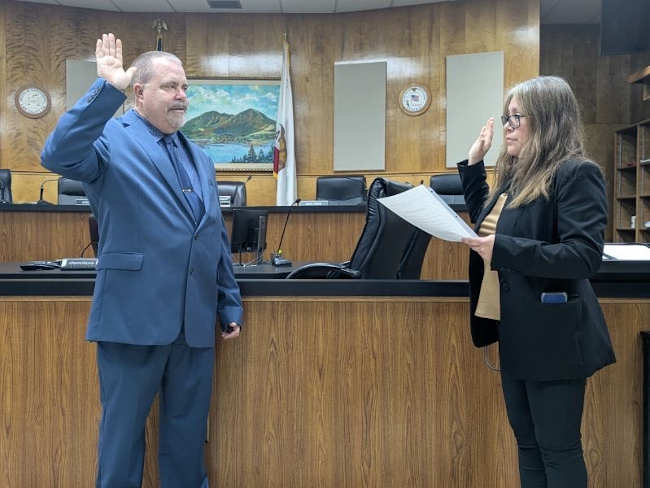
Brad Rasmussen takes his oath as supervisor of District 4 in Lake County, California, on Monday, Jan. 6, 2025, the day before his first Board of Supervisors meeting. Lake County Registrar of Voters Maria Valadez administered the oath. Courtesy photo.

Goals and priorities

One of Rasmussen’s top priorities is public safety. For him, it does not only encompass law enforcement, but also fire prevention and mitigation, disaster responses and recoveries.

When it comes to public safety, Rasmussen said he wants to “Make sure that we're prepared to respond to any further disasters and to mitigate them and to do the best we can for the public.”

Rasmussen also said he aims to take care of Clear Lake, preserving the cultural history and keeping away invasive mussels.

“The lake is a huge economic drive for our county — it’s used extensively for recreation,” said Rasmussen. “It'd be devastating not only for the wildlife, but it would also be detrimental to our economy.”

Rasmussen said he wanted to “keep the rural aspect of Lake County” with recreation opportunities that a lot of people live here and come here for while keeping up with the development that is needed.

Also standing atop Rasmussen’s goals is to “set the stage” for transparency and accountability, starting from the Board of Supervisors.

“We need to hold ourselves accountable and expect the same accountability all the way down through the ranks,” he said. “We need to hold ourselves to the highest accountability before we can expect others to do it.”

Rasmussen said providing as much information to the community as possible, motivating the public to be more involved, and keeping citizens recruited to sit on various committees will be key.

First elected position

District supervisor is not Rasmussen’s first public service job.

In August, Rasmussen retired after serving 35 years at the Lakeport Police Department — 14 of them as chief.

Yet, this is his first elected position.

So how does being elected feel?

“It feels good,” Rasmussen said. “I feel like people voted for me because they trusted me to be knowledgeable and be able to handle this extensive position.”

Comparing the role as a supervisor to that of a police chief, Rasmussen said the difference lies in who he works for.

When he ran the police department, “I worked for the city manager. I made the decisions on how the police department operated, but they’re still working for a director,” Rasmussen said. “And in this case, I’m working for the people.”

“I want to work hard to exceed the expectations of the people; that’s my goal,” said Rasmussen.

At the board meeting on Jan. 7, after the swearing-in of the new supervisors, newly elected District 1 Supervisor Helen Owen nominated Rasmussen to serve as the board’s vice chair for 2025.

The nomination was immediately challenged by re-elected District 5 Supervisor Jessica Pyska, who pointed to a board policy requiring at least one year of experience for supervisors to be eligible for chair or vice chair roles.

County Counsel Lloyd Guintivano reviewed the policy and clarified that the one-year prerequisite applies solely to the chair position, not the vice chair. However, he added that the vice chair’s responsibility to act as chair in their absence could raise concerns about potential conflicts with the policy’s intent.

Despite the debate, with no other nominations brought forward, the board elected Rasmussen as vice chair.

When asked his thoughts on this short episode, Rasmussen seemed unbothered.

“I’ve read it a couple times,” Rasmussen said. “The intent [of the policy] is more that you just can’t be the chair.”

“I was comfortable accepting the vice chair position with the way the policy’s written,” he added.

Email staff reporter Lingzi Chen at This email address is being protected from spambots. You need JavaScript enabled to view it..

Cal Fire alerts public of fake social media accounts requesting donations

Details
Written by: LAKE COUNTY NEWS REPORTS
Published: 17 January 2025
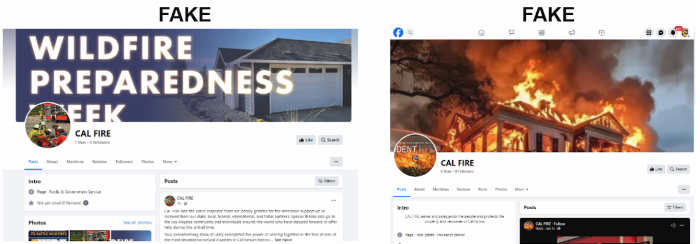
The California Department of Forestry and Fire Protection, or Cal Fire, is alerting the public about fraudulent social media accounts impersonating Cal Fire and soliciting donations.

Cal Fire said it does not solicit donations from the public, either in person or online.

Additionally, all of Cal Fire’s social media accounts are verified accounts and have the blue or gray checkmark and are categorized as a government organization. If you do not see the checkmark, it is not an official Cal Fire account.

While Cal Fire does not request donations, there are legitimate organizations that support victims affected by disasters, the fire service and first responders.

Anyone wishing to contribute to such organizations are encouraged to thoroughly research them to ensure their validity before making a donation.

Cal Fire urges the public to remain vigilant and report suspicious accounts or activity to the relevant social media platform or authorities. “Protecting our communities includes safeguarding them against scams and misinformation,” the agency said.


For official information and updates from Cal Fire, visit the agency’s verified website at www.fire.ca.gov or follow its official social media channels: @CALFIRE (Instagram); @CALFIRE (Facebook); and @CAL_FIRE (X).

Tips for confirming that a Government Organization’s social media account is valid:

• Make sure the social media handle matches what is listed on official websites.
• Official government accounts generally post professional, relevant, and timely information.
• Look for official announcements or references to other credible sources, such as links to government websites or trusted news outlets.
• Be wary of accounts with low follower counts or sudden, rapid growth.
• Government accounts will never ask for sensitive personal information via social media.
  1. Clearlake Animal Control: ‘Shadow’ and the dogs
  2. 3 myths about rural education that are holding students back
  3. Federal agency proposes protection of Clear Lake hitch
  • 413
  • 414
  • 415
  • 416
  • 417
  • 418
  • 419
  • 420
  • 421
  • 422
How to resolve AdBlock issue?
Refresh this page