How to resolve AdBlock issue?
Refresh this page
How to resolve AdBlock issue?
Refresh this page
Lake County News,California
  • Home
    • Registration Form
  • News
    • Education
    • Veterans
    • Community
      • Obituaries
      • Letters
      • Commentary
    • Police Logs
    • Business
    • Recreation
    • Health
    • Religion
    • Legals
    • Arts & Life
    • Regional
  • Calendar
  • Contact us
    • FAQs
    • Phones, E-Mail
    • Subscribe
  • Advertise Here
  • Login
How to resolve AdBlock issue?
Refresh this page

News

Monday wind advisory issued for Lake County

Details
Written by: Elizabeth Larson
Published: 20 January 2025
LAKE COUNTY, Calif. — The National Weather Service has issued a wind advisory for Lake County on Monday as high northeast winds are expected throughout the day.

The advisory is in effect from 4 a.m. to 10 p.m.

The forecast calls for northeast winds of 20 to 30 miles per hour, with gusts of up to 50 miles per hour expected.

Martin Luther King Jr. Day is expected to have a high of 56 degrees during the day with a nighttime low of 37 degrees.

Daytime temperatures are forecast to rise to the high 60s mid-week before dropping back to the low 50s during the weekend.

Nighttime conditions will range from the low 40s midweek to the high 30s at the weekend.

Email Elizabeth Larson at This email address is being protected from spambots. You need JavaScript enabled to view it.. Follow her on Twitter, @ERLarson, and on Bluesky, @erlarson.bsky.social. Find Lake County News on the following platforms: Facebook, @LakeCoNews; X, @LakeCoNews; Threads, @lakeconews, and on Bluesky, @lakeconews.bsky.social.

U.S. Census Bureau data looks at socioeconomic inequalities between remote workers and commuters

Details
Written by: Michael Burrows, Charlynn Burd and Mehreen S. Ismail
Published: 20 January 2025
The share of the workforce working from home has declined in recent years but remains more than double what it was before COVID-19. New data reveal significant inequalities between remote workers and commuters: remote workers tend to be older, are more likely to be White and less likely to be in poverty.

These findings are consistent with earlier research that showed the generally higher earnings of home-based workers and the disproportionately White composition of remote workers.

In 2023, 13.8% of U.S. workers usually worked from home — more than twice the 5.7% that did so in 2019, despite a decrease from 17.9% in 2021 and 15.2% in 2022.

In 2019, around 9 million people worked from home in the United States. By 2023, that number had soared to more than 22 million.


New data on remote workforce

Because of the increased prominence of home-based workers within the U.S. workforce, American Community Survey (ACS) tables have been updated beginning in 2023 to include their key sociodemographic characteristics.

Previously, the ACS subject tables describing worker characteristics according to their means of transportation to work (Tables S0802 and S0804, corresponding to workers’ residence and workplace geographies, respectively) only accounted for workers who commuted by driving alone, carpooling, or public transportation — generally the most common commuting modes prior to the COVID-19 pandemic.

A “worked from home” category was added to both tables. Users can now explore the characteristics of home-based workers relative to other workers.

For example, the workers’ residence geography table (S0802) shows these characteristics of U.S. home-based workers in 2023:

• Their median age was about 43.5, almost two years older than the median age of the total workforce (41.7).
• Roughly two-thirds were White, compared to about one-half of workers who carpooled.
• Around 3.6% were below the poverty level in 2023, compared to 9.3% of workers who commuted by public transportation.

These residence and workplace geography tables (S0802 and S0804) are also available for more detailed geographies like states, metro areas and counties. Examples of the comparisons possible using these publicly available tables include:

• In North Carolina, the median earnings of home-based workers ($65,652) were roughly twice that of public transportation commuters ($30,664).
• In the Denver, Colorado, metropolitan area, 11.8% of home-based workers spoke a language other than English at home in 2023, compared to 20.5% of workers who commuted by driving alone.
• In New York’s Bronx County, 39.3% of home-based workers worked in the management, business, science and arts occupations, compared to 27.6% of all workers.

Other characteristics, such as industry, housing tenure and vehicle availability are also available in these tables, giving data users new insight into the make-up of different groups of commuters.

Because residence and workplace geographies are identical for home-based workers, statistics for this group are also identical in the two tables (S0802 and S0804).


Highlighting inequality

Earnings and poverty status are common measures to describe inequality within a population.

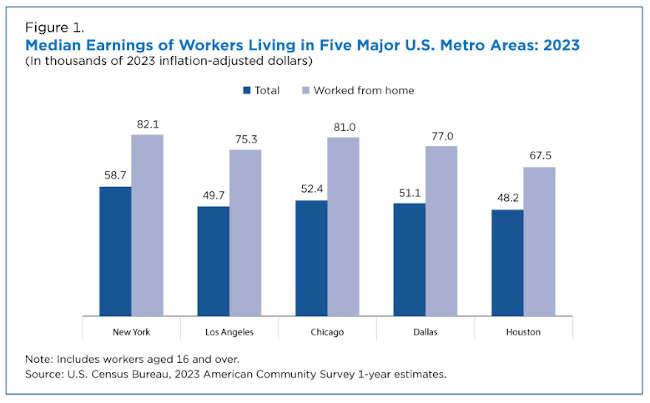
In five of the most populous metropolitan areas in the United States, home-based workers consistently showed higher median earnings than all workers in 2023 (Figure 1).

Among home-based workers in these five metro areas, median earnings were highest in the New York and Chicago metros (over $80,000), and lowest in the Houston metro (under $70,000).

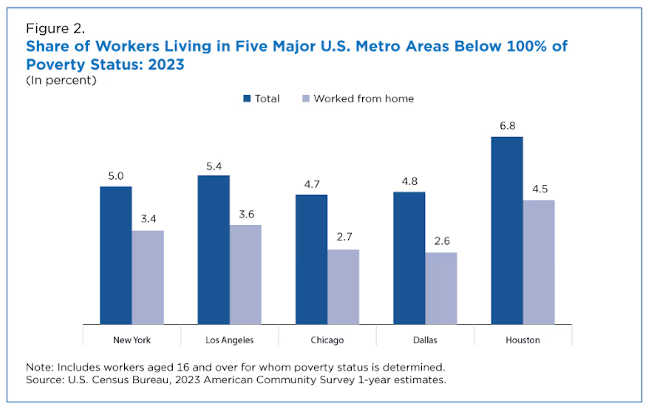
Figure 2 displays the percentage of workers living below the poverty level in five of the most populous metro areas.

In line with their generally higher earnings, a smaller share of home-based workers lived below 100% of the poverty level in 2023 than all workers in each metro area included in this analysis.

Among all workers in these metro areas, the Houston metro had the highest percentage (6.8%) of all workers living below the poverty level.

The dynamic relationship between people and their jobs provides valuable context for understanding numerous dimensions of individual wellbeing. The ACS will continue to collect data that help describe changing commuting and employment trends in the United States.

Michael Burrows, Charlynn Burd and Mehreen S. Ismail are survey statisticians in the Census Bureau’s Social, Economic, and Housing Statistics Division.

Lake County Farm Bureau named 2024 County Farm Bureau of the Year

Details
Written by: LAKE COUNTY NEWS REPORTS
Published: 19 January 2025
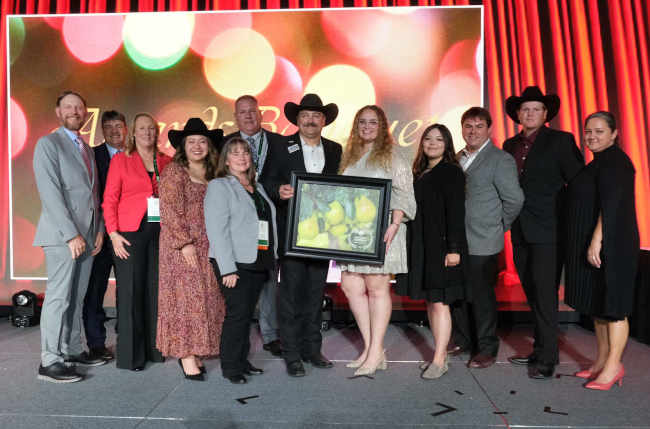
Members of the Lake County Farm Bureau receiving the 2024 County Farm Bureau of the Year Award in Monterey, California, in December 2024. Courtesy photo.

LAKE COUNTY, Calif. — The Lake County Farm Bureau has received a prestigious statewide award.

LCFB has been named the 2024 California Farm Bureau, County Farm Bureau of the Year for counties with up to 300 agricultural members.

This prestigious honor was presented at the 106th California Farm Bureau Annual Meeting in Monterey last month, and highlights the exceptional efforts of LCFB to serve its members and the broader community.

This recognition celebrates a year of outstanding achievements, including:

● Exceeding membership goals: In February, LCFB set an ambitious target to recruit 60 new members. By October, the goal was surpassed, strengthening the voice and representation of Lake County agriculture.
● Enhanced member benefits: LCFB added valuable new discounts, including propane and local agricultural supply savings.
● Expanded outreach: Initiatives like the launch of a weekly e-newsletter, educational workshops, and a supervisor candidate forum deepened member engagement.
● Community engagement: Events like Punkin Chunkin united youth and agriculture in fun, meaningful ways.
● Advocacy and natural resource stewardship: LCFB championed critical issues like water quality and availability, while actively engaging in presentations and conversations with community stakeholders.

In addition to this award, Executive Director Rebecca Harper and staff member Serena Oñate
were honored with the Outstanding Membership Award, recognizing their exceptional efforts
in membership recruitment and engagement.

“This award is a reflection of the incredible dedication and hard work of our Board of Directors,
staff, and members,” said Harper. “From recruiting new members to fostering community connections, each of you plays a vital role in our success. I am truly inspired by the passion and commitment that drive our organization forward.”

The award announcement said it’s “a testament to the collective creativity, dedication, and vision that fuel the Lake County Farm Bureau’s ongoing mission to advocate for agriculture and support the farming community.”

For more information about the LCFB, contact Harper at This email address is being protected from spambots. You need JavaScript enabled to view it.t.

MLK’s ‘beloved community’ has inspired social justice work for decades − what did he mean?

Details
Written by: Jason Oliver Evans, University of Virginia
Published: 19 January 2025


Volunteers paint columns in a hallway during the Martin Luther King Jr. National Day of Service at Ron Brown College Preparatory High School in Washington, D.C., in 2019. Katherine Frey/The Washington Post via Getty Images

Since 1983, when President Ronald Reagan signed Martin Luther King Jr. Day into law, many Americans have observed the federal holiday to commemorate the life and legacy of the civil rights leader, Baptist minister and theologian.

MLK Day volunteers typically perform community service that continues King’s fight to end racial discrimination and economic injustice – to build the “beloved community,” as he often said.

King does not fully explain the phrase’s meaning in his published writings, speeches and sermons. Scholars Rufus Burrow Jr. and Lewis V. Baldwin, however, argue that the beloved community is King’s principal ethical goal, guiding the struggle against what he called the “three evils of American society”: racism, economic exploitation and militarism.

As a Baptist minister and theologian myself, I believe it is important to understand the origins of the concept of the beloved community, how King understood it and how he worked to make it a reality.

Older origins

Although King popularized the beloved community, the phrase has roots in the thought of 19th-century American religious philosopher Josiah Royce.

In 1913, toward the end of his long career, Royce published “The Problem of Christianity.” The book compiles lectures on the Christian religion, including the idea of the church and its mission, and coined the term beloved community. Based on his readings of the biblical gospels, as well as the writings of the apostle Paul, Royce argued that the beloved community was one where individuals are transformed by God’s love.

A black and white portrait of a man in a dark suit jacket and black bow tie.
Philosopher Josiah Royce (1855-1916). The Royce Society via Wikimedia Commons

In turn, members express that love as loyalty toward each other – for example, the devoted love a member of the church would have toward the church as a whole.

While Royce often identified the beloved community with the church, he extends the concept beyond the walls of Christianity. In any type of community, Royce argued, from clans to nations, there are individuals who express love and devotion not only to their own community, but who foster a sense of the community that includes all humankind.

According to Royce, the ideal or beloved community is a “universal community” – one to which all human beings belong or will eventually belong at the end of time.

‘Beloved’ diversity

Twentieth-century pastor, philosopher, mystic, theologian and civil rights leader Howard Thurman retrieved Royce’s idea of the beloved community and applied it to his life and work, most notably in his 1971 book “The Search for Common Ground.”

Thurman first used the term in an unpublished and undated article: Desegregation, Integration, and the Beloved Community. Here, he argued that the beloved community cannot be achieved by sheer will or commanded by force. Rather, it begins with transformation in each person’s “human spirit.” The seeds of the beloved community extend outward into society as each person assumes the responsibility of bringing it to pass.

Thurman envisioned the beloved community as one that exemplifies harmony – harmony enriched by members’ diversity. It is a community wherein people from all racial, national, religious and ethnic backgrounds are respected, and where their human dignity is affirmed. Thurman was convinced that beloved community was achievable because of the dedication he saw from activists during the struggle for racial integration.

A man in clerical robes photographed sitting off-center in the frame, against a white wall.
Minister, theologian and civil rights activist Howard Thurman. On Being/Flickr, CC BY-NC-SA

During his lifetime, Thurman sought to build this beloved community through his activism for racial justice. For example, he co-founded the Church for the Fellowship of All Peoples, an interracial and interfaith community in San Francisco, which he co-pastored from 1943 to 1953.

Thurman’s writings and activism deeply influenced King. Burrow argued that it is not entirely clear when and where King first learned the concept of beloved community. Yet King emphasized its importance in much of his writing and political action.

Love and action

In simplest terms, King defined the beloved community as a community transformed by love. Like Royce, he drew his understanding of love from the Bible’s New Testament. In the original Greek, the Gospels use the word “agape,” which suggests God’s self-giving, unconditional love for humanity – and, by extension, human beings’ self-giving, unconditional love for each other.

According to Baldwin, however, King’s understanding of the beloved community is better understood against the backdrop of the Black church tradition. Raised in the Ebenezer Baptist Church of Atlanta, King learned lessons on the meaning of love from his parents, Rev. Martin Luther King Sr. – Ebenezer’s pastor, who was also a leader in the local chapter of the National Association for the Advancement of Colored People – and Alberta Christine Williams King.

One of the distinctions in King’s thought is that he believed the beloved community could be achieved through nonviolent direct action, such as sit-ins, marches and boycotts. In part, he was inspired by Thurman, who had embraced the nonviolence at the heart of Mahatma Gandhi’s resistance against the British in India. For King, nonviolence was the only viable means for achieving the United States of America’s redemption from the sin of racial segregation and white supremacy.

A crowd of people walking in lines march in suits and ties, with one participant holding an American flag.
Martin Luther King Jr. and his wife, Coretta, lead a five-day march to the Alabama State Capitol in Montgomery in 1965. Bettmann via Getty Images

For King, therefore, the beloved community was not merely a utopian vision of the future. He envisioned it as an obtainable ethical goal that all human beings must work collectively toward achieving.

“Only a refusal to hate or kill can put an end to the chain of violence in the world and lead us toward a community where men can live together without fear,” King wrote in 1966. “Our goal is to create a beloved community and this will require a qualitative change in our souls as well as a quantitative change in our lives.”

Searching for the beloved community today

King’s idea of the beloved community has not only influenced people affiliated with the Christian tradition but also people from other faiths and none.

For instance, scholars Elizabeth A. Johnson, bell hooks and Joy James have reflected upon the meaning of the beloved community amid ongoing challenges such as global climate change, sexism, racism and other forms of structural violence.

People around the world continue to draw insight and inspiration from King’s thought, especially from his insistence that love is “the most durable power” to change the world for the better. Questions remain about whether his beloved community can be realized, or how. But I believe it is important to understand King’s ethical concept and its continuing influence on movements that seek an end to injustice.The Conversation

Jason Oliver Evans, Research Associate and Lecturer, University of Virginia

This article is republished from The Conversation under a Creative Commons license. Read the original article.


  1. Helping Paws: Many new puppies
  2. Space News: Hubble’s Night Sky Challenge
  3. Police capture Lakeport man responsible for armed assault
  • 411
  • 412
  • 413
  • 414
  • 415
  • 416
  • 417
  • 418
  • 419
  • 420
How to resolve AdBlock issue?
Refresh this page