How to resolve AdBlock issue?
Refresh this page
How to resolve AdBlock issue?
Refresh this page
Lake County News,California
  • Home
    • Registration Form
  • News
    • Education
    • Veterans
    • Community
      • Obituaries
      • Letters
      • Commentary
    • Police Logs
    • Business
    • Recreation
    • Health
    • Religion
    • Legals
    • Arts & Life
    • Regional
  • Calendar
  • Contact us
    • FAQs
    • Phones, E-Mail
    • Subscribe
  • Advertise Here
  • Login
How to resolve AdBlock issue?
Refresh this page

News

Cutting funding for science can have consequences for the economy, US technological competitiveness

Details
Written by: Chris Impey, University of Arizona
Published: 18 February 2025


National Institutes of Health indirect costs, which are under the knife, go toward managing laboratories and facilities. Fei Yang/Moment via Getty Images

America has already lost its global competitive edge in science, and funding cuts proposed in early 2025 may further a precipitous decline.

Proposed cuts to the federal agencies that fund scientific research could undercut America’s global competitiveness, with negative impacts on the economy and the ability to attract and train the next generation of researchers.

I’m an astronomer, and I have been a senior administrator at the University of Arizona’s College of Science. Because of these roles, I’m invested in the future of scientific research in the United States. I’m worried funding cuts could mean a decline in the amount and quality of research published – and that some potential discoveries won’t get made.

The endless frontier

A substantial part of U.S. prosperity after World War II was due to the country’s investment in science and technology.

Vannevar Bush founded the company that later became Raytheon and was the president of the Carnegie Institution. In 1945, he delivered a report to President Franklin D. Roosevelt called The Endless Frontier.

In this report, Bush argued that scientific research was essential to the country’s economic well-being and security. His advocacy led to the founding of the National Science Foundation and science policy as we know it today. He argued that a centralized approach to science funding would efficiently distribute resources to scientists doing research at universities.
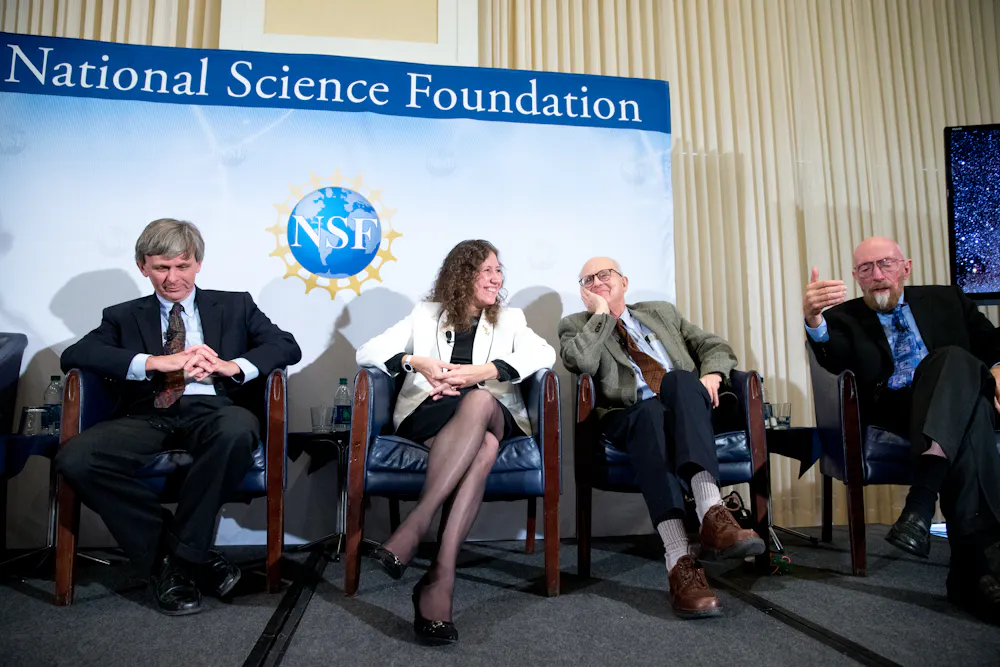
Four scientists sitting in front of a sign reading National Science Foundation, with the NSF logo
The National Science Foundation awards funding to many research projects and early career scientists. Pictured are astronomers from the LIGO collaboration, which won a Nobel Prize. AP Photo/Andrew Harnik

Since 1945, advances in science and technology have driven 85% of American economic growth. Science and innovation are the engines of prosperity, where research generates new technologies, innovations and solutions that improve the quality of life and drive economic development.

This causal relationship, where scientific research leads to innovations and inventions that promote economic growth, is true around the world.

The importance of basic research

Investment in research and development has tripled since 1990, but that growth has been funded by the business sector for applied research, while federal investment in basic research has stagnated. The distinction matters, because basic research, which is purely exploratory research, has enormous downstream benefits.

Quantum computing is a prime example. Quantum computing originated 40 years ago, based on the fundamental physics of quantum mechanics. It has matured only in the past few years to the point where quantum computers can solve some problems faster than classical computers.

A crowd looks at a quantum computer on display, which looks like a large structure containing wires and electronics.
Basic research into quantum physics has allowed quantum computing to develop and advance. AP Photo/Ross D. Franklin

Worldwide, basic research pays for itself and has more impact on economic growth than applied research. This is because basic research expands the shared knowledge base that innovators can draw on.

For example, a biotech advocacy firm calculated that every dollar of funding to the National Institutes of Health generates US$2.46 in economic activity, which is why a recent cut of $9 billion to its funding is so disturbing.

The American public also values science. In an era of declining trust in public institutions, more than 3 in 4 Americans say research investment is creating employment opportunities, and a similar percentage are confident that scientists act in the public’s best interests.

Science superpower slipping

By some metrics, American science is preeminent. Researchers working in America have won over 40% of the science Nobel Prizes – three times more than people from any other country. American research universities are magnets for scientific talent, and the United States spends more on research and development than any other country.

But there is intense competition to be a science superpower, and several metrics suggest the United States is slipping. Research and development spending as a percentage of GDP has fallen from a high of 1.9% in 1964 to 0.7% in 2021. Worldwide, the United States ranked 12th for this metric in 2021, behind South Korea and European countries.

In number of scientific researchers as a portion of the labor force, the United States ranks 10th.

Metrics for research quality tell a similar story. In 2020, China overtook the United States in having the largest share of the top 1% most-cited papers.

China also leads the world in the number of patents, and it has been outspending the U.S. on research in the past few decades. Switzerland and Sweden eclipse the United States in terms of science and technology innovation. This definition of innovation goes beyond research in labs and the number of scientific papers published to include improvements to outcomes in the form of new goods or new services.

Among American educators and workers in technical fields, 3 in 4 think the United States has already lost the competition for global leadership.

Threats to science funding

Against this backdrop, threats made in the beginning of President Donald Trump’s second term to science funding are ominous.

Trump’s first wave of executive orders caused chaos at science agencies as they struggled to interpret the directives. Much of the anxiety involved excising language and programs relating to diversity, equity and inclusion, or DEI.

The National Science Foundation is particularly in the crosshairs. In late January 2025, it froze the routine review and approval of grants and new expenditures, impeding future research, and has been vetting grants to make sure they comply with orders from the U.S. president.

The National Institutes of Health announced on Feb. 7, 2024 a decision to limit overhead rates to 15% which sent many researchers reeling though it has since been temporarily blocked by a judge. The National Institutes of Health is the world’s largest funder of biomedical research, and these indirect costs provide support for the operation and maintenance of lab facilities. They are essential for doing research.

The new administration has proposed deeper cuts. The National Science Foundation has been told to prepare for the loss of half of its staff and two-thirds of its funding. Other federal science agencies are facing similar threats of layoffs and funding cuts.

The impact

Congress already failed to deliver on its 2022 commitment to increase research funding, and federal funding for science agencies is at a 25-year low.

As the president’s proposals reach Congress for approval or negotiation, they will test the traditionally bipartisan support science has held. If Congress cuts budgets further, I believe the impact on job creation, the training of young scientists and the health of the economy will be substantial.

Deep cuts to agencies that account for a small fraction – just over 1% – of federal spending will not put a dent in the soaring budget deficit, but they could irreparably harm one of the nation’s most valuable enterprises.The Conversation

Chris Impey, University Distinguished Professor of Astronomy, University of Arizona

This article is republished from The Conversation under a Creative Commons license. Read the original article.

NOAA’s vast public weather data powers the local forecasts on your phone and TV – a private company alone couldn’t match it

Details
Written by: Christine Wiedinmyer, University of Colorado Boulder and Kari Bowen, University of Colorado Boulder
Published: 17 February 2025


A forecaster monitors incoming data for Hurricane Irma in 2017 at the National Hurricane Center, part of the NOAA. Matt McClain/The Washington Post via Getty Images

The forecasts can seem effortless, but behind the scenes, a vast network of satellites, airplanes, radar, computer models and weather analysts are providing access to the latest data – and warnings when necessary. This data comes from analysts at the National Oceanic and Atmospheric Administration, known as NOAA, and its National Weather Service.

Atmospheric scientists Christine Wiedinmyer and Kari Bowen, who is a former National Weather Service forecaster, explained NOAA’s central role in most U.S. weather forecasts.

When people see a weather report on TV, what went on at NOAA to make that forecast possible?

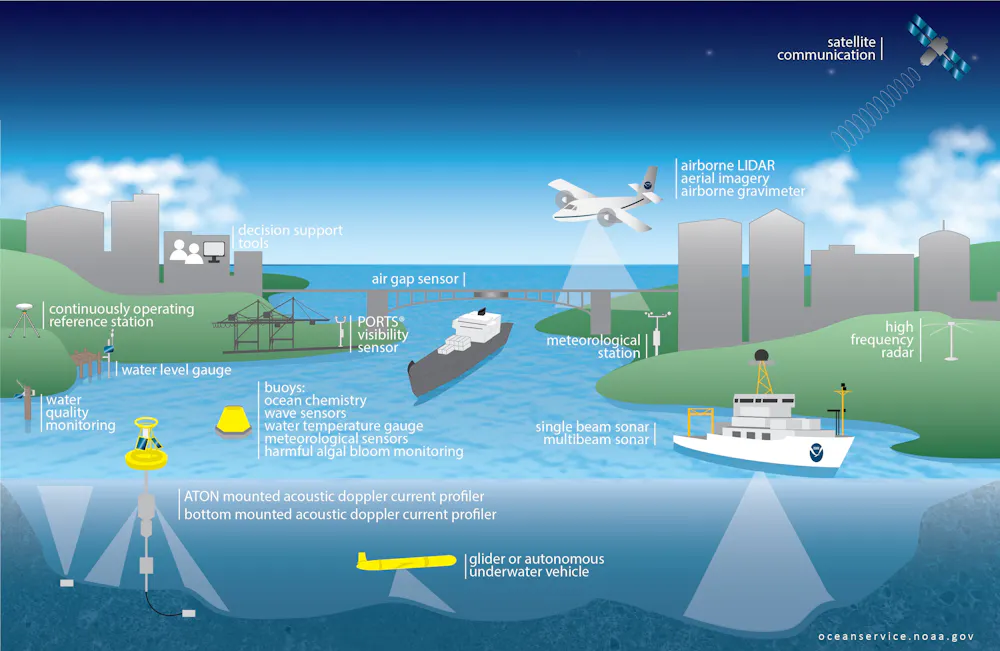
A lot of the weather information Americans rely on starts with real-time data collected by NOAA satellites, airplanes, weather balloons, radar and maritime buoys, as well as weather stations around the world.

All of that information goes into the agency’s computers, which process the data to begin defining what’s going on in different parts of the atmosphere.

NOAA forecasters use computer models that simulate physics and the behavior of the atmosphere, along with their own experience and local knowledge, to start to paint a picture of the weather – what’s coming in a few minutes or hours or days. They also use that data to project seasonal conditions out over weeks or months.

An illustration shows ships, satellites, planes and ocean-going vessels.
NOAA’s data comes from many sources to provide a more complete picture of developing climate and weather conditions. Communities and economies rely on that constantly updated information. NOAA

When severe weather is on the way, the agency issues the official alerts you’ll see in the news and on your phone.

All of this analysis happens before the information reaches private weather apps and TV stations.

No matter who you are, you can freely access that data and the analyses. In fact, a large number of private companies use NOAA data to create fancy maps and other weather products that they sell.

It would be extremely difficult to do all of that without NOAA.

The agency operates a fleet of 18 satellites that are packed with instruments dedicated to observing weather phenomena essential to predicting the weather, from how hot the land surface is to the water content of the atmosphere. Some are geostationary satellites which sit high above different parts of the U.S. measuring weather conditions 24/7. Others orbit the planet. Many of these are operated as part of partnerships with NASA or the Air Force.

Some private companies are starting to invest in satellites, but it would take an enormous amount of money to replicate the range of instrumentation and coverage that NOAA has in place. Satellites only last so long and take time to build, so NOAA is continually planning for the future, and using its technical expertise to develop new instruments and computer algorithms to interpret the data.

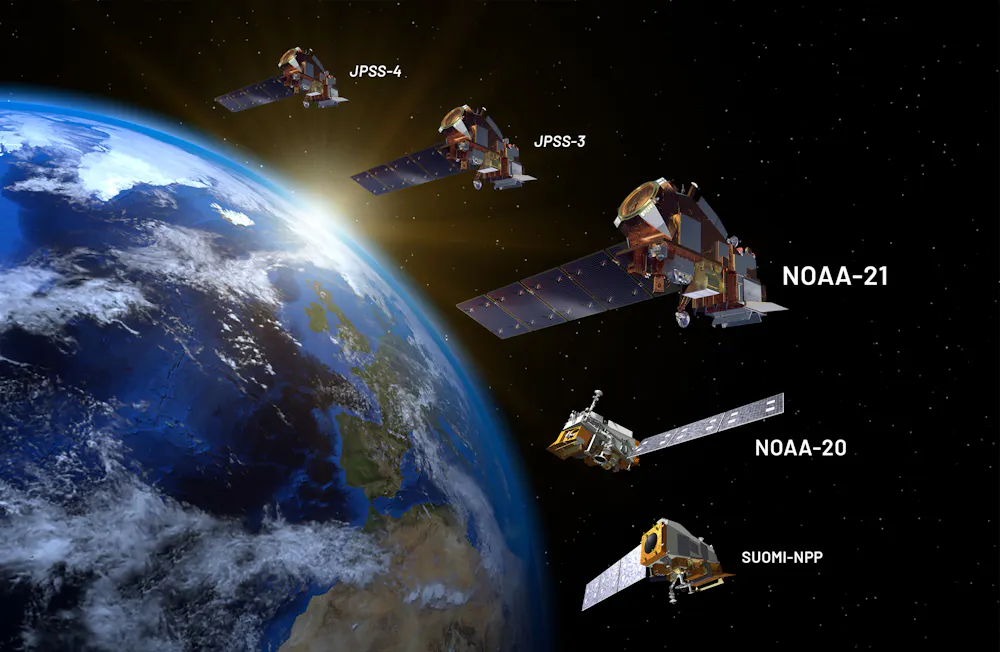
An illustration of several NOAA satellites.
NOAA’s low earth orbiting satellites circle the planet from pole to pole and across the equator 14 times a day to provide a full picture of the year twice a day. The agency also has geostationary satellites that provide continuous coverage over the U.S. NOAA

Maritime buoys are another measuring system that would be difficult to replicate. Over 1,300 buoys across oceans around the world measure water temperature, wind and wave height – all of which are essential for coastal warnings, as well as long-term forecasts.

Weather observation has been around a long time. President Ulysses S. Grant created the first national weather service in the War Department in 1870. It became a civilian service in 1880 under the Department of Agriculture and is now in the Commerce Department. The information its scientists and technologists produce is essential for safety and also benefits people and industries in a lot of ways.

Could a private company create forecasts on its own without NOAA data?

It would be difficult for one company to provide comprehensive weather data in a reliable way that is also accessible to the entire public.

Some companies might be able to launch their own satellite, but one satellite only gives you part of the picture. NOAA’s weather observation network has been around for a long time and collects data from points all over the U.S. and the oceans. Without that robust data, computer models and the broad network of forecasters and developers, forecasting also becomes less reliable.

Analyzing that data is also complex. You’re not going to be able to take satellite data, run a model on a standard laptop and suddenly have a forecast.

And there’s a question of whether a private company would want to take on the legal risk of being responsible for the nation’s forecasts and severe weather warnings.

Neil Jacobs, nominated to oversee NOAA, explains why the agency is essential for accurate national weather forecasting, and why private companies might not want to take on the legal risk on their own.

NOAA is taxpayer-funded, so it is a public good – its services provide safety and security for everyone, not just those who can pay for it.

If weather data was only available at a price, one town might be able to afford the weather information necessary to protect its residents, while a smaller town or a rural area across the state might not. If you’re in a tornado-prone area or coastal zone, that information can be the difference between life or death.

Is climate data and research into the changing climate important for forecasts?

The Earth’s systems – its land, water and the atmosphere – are changing, and we have to be able to assess how those changes will impact weather tomorrow, in two weeks and far into the future.

Rising global temperatures affect weather patterns. Dryness can fuel wildfires. Forecasts have to take the changing climate into account to be accurate, no matter who is creating the forecast.

Drought is an example. The dryness of the Earth controls how much water gets exchanged with the atmosphere to form clouds and rainfall. To have an accurate weather prediction, we need to know how dry things are at the surface and how that has changed over time. That requires long-term climate information.

NOAA doesn’t do all of this by itself – who else is involved?

NOAA partners with private sector, academia, nonprofits and many others around the world to ensure that everyone has the best information to produce the most robust weather forecasts. Private weather companies and media also play important roles in getting those forecasts and alerts out more widely to the public.

A lot of businesses rely on accuracy from NOAA’s weather data and forecasts: aviation, energy companies, insurance, even modern tractors’ precision farming equipment. The agency’s long-range forecasts are essential for managing state reservoirs to ensure enough water is saved and to avoid flooding.

The government agency can be held accountable in a way private businesses are not because it answers to Congress. So, the data is trustworthy, accessible and developed with the goal to protect public safety and property for everyone. Could the same be said if only for-profit companies were producing that data?The Conversation

Christine Wiedinmyer, Associate Director for Science at CIRES, University of Colorado Boulder and Kari Bowen, Atmospheric Scientist, Program Manager at CIRES, University of Colorado Boulder

This article is republished from The Conversation under a Creative Commons license. Read the original article.
When a hurricane or tornado starts to form, your local weather forecasters can quickly pull up maps tracking its movement and showing where it’s headed. But have you ever wondered where they get all that information?

Western Region Town Hall to discuss biochar project

Details
Written by: Elizabeth Larson
Published: 17 February 2025
UPPER LAKE, Calif. — The Western Region Town Hall will meet this week to discuss a biochar project which community members are appealing.

The meeting will take place from 5:30 to 7 p.m. Wednesday, Feb. 19, in the Habematolel tribal room, 9460 Main St. in Upper Lake.

The meeting also will be available on Zoom. The link is here; the webinar ID is 833 1071 8838, passcode is 222669.

On the agenda is a discussion of a biochar project proposed by Scotts Valley Energy on county-owned property that the Lake County Planning Commission approved late last year. Community members have joined together and are appealing the project to the Board of Supervisors.

In other business, Angela DePalma-Dow of Lake County Water Resources will discuss with the group the Clover Creek diversion channel.

There also will be subcommittee reports on Upper Lake traffic safety, Pyle Road and the Upper Lake levees.

Email Elizabeth Larson at This email address is being protected from spambots. You need JavaScript enabled to view it.. Follow her on Twitter, @ERLarson, and on Bluesky, @erlarson.bsky.social. Find Lake County News on the following platforms: Facebook, @LakeCoNews; X, @LakeCoNews; Threads, @lakeconews, and on Bluesky, @lakeconews.bsky.social.

Flu activity remains high, but it’s not too late to get vaccinated

Details
Written by: LAKE COUNTY NEWS REPORTS
Published: 17 February 2025
Seasonal influenza cases and activity are high in California, but it’s not too late to get the flu shot to prevent severe illness and hospitalization.

The California Department of Public Health, or CDPH, recommends all Californians six months of age and older receive the flu vaccine to help protect against flu complications.

“Over the last several weeks, we have seen an increase in flu cases and hospitalizations,” said Dr. Erica Pan, CDPH director and State Public Health officer. “As long as flu is circulating in our communities, it’s not too late to get your flu vaccine, so we encourage all Californians who have not yet received their flu vaccine to get vaccinated. As a parent and a pediatrician, I ensure my family gets flu vaccine every year because I am confident the flu vaccine is safe and can help prevent serious illness like pneumonia and hospitalization."

Flu test positivity remains very high at 26.7% for the week ending Feb. 8. This indicates a continued high level of flu activity across the state.

This winter, flu has caused more hospitalizations than COVID-19 for all age groups. In addition, CDPH has received reports of 11 children who have had flu related deaths. This is a reminder that influenza can cause severe illness in people of all ages.

Additional influenza data is available on CDPH’s Respiratory Virus Report.

At the same time, fewer Californians have received the seasonal flu vaccine than in years past. Vaccines are safe and effective at protecting against severe illness due to flu, and CDPH continues to recommend that all eligible individuals ages six months and older to receive a flu vaccine.

Scheduling: Schedule a vaccine appointment by visiting MyTurn.ca.gov, or contacting your local pharmacy or health care provider.

Cost: Flu vaccines are covered for most people through their health insurance plans, including Medi-Cal and regular health care providers. Those having difficulty obtaining vaccines can contact their health care provider or local health department for help finding a place to get immunized.

The Vaccines For Children, or VFC, program is a federally funded program that provides vaccines at no cost to children (18 and younger) who might not otherwise be vaccinated because of an inability to pay. Contact your doctor to learn if they are enrolled in VFC or visit MyTurn to find a location based on your eligibility.

Protect Yourself and Your Loved Ones: In addition to vaccines, people can follow simple actions to prevent viruses from spreading this winter.

Stay Home When Sick: Flu is a contagious respiratory illness, staying home when you're sick helps prevent the spread to others.

Test and Treat: If you have symptoms (like fever, chills, body aches, runny or stuffy nose, cough, sore throat, stomach issues), contact your health care provider and ask about prescription medications which work best when started right after symptoms begin. Learn more about flu treatments.

Wear a High-quality Mask (N95, KN95, KF94) in Indoor Public Places: Wearing a mask significantly reduces the spread of the flu, especially in crowded or poorly ventilated spaces.

Wash Hands: Wash hands throughout the day with soap and warm water for at least 20 seconds. If soap and water are not available, use a hand sanitizer with at least 60% alcohol.

Cover Coughs and Sneezes: Remember to cough or sneeze into your elbow, your arm, or a disposable tissue to help prevent the spread of viruses. Wash or sanitize your hands and dispose of your tissue after.

Ventilate Indoor Spaces: Good ventilation helps reduce the spread of viruses. If it is safe to do so, open doors and windows as much as possible to bring in fresh outdoor air. This can help keep virus particles from building up indoors.

Get more information about respiratory virus prevention by visiting CDPH's Influenza (Flu) webpage.
  1. Bipartisan bill introduced to promote wildfire mitigation through wildlife grazing
  2. Salato named ACSA Region 4 Superintendent of the Year
  3. Thompson blasts Musk for firing all federal agriculture smoke exposure researchers in California
  • 379
  • 380
  • 381
  • 382
  • 383
  • 384
  • 385
  • 386
  • 387
  • 388
How to resolve AdBlock issue?
Refresh this page