How to resolve AdBlock issue?
Refresh this page
How to resolve AdBlock issue?
Refresh this page
Lake County News,California
  • Home
    • Registration Form
  • News
    • Education
    • Veterans
    • Community
      • Obituaries
      • Letters
      • Commentary
    • Police Logs
    • Business
    • Recreation
    • Health
    • Religion
    • Legals
    • Arts & Life
    • Regional
  • Calendar
  • Contact us
    • FAQs
    • Phones, E-Mail
    • Subscribe
  • Advertise Here
  • Login
How to resolve AdBlock issue?
Refresh this page

News

If FEMA didn’t exist, could states handle the disaster response alone?

Details
Written by: Ming Xie, University of Maryland, Baltimore County
Published: 15 February 2025


Hurricane Ian caused widespread damage in Florida in 2022, estimated at over $112 billion. This scene was once a shopping center. Giorgio Veira/AFP via Getty Images

Imagine a world in which a hurricane devastates the Gulf Coast, and the U.S. has no federal agency prepared to quickly send supplies, financial aid and temporary housing assistance.

Could the states manage this catastrophic event on their own?

Normally, the Federal Emergency Management Agency, known as FEMA, is prepared to marshal supplies within hours of a disaster and begin distributing financial aid to residents who need help.

However, with President Donald Trump questioning FEMA’s future and suggesting states take over recovery instead, and climate change causing more frequent and severe disasters, it’s worth asking how prepared states are to face these growing challenges without help.

What FEMA does

FEMA was created in 1979 with the job of coordinating national responses to disasters, but the federal government has played important roles in disaster relief since the 1800s.

During a disaster, FEMA’s assistance can begin only after a state requests an emergency declaration and the U.S. president approves it. The request has to show that the disaster is so severe that the state can’t handle the response on its own.

FEMA’s role is to support state and local governments by coordinating federal agencies and providing financial aid and recovery assistance that states would otherwise struggle to supply on their own. FEMA doesn’t “take over,” as a misinformation campaign launched during Hurricane Helene claimed. Instead, it pools federal resources to allow states to recover faster from expensive disasters.

During a disaster, FEMA:

  • Coordinates federal resources. For example, during Hurricane Ian in 2022, FEMA coordinated with the U.S. Coast Guard, the Department of Defense and search-and-rescue teams to conduct rescue operations, organized utility crews to begin restoring power and also delivered water and millions of meals.

  • Provides financial assistance. FEMA distributes billions of dollars in disaster relief funds to help individuals, businesses and local governments recover. As of Feb. 3, 2025, FEMA aid from 2024 storms included US$1.04 billion related to Hurricane Milton, $416.1 million for Hurricane Helene and $112.6 million for Hurricane Debby.

  • Provides logistical support. FEMA coordinates with state and local governments, nonprofits such as the American Red Cross and federal agencies to supply cots, blankets and hygiene supplies for emergency shelters. It also works with state and local partners to distribute critical supplies such as food, water and medical aid.

The agency also manages the National Flood Insurance Program, offers disaster preparedness training and helps states develop response plans to improve their overall responses systems.

What FEMA aid looks like in a disaster

When wildfires swept through Maui, Hawaii, in August 2023, FEMA provided emergency grants to cover immediate needs such as food, clothing and essential supplies for survivors.

The agency arranged hotel rooms, rental assistance and financial aid for residents who lost homes or belongings. Its Direct Housing Program has spent $295 million to lease homes for more than 1,200 households. This comprehensive support helped thousands of people begin rebuilding their lives after losing almost everything.

FEMA also helped fund construction of a temporary school to ensure that students whose schools burned could continue their classes. Hawaii, with its relatively small population and limited emergency funds, would have struggled to mount a comparable response on its own.
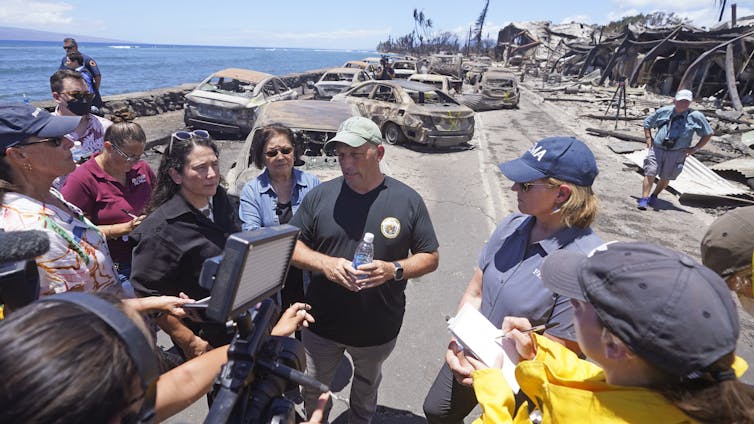
A man wearing a T-shirt with the state seal of Hawaii speaks with reporters, standing next to a woman with 'FEMA' on her cap and shirt with ocean and burned properties behind them.
Hawaii Gov. Josh Green, center, and then-FEMA Administrator Deanne Criswell speak to reporters in Lahaina, Hawaii, on Aug. 12, 2023, while assessing the wildfire damage there. AP Photo/Rick Bowmer

Larger states often need help, too. When a 2021 winter storm overwhelmed Texas’ power grid and water infrastructure, FEMA coordinated the delivery of essential supplies, including water, fuel, generators and blankets, following the disaster declaration on Feb. 19, 2021. Within days, it awarded more than $2.8 million in grants to help people with temporary housing and home repairs.

Which states would suffer most without FEMA?

Without FEMA or other federal support, states would have to manage the disaster response and recovery on their own.

States prone to frequent disasters, such as Louisiana and Florida, would face expensive recurring challenges that would likely exacerbate recovery delays and reduce their overall resilience.

Smaller, more rural and less wealthy states that lack the financial resources and logistical capabilities to respond effectively would be disproportionately affected.

“States don’t have that capability built to handle a disaster every single year,” Lynn Budd, director of the Wyoming Office of Homeland Security, told Stateline in an interview. Access to FEMA avoids the need for expensive disaster response infrastructure in each state.

States might be able to arrange regional cooperation. But state-led responses and regional models have limitations. The National Guard could assist with supply distribution, but it isn’t designed to provide fast financial aid, housing or long-term recovery options, and the supplies and the recovery effort still come at a cost.
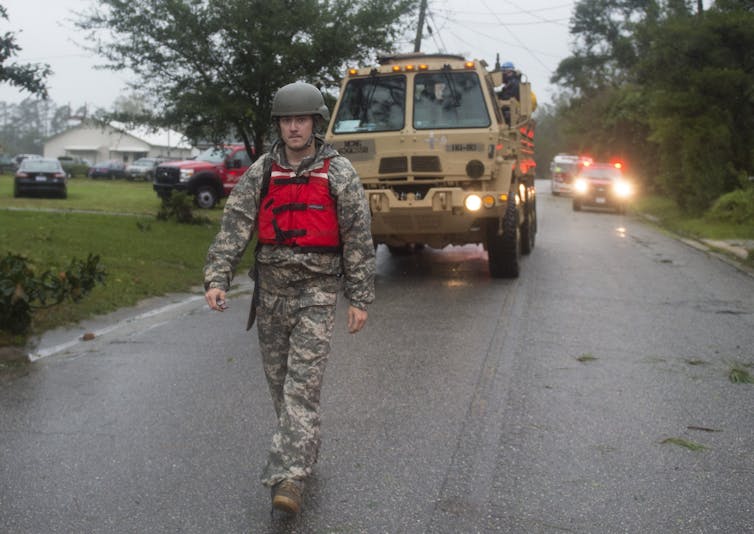
A National Guard member walks in front of search and rescue vehicles.
Members of the National Guard and a FEMA search-and-rescue team work together in the disaster response after Hurricane Florence pounded Wilmington, N.C., in September 2018. Andrew Caballero-Reynolds/AFP via Getty Images

Wealthier states might be better equipped to manage on their own, but poorer states would likely struggle. States with less funding and infrastructure would be left relying on nonprofits and community-based efforts. But these organizations are not capable of providing the scope of services FEMA can.

Any federal funding would also be slow if Congress had to approve aid after each disaster, rather than having FEMA already prepared to respond. States would be at the mercy of congressional infighting.

In the absence of a federal response and coordinating role, recovery would be uneven, with wealthier areas recovering faster and poorer areas likely seeing more prolonged hardships.

What does this mean?

Coordinating disaster response is complex, the paperwork for federal assistance can be frustrating, and the agency does draw criticism. However, it also fills an important role.

As the frequency of natural disasters continues to rise due to climate change, ask yourself: How prepared is your state for a disaster, and could it get by without federal aid?The Conversation

Ming Xie, Assistant Professor of Emergency Management and Public Health, University of Maryland, Baltimore County

This article is republished from The Conversation under a Creative Commons license. Read the original article.


Estate Planning: Managing the affairs of an aging parent

Details
Written by: DENNIS FORDHAM
Published: 15 February 2025
Dennis Fordham. Courtesy photo.

As a parent ages, or declines in health, he or she may see the need to rely more on their children, typically, to manage their financial, property and legal matters.

This includes managing assets titled to the parent’s living trust, assets owned individually by the parent, and the parent’s other financial and legal affairs.

Relinquishing control is difficult. A parent may fear becoming a bystander. How can an aging parent remain involved with their finances, avoid losing access to their assets, and still receive assistance?

First, consider the parent’s trust owned assets, usually real property and investment accounts. Trust assets can either be co-managed by the parent and one or more children together as co-trustees or be managed by the child(ren) as trustee(s) with the parent’s indirect (behind the scenes) involvement.

An aging or ill parent may decide to remain as a co-trustee to keep his or her name on title to trust assets.

The trust may give the other trustees varying degrees of authority, including independent authority so that any one trustee can act on behalf of the trust without requiring the written consent or joinder of the other trustees.

This last approach is not without risk should the trustees not act in concert with each other or if disagreements arise. Nonetheless, it is a flexible option that allows one or more children to assist in managing the trust.

Alternatively, a parent may resign as trustee but indirectly control the living trust assets. I say indirectly because the trustee of a revocable trust owes their fiduciary duties as trustee to the person with the authority to revoke the trust, in our discussion the parent.

Thus, the child as trustee owes the duty to the parent as the settlor because the assets in the living trust belong to the settlor who can revoke the trust and regain direct title to the assets. Moreover, the parent can terminate and replace trustees.

Second, consider the parent’s financial, property and legal affairs outside of managing the parent’s trust own assets, including retirement accounts and government benefits. A parent may appoint a child with present authority to act on behalf of the parent to manage operating accounts and pay day to day expenses; this way parents’ bills and living expenses do not become delinquent.

The scope of authority granted in the power of attorney may be narrow or broad. The parent may also name the child as an authorized signor on one or more of the parent’s bank accounts so that the child can write checks and pay the parent’s bills from such “signor accounts.”

The funds in the account still belong to the parent. However, as with any power of attorney, the possibility for abuse exists.

Third, the parent may also appoint a child, or children, as representatives under an advanced health care directive and Health Insurance Portability Act, or HIPAA, release so that the child can attend doctor meetings, discuss the parent’s health condition, help the parent to understand options and make health care decisions.

Fourth, a lesser level of representative authority can be granted to a “supporter” under a supported decision-making agreement to allow a “supporter” of a disabled person to participate at meetings (including at banks and with professionals) and to act as an advisor to, and as a representative of, a disabled person, as directed by the disabled person.

Depending on the scope of the supported decision-making agreement, the supporter’s role can generally involve many of the same issues covered by powers of attorney and advanced health care directives.

However, the disabled person must still be able to make and communicate their decisions (usually with recommendations) that the supporter can then assist with implementing. This is a much newer approach whose practice remains unfamiliar to most and is not yet so well established.

Lastly, the parent is not limited to relying on children. Trusted friends and professional fiduciaries are alternative options. Anyone who assumes the role does so as a fiduciary with legal duties and liabilities for breach of duties. They need legal guidance.

The foregoing is not legal advice.  Consult a qualified estate planning attorney for guidance.

Dennis A. Fordham, Attorney, is a State Bar-Certified Specialist in estate planning, probate and trust law. His office is at 870 S. Main St., Lakeport, Calif. He can be reached at This email address is being protected from spambots. You need JavaScript enabled to view it. and 707-263-3235. 

Space News: Hubble captures a cosmic cloudscape

Details
Written by: Goddard Space Flight Center
Published: 15 February 2025
This NASA/ESA Hubble Space Telescope reveals clouds of gas and dust near the Tarantula Nebula, located in the Large Magellanic Cloud about 160,000 light-years away. ESA/Hubble & NASA, C. Murray.

The universe is a dusty place, as this NASA/ESA Hubble Space Telescope image featuring swirling clouds of gas and dust near the Tarantula Nebula reveals.

Located in the Large Magellanic Cloud about 160,000 light-years away in the constellations Dorado and Mensa, the Tarantula Nebula is the most productive star-forming region in the nearby universe, home to the most massive stars known.

The nebula’s colorful gas clouds hold wispy tendrils and dark clumps of dust.

This dust is different from ordinary household dust, which may include bits of soil, skin cells, hair, and even plastic.

Cosmic dust is often composed of carbon or of molecules called silicates, which contain silicon and oxygen.

The data in this image was part of an observing program that aims to characterize the properties of cosmic dust in the Large Magellanic Cloud and other nearby galaxies.

Dust plays several important roles in the universe. Even though individual dust grains are incredibly tiny, far smaller than the width of a single human hair, dust grains in disks around young stars clump together to form larger grains and eventually planets.

Dust also helps cool clouds of gas so that they can condense into new stars. Dust even plays a role in making new molecules in interstellar space, providing a venue for individual atoms to find each other and bond together in the vastness of space.

Witness recounts shooting that took life of poet

Details
Written by: Elizabeth Larson
Published: 14 February 2025
LAKEPORT, Calif. — The man who witnessed the killing of his friend in Library Park has offered an account of the incident as part of attempting to clear up incorrect information circulating in the community.

The shooting on the night of Friday, Jan. 31, took the life of 32-year-old Vicente Zeta Colacion of Lakeport.

Joshua Jacob Tovar, 33, has been charged with the killing. Authorities are investigating the role of a second man, Parker John Coggins, 27, also of Lakeport, who could face charges in the case.

Lake County News spoke with a witness to Colacion’s killing. He asked that his name not be used due to fear of retaliation.

Separately, Lake County News confirmed with Lakeport Police Chief Dale Stoebe that the man was indeed a witness to the crime.

The witness said he and Colacion were at the Clearlake Club on Main Street on the night of the shooting. He said he and Colacion, a poet, were reciting poetry back and forth to each other.

They had gone outside, but Colacion decided to go back into the bar. It was then that there was a dispute between Colacion and Coggins, who came out of the bar, followed by Colacion.

Colacion, followed by his friend, went to Library Park where Coggins and two other men, one of them believed by authorities to be Tovar, were standing by a large tree by the seawall.

The witness said he followed Colacion as he approached the three men, one of whom pulled out a gun and threatened to shoot. As soon as he did that, Colacion’s friend said he put up his hands and backed away.

Before Colacion could back away, Coggins attacked him and hit him with a bluetooth speaker. The witness said Colacion, in turn, knocked Coggins to the ground.

A man police believed to be Tovar then pulled a gun and shot Colacion, the witness said. There were a total of three shots.

“It didn’t seem to stop them. They kept fighting,” Colacion’s friend said.

He said Colacion and Coggins continued to fight, with Coggins knocked to the ground.

“There was no drug deal involved. There was no knife involved. There was no gang members involved. It was just a matter of a simple physical dispute that could have been handled,” Colacion’s friend explained.

After the fight, the suspects walked northbound. “I dropped to my knees and grabbed Vicente,” Colacion’s friend said.

He said Colacion had been shot twice but he only saw one wound, and it caused Colacion to suffer massive bleeding.

The witness said he placed Colacion on his side so he could breathe while holding pressure on his wound and calling 911.

“He passed before the police got here,” the witness said.

Tovar, who is being represented by the Public Defender’s Office, will return to court on March 26 for his preliminary hearing.

Email Elizabeth Larson at This email address is being protected from spambots. You need JavaScript enabled to view it.. Follow her on Twitter, @ERLarson, and on Bluesky, @erlarson.bsky.social. Find Lake County News on the following platforms: Facebook, @LakeCoNews; X, @LakeCoNews; Threads, @lakeconews, and on Bluesky, @lakeconews.bsky.social.
  1. Field, Rosenthal appointed to Lake County Planning Commission
  2. Community members invited to give input on hazard mitigation plan
  3. Clearlake Animal Control: Adopt your Valentine
  • 382
  • 383
  • 384
  • 385
  • 386
  • 387
  • 388
  • 389
  • 390
  • 391
How to resolve AdBlock issue?
Refresh this page
