How to resolve AdBlock issue?
Refresh this page
How to resolve AdBlock issue?
Refresh this page
Lake County News,California
  • Home
    • Registration Form
  • News
    • Education
    • Veterans
    • Community
      • Obituaries
      • Letters
      • Commentary
    • Police Logs
    • Business
    • Recreation
    • Health
    • Religion
    • Legals
    • Arts & Life
    • Regional
  • Calendar
  • Contact us
    • FAQs
    • Phones, E-Mail
    • Subscribe
  • Advertise Here
  • Login
How to resolve AdBlock issue?
Refresh this page

News

Space News: Colliding plasma ejections from the Sun generate huge geomagnetic storms − studying them will help scientists monitor future space weather

Details
Written by: Shirsh Lata Soni, University of Michigan
Published: 22 February 2025


The Sun periodically ejects huge bubbles of plasma from its surface that contain an intense magnetic field. These events are called coronal mass ejections, or CMEs. When two of these ejections collide, they can generate powerful geomagnetic storms that can lead to beautiful auroras but may disrupt satellites and GPS back on Earth.

On May 10, 2024, people across the Northern Hemisphere got to witness the impact of these solar activities on Earth’s space weather.

Bright colors visible across the night sky, with a tree silhouetted in the foreground.
The northern lights, as seen here from Michigan in May 2024, are caused by geomagnetic storms in the atmosphere. Shirsh Lata Soni

Two merging CMEs triggered the largest geomagnetic storm in two decades, which manifested in brightly colored auroras visible across the sky.

I’m a solar physicist. My colleagues and I aim to track and better understand colliding CMEs with the goal of improving space weather forecasts. In the modern era, where technological systems are increasingly vulnerable to space weather disruptions, understanding how CMEs interact with each other has never been more crucial.

Coronal mass ejections

CMEs are long and twisted – kind of like ropes – and how often they happen varies with an 11-year cycle. At the solar minimum, researchers observe about one a week, but near the solar maximum, they can observe, on average, two or three per day.

During the solar maximum, solar flares and coronal mass ejections are more common.

When two or more CMEs interact, they generate massive clouds of charged particles and magnetic fields that may compress, merge or reconnect with each other during the collision. These interactions can amplify the impact of the CMEs on Earth’s magnetic field, sometimes creating geomagnetic storms.

Why study interacting CMEs?

Nearly one-third of CMEs interact with other CMEs or the solar wind, which is a stream of charged particles released from the outer layer of the Sun.

In my research team’s study, published in May 2024, we found that CMEs that do interact or collide with each other are much more likely to cause a geomagnetic storm – two times more likely than an individual CME. The mix of strong magnetic fields and high pressure in these CME collisions is likely what causes them to generate storms.

During solar maxima, when there can be more than 10 CMEs per day, the likelihood of CMEs interacting with each other increases. But researchers aren’t sure whether they become more likely to generate a geomagnetic storm during these periods.

Scientists can study interacting CMEs as they move through space and watch them contribute to geomagnetic storms using observations from space- and ground-based observatories.

In this study, we looked at three CMEs that interacted with each other as they traveled through space using the space-based observatory STEREO. We validated these observations with three-dimensional simulations.

The CME interactions we studied generated a complex magnetic field and a compressed plasma sheath, which is a layer of charged particles in the upper atmosphere that interacts with Earth’s magnetic field.

When this complex structure encountered Earth’s magnetosphere, it compressed the magnetosphere and triggered an intense geomagnetic storm.

Four images showing a CME–CME interaction based on white-light observations from the STEREO telescope.
Four images show three interacting CMEs, based on observations from the STEREO telescope. In images C and D, you can see the northeast flank of CME-1 and CME-2 that interact with the southwest part of CME-3. Shirsh Lata Soni

This same process generated the geomagnetic storm from May 2024.

Between May 8-9, multiple Earth-directed CMEs erupted from the Sun. When these CMEs merged, they formed a massive, combined structure that arrived at Earth late on May 10, 2024. This structure triggered the extraordinary geomagnetic storm many people observed. People even in parts of the southern U.S. were able to see the northern lights in the sky that night.

More technology and higher stakes

Scientists have an expansive network of space- and ground-based observatories, such as the Parker Solar Probe, Solar Orbiter, the Solar Dynamics Observatory and others, available to monitor the heliosphere – the region surrounding the Sun – from a variety of vantage points.

These resources, coupled with advanced modeling capabilities, provide timely and effective ways to investigate how CMEs cause geomagnetic storms. The Sun will reach its solar maximum in the years 2024 and 2025. So, with more complex CMEs coming from the Sun in the next few years and an increasing reliance on space-based infrastructure for communication, navigation and scientific exploration, monitoring these events is more important than ever.

Integrating the observational data from space-based missions such as Wind and ACE and data from ground-based facilities such as the e-Callisto network and radio observatories with state-of-the-art simulation tools allows researchers to analyze the data in real time. That way, they can quickly make predictions about what the CMEs are doing.

These advancements are important for keeping infrastructure safe and preparing for the next solar maximum. Addressing these challenges today ensures resilience against future space weather.The Conversation

Shirsh Lata Soni, Postdoctoral Research Fellow, University of Michigan

This article is republished from The Conversation under a Creative Commons license. Read the original article.
Clearlake City Council approves eminent domain acquisition for Lakeshore Drive repair project

Details
Written by: Elizabeth Larson
Published: 21 February 2025
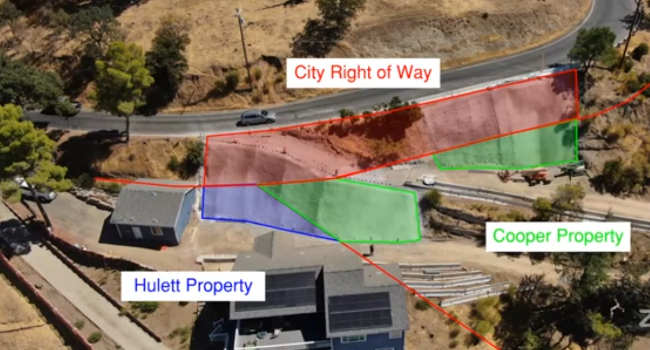
A drone shot of the property owned by Bailey and Andrew Hulett, in blue at the left, that the Clearlake City Council voted to acquire by eminent domain on Thursday, Feb. 20, 2025. Photo courtesy of the city of Clearlake.

LAKE COUNTY, Calif. — What is believed to be the first eminent domain action in the city of Clearlake’s history, which officials said is necessary due to a landslide repair project, has received approval to move forward.

The Clearlake City Council voted Thursday night to approve the eminent domain acquisition of a small portion of a property located at 12105 San Joaquin Ave., over the objection of the owners, Bailey and Andrew Hulett.

City leadership brought the item forward as part of the Gooseneck Landslide Emergency Repair Project, which was necessitated by a February 2024 storm that caused a landslide that threatened the integrity of Lakeshore Drive, a major city roadway for thousands of residents.

Lake County Superior Court records show that the Huletts filed a lawsuit against the city over the eminent domain action on Feb. 5.

“This is a procedurally required step in the eminent domain process,” City Attorney Dean Pucci told the council.

Pucci said that the city received a letter from the Huletts’ attorney, Robert Riggs, at 4:37 p.m. Thursday and at 4:47 p.m. that document was forwarded to the council and later added to the city website. The meeting started at 6 p.m.

Riggs’ letter had three primary requests: A continuance, which Pucci said staff recommended not granting because they believed the request lacked reasonable grounds; making the letter a part of the record; and giving the Huletts an opportunity to speak.

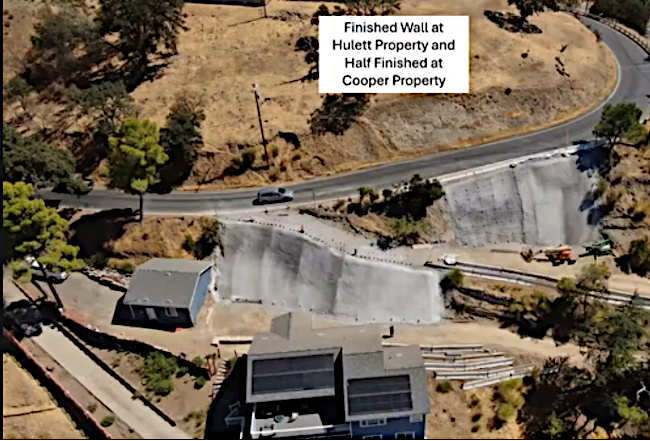
As part of the hearing, Public Works staff gave a report on the landslide repair project, describing the installation of two soil nail walls, a new guardrail on Lakeshore Drive, hydroseeding fo disturbed soil and restoration to as close as possible to the area’s original condition.

Staff said a large portion of the landslide was in the city right of way, but it was impossible to repair only the area of the landslide in the city right of way and not encroach onto private property.

They said the property acquisition is necessary to ensure the landslide area was fully repaired and to prevent future incidents.

The city wants to acquire 790 square feet from the Huletts’ property. The staff report showed the city offered the Huletts $990 for that portion of land.

The staff report showed that the city already has acquired 2,695 square feet from an adjacent parcel at 12115 San Joaquin Ave., owned by Mark and Renee Cooper, for $3,370.

Last week, the Huletts requested staking on the property that the city is looking to acquire, which was completed by a surveyor on Tuesday, city staff reported.

The Huletts spoke during the hearing, with Bailey Hulett reading from the letter from their attorney.

“We do not question the necessity of the project itself,” however they question the need to take their property for the project and the extent of the taking, she said.

They asked that the item be removed from the agenda, explaining that the city hadn’t yet provided them with a plot map or adequately identified the property portion they were seeking. The information they had received, she added, had raised more questions.

They requested to walk the property with a city representative, and objected to any determination that the take of their property as configured is necessary on several grounds, including it not being compatible with the greatest public good and the least private injury, and the amount of property being taken.

The Huletts also said the boundaries of the property to be taken were still not understood, but that as presented, it would cause them to lose parts of their property with standing structures. One boundary line will be immediately adjacent to their home.

There was no other public comment before the council briefly discussed the proposal.

Councilmember Tara Downey said she had a lot of questions and felt there needed to be more information discussed.

As a homeowner herself, she said she understood needing additional time, adding that, from the city’s perspective and safety of people, she understood why the city was trying to get eminent domain for the property.

She said she planned to vote no if the council proceeded.

Vice Mayor DIrk Slooten said there should be some more communication with homeowners about the property survey. “There seems to be some misunderstanding.”

Slooten said it was the state, not the city, requiring the taking of the property because, if the city fails to do so, it will be out a significant amount of money — basically the cost of the landslide repairs.

He moved to approve the resolution, with Councilmember Jessica Hooten seconding.

Before the vote, City Manager Alan Flora told the council, “We have had correspondence over the year of this project with the property owners.”

He said city staff are happy to do additional communication with the Huletts and help them understand the area but still recommended moving forward with the eminent domain action.

Pucci said that any conversations during a walk-through such as the Hulets requested would have to be guarded due to the active litigation between the Huletts and the city. He said he will consult with staff on how to do that.

The council voted 4-1, with Downey the lone dissenter. As it received the fourth-fifths vote Pucci said was required, the motion passed.

City Clerk Melissa Swanson told Lake County News that, after reviewing city resolutions back to incorporation in 1980, she didn’t find anything stating the city has used the eminent domain process before.

Email Elizabeth Larson at This email address is being protected from spambots. You need JavaScript enabled to view it.. Follow her on Twitter, @ERLarson, and on Bluesky, @erlarson.bsky.social. Find Lake County News on the following platforms: Facebook, @LakeCoNews; X, @LakeCoNews; Threads, @lakeconews, and on Bluesky, @lakeconews.bsky.social.

Completed shotcrete walls at the Hulett and Cooper properties on Lakeshore Drive in Clearlake, California. Photo courtesy of the city of Clearlake.

Aerial mosquito control application planned

Details
Written by: Elizabeth Larson
Published: 21 February 2025
This story has been updated with a new time for the treatment.

LAKEPORT, Calif. — In an effort to reduce the number of biting adult mosquitoes emerging this spring, the Lake County Vector Control District will be making an aerial treatment to the marshlands adjacent to the lake between Clear Lake State Park and Lakeport, parts of Anderson Marsh State Park, a small section east of the Clearlake Keys, and a small area near Bridge Arbor South in north Lakeport.

The treatment originally was expected to occur during daylight hours on Friday, Feb. 21. However, that morning, Vector Control said it has been rescheduled to Tuesday, Feb. 25.

The application date and any subsequent changes will be posted on the district’s website.

The application is being made because the district’s winter mosquito surveillance program has detected large numbers of mosquito larvae in the marshlands along the perimeter of the lake that flooded as the lake rose due to the abundant rains.

These mosquito larvae are an early-season floodwater species (Aedes increpitus) that hatch from eggs laid in the mud in previous years as the lake receded. When winter rains flooded the eggs, the larvae hatched and began developing in the still, shallow water.

As temperatures and day length increase in early spring, the Ae. increpitus mosquito larvae will pupate and then emerge as biting adults.

These mosquitoes are the aggressive biters experienced every spring by people living and recreating near this area.

The majority of applications will be made by a yellow crop duster flying at a low altitude over these marshy areas. Some of the marshy areas are near homes, and people may experience a brief noise nuisance from the plane. Additional applications to small areas using a drone are planned in late February or early March. Updates will be posted to the District’s website.

The product applied will be VectoBac GS, a biological larvicide used to control mosquito larvae in aquatic habitats. VectoBac is manufactured by Valent BioSciences, and is based on the naturally occurring soil bacterium, Bacillus thuringiensis israelensis, or Bti.

Vector Control called the VectoBac a “highly effective and economical microbial insecticide” that’s registered with the Environmental Protection Agency for the control of larval mosquitoes in nearly all aquatic habitats.

“Bti is highly selective for the control of mosquito larvae in water and does not affect plants, animals, or beneficial insects that live in or drink the water. The formulation is a biodegradable solid corncob granule coated with Bti. The Bti breaks down rapidly in nature so there is no persistence of the active ingredient. The use of a solid formulation reduces the possibility of drift onto adjacent property,” Vector Control reported.

The Lake County Vector Control District makes every effort to use the safest product available to minimize any health concerns the public may have.

The VectoBac GS label and the Safety Data Sheet are available from the Lake County Vector Control District’s website http://www.lcvcd.org/ or may be requested by calling 707-263-4770.

For more information about the Lake County Vector Control District and its services, please visit our website www.LCVCD.org. 

For information about West Nile virus, visit http://westnile.ca.gov/. 

Information about mosquito repellents can be found on the US Centers for Disease Control and Prevention website at http://www.cdc.gov/westnile/faq/repellent.html.

Clearlake Animal Control: “Riley” and the dogs

Details
Written by: Elizabeth Larson
Published: 21 February 2025
“Riley.” Photo courtesy of Clearlake Animal Control.

CLEARLAKE, Calif. — Clearlake Animal Control has new puppies and adult dogs ready to join their new families.

The shelter has 49 adoptable dogs listed on its website.

This week’s dogs include “Riley,” a 3-month-old female mixed breed puppy.

Shelter staff said she is very playful, and loves other dogs and toys.

The shelter is located at 6820 Old Highway 53. It’s open from 9 a.m. to 6 p.m. Tuesday through Saturday.

For more information, call the shelter at 707-762-6227, email This email address is being protected from spambots. You need JavaScript enabled to view it., visit Clearlake Animal Control on Facebook or on the city’s website.

This week’s adoptable dogs are featured below.

Email Elizabeth Larson at This email address is being protected from spambots. You need JavaScript enabled to view it.. Follow her on Twitter, @ERLarson, and on Bluesky, @erlarson.bsky.social. Find Lake County News on the following platforms: Facebook, @LakeCoNews; X, @LakeCoNews; Threads, @lakeconews, and on Bluesky, @lakeconews.bsky.social.


  1. Governor proposes $125 million in mortgage relief for victims of recent natural disasters
  2. Clearlake City Council to consider eminent domain action, updated state fire mapping
  3. Efforts continue to locate missing Middletown woman
  • 375
  • 376
  • 377
  • 378
  • 379
  • 380
  • 381
  • 382
  • 383
  • 384
How to resolve AdBlock issue?
Refresh this page