How to resolve AdBlock issue?
Refresh this page
How to resolve AdBlock issue?
Refresh this page
Lake County News,California
  • Home
    • Registration Form
  • News
    • Education
    • Veterans
    • Community
      • Obituaries
      • Letters
      • Commentary
    • Police Logs
    • Business
    • Recreation
    • Health
    • Religion
    • Legals
    • Arts & Life
    • Regional
  • Calendar
  • Contact us
    • FAQs
    • Phones, E-Mail
    • Subscribe
  • Advertise Here
  • Login
How to resolve AdBlock issue?
Refresh this page

News

Why including people with disabilities in the workforce and higher education benefits everyone

Details
Written by: Lauren Shallish, Rutgers University - Newark
Published: 26 February 2025


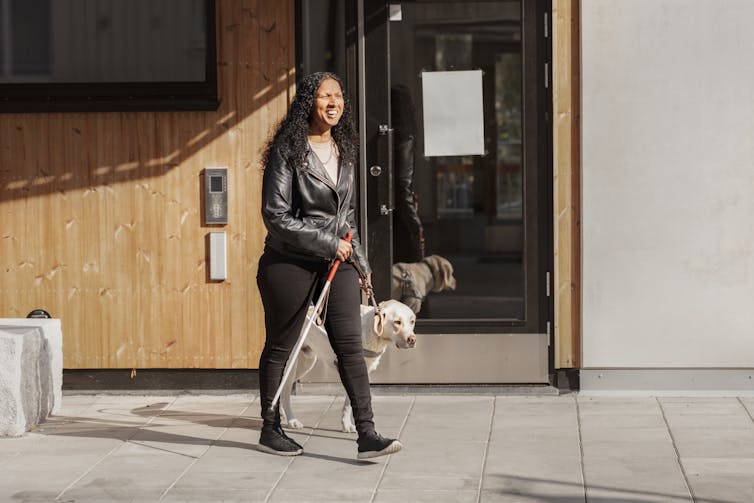
The employment rate for people with disabilities is about half that of nondisabled people. Johner Images via Getty Images

Whether it’s declaring that blindness prevents government employees from doing their jobs or suggesting that hiring workers with intellectual disabilities contributed to Federal Aviation Administration safety lapses, the Trump administration has repeatedly questioned whether people with disabilities belong in the workplace.

This stance reflects widespread stigma and misconceptions about what people with disabilities can and do accomplish.

Negative stereotypes and exclusionary practices persist despite the fact that people with disabilities are the largest minority group in the United States, representing nearly 30% of the population. Whether or not you identify as disabled, most people live or work in close proximity to others with a disability.

For years I have researched how people with disabilities have been kept out of efforts to guarantee equal access for everybody, particularly in higher education. This exclusion is often due to unfounded beliefs about capacity, intellect and merit, and the false premise that disability inclusion requires lowering standards.

However, studies demonstrate that including people with disabilities is good for everyone, not just disabled people. Schools and workplaces are more collaborative and responsive when people with disabilities are included at all levels of the organization. In other words, disability inclusion isn’t about charity; it’s about making organizations work better.

Woman on wheelchair with her colleague at office
The Americans with Disabilities Act, enacted in 1990, provides legal protections for people with disabilities in the workplace. kyotokushige/DigitalVision via Getty Images

Rolling back protections

President Donald Trump issued executive orders the day he took office for a second time that aimed at ending government and private-sector efforts to make U.S. workplaces and schools more diverse, equitable and inclusive. In addition to affecting LGBTQ+ communities and people of color, these measures could erode years of progress toward protecting the rights of people with disabilities to earn a living.

Between 40 million and 80 million Americans identify as disabled. Even the higher end of this range underestimates the actual number of people with disabilities, because some individuals choose not to identify that way or even realize they qualify as such. That includes people with impairments from chemical and pesticide exposure, as well as many older people and those who are living with HIV and AIDS, to name some examples.

Only 15% of people with disabilities are born with their impairment, so most individuals become disabled over their lifetime.

Tracing historical precedents

Blaming failures on people with disabilities and people of color echoes the harms embedded in eugenics, an attempt to scientifically prove genetic inferiority of disabled, LGBTQ+ Indigenous and Black people.

Eugenics led to the institutionalization and forced sterilization of, and the coercive experimentation on, people with disabilities, immigrants and people of color across the U.S. Even the Supreme Court endorsed the concept in the early 20th century.

These studies began to fade after World War II, but their legacy persists. Even today, forced sterilization continues to be lawful in U.S jurisdictions in 31 states and in Washington.

Due to widespread activism and the advent of new legal protections, many states finally dismantled their eugenic policies in the late 1970s. But eugenics-era experiments provided foundations for contemporary medical research, standardized testing and segregated school placements.

People with disabilities have far-reaching legal guarantees of civil rights and access today due to the Americans with Disabilities Act. The statute, which was enacted in 1990 and strengthened in 2008, provided protections in the workplace, educational settings, transportation and places of recreation and commerce, among others. It also guarded against negative perceptions of disability.

For example, if an employer perceived someone as disabled and denied them consideration in the hiring process because of that, the candidate would be protected from discrimination under the ADA – whether or not they had a disability.

While these advances are significant, many people with disabilities still do not have access to their basic civil rights. This is particularly true of Black people with disabilities, as they are disproportionately pushed out of school, disciplined more harshly, targeted for incarceration and marginalized in disability representation and research.

Young man with laptop signing on a video call
Accommodations for people with disabilities enable them to contribute unique talents to classrooms and workplaces. Halfpoint Images via Getty Images

Gaining workplace accommodations

Critics of inclusion efforts sometimes wrongly argue that employing people with disabilities is too costly due to the accommodations they may require. But the Job Accommodation Network in the Department of Labor’s Office of Disability Employment Policy found in 2023 that nearly 60% of these accommodations cost nothing.

What’s more, many tax incentives are available to cover these costs.

Disability civil rights law does not mandate hiring people who are not qualified or lowering standards to include the disabled. The law requires that candidates meet the “essential functions” of the job in order to be hired.

According to a 2024 Labor Department report, the employment rate for working-age people with disabilities was 38% compared with 75% for nondisabled people. Though there are countless reasons for this disparity, many people with disabilities can and want to work, but employers don’t give them the opportunity.

Providing benefits for everyone

Many accommodations designed for people with disabilities also benefit others.

Captioning on videos and movies was originally meant to benefit the deaf community, but it also helps multilingual speakers and people who simply are trying to follow the dialogue. Similarly, visual or written instructions assist people with depression, Down syndrome or attention-deficit/hyperactivity disorder, but they can also make tasks more accessible for everyone, along with breaking assignments into smaller components.

Sensory break rooms benefit people with autism and post-traumatic stress disorder, while also providing a reprieve in a noisy work environment and minimizing distractions. Remote work options can make it easier for people with chronic illnesses to be employed, and they similarly benefit others who may have caregiving responsibilities – helping attract and retain talented employees. Text-to-speech software provides people with cerebral palsy and nonspeaking individuals with options for communication, similar to options that many people already use on their phones.

A large body of research demonstrates the broad benefits of making jobs and schools more accessible to people with disabilities, which is ultimately an advantage for everyone.

Studies on diversity in educational and workplace settings also demonstrate positive outcomes. In a study of 10 public universities, researchers found that students who reported positive, informal interactions with diverse peers had higher scores on measures of more complex thinking, a concern for the public good and an interest in poverty issues, and were more likely to vote and develop strong leadership skills.

In a national survey of human resources managers conducted in 2019, 92% of the respondents who were aware that one or more of their employees had a disability said those individuals performed the same or better than their peers who did not.

Research published by the Harvard Business Review found many advantages to hiring people with disabilities.

For one thing, people with disabilities can have unique insights that contribute to the workplace culture. The presence of employees with disabilities can make the environment of entire companies and organizations more collaborative. Earning a reputation for inclusiveness and social responsibility can improve customer relations and can give businesses an edge when they seek funding and recruit talented new employees.

Ultimately, I believe it’s important to create conditions where anyone can thrive, including people with disabilities. Doing so benefits everyone.The Conversation

Lauren Shallish, Associate Professor of Disability Studies in Education, Rutgers University - Newark

This article is republished from The Conversation under a Creative Commons license. Read the original article.


Clearlake crime drops in 2024, traffic collisions down

Details
Written by: LINGZI CHEN
Published: 25 February 2025
CLEARLAKE, Calif. — New police data shows an overall drop in crime in Clearlake in 2024 and the number of traffic collisions falling to their lowest number since 2016.

Clearlake Police Chief Timothy Hobbs presented police statistics for 2024 at the Clearlake City Council meeting on Thursday.

The data shows less crime and fewer traffic collisions in Clearlake. At the same time, police made fewer traffic stops but issued more traffic citations.

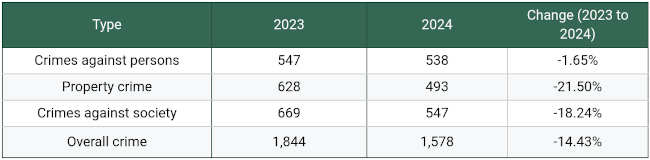
In 2024, Clearlake recorded a total of 1,578 crime incidents, a 14.43% decrease from 1,844 in 2023. While crimes against persons decreased only slightly, property crime dropped by 21.5%.

Hobbs also reported positive traffic statistics.

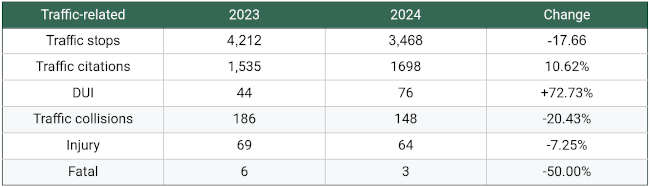
Traffic citations increased by more than 10%, totaling 1,698 cases. However, traffic collisions decreased by 20.43%, from 186 incidents in 2023 to 148 in 2024. Fatal collisions also declined, from six in 2023 to three in 2024.

“The overall traffic collision number is pretty significant. The last time we had that few traffic collisions was in 2016,” Hobbs said during his presentation.

“Hopefully next year they'll remain at this level, or hopefully even get lower,” he added.

“You guys have been doing a great job this year. Crime statistics are down. That's always good,” Clearlake Mayor Russ Cremer commented.

Mayor Russell Cremer said he sees police cars all over the city “to catch unsuspecting drivers like me. Fortunately, they haven't,” Cremer joked, prompting a chuckle from Hobbs.

In a more detailed report Hobbs provided to Lake County News, Clearlake police made 3,468 traffic stops throughout 2024, a 17.66% drop compared to 4,212 in 2023.

Hobbs also reported 34 incidents of use of force in 2024, including 30 incidents that involved the use of physical force and four cases of Taser use. Similar to 2023, none of the cases was required to be reported to the California Department of Justice, according to Hobbs.

In almost every data set Hobbes discussed, he made comparisons between 2023 and 2024, remarking the percentage of change between the two years. However, statistics prior to 2023 were not available.

Chief Hobbs said the department used another reporting system before 2023.

“You can’t look at the numbers and get a comparison because it’s a different reporting system,” he told Lake County News during a phone call, explaining why only two years of data were compared.

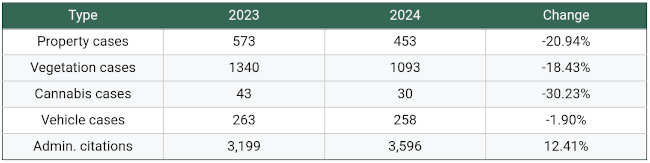
Apart from crime and traffic, code enforcement cases declined sharply in property and vegetation cases, while administrative citations were up.

“We were short one code enforcement person about 10 months of the year,” Hobbs said of an officer who was moved to another department as part of explaining the reasons behind the numbers.

He added that for each of the cases, code enforcement officers took more time to do “more focused work on trying to solve and clear up some of these properties versus kind of just targeting places all across the city and not putting that time in work.”

In addition, the Clearlake Police Department made nine new hires in 2024.

“The council has done a lot for the police department in the city as a whole over the last several years, and with that help, we've been able to get a lot more staff hired, and especially retain the staff,” Hobbs said.

Lake County News has put together five most important data sets, drawing data Hobbs provided during and after the council meeting.

To note, the data sets display “change” in percentage from 2023 to 2024. A plus sign marks an increase in value while a minus sign indicates a decrease.

General police statistics

While the number of incidents stayed relatively consistent with the previous year, Clearlake police made 1,830 arrests in 2024 — a 13.6% decrease from 2,118 in 2023.

In 2024, officer-initiated incidents declined whereas calls for service became more frequent.


Response time

The police response time measures the time used from the moment the call comes in till the moment the officer arrives at the scene, according to Hobbs.

In 2024, Clearlake police were 36 seconds quicker in responding to Priority 1 calls, which means “emergency calls that require officers to go to immediately,” Hobbs said.


Crime

Hobbs said Clearlake has been using the National Incident-based Reporting System, or NIBRS, for crime reporting since 2023, which categorizes crimes into three broad groups:

• Crimes against persons, including assault, homicide, human trafficking, kidnapping, and sex offenses;
• Crimes against property, such as arson, bribery, burglary, vandalism, and embezzlement;
• Crimes against society, including animal cruelty, drug offenses, and gambling violations.

While property crimes and crimes against society saw significant drops of 21.5% and 18.24%, respectively, crimes against persons remained relatively unchanged from the previous year.


Traffic-related

In 2024, Clearlake police made fewer traffic stops but issued more citations. In the meantime, fewer collisions occurred, especially fatal ones.

Apart from all the improvement, drive-under-influence offences, or DUI offences, surged by 72.73% from 44 in 2023 to 76 in 2024.


Code enforcement

Code enforcement cases dropped across all types but administrative citations grew.

The biggest changes took place in property and cannabis cases, which declined by 20.94% and 30.23% respectively. Citations grew from 3,199 cases in 2023 to 3,596 in 2024, an increase by 12.41%.


Email staff reporter Lingzi Chen at This email address is being protected from spambots. You need JavaScript enabled to view it.. 

State releases new online tool to measure local progress in tackling homelessness

Details
Written by: LAKE COUNTY NEWS REPORTS
Published: 25 February 2025
As part of the state’s ongoing efforts to address the national homelessness crisis, Gov. Gavin Newsom on Monday announced strong accountability measures for local jurisdictions to demonstrate results to continue receiving state homelessness funding.

Gov. Newsom is also launching a new online tool, accountability.ca.gov, which brings together thousands of locally reported data points to provide a clear picture of local communities’ work on California’s most pressing issues, including homelessness, housing, and behavioral health.

“No one in our nation should be without a place to call home. As we continue to support our communities in addressing homelessness, we expect fast results, not excuses. While we are pleased by the progress many communities have made to address the homelessness crisis, there is more work to do,” said Newsom.

Newsom announced additional accountability measures for communities that receive state funding. The announcement comes alongside new Homeless Housing, Assistance and Prevention, or HHAP, funding to support local homelessness efforts, tied to performance benchmarks and the ability for the state to withhold funding allocations if local communities do not make progress.

The funding also comes with flexibility for communities that need to modify their plans in the case of natural disasters, such as the recent Los Angeles area firestorms.

Communities that receive awards through the newest round of HHAP funding must adhere to increased accountability, transparency, and compliance measures. These include an increased focus on resolving encampments, requirements that recipients have a compliant housing element to obtain future funding, and requirements that grantees obligate and expend past awards before receiving new funds. These strengthened measures will better ensure real, measurable results and will improve the tracking of data and outcomes.

As part of the proposed 2025-2026 budget, the governor has called for even stronger accountability measures as a condition on any additional state funding, including requirements that grantees have and maintain a compliant housing element, prioritization for communities designated as “pro-housing,” and mechanisms to claw back funding from local governments that fail to demonstrate progress.

Dashboard shows how communities are doing

Monday’s announcement comes alongside the debut of a new online tool accountability.ca.gov, which brings together thousands of locally reported data points to provide an accurate picture of local communities’ work to address homelessness, create housing, and create behavioral health supports.

The new accountability tool will allow Californians to quickly and clearly assess the progress being made by their local governments on these pressing issues, and learn more about the process and funding provided to communities by the state.

In the case of Lake County, the dashboard shows it as having the second-highest increase statewide in unsheltered individuals, at 68%. Based on the available data, San Joaquin had the highest increase, with 156% increase. Fifteen counties did not provide new data on their unsheltered populations.

Lake County created a total of 123 housing units between 2019 and 2023. There are 10 counties, all in rural Northern California, that created fewer units, the smallest being Modoc, with five.

The dashboard also showed 35 people in Lake County being in full-service partnerships with Behavioral Health.

Lake’s neighboring counties reported the following statistics:

• Colusa: 95 housing units created; unsheltered down 28.3%.
• Glenn: 118 housing units created; unsheltered down 28.3%.
• Mendocino: 780 housing units created; unsheltered up 34.6%.
• Napa County: 718 housing units created; unsheltered down 41.8%.
• Sonoma County: 6,364 housing units created; unsheltered up 22.2%.
• Yolo County: 1,541 housing units created; unsheltered up 67.5%.

State is slowing growth of homelessness

As states throughout the nation continue to see ever-higher increases in homeless populations, Newsom’s office reported that California has dramatically slowed the growth in homelessness and reduced the number of veterans and youth experiencing homelessness — more than any other state.

Homelessness continues to increase nationwide, increasing in 2024 by more than 18%, but California is bucking the national trend by holding the statewide increase to 3%. This is a lower rate than in 40 other states.

California is also one of the few states that have dramatically blunted the increases in unsheltered homelessness, holding it to 0.45%. By comparison, in 2024, nationwide unsheltered homelessness grew by nearly 7%. Unsheltered homelessness growth in other large population states like Illinois, Florida, New York, and Texas surpassed California’s in terms of percentage and number.

Newsom’s administration reported that it is making significant progress in reversing decades of inaction on homelessness.

Between 2014 and 2019, unsheltered homelessness in California increased by approximately 37,000 people — more than double the increase seen during the Newsom Administration.

New state legislative bill package includes focus on tribal issues

Details
Written by: LAKE COUNTY NEWS REPORTS
Published: 25 February 2025
A new legislative package in the California Legislature includes several bills focusing on tribal issues.

The package is being put forward by Assemblymember James C. Ramos (D-San Bernardino), the first and only California Native American serving in the state’s legislature.

Some of the key bills in Ramo’s package focus on confronting the Missing and Murdered Indigenous People crisis and “furthering acceptance and knowledge of state tribes,” Ramos said.

The bills in the package focusing on tribal issues are as follows.

AB 31 (Tribal Peace Officer Status) authorizes the state Department of Justice to grant tribal police from three California tribes state peace officer status if they meet the same California requirements and standards as other police officers in the state. Enactment of AB 31 would assist all law enforcement by clarifying jurisdiction and permitting tribal police to assist communities close to reservations. The bill would also allow participating tribes to enter into agreements to share liability and collaborate on MMIP cases. Sponsor: Yurok Tribe. Referred to the Assembly Committee on Public Safety.

AB 221 (Tribal Nation Grant Fund) would streamline the existing Tribal Nation Grant Fund process to provide annual equal distribution grants, upon application, to all federally recognized tribes that either have no gaming or operate less than 350 Class III gaming devices. Federally recognized Indian tribes pay for the grant funds that exclusively benefit eligible federally recognized nongaming and limited gaming tribes. Sponsors: California Nations Indian Gaming Association and Tribal Alliance of Sovereign Nations. Referred to the Assembly Committee on Governmental Organization.

AB 362 (Shingle Springs Water) would add tribal water uses as a beneficial use of water in the state. AB 362 would also require the State Water Quality Control Board or a regional water quality control to describe, with both quantitative and qualitative information, how the project or regulatory program will impact tribal water uses. Sponsor: Shingle Springs Band of Miwok Indians. Not yet referred to a policy committee.

AB 977 (California State University Burial Sites) would require the California State University, or CSU, system, in consultation with Native American tribes to develop a policy to identify available CSU-owned land for the burial of Native American human remains and establish three tribal burial sites — one in the Northern, Central and Southern regions of the state. Sponsor: Tachi Yokut Tribe. Not yet referred to committee.

AB 989 (Native American Day State Holiday) would make the state Native American Day holiday — the fourth Friday in September — a paid holiday for state employees. Not yet referred to committee.

AB 1369 (Tribal Regalia at High School Graduations) would add clarification to students’ right to wear traditional tribal regalia as determined by the pupil and the pupil’s family at high school graduations. AB 1369 also reaffirms that a local educational agency cannot require a preapproval process to exercise this right or demand that the student wear a cap if the adornment is incompatible with the adornment. Sponsor: California Indian Legal Services. Bill not yet referred to committee.
  1. CDC layoffs strike deeply at its ability to respond to the current flu, norovirus and measles outbreaks and other public health emergencies
  2. Supervisors to discuss concerns over plan to remove Scott Dam, consider letters to governor and Trump Administration
  3. Lincoln named to Lake County Fair Board
  • 371
  • 372
  • 373
  • 374
  • 375
  • 376
  • 377
  • 378
  • 379
  • 380
How to resolve AdBlock issue?
Refresh this page