How to resolve AdBlock issue?
Refresh this page
How to resolve AdBlock issue?
Refresh this page
Lake County News,California
  • Home
    • Registration Form
  • News
    • Education
    • Veterans
    • Community
      • Obituaries
      • Letters
      • Commentary
    • Police Logs
    • Business
    • Recreation
    • Health
    • Religion
    • Legals
    • Arts & Life
    • Regional
  • Calendar
  • Contact us
    • FAQs
    • Phones, E-Mail
    • Subscribe
  • Advertise Here
  • Login
How to resolve AdBlock issue?
Refresh this page

News

Kelseyville High School hosts College & Career Day; more than 400 students experience future opportunities

Details
Written by: LAKE COUNTY NEWS REPORTS
Published: 02 March 2025
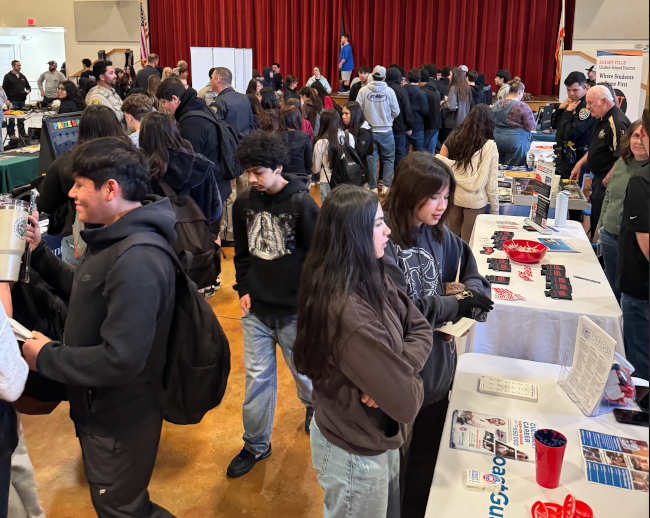
Students at the event at the College & Career Day at Kelseyville, Calif., on Feb. 19, 2025. Courtesy photo.


KELSEYVILLE, Calif. — Kelseyville High School was buzzing with excitement Feb. 19 as more than 400 students of all grades, freshmen, sophomores, juniors and seniors, participated in a College & Career Day.

During the event, students had direct access to representatives from over 30 agencies, including universities, educational programs, skilled trades, health care, the military, law enforcement, local businesses, government agencies and more.

The event provided students with valuable insight into their future academic and career pathways, reinforcing the importance of post-secondary planning.

From four-year universities and community colleges to trade schools and industry professionals, attendees had the opportunity to explore a diverse range of career options.

Hands-on demonstrations and one-on-one conversations helped students understand the real-world skills and education needed for their futures.

To encourage engagement, students were given passports to track their participation. Those who completed their passports by visiting multiple booths and interacting with professionals had the chance to win exciting prizes donated by local businesses, including hats, gift cards, Stanley tumblers, and Beats headphones.

College & Career Day event planners Allison Panella, Christian Villalobos and Leticia Garcia. Courtesy photo.

One student described the prizes as “fire,” with adults in attendance assuming that was a positive review.

“The event was pretty cool,” said Briana Davis, a senior at Kelseyville High. “ I like that it had lots of options to meet with different careers like real estate, wineries, healthcare, not just colleges and military branches.”

Kelseyville High School teacher Daniel Conklin highlighted the event’s impact on students. “It was great to see how excited all of my Life Skills and Personal Finance students were,” Conklin said. “Being able to speak with professionals about careers they are interested in, without having to step foot off campus, is a great opportunity for our students.”

The school offered a major thank you to Lake Event Design, whose generous donation of tables helped create an organized and welcoming space for students and professionals to connect.

Organizers said Kelseyville High School's College & Career Event was a success, with an incredible turnout and positive feedback from students, staff, and exhibitors alike.

The school looks forward to continuing to provide students with hands-on opportunities to explore and prepare for their futures.

The Pacific Gas and Electric Crew at the College & Career Day at Kelseyville, Calif., on Feb. 19, 2025. Courtesy photo.

Helping Paws: Shiba Inus and poodles

Details
Written by: Elizabeth Larson
Published: 02 March 2025
LAKE COUNTY, Calif. — Lake County Animal Care and Control is offering many dogs to new homes this week.

The dogs available for adoption this week include mixes of Australian shepherd, border collie, cattle dog, German shepherd, Great Pyrenees, husky, Labrador Retriever, pit bull terrier, poodle, Rhodesian ridgeback, Rottweiler, Shiba Inu and terrier.

Dogs that are adopted from Lake County Animal Care and Control are either neutered or spayed, microchipped and, if old enough, given a rabies shot and county license before being released to their new owner. License fees do not apply to residents of the cities of Lakeport or Clearlake.

Those dogs and the others shown on this page at the Lake County Animal Care and Control shelter have been cleared for adoption.

Call Lake County Animal Care and Control at 707-263-0278 or visit the shelter online for information on visiting or adopting.

The shelter is located at 4949 Helbush in Lakeport.

Email Elizabeth Larson at This email address is being protected from spambots. You need JavaScript enabled to view it.. Follow her on Twitter, @ERLarson, and on Bluesky, @erlarson.bsky.social. Find Lake County News on the following platforms: Facebook, @LakeCoNews; X, @LakeCoNews; Threads, @lakeconews, and on Bluesky, @lakeconews.bsky.social.

 
Fern's preview photo
Fern

Cedar's preview photo
Cedar

Willow's preview photo
Willow

Maple's preview photo
Maple

Diesel's preview photo
Diesel

Bailey's preview photo
Bailey

Mocha's preview photo
Mocha

Ruby's preview photo
Ruby

Koa's preview photo
Koa

Kai's preview photo
Kai

Jet's preview photo
Jet

Sam's preview photo
Sam

Bear-Bear's preview photo
Bear-Bear

Chai's preview photo
Chai

Hazel's preview photo
Hazel

Hamilton's preview photo
Hamilton

Hulk's preview photo
Hulk

Scout's preview photo
Scout
Buddy's preview photo
Buddy
Holly's preview photo
Holly
Brynn's preview photo
Brynn
Lynn's preview photo
Lynn

Quarantine#1(Chico)
Opie's preview photo
Opie

Quarantine#3
Sable's preview photo
Sable
Shepp's preview photo
Shepp
Sophie's preview photo
Sophie
Fergus's preview photo
Fergus
Sowyer's preview photo
Sowyer
Bella's preview photo
Bella
Foster#10149's preview photo
Foster#10149
Pancho's preview photo
Pancho
B#114(Lucas)'s preview photo
B#114(Lucas)
Chia's preview photo
Chia
Gabe's preview photo
Gabe
Kennel#11's preview photo
Kennel#11
LCAC-Stray-10169's preview photo
LCAC-Stray-10169
Spazz's preview photo
Spazz
Fuzzy Brains's preview photo
Fuzzy Brains
Kennel #26's preview photo
Kennel #26

Kennel#30's preview photo
Kennel#30

As flu cases break records this year, vaccine rates are declining, particularly for children and 65+ adults

Details
Written by: Annette Regan, University of California, Los Angeles
Published: 02 March 2025


It’s not too late to get a flu shot. Fat Camera/E+ via Getty Images

In February 2025, flu rates spiked to the highest levels seen in at least 15 years, with flu outpacing COVID-19 infections and hospitalizations for the first time since the beginning of the COVID-19 pandemic. The Centers for Disease Control and Prevention has classified this flu season as having “high” severity across the U.S.

The Conversation asked epidemiologist Annette Regan to explain why this flu season is different from last year’s and what people can do to help reduce the spread.

How do flu cases and hospitalizations this year compare with previous years?

Beginning in late January and extending through February 2025, flu hospitalizations have been higher than any other week since before 2009.

Most flu cases appear to be from influenza A strains, with a split between influenza A/H3N2 and influenza A/H1N1. These are two different subtypes of the influenza A virus.

Researchers believe that historically seasons that are predominated by influenza A/H3N2 infections tend to be more severe, but infections from influenza A/H1N1 can still be very severe.

This year’s season is also peaking “late” compared with the past three flu seasons, which peaked in early or late December.

Unfortunately, there have been a number of deaths from flu too this season. Since Jan. 1, 2025, alone, over 4,000 people, including 68 children, have died from flu. While the number of deaths do not mark a record number, it shows that flu can be a serious illness, even in children.

Unless directed otherwise, everyone ages 6 months and older should get a flu shot.

Why are flu cases so high this year?

There are a number of factors behind any severe season, including poor community protection from low immunization rates and low natural immunity, virus characteristics, vaccine effectiveness and increased human contact via travel, office work or schools.

Unfortunately, flu vaccination rates have declined since the COVID-19 pandemic. At the end of the 2023-24 flu season, 9.2 million fewer doses were administered in pharmacies and doctors’ offices compared with an average year before the pandemic.

In addition, since 2022, fewer and fewer doses of flu vaccine have been distributed by private manufacturers. Flu vaccination rates for adults have historically been in the 30% to 60% range, much lower than the recommended 70%. Before the COVID-19 pandemic, flu vaccination rates were increasing by around 1% to 2% every year.

Flu vaccination rates began dropping after the COVID-19 pandemic, especially in higher-risk groups. Flu vaccination in children has dropped from 59% in 2019-20 to 46% in 2024-25. In adults 65 years and older, the group with the greatest risk of hospitalization and death, flu vaccination rates dropped from 52% in 2019-20 to 43% in 2024-25.

Lower vaccination rates mean a greater portion of the population is not protected by vaccines. Data shows that vaccination reduces the risk of flu hospitalization. Even if a vaccinated person gets infected, they may be less likely to experience severe illness. As a result, low vaccination rates could contribute to higher flu severity this season.

However, low vaccination rates are probably not the only reason for the high rates of flu this season. In previous severe seasons, genetic changes to the viruses have made them better at infecting people and more likely to cause severe illness.

The effectiveness of annual flu vaccines varies depending on how well the vaccine matches the circulating virus. The effectiveness of vaccines ranges from 19% to 60% in any given season. In the 2023-24 flu season, the vaccine was 42% effective.

Similarly, early 2024-25 data from the U.S. shows that the vaccine was 41% to 55% effective against flu hospitalizations in adults and 63% to 78% effective against flu hospitalizations in children.

Something as simple as regular handwashing could keep you from getting the flu.

How do seasonal flu symptoms differ from COVID-19 and other illnesses?

It’s important to remember that people often incorrectly refer to “the flu” when they have a common cold. Flu is caused only by the influenza virus, which tends to be more severe than common colds and more commonly causes a fever.

Many of the signs and symptoms for flu, COVID-19 and other respiratory viruses are the same and can range from mild coldlike symptoms to pneumonia and respiratory distress. Common flu symptoms are fever, cough and fatigue, and may also include shortness of breath, a sore throat, nasal congestion, muscle aches and headache.

Some symptoms, such as changes in or loss of taste and smell, are more common for COVID-19. For both COVID-19 and flu, the symptoms do not start until about one to four days after infection, and symptoms seem to last longer for COVID-19.

The only way to know what virus is causing an infection is to test. This can be done using a rapid test, some of which now test for flu and COVID-19 together, or by seeing a doctor and getting tested using a nasal swab. There are prescription antiviral medications available to treat flu and COVID-19, but they need to be taken near the time that symptoms start.

Some people are at high risk of severe flu and COVID-19, such as those who are immunosuppressed, have diabetes or have chronic heart or lung conditions. In these cases, it is important to seek early care and treatment from a health care professional. Some doctors will also prescribe via telehealth calls, which can help reduce the strain on doctors’ offices, urgent care centers and emergency rooms when infection rates are high.

What can people do now to help steer clear of the flu?

There are a number of ways people can reduce their risk of getting or spreading flu. Since the flu season is still underway, it’s not too late to get a flu vaccine. Even in seasons when the vaccine’s effectiveness is low, it is likely to offer better protection compared with remaining unvaccinated.

Handwashing and disinfecting high-traffic surfaces can help reduce contact with the flu virus. Taking efforts to avoid contact with sick people can also help, including wearing a mask when in health care facilities.

Finally, remember to take care of yourself. Exercising, eating healthy and getting sufficient sleep all help support a healthy immune system, which can help reduce chances of infection.

Those who have been diagnosed with flu or are experiencing flu-like symptoms should avoid contact with other people, especially in crowded spaces. Covering coughs and sneezes can help reduce the amount of virus that is spread.The Conversation

Annette Regan, Adjunct Associate Professor of Epidemiology, University of California, Los Angeles

This article is republished from The Conversation under a Creative Commons license. Read the original article.

Space News: What’s up for March 2025

Details
Written by: PRESTON DYCHES
Published: 02 March 2025


What’s up for March? A good time to catch Mercury, an eclipse approaches, and the dark side of the Moon.

March begins with Venus still hanging out low in the west after sunset, but it quickly drops out of the sky – by mid-month it's getting lost in the glare of sunset. Once it gets dark, you'll find Jupiter and Mars high overhead, keeping you company through the evening. Mars sets a couple of hours after midnight this month, leaving the morning sky "planet free" for the first time in a year.

March also has the best opportunity this year for trying to spot fast-moving Mercury if you're in the Northern Hemisphere. It's only visible for a few weeks at a time every 3 to 4 months. This is because the speedy planet orbits the Sun in just 88 days, so it quickly shifts its position in the sky from day to day.

It's always visible either just after sunset or just before sunrise. On March 7th through 9th, look for Mercury beginning about 30 minutes after sunset in the west, about 10 degrees above the horizon.

You'll want to ensure your view isn't blocked by trees, buildings, or other obstructions. Observing from a large, open field, or the shore of a lake or the seaside can be helpful. Spying Mercury isn't always easy, but catching the fleet-footed planet is a worthy goal for any skywatcher.

There's a total lunar eclipse on the way this month, visible across the Americas. Lunar eclipses can be viewed from anywhere the Moon is above the horizon at the time. The show unfolds overnight on March 13th and into the 14th, depending on your time zone. Check the schedule for your area for precise timing.

Now, during a total lunar eclipse, we watch as the Moon passes through Earth's shadow. It first appears to have a bite taken out of one side, but as maximum eclipse nears, the Moon transforms into a deep crimson orb. That red color comes from the ring of all the sunsets and sunrises you'd see encircling our planet if you were an astronaut on the lunar surface right then.

Afterward, the eclipse plays out in reverse, with the red color fading, and the dark bite shrinking, until the Moon looks like its usual self again.

And here's an interesting pattern: eclipses always arrive in pairs. A couple weeks before or after a total lunar eclipse, there's always a solar eclipse. This time, it's a partial solar eclipse that will be visible across Eastern Canada, Greenland, and Northern Europe.

The dark side of the Moon

The Moon has a dark side, but it may not be what you think. As it orbits around Earth each month, the Moon is also rotating (or spinning). So, while we always see the same face of the Moon, sunlight sweeps across the lunar surface every month as it rotates.

This means there's no permanently "dark" side. The Moon's dark side faces Earth when the Moon passes between our planet and the Sun each month. This is the moment when the Moon is said to be "new," as in a fresh start for its changing phases.

The new moon is also located quite close the Sun in the sky, making it more or less invisible, unless there's a solar eclipse.

Nights around the new moon phase provide excellent opportunities for observing the sky – especially if you're using a telescope or doing astrophotography. Without moonlight washing out the sky, you can better see faint stars, nebulas, the Milky Way, and distant galaxies. So next time someone mentions the "dark side of the Moon," you'll know there's more to the story – and you might even discover some deep-sky treasures while the Moon takes its monthly break.

Above are the phases of the Moon for March. Stay up to date on all of NASA's missions exploring the solar system and beyond at NASA Science.

Preston Dyches works for NASA's Jet Propulsion Laboratory.
  1. Proposed federal budget cuts could ‘devastate’ local health care
  2. February storms help snowpack, but regional disparities remain
  3. March 13 town hall to discuss Clearlake Fire Safe Council, Firewise Community project
  • 366
  • 367
  • 368
  • 369
  • 370
  • 371
  • 372
  • 373
  • 374
  • 375
How to resolve AdBlock issue?
Refresh this page